The Security Lobby

I am free. They said, you are free to go. For the moment. I’m not in Gitmo. I haven’t been rendered. Not yet. I’m taking the opportunity to set it all down.

There’s not that much to tell. Step this way please sir.

The officer in Security at SFO spoke politely. All her colleagues – in a short space I met quite a few – spoke politely. I followed the officer to an open space at one side of the XRAY scanner. Your XRAY was not satisfactory, sir. My colleague will pat you down.

Her colleague is male. He pats me down, very thoroughly from the rear. From the front he pats me down vigorously, albeit selectively. A man asks me to touch some paper. After I do so the paper is tested in a machine. Your fingers show the presence of residues, sir. For a short space we stand in silence. The silence of the officers is an interrogation. I offer my own silence in return. How will this play out? It is only six am. I arose this morning at four. What have my fingers touched over these hours? I mean, what chemicals?

The officers asked me to come this way. Politely. This way is a small room. A third officer joined us and closed the door. The smallness of the room brought all occupants closer. Opposite me, smiling broadly, the patting officer, broad and tall. A powerful man. The presiding officer slim, female, perhaps forty years of age, standing at my right, the line of fine dark hairs running along her upper lip interrupted by the fine surgical scar of her neatly repaired hare lip. The last-entered officer took up his position behind me, between me and the door.

Are these your items, sir? I looked at the items resting mysteriously on the bench behind the widely smiling Patting Officer. The items are mine. I said so.  Please open them sir. I did so as they watched and waited – for what? Explosives? Firearms? Tweezers? 

The lady pulled open a box of sky blue plastic gloves, inserted her delicate hands and groped inside my baggage. I pointed out the small velvet bag containing my ritual gear – phylacteries, prayer shawl: Those are holy. Please handle them with respect. The officers, being American, respected ‘holy’.

The groping of my backpack completed, they turned to my roll on. The gloves were pulled off and tested for residues, a fresh pair pulled on. Grope, grope: What are all these books?

They are gifts for family, books. I wrote them.

Really?

Eyebrows shot up, faces turned from my items to me; for the first time the officers – all three – reacted to the unexpected. They looked impressed. Or something. For my part I misgave: perhaps ‘writer’ equals ‘leftist’, equals ‘intellectual’, equals ‘terrorist’? Should I have said, I am a doctor? That might remind them of terrorist doctors from George Habash to the English train bombers to hapless cousin Mohammad Hanif, who wasn’t, but who owned a guilty Sim Card. 

What guilty information lies concealed in my laptop?

What traitorous phone calls hide in my phone? They wilI find I have advocated for refugees, cheats, Muslims, border violators.


I reverted to silence as the chief Groper resumed groping and the others seem to disengage. The silence was very silent. Only a few feet distant from this room hundreds of bootless feet passed through Security. The hall that buzzed and rang around me a few minutes ago was not heard in here. It occurred to me that just as I did not hear the world, the world was unable hear me.


Groper looked up. Her hand rested upon something I did not see, something I own. Do all these items belong to you?

To the best of my knowledge, yes, they do.

To the best of your knowledge.  A harder edge to the voice.  An unpleasant pause.

Sir, do you know or do you not know? Did you pack this bag? Has this bag been out of your direct sight at all?

I mumbled reassurance that made things no better, no clearer.


Blue gloves that had done groping touched strips of test paper. All quiet as the machine pondered my possible residues. 

Groper-chief officer straightened, exchanged a look with the tall broad man. A small movement from behind, a sensation of space encroached.


You can go, sir. The ritual fringes you wear set off our scanner. We see that in people of your faith. And you

must have touched something this morning, perhaps a bench in the Security Lobby. You are free to go. Have a safe trip, sir.


News Flash

NEWS JUST IN, FROM OUR MAN ON THE SPOT IN HOPKINTON, MASSACHUSETTS


BOSTON MARATHON CONTESTANT, PHEIDIPIDES GOLDENBERG, (RUNNING INCOGNITO AS HOWARD GOLDENBERG), WILL COMMENCE RUNNING ON APRIL 20  AT 1115 HOURS, BOSTON TIME.

THIS CORRESPONDS TO 0115, AUSTRALIAN EASTERN TIME ON TUESDAY 21 APRIL

KEEN JUDGES PREDICT  PHEIDIPIDES’ ELAPSED TIME (WHICH WILL INCLUDE TWO COFFEE BREAKS) AT 4 HOURS AND 45 MINUTES, CORRESPONDING TO A FINISH TIME OF 0600, AEST, TUES 21 APRIL..

THE THRILLING NEWS IS YOU CAN FOLLOW PHEIDIPIDES’ PROGRESS AT http://www.baa.org.BAA.ORG, BY KEYING IN HIS BIIB NUMBER = 25666  

MANY FANS AND FOLLOWERS TRADITIONALLY STAY UP ALL NIGHT ENJOYING ‘WAITING FOR PHEIDIPIDES’ PARTIES

THIS IS TO BE ENCOURAGED: WATCH YOUR DONATIONS MAKE THEIR PAINFUL WAY TO THE FINISH

ANY EMPLOYER WHO DOCKED A WORKER’S PAY THE FOLLOWING DAY WOULD BE UNAUSTRALIAN 

Tearful in New York City – II

One or two days after posting Tearful in NYC, I visited Ground Zero. The skies lowered and wept as I meandered lost through the plaza. A day of such dimness, of visual images blurring, of persons indistinct, of sounds muffled, of voices softened as if retreating from the pressing silence.

I arrived at Ground Zero unburdened by foreknowledge or expectation, carrying only the vague apprehension of linguistic hyperbole: ‘Ground Zero’ is – or used to be – the expression for the epicentre of an atomic explosion. The original ground zero was a location in the Nevada Desert in the Manhattan Project during WWII. What were the Americans of the new millennium claiming – in this place, in this moment – for New York City?

The plaza was gray. Not the gray of the rainy weather, a gray in any weather, charcoal coloured, the colour of the burned, the colour of char. A rectangular shape rose before me in the gloom, formed by four bulky walls a little above waist height. Stencilled into the steel upper surface of the walls were the names.

I read Japanese names in their staccato syllables, I read the flowing polysyllables of the subcontinent, I read Mayflower names, names from Arabia, Hispanic names, Jewish names, names of all the tribes of modern America. Where a person had more than one forename, all additional names were duly inscribed. Those multipartite names claimed their solemn space.

I walked the walls and read the names, pausing here, stopping there, where the stenciled lettering was unclear, my gloved fingers wiping away the obscuring water. I felt the call of the names, their need to be seen, to stand distinct.

I didn’t want more than my first glimpse of the space enclosed by the walls, the space that fell, tumbling with the eye to a depth beyond sight. Water cascaded with a muted rushing from the interior of these walls, falling, falling to the unseen depths. The walls wept mutely, immutably, for the names.

More meandering brought me to the entry to the Museum. Young women in skyblue tops stood smiling in the rain. ’Welcome sir. Thank you for coming here.’

An hour later my wife arrived, together with my sister and her husband. Both the latter have resided in New York City since 1978. My brother-in-law has become an American patriot. On the day America found itself under attack, he found himself aroused, engaged, American. ‘I saw the footage, the destruction. I ordered my team at the hospital to be ready for casualties. I expected casualties in the thousands. But they never arrived. The injured were few, the dead too many.

‘I walked down to towards the World Trade Center. The air was thick, you could feel it. Ash, grey, soft, floated and fell onto every surface.’

Listening, my mind in Hiroshima.

‘You could smell the air. A smell of burning.’

Listening, my mind in Auschwitz.

We descended a long way into the museum. Here, in darkness dimly lit, tortured steel relics, visual images, sound recordings of speaking voices told the story. One wall showed faces of watchers looking upwards: hands flew to cover shocked mouths, frantic hands flew to clutch at anguished heads. These were civilian faces, firefighter faces, police faces – human faces facing the immolation above of humans. A nearby wall panel recorded verbatim reports of horrified watchers as people emerged from above, pausing in agonising premeditation, before leaping from the fire engulfing the upper storeys.

One said, ‘ I saw a man leap, tumbling end over end. I looked away. He took so long…’

Another reacted differently: ‘A woman appeared at the window. She waited for a time, preparing. Then she leapt. I wanted to look away, but I forced myself to watch. I felt she had the right to claim me as a witness.’

Around a corner I stumbled upon a tall colour photograph of a building of immense height standing out against a blue sky. The camera captured one, two, three bodies, each separated by a good distance from the others, all three falling from that great height. The bodies were black against that brilliant sky.

At every turn, my eyes, my eyes smarted and teared.

We spent hours in the subdued spaces underground: Ground Zero is apt, no quotation marks, no hyperbole.

abc7.com

abc7.com

Tearful in New York City

My red rimmed eyes smart. Tears fall. A victim of homeland security in the United States, I cannot blame the state of my eyes solely on the State of Siege. My blephs were reddened and my tears prone to fall before leaving Australia.

What is blepharitis?

In general I know –itis. -itis is my stock in trade – be it stomatitis, be it balanitis*, be it appendicitis – if it’s inflamed, it’s an –itis. My own inflammation is blepharitis. Blepharitis is the inflammation of an organ that has no known name: search as we might in medical dictionaries and in general lexicons we will find no blephs. But blepharitis, which is the inflammation of that part of your eyelid which is neither external skin, nor internal membrane, but the terminal edge of the lid, hurts in a niggling and mildly miserable manner. The seat of the problem is a scaly deposit, a scurf, somewhat like dandruff, that forms on the edge of the lid. With every blink that scaly stuff scratches the surface of the eye. The eye responds with perpetual tearing.

There is no cure for blepharitis.

My grandson Toby – known in this blog for his flirtations with danger and for his love of this grandfather – witnesses my tears as they swell to a fullness and fall. His insect features tighten with concern. He approaches, leans forward, pulling me down towards him,
studying my face anxiously. His rodent digits grab at my arms to arrest me: ‘Are you sad, Saba?’

His love makes me laugh for joy. My mirth augments the tearing. A full waterfall of affection and my blepharitis is somehow sweetened.

My son-in-law Dov, a rising genius in ophthalmology, advises me: ‘There’s no cure, but there is treatment; you need to dip a cotton bud in diluted baby shampoo then scratch away at the scaly stuff at the edge of your eyelids. I invite my readers to try this: most enjoy the practice quite as much as vaginal douching performed with sandpaper.

On the eve of my trip abroad, I decant some baby shampoo into a urine-less urine specimen jar. I seal the jar and pack it carefully in a nest of socks in my suitcase. On arrival in the United States I open my suitcase and read the enclosed:

NOTICE OF BAGGAGE INSPECTION.

To protect you and your fellow passengers, the Transportation Security Administration is required by law to inspect all checked baggage. As part of this process some bags are opened and yours was selected for physical inspection.

My suitcase has been selected! I feel honoured. Glad to protect my fellow passengers in this manner, I rummage for a pair of socks. My fingers report something unexpected, the tactile sensation of something cold and viscous and gooey, not unlike cooled semen. Sticky soggy socks everywhere swim in baby shampoo manufactured by Johnson and Johnson. The urine jar itself is fragmented, shards of plastic dripping yellow.

The shampoo treatment suspended, my blephs scale, my eyes smart and redden and weep. Without Toby’s loving concern blepharitis is no fun at all.

Melatonin and the Meaning of Five Lives

Melatonin and the Meaning of Five Lives

– written in the high season of jetlag

Why would I wake after only four hours of sleep? Here I am, sleepless in Pittsburgh. It is 2.00am and for five days now I have slept too little. There is nothing to stop me sleeping: the house is quiet, snow falling outside hushes the world. Sleep is an ambition unrealised.

My mind has nothing useful to do other than to keep me from sleep. My mind visits my home in Diamond Creek. The date is December 7, 1974. I see it all in the dark from my bedroom upstairs in the house of friends in Pittsburgh.

Around 7.00 am

I am first to waken. I wash my hands and a noisy clanking in the pipes threatens the precious sleep of the children. Steam emerges when I turn on the hot tap. I turn it off. I pay no heed to the meaning of noises in the plumbing, to steam from the tap. These are practical concerns; I wash my hands of practical concerns. I remove my wedding ring to recite my morning prayers and go to my work, leaving the children unkissed, leaving the ring on the dresser, leaving Annette as she prepares for the day.

Around 8.15 am

The receptionist says: ‘Mrs. West is on the line. She says it’s an emergency.’ I take the call. Lynne says, ‘Howard. I think you’d better come home, straight away. There’s been an explosion at your house.’ I don’t come home straight away; Lynne West is an excitable person and I have a patient sitting before me. More patients wait in the waiting room. I see these patients and I drive to my house.

Around 8.10 am

The house exploded.

Around 9.15 am

I do not witness the explosion but Lynne is eager to regale me: ‘I heard a loud boom from your house and I looked over and a huge cloud of smoke came out of the roof. And the walls fell down.’

But before encountering Lynne and her tale of smoke and thunder I turn from the unmade road into our dirt driveway at 36 Deering Street. Lying flat on the ground to my left are the brick walls of my home. Before me the driveway leads to an empty carport. ‘Empty, ergo Annette is not at home, the children are not at home. Ergo I have lost nothing but bricks and mortar.’ And, as I will discover later, a wedding ring.

Until I married I disdained rings on men. Worse than effeminate, in my regard they were affected. A judgement made before I married. This ring was different: slender, of unostentatious white gold, engraved on the inner surface with words of love from Annette, words for my eyes only.

Around 10.05 am

I run Annette to ground at her sister’s house. She has dropped our firstborn at kindergarten early, as she always does. Earlier Annette sat in the armchair, breastfeeding the newborn while the older two watched Sesame Street on a couch in the same room. I ring Annette and tell her she is homeless. That we have been so since shortly after

8.05 am

Annette and the children left home for kindergarten. Punctual as always. Not only early, but early for early, as I was prone to point out irritably, in Annette’s overturning of my native tardiness.

11.00 am

Annette joins me at the wrecked house. We find two goldfish still alive, lying in the few milimetres of water on the surface of the kitchen table. That flimsy table is one of the few sticks of furniture that still stands. Paintings hang at angles from the walls, canvas gashed by flying debris. The dining table lies in heavy fractions, its geometry denuded. Ancestral bedroom furniture has collapsed. Of the wedding ring no trace.

My mind is fixed on the hot water service that exploded. Emplaced on the slope beneath the house, the hot water service – that ticking bomb – stood directly beneath the armchair where Annette sustained our baby with her milk; one metre removed from the suckling pair were the Sesame Street watchers, sitting in pleasant terror of Cookie Monster. Lynne West’s ‘smoke’ was the steam released by that bomb.

Annette is upset: unlike me she never held in her imagination the thought that arrested me for one second or perhaps two: that my loved ones are lost. Annette is a mother of children and she knows, as I will continue to refuse to know, that a family lacking a home is a frail thing, that we have lost our anchor upon this earth.

Our son, aged two and a half, knows something. Prior to December 7 he is a highly verbal person. From that time, for the next six months, Raphael will not speak.

I lie in the dark, useless to myself, tossing in all this unusable time. But unwelcome consciousness wastes nothing. It takes me back thirty-nine years in time. There were questions that Annette faced in those first few seconds, questions that my son asked in his mutism.

In the simplicity of 1976 I asked nothing. Now the darkness asks me:

What does it mean?

Why has this happened – this loss?

Why has this happened – this being spared from loss?

What, as our lives were spared, are our lives for?

What will you do with, how will you use this time?

A novel experience, this guilt, this sense of time debt, the debt unserviced, accruing, unpaid. The infant at the breast, her elder brother, their big sister, each of them has employed the time, each has grown and grown, grown and learned, grown and created a family. Throughout all Annette has been their home.

What have I not attended to?

I must listen to the pipes. When the pipes, the pipes are calling I must listen. I must not wash my hands of practical matters. The practical reality was shrapnel of exploding wine bottles stacked next to the suckling chair, next to the Sesame watchers. Those jagged fragments were flung with force from floor through the ceiling into the roof space. Grenades of glass shattered the room of milk and sesame and soft infant flesh.

I must learn from the steam. Steam, as Lynne might put it, is smoke – and where there’s smoke, there’s fire. The steam warned me: get your loved ones to safety, far from the fire.

Why live? Why us? These teasing whys tease. Abstruse abstractions, they distract from the concrete, the practical.

And Annette? Annette is where truth is writ plain and practical. The truth lies with Annette.

These musings are, as I suggested at the beginning, the children of the muse melatonin. I am in foreign territory here, lost, perhaps even found, somewhere between memory and regret.

As if to answer the questions of the dark, questions I never spoke aloud, my host passes me ‘The Descent’, a poem of William Carlos Williams:


No defeat is made up entirely of defeat –

Since the world it opens up is always a place

Formerly unsuspected.

A world lost, a world unsuspected

Beckons to new places

And no whiteness (lost) is so white as the memory

Of whiteness.

Small Town

Wide streets, slow talk, visible horizons, unhaste, drinkable coffee, air you can’t see, first prize in the Trap Shoot a ham (second prize two chooks), courteous people, a main street monument to Glenn McGrath, traffic slowing to circle the cenotaph that recalls the one-hundred-year dead, terrain so flat a granite mound (250 metres) is a mountain)*, forty eight social, sporting and cultural clubs (including Writers’ Inc – contact Mrs Shirley Todhunter**), a nursing home full of smiling nonagenarians, churches of wood, the CWA***, a beauty queen crowned Miss Beef…

I like the town.

Walking down the sunblazing main street on a Friday afternoon I pass by three girls slim enough to sit side by side on a single doorstep. All three meet my curious gaze, two smile, one speaks: ‘Good afternoon.’

‘Good afternoon girls.’

Three smiles. These girls, just at the threshold of puberty, haven’t been taught to fear. They smile like their great-grannies who greet me at the nursing home.

I like the town.

In the hospital I treat too many for alcoholism. Ice floods the town, destroying minds, ravaging families. I feel a pang for the three small smilers who did not fear to smile at a stranger.

I come as a gap filler for the doctor who left last week after twenty years of service. The town is in mourning. ‘Will you be staying, doctor?’, the townsfolk ask me.

I don’t like to say no: I like the town.

* Mount Foster.

** I did contact her.

*** If you don’t know the CWA (Country Women’s Association) you have probably never eaten a cream-filled passionfruit sponge cake. If you haven’t eaten a passionfruit sponge, move to a small town and do so.

nevertire of eenaweena

never beenta eenaweena

you’ll never tire of nevertire

when I’ve beenta

eenaweena and nevertire

i’ll have beenta elong elong –

grong grong and matong

were nearer my home town:

I’ve eaten meringue

in wulgulmerang –

in betweena hell,

booligal as well

a long time ago,

in eulomogo;

been alone in quambone

felt at home in gulargambone

done algebra in egelabra

and once in gilgandra

reclined on veranda

and free from hungery

in eumungerie

with grub o from dubbo

found peace, release, ease

at least in burrumbuttock

never felt foreign

in a small town like warren

/home/wpcom/public_html/wp-content/blogs.dir/27f/42161029/files/2014/12/img_4762.jpg

No Sexual Massage in Yangon

When I visited Yangon a couple of years ago I enjoyed a number of curious, memorable and stimulating experiences. Among these I recall the vivid sight of a mouthful of ragged teeth swimming in blood-red betel juice. I saw lovely women and lovelier children with cheeks daubed in discs of a caked pink, ochreous pigment. I ran in a huge mid-city park where I was alone, save for thirty men scything a small patch of pedicured grass of brilliant green, and lovers on park benches, enfolded in each others’ arms in the slow ballet of discreet half-satisfaction. I saw women and men banquetting at kerbsides on evil-smelling fishes, I read an English language newspaper from cover to cover, in which grown up writers and editors repeated children’s stories for grownup readers. (These stories, simply told and endlessly retold, announced that the government was very pleased with itself and if we had any further questions we should read the account of the Press Release on page three, which announced how pleased the government was with its plans to change nothing.)

I rode in taxis that had been young when I reached puberty and which still functioned – but only just. I recognised my own physiology mirrored in these noisy, puffing, sluggish vehicles. At the airport I was met by unsmiling men wearing military and paramilitary uniforms that would be laughable in comic opera. Under the hard eyes of these protectors of the public order young female Immigration Clerks checked my passport for twenty solemn minutes before passing me down a chain of clerks similarly trained in solemnity. The solemnity training is impressive, achieving as it does the extinguishing of the endemic native joy that radiates from the Yangonese. In a shop I saw a longhi. I always wanted a longhi and when I went to purchase one, eight young women, so feminine, so, so slim, all stepped forward to fit me. I went to a hairdressing salon where some hair was cut and someone sold someone else a massive bag of rice, while all the staff – including the person cutting the hairs around my throat – watched a lengthy and particularly violent show on TV.

I saw and enjoyed many things in Yangon but I never bought, received, contemplated, witnessed or wished for sexual massage in Yangon. I did, however, post an innocent blog report on my visit to the hairdresser.

Ever since that post my blog has been visited by readers from around the world, googling key words ‘Sexual Massage Yangon.’ I have innocently discovered the secret to a massive blog following. In posting this I expect to redouble that following. Fame and Greatness beckon.

A Small Town in the Bush

Water is the secret, the theme, the meaning, the life of the town. If the town is to die it will be the failing – or the flowing – of water that will see its death.

Driving in at night I missed the river. Unaware even of the fact of the bridge, watching always for suicidal kangaroo, I followed the bitumen and missed the river. After unpacking I ran the shower. Who farted? Mother earth, is the answer: borne on bore water were those sulphurous fumes from antiquity. I lathered and rinsed. And rinsed again. Still slimy with slippery salts I towelled myself with vengeful vigour.

In the morning I brewed a bore water cuppa. It tasted fine, of coffee, not of earth’s bowel.

Before work I went for a run. Here was Terry, a cheerful sixty-year-old hosing the wide grassy expanses that surround the hospital. Modern sprinklers invented in, say,1950, would see the extinction of this man’s job.

Memorial Park with its humble cylinder of brown marble rising less than three metres from its plinth. From its pediment I read names from the Great War. This very small town offered up too many. Two of the dead bore the same family name.

Below the names from the First War were listed those who died in WWII. These names took up two of four wide rectangles of space at the base of the monument. Two rectangles remain for future names of dead from a nation that has always fought the distant wars of others.

A team of workmen clustered at a roadside. Beefy men all in their high-vis yellows, they watched as one of their number swung a sledge hammer. The hammer was a mighty instrument, the hammerer broadest of all, taller when recumbent. Four watched as one swung. A cement gutter cracked, disintegrated. Five men at work, working to undo the work of yesterday.

The shops sit behind their generous tin verandahs, shaded by rooves supported on wooden poles. The shops, house-proud but not fancy, wear old livery touched up and respectable. A notice offers me the chance to buy one of two coffee shops in the main street: it lists ‘large shop, vacant possession, on generous grounds with six-car shed and outbuildings’. “Hunter’s Supermarket” sits in dignified desolation beneath its formal signage. Its windows are covered on the inside by broadsheet newspaper. ‘For Sale’, says the sign.

At lunchtime I visit the emporium. Triple fronted, its three doorways lead to three sections. One displays work clothes, a second sells ‘guns and ammo’ and cooking implements ranging from basic aluminium to imported chefware. The third section offers saddles, riding boots, rodeo hats. The floors are of wood, the high ceilings of patterned pressed metal. ‘Handsome ceilings’, I remark to the sales lady. She nods, smiles attractively, and observes, ‘They leak when it rains. And the owners aren’t keen to repair the roof.’ Water again.

I am not here for the superstructure but for my own infrastructure: I need new undies. Sales lady leads me to them and removes to a discreet distance. Slim, tall in her tooled rodeo boots, her jeans scrolled and silvered at the seat, she’s a distraction. I find a pack of two pairs in interesting colours. The brand name is ‘Heavy Lifters.’ The sales lady keeps a straightish face: ‘It’s the name of a whole range of work clothes, not just, ah, men’s personal things.’

I buy some men’s personal things.

I show interest in men’s work shirts. These too are in electric shades of lime and purple. ‘They’d alarm my bride,’ I say.

Sales lady points me to a different rack of iridescence: ‘Why not you buy your bride one of these pretty shirts for girls?’

I settle for Goondiwindi Cream Soap, picturing my wife’s limbs, clean as Gunsynd’s.

At work my patients are generally aged. One group consists of slow moving stout people, retired, in their fifties and early sixties, who live here in town. The others, slimmer, gnarled of knuckle and sun blighted, are in their seventies and eighties. These live out of town on cattle properties which they continue to work. For the trip into town these folk dress smartly. Lots of colour, a quiet elegance.

It’s more enjoyable doctoring the farm folk with their accidents of activity than the town folk, who, although younger, are less healthy with their illnesses of inactivity.

In the waiting room no-one checks a wristwatch. All appear unhurried and relaxed and friendly. All but one, a hunched small lady, 83 years of age, who wears a floral yellow dress and a fierce mien. ‘I won’t see that other doctor! And don’t you try and give that useless tablet he gave me!’

At this stage, unaware of the identity of that other doctor or of the useless tablet or of the condition treated, I am at a disadvantage. The lady has me pinned to the ropes where she continues to batter me for the next twenty minutes. ‘Those blue tablets, don’t give me those!’

‘Which blue tablets?’ – diffidently.

‘You know the ones. I won’t take them. So don’t try to make me. I might look old but I’m still manhandling steers and I’m not simple.’

I study her file for clues.

‘Well? What are you going to do for me? Don’t give me any of your soft soap, young man. I’ve put up with this for long enough.’

I point out that I’m not her adversary, that it’s up to her to decide whether or not to trust me, and if she doesn’t trust me she should not waste her time on me.

She falls silent, her large mouth hanging slack as she regards me in surprise. I am surprised too. I’m starting to enjoy myself.

A truce is declared. Later in the waiting room, she informs the office staff, bellowing, ‘That new young doctor’s all right. Don’t you try to make me see that other one. I won’t have a bar of him.’

Day after day the skies are cloudless, palest blue, arching high to eternity. Not a cloud in sight. But yesterday low grey cloud hovered. The waiting room was full of talk. Veterans of too much faithless cumulus, the farmers were skeptical. Today all is blue again; the old men were right. One old bloke with a great hole in his leg – he came off his motor bike, digging out a divot of flesh – tells me: ‘There are three year old frogs out on my farm that don’t know how to swim.’

He laughs. A wounded leg and a dry dry spring don’t exhaust his well of good humour.

‘Any cane toads?’

‘No, no toads. Too dry for them.’

He laughs again.

Not all laugh. The visiting psychologist tell me, ‘I go out to the farms and visit the farmers regularly. In the droughts some despair.’

The temperature reaches forty – in October – and no-one remarks on it. The Bureau predicts a thunderstorm. It duly arrives. One peal of thunder, the temperature falls but the rains do not.

‘How is it on the farm?’ – I enquire of every farmer.

All respond, ‘It’s dry.’

‘Are you worried?’

‘Yes, it’s very dry.’

‘Is this the driest you’ve known it?’

‘2003 was worse. But this is bad…’

No-one says so explicitly but the floods of 2012 were worse than bad. In those few days lives turned, settled families in their dynasties saw nature’s violent face anew.

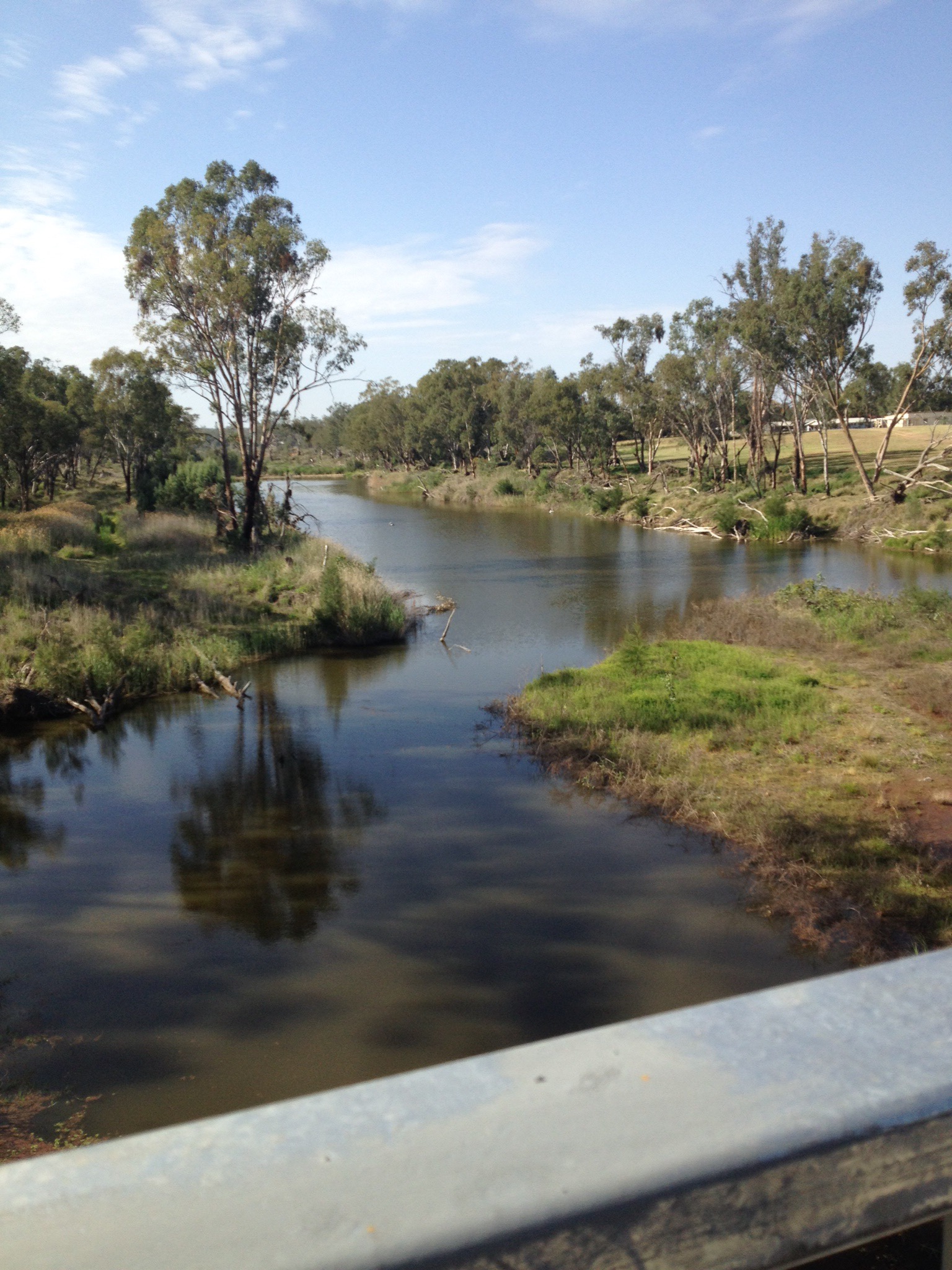
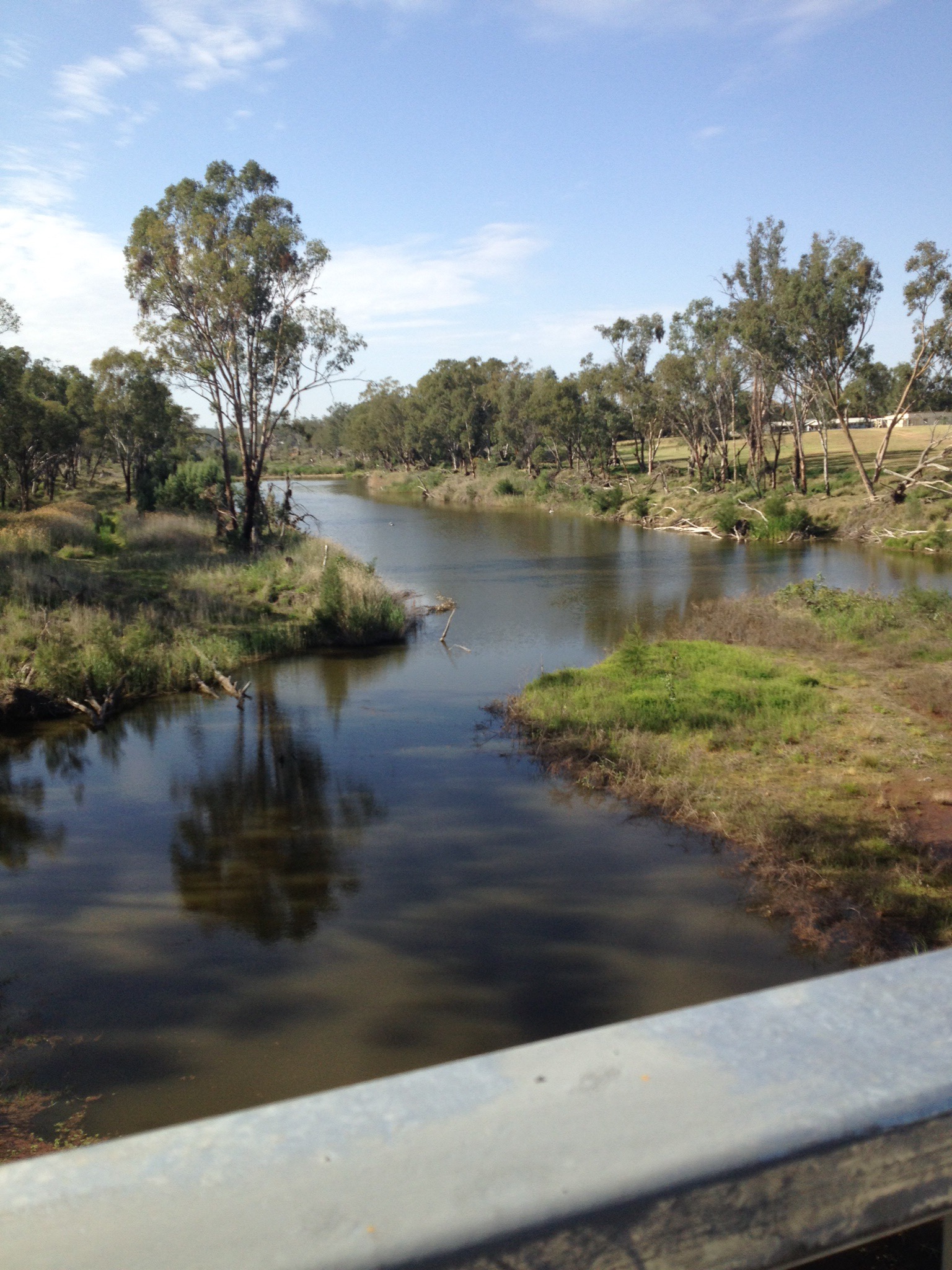
By the third morning I still had not sighted the river. On previous morning runs I headed north and south. This time I went east. Past the library on the main street in premises vacated by the extinct cinema; past the pool gleaming fluoridated blue; past The Great Artesian Spa; up a rise to the edge of town – and there was the bridge, a modern structure of cement and steel, its slow length elegant against the sky. Below, far below, indolent waters were a silver ribbon. Tall green grasses pleased the eye.

A slender roo, disturbed by this sole intruder, widened the gap in graceful bounds, then stopped and looked me over at leisure. A moment of shared wonder.

At the approach to the bridge a wall of dark granite, cuboidal, taller than me and wider than the hammer-wielder of the first morning, detailed the floods. Undemonstratively, without self-sympathy, in the manner of farmer conversation, the wall of stone gave fact and context:

1864 – 9.56 m,1949 – 4.86 m, floods in 1950, 1954,

then, in February 1956 the waters reached 7 metres; and in April the same year, 9.26 metres. Photographs show island buildings, white against the silent black of inland sea. Some left town. Most remained to face flooding again – in 1983, 1990, 2010. Then came the waters of February 2012, peaking at 9.84 metres, breaking the record of 1864. People speak flatly of ‘before the floods’ and ‘after the floods.’ I hear the same throughout the state.

One farmer replies to my stock enquiry with a quiet,’The dams are both dry. It’s fortunate we have a couple of bores.’ I look at him, his face etched with decades of flood and drought. He knows fortune.

No-one in back in the Collins Street practice uses that expression, it’s fortunate.

Something missing here. Someone not heard, stories not told. Where are the first owners? Further morning runs uncover traces. At the Information Centre an elaborate sign invites me to follow the Yumba interpretive trail: ‘Mon-Thurs mornings.’ Below this a handmade sign amends tour times: ‘Tues and Thurs.’

And to one side a larger, handmade sign advises

NALINGU

ABORIGINAL

CORPORATION

WISH TO ADVISE THE

YUMBA

INTERPRETIVE TRAIL

AND MITCHELL YUMBA

IS CLOSED

UNTIL FURTHER NOTICE.

But the first people are here. I see them with their ailments and their children at the hospital and the clinic. In the main street, Nalingu has its dusty offices, and just down the same street is the Aboriginal Health Centre. Inside this hive a small lady of middle years buzzes with purpose. She searches my face, wondering whether perhaps I might be a JP. She needs a JP to certify photocopies of documents for the tall Finn standing at my side. He’s jackerooing on a station. (The Finn does not look Aboriginal. But some say I don’t ‘look Jewish.’)

The lady finds time for my questions: Yes, this is a health centre and yes she’s here four days a week helping local Aboriginal people with transport and health appointments in the bigger town one hour east of here. And no, the bigger town doesn’t have a doctor at the Health Centre either, not regularly, just a couple of days a month. ‘But I look after things.’ She tells me all this with evident pride, vibrating with energy and quiet command. She looks up at her curious visitor, radiating confidence and belief in her role. I guess she’s the dynamo of a community that might otherwise not be a community.

Back at the clinic, a tall man in his late fifties has plenty of time to chat. He’s intrigued by the phenomenon of a Jewish doctor way out west; and I’m interested in his experiences as a cattle man. He’s been out here all his life but he sent his daughters to boarding school in the city. I ask my usual questions – how’s the farm going, water, rain, feed?

‘Well it’s hard. If it wasn’t a challenge I’d have to go and find one. But surviving here calls for something. I like that. I like to be tested. Every difficulty demands something of me. I want to create, I don’t want a dull existence. I’m lucky with my life here.’ He smiles, a smile of good teeth and good skin, the smile of broad vitality. Why has he come to see me today? ‘I’m well, but I spend my life in the sun. Will you check my skin? Any other tests or checks a fifty-eight-year old should have?’

We do the medical stuff then conversation resumes. He employs backpackers from around the world. ‘I look for people others won’t take – people with problems. With patience you find the goodness in a person and help them become productive. I’ve had alcoholics. They come to the station, I let them dry out, I expect them to be temperamental until they settle. Then you find the person with a problem has some drive that might have got them into trouble; now they have a chance to direct the drive productively. There’s pride in that. A small start to a better way. After three months they leave, and we are both winners.’

The cow man has questions for me – about my origins, any children, a wife? He tells me about his girls, working in distant places, how he encourages them to pursue their passions in their occupations, not to settle for work that won’t fulfill them.

‘Have you been to Israel, doctor?’ – in the city this is the litmus question of my decency, out here it’s a question couched in curiosity or envy.

‘Israelis inspire me. They have never had it easy but you can see their drive to survive. And they do it by innovation, by creativity. They’ve never had enough rainfall where they are, but they farm, they feed their people and they have create a surplus to export.’

IMG_3980.JPG

IMG_3980-0.JPG

So Foul and Fair a Day

Howard at the Boston Marathon 2013

Howard at the Boston Marathon 2013

When I solicited funds as a charity runner in the 2013 Boston Marathon I promised to write a report on the race and my donors’ ‘investment.’ The moment the race started I started to compose my report. The mood was light, the crowd a united force of love, the events and sights all affirming a shared humanity. This would be a report of smiles. The serious counterpoint would be the 26.2 long miles.

At 2.07pm the mood changed. After that the playful response would feel profane. But I did promise a race report.

I slept on the matter. The evil was great and real, certainly. Real too was the goodness. Both demand to be written.

***

Does any runner sleep well the night before a marathon? I don’t. To prevent dehydration on race day I drink plenty through the previous day and every cupful demands its exit through the night. I am excited, nervous, a kid before his birthday party. Boston, after all, is to marathoners as Wimbledon is to tennis players. An enormous privilege, unearned by any effort of my legs, paid for in thousands of donated dollars.

The playful mind must be carried by legs that are 67 years old. Some prudence surfaces. The sixty-seven year old prepares methodically. The experience of forty past marathons insists I vaseline my second toes (which always blister), my armpits (which chafe), my nipples (which bleed) and my private bits (none of your business).
To prevent my shoelaces untying over the distance I double knot them: a trivial detail? No, not in Boston, for it was at the start line of one Boston Marathon back in the seventies that the favourite, noting his arch rival’s single-knotted shoes, bent down and double-tied them.

Continue reading

Watching Women Drowning their Babies

London, heart of anglophone civilisation, cradle of British culture? ‘For british’ read ‘brutish’.

See below. This is a true story.

This morning I watched a group of six young mothers and their babies, aged six to fifteen months, in an indoor pool in London. The pool was heated: they’re very considerate here when they set out to torture their young. The mothers undressed their babies and clad them in little wet suits. Entering the water they held the babies close to their perfidious breasts, murmuring the tender endearments that loving mothers do. They walked backwards in a circle, bouncing their babes in the water, hoisting them high, beaming, beaming all the time. Choreographed by Nicola – that’s the name of the licensed water torturer – the same cooing, smiling mothers all splashed water into the faces of their young. Spluttering, the babes looked up, discomfited. Their mothers chorused “hooray!”, made loving whisper and song, reassured the children that what had passed was not real, then splashed them again. After half a dozen such passes it was time for holding on. Holding on is taught by placing the babe, until now an entirely earthbound being, facing a horizontal railing just inside the margin of the pool. The mothers all sang “Hold on! Hold On!” Nicola sang the same. A sweeter chorus you never heard. Then the mothers let go of the slippery bodies, singing gaily as the newborn of their flesh slipped below the surface. Here the babies enhanced their education by breathing in water. After a little bit of this, desperate bodies surfaced, flailing arms found the railing, and most survived. None looked happy, but the mothers beamed and sang and cried “Hooray!”

I looked at my watch. We had been going for only seven minutes of the thirty that the mothers had paid for. I braced myself.

Now came swimming. Swimming is done by having your face pushed beneath the surface and held there for two seconds. To condition you for this submersion your mother calls your name, once, twice, then drowns you briefly, smiling withal. Mother Malvolio brings you to the surface, cuddles and coos. When you are a year old or a little more or a little less, you still can recall those aqueous moments of birth, when you suffered anoxia, your first near-life experience. Here, during the your seconds underwater you go through it all again. You’ve been flatlining: you never felt so thoroughly alive.

Throughout your thirty minute session of education you drink a good deal of pool water, chlorinated for your safety (and to foster your eczema). When you have drunk all your small tummy can hold, you pee, re-warming the water for the next baby to drink. The mothers never drink, their faces held above water level as befits members of an air-breathing species. Instead the adult female bodies shed their dribs and their drabs of belly button fluff and sundry fluids, augmenting the brew drunk by their young.

After too long the session is at an end. Money passes to Nicola. Stunned babies, shuddering, shivering as the cooler air hits them, blue of lip, mute with disbelief and moral shock, nestle in mothers’ arms. Those adults smile at each other in congratulation of their depredations.
Scot-free they’ll congregate here again next Thursday and do it all again.