A Backward Country 

There’s a problem here. Police officers wander around singly, unadorned by bullet-proof vestments, no gun at their hips. I took the ferry to Gozo. No-one searched my bag or my body. Same when I entered the bank, the same at The Grand Hotel Excelsior. The same at the Biblioteca National. 

People seem relaxed. A citizen trusts her neighbour. 

The place is full of foreigners but no-one seems to care. We are just across the water from Libya and no-one is afraid. Negligent governments have not sown mistrust. Is everyone here asleep?

A backward country, this. I met Malta’s number three cop. A gentle sort of fellow, he seemed about as menacing as a powder puff. Where were their blokes who swagger around the borders and within them, like the Border Protection Force that keeps all us Aussies feeling so safe?

I went to a barber shop. Hidden up a staircase above a (not very) supermarket, and around some corners, it was a narrow establishment, its proportions little bigger than our guest powder room in my home. I hesitated at the threshold. Something faintly seedy about the joint, hard to pin down. A scent of tobacco breath mingled with barbershop smells. There were two chairs, one occupied. A tangle of odd black electric cords hung from a power point, metal implements lay scattered as if some disturbance had been and passed.
 

A young man with olive skin and a spade-shaped black beard looked up from the head he was trimming and waved me in. He was lean and tall, his black hair falling in wild waves about his narrow head. I guessed the young man might be in his late twenties. He looked lithe and coiled – Caravaggio before a brawl.

A second young man seated in the depths of the room rose as I entered. He too was tall, but better fed, perhaps a few years younger. His head was crowned with tight black curls pulled back into a pony tail, his jaw covered in a curly black spade. I thought I caught a fugitive smile. He waved me to the second chair, stood over and close to me, and raised an eyebrow. It was a question. I answered with a question: Can you make me beautiful?

I no English much.  

I pointed to my own chin, scruffy with whitish undergrowth. Zero, I said.

He nodded enthusiastically.

I pointed to my scalp, an arid garden.

Two, please.

More nodding, a big smile.

I sat back and considered. Flowing beards are all the go here, but it’s the barbers not the barbered who wear them. I looked around for a cut-throat blade, sighted none, sat back again and relaxed. The two young men were engaged in jovial conversation with a third, the customer in the first chair. I wondered what the joke was. Perhaps it was me. I listened for words I might recognise. The local language Malti is Semitic. It sounds quite a bit like Arabic, from which it traces its origins, with plenty of words similar to Hebrew which I can speak tolerably fluently. As the men conversed I sensed this might be street Malti, pretty rough and ready, perhaps untroubled by grammar or syntax. I listened some more. Lots of words were familiar, too many: this was Arabic, not Malti.

In all the flow of camaraderie and good humour, my barber man concentrated hard on my hair. His movements were gentle and deft. In the mirror my scalp rose into view from its sheddings; a wide and empty plain surfaced where I was used to seeing hairs. Two was shorter than I expected. Given the intimacy between me and the barber man, I felt we should be on first name terms: 

What’s your name?

Asraf.

My name is Howard.

Hawa?

How-wad. 

How Wad.

I nodded and grinned. Good to meet you, Asraf. 

From where you come?

Australia.

Asraf digested this: Much far.

Yes. Where do you come from Asraf?

Tripoli.

Libya!

Yes.

Asraf grinned and resumed operations.

My artist spent a lot of time and close concentration on corners and in nooks where I seldom gaze. Nostrils were explored, earholes broached, ear perimeters subject to hair-by-hair extirpation. Finally he straightened, turned, laid down his electric instrument, and advanced bearing a cut-throat blade. I felt a tremor. My misgiving derived not for Ironbark but Sinai: the biblical prohibition echoed -Ye shall not round the corners of your heads, neither shalt thou mar the corners of thy beard. For some reason the naked blade is held to violate this Law while the electric trimmer is accepted – by some. I waved away Asraf’s trusty skibouk: Not this one. I like electric. After a further fifteen minutes of electric search and destroy Asraf was content there were no escapees.  
Asraf removed the tarp from my torso. I rose and together we surveyed my remains:

Shukran, I said.

How you know Arabic?

I produced my yarmulke and applied it to my naked scalp.

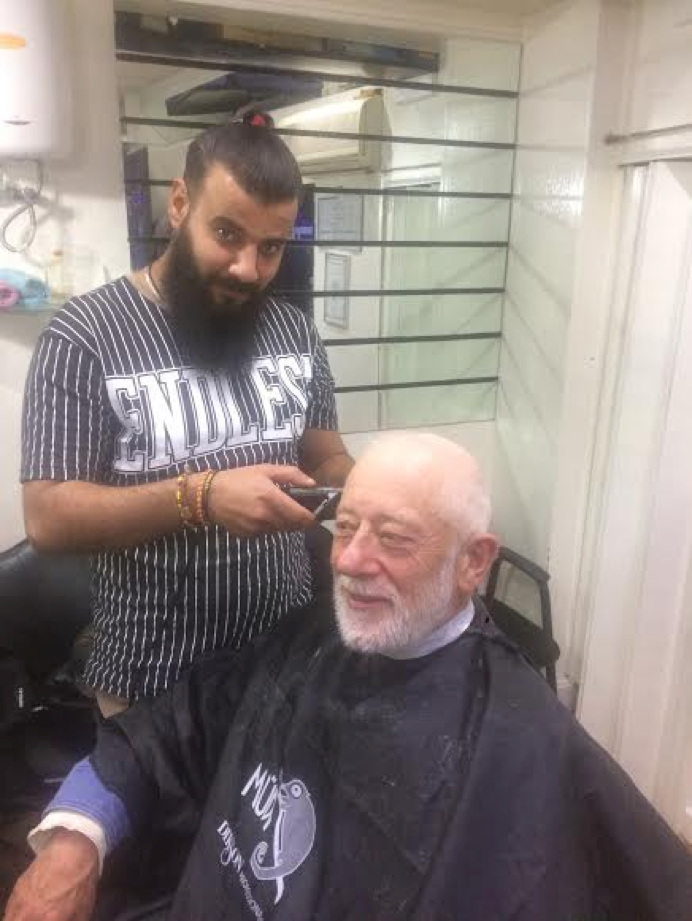
Asraf’s grin was huge. Reaching for his phone he leaned and wrapped his arm around me and took a photo of us both. A modest sum augmented by an immodest tip changed hands. We shook, I left and went to buy groceries next door. Exiting the grocer’s a few minutes later, I nearly bumped into Asraf and Carravaggio. They’d gone outside for a smoke. Whenever I see someone smoking I feel a pang, and I ask myself, Why? 

I waved as I passed by my friend from Tripoli and guessed the answer to Why? might lie in what he’d seen, what and whom he’d left behind. 


Last Coffee at the Prairie Hotel


It will be centuries/before many men are truly at home in this country,/and yet, there have always been some, in each generation/there have always been some who could live in the presence of silence.*


Have you ever visited Parachilna? Situated in the remote north end of the Flinders Ranges in the South Australian outback, this town is reckoned to have a population of six souls. The principal edifice in the town is the Prairie Hotel. If you visit this pub, as I have, repeatedly over the past two decades, you will count many more bodies than the half dozen you might expect. We come in all our different ages and stages to Parachilna and we stop at the Prairie Hotel. We come – grey nomads and graziers and gourmands – we come in our large SUV’s, our battered utes, our private planes. We arrive for the famous food, the haunting landscape, the novelty, the romance!


Though I myself run to the cities. I will forever/be coming back here to walk…up and away from this metropolitan century…*


I come for the coffee and the company. Around Christmas time, with summer blazing in the Flinders, the nomads have fled back south, tourism has withered and the hills stare back at the bleaching sun. The world lies silent, listening to its aeons. The Prairie Hotel is old, its walls of stone thick, holding the heat at bay. In this heat and desolation eccentrics and locals gather in the cool of the bar of the pub.


And some, I have known them, men with gentle broad hands,/ who would die if removed from these unpeopled places…*


At this time of the year Christian doctors have joined their loved ones in the moist green down south, leaving in their place a locum, old, wearing his Jewish hat. In that sense I am both eccentric and a local. 


Though I go to the cities, turning my back on these hills/…for the sake of belonging…/the city will never quite hold me. I will be always/coming back here…to see, on far-off ridges,/ the sky between the trees, and…to hear the echo and the silence.*


I mentioned the coffee. If you hate coffee most places in the Flinders Ranges will reinforce your hatred. But if you revere the sacred bean, come drink at The Prairie Hotel. There, Lachlan Fargher presides over a serious espresso machine. There I drop in year upon year, unannounced. Lachie looks up, says, ‘Hello Howard. Strong latte, extra hot?’ I nod, Lachie bends his handsome head in concentration and soon I sip that elixir that brings me on a drive of sixty-seven kilometres (each way) every lunchtime of my fortnight locum. (Excepting Shabbat. I sure as shit don’t drive on Shabbat.) Others come to drink the eponymous Fargher Lager, others to eat the famed Feral Grill, a collation of native viands, not – I regret – kosher.

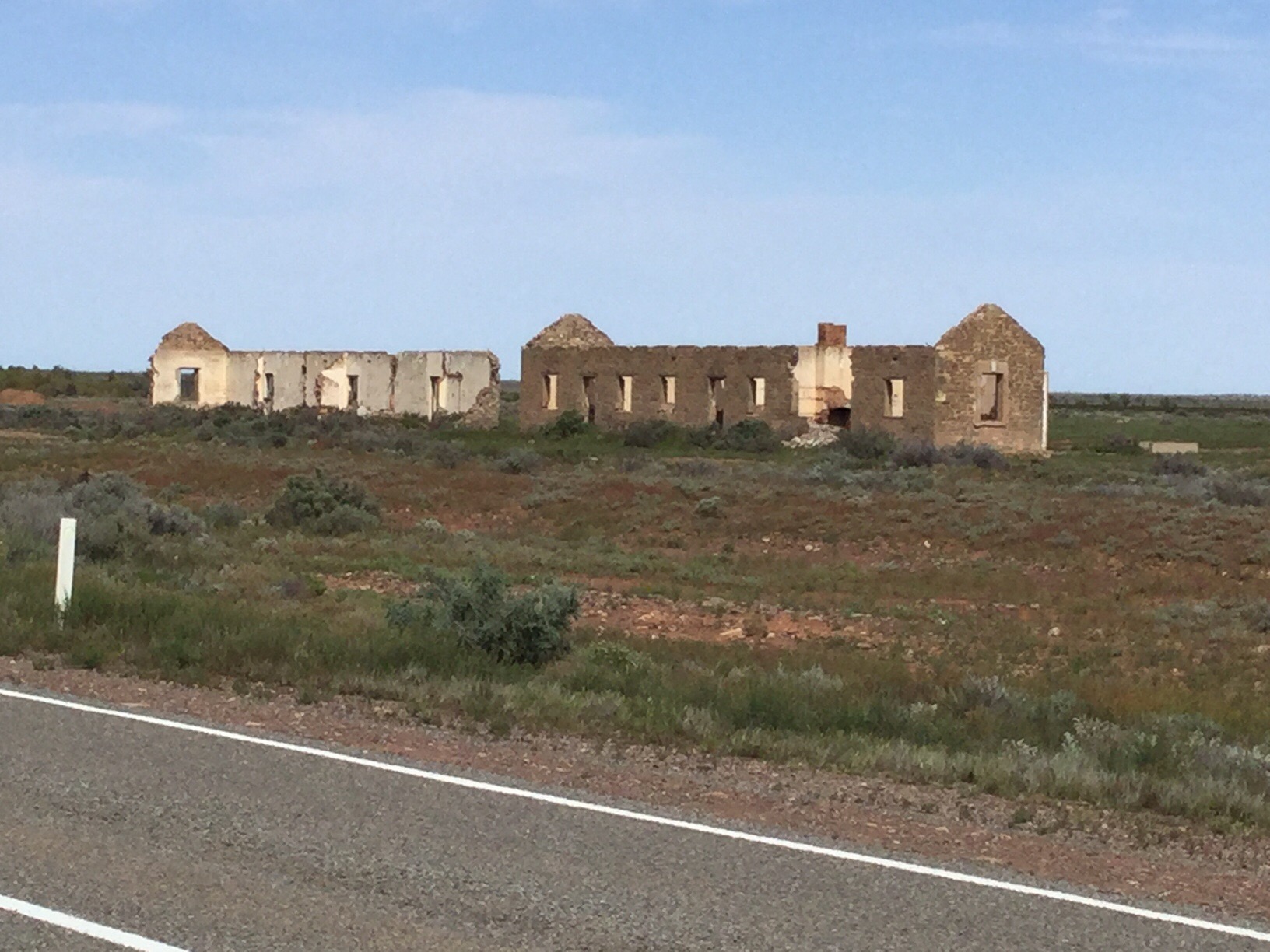
 ‘To everything under the sun there is a season…’ All ends, everything passes. That’s what nostalgia is for. The North Flinders is a treasure house for the nostalgist; in Brachina Gorge, see geological striations in great walls of rock telling their mute tale of aeons unimagined; in Arkaroola, note and lament the passing of the ediacaran, whose fossils mark the first life on earth to have nerve cells organised to process sensation; and note the lonely stone walls – unroofed but still erect in their noble proportions – of dwellings abandoned by pioneers whose hearts cracked in the long droughts.


Add to this is my own lament. With the passing of the unlamented, lamentably polluting coal resource in Leigh Creek, the mine has closed. Soon the Clinic that served the mine will close too. In future summers the North Flinders will not summon its Jewish locum.


Driving south yesterday, at the conclusion of a medical estivation in Leigh Creek, I stopped at the Prairie Hotel. Lachlan Fargher looked up: ‘Hello Howard. Strong latte, extra hot?’ I looked at the Aboriginal paintings in the Dining Room that is really a gallery of fine art. I took in the old timbers, the scarlet collection tin for The Royal Flying Doctor Service. I took in Jane Fargher, Licensee, the brain and spine of a brave enterprise. I looked at Lachie, his black curls bent over his machine; at Avalon, springtime’s barperson. Tomorrow, or tomorrow’s tomorrow, the former will brew Aussie coffee in Nashville Tennessee and the latter will practise criminal law. I drank my latte, said goodbye and drove away.


• Fragments of ‘Noonday Axeman’, by Les Murray


Lights off in the City of Churches

We are driving along a principal Adelaide artery. Dusk has fallen and passed. It is dark now. This main road carries a lot of traffic along its numerous parallel lanes. Unfamiliar with Adelaide and totally devoid of any sense of direction, I pay close heed to my guide, Georgie, a native of the city.

 
‘Merge left,’ commands Georgie. I obey. On my right a larger car swoops close, overtaking me. Studiously attentive to my own lane, I concentrate on the road ahead.
 
Georgie explodes. Pablo guffaws. They point: ‘Look! Look! Look over there!’ I look over there. Over there is the car that swooped by a few seconds ago. Indistinct movement from the roof of the car. Lines of cars in our many lanes slow now to take a bend and we close on the vehicle of interest. I sneak another look. There is movement: a head and torso project up through a sunroof.
 
Straightening up now, I resume driving as Pablo and Georgie shriek ever louder: ‘Look! Look!’ I do look. The moving torso has arms. The arms wave frantically. The face appears to be female. The torso is manifestly female: with every wave of her arms the waver causes her breasts to wobble wildly. I know all this because the waving woman is naked from the waist up. What is more, the waving lady seems to be performing specifically for us.
 
This is puzzling. Unfamiliar with local road culture, I wonder whether we are witnessing a species of road rage. In fact the waving and the wobbling – and quite likely the undressing – are all the opposite of road rage: road love, in fact.
 
Jumping and wobbling and waving in the cold of this winter night the woman mouths words in our direction. We cannot hear. Quite frantic now the dancing mime of The Great Northern Road redoubles her tempo. Surely we will notice her, surely we must hear.
 
The traffic lights turn red and all cars come to rest. The swooping car has swapped lanes, drawing directly alongside us so the terpsichorean gesticulator can make herself heard. She makes a winding movement with her right hand. She mouths her message. Windows slide downward in the car on our right. We lower our own. Voices are heard, a chorus from our neighbours: ‘Your lights! Turn on your lights!’
 
We turn on our lights, smile, wave and mouth our thanks. The lights turn green, the dancer disappears from the sunroof and we drive our ways.


Taxi Driver in Jerusalem

The cab driver’s clothing smells of cigarette smoke. He looks about seventy but I tell him he is too young to smoke. He asks, ‘You are doctor?’His throaty voice is the ashtray of a thousand smokes.

I confess I am a doctor and the driver changes the subject. He drives with dash and confidence, like the tank commander he used to be, a few wars ago.


He detects my foreigner’s accent in his own language and asks: ‘From which country you come?’

‘Australia. You?’

‘Here. Born here, in this city. Only here.’

‘Here’ is Jerusalem.

The driver starts to sing a love song to his city, the song of a faithful son sung to a mother. 

I listen to the words and as the singer’s voice thickens I take a peek. Tears glisten on the driver’s cheeks as he sings his song.

‘All my life in this city. I live in the house I born. Never leave, never change address. This my one home.’


The song ends as we approach our destination, the fruit and produce market. ‘You maybe visit other places, maybe Tel Aviv?’

‘Yes, we’re going there in a couple of days.’

‘I take you. Only 260 shekel.’

The price is fair. We agree. I give him the address and he will pick us up at 8.30 am.

‘I am best taxi in Jerusalem. My mother tell me I am best. Not my wife say this.’ A hoarse smoker’s laugh.


Eight-twenty we sit at the kerbside, two old tourists and two thirteen-year old grandchildren and four suitcases and sundry packages. Eight-thirty, still sitting. Eight-forty, a bit restless. I call the best taxi driver in Jerusalem. The recorded voice invites me to leave a voicemail. I do so. Eight-fifty, no driver, a new voicemail with a bit of an edge to it. At nine, no driver and my voicemail is choicemail. I end with, ‘Would your mother be proud of you this morning?’


A man pulls up in a brand new cab, a squat little vehicle with a raised ceiling, a sort of minimaxicab. Yes, the driver will take us to Tel Aviv. His price? ‘Two hundred forty. Is OK?’ Is more than OK. The cab smells of new car. The driver hums with the pleasure of his new vehicle and the vehicle hums up and down the great hills that surround the city and the driver tells us what we are seeing. Hill follows hill, hills unfolds into yet more hills and every hillside is dotted with dwellings and farmland. Yaakov – that’s our driver’s name – gives a quick history of every community. ‘This one settled by Hasidim from Rumania, that one is collective, built by kibbutzniks, you know, communists? This one – you see minaret? – a Muslim community. That one a “moshav”, cooperative farm, Palestinians and Zionists together, in one community. Down there, old tank, burned out, from the first war.’ And so the drive goes on, every hill telling a story, the same old stories, sad stories of conflict, stories of hardship, of failure, of success.


Yaakov’s phone rings, a woman’s voice. He listens and answers: ‘Yes, we arrive soon. I meet you at the beach. Yes, I drop customers, I come and we meet.’ Yaakov smiling, the smile a grandfather smiles on his way to a picnic on the beach with his daughter and the grandchildren.


The land flattens, the traffic slows and thickens, green gives way to cement, here is Tel Aviv, sparkling by its beaches, the light a blaze. We alight and pay and take Yaakov’s card. We will ride with him again.


The best driver in Jerusalem is forgotten. Two days later my phone rings. A voice thick with smoke says, ‘I miss your call. You want me?’ It takes me a moment to recognise the voice of the lachrymose singer of Jerusalem, his mother’s pride. Not his wife’s. I remind him of our arrangement.

’O yes, something happen. Family…’

I remind him of my family. I remind him he has a phone and our number.

‘Yes. Sorry for that.’

I ask, ‘Would your mother be proud of you this morning?’

The man’s voice, softer now, says, ‘No.’

I tell him he has shamed his city. ‘Do better next time.’


Flea Market

A hazy day in Jaffa. The Old City is full of blind turns and all turns are the right ones and no crooked street or alleyway disappoints. Galleries abound and every one repays our curiosity. The blaze of sun and the blue of sea have penetrated the local artists like an inoculum. Helpless, they turn out vivacious works bursting with colour. Over a number of hours we come across nothing that is dull or derivative or second rate.
 

Every so often we tumble from a narrow and twisting descent into an open space crammed with broken bric a brac. By one such space, a dusty shop manned by a torpid, pear-shaped man sells old art works of varying mediocrity and unvarying neglect. Here in this luminous place I come across a stark photograph. The image in black and white shows a cinematic scene that surely predates all cinema. In the picture a large man in a formal black suit stands at one side of a square like the Jaffa square at our shoulder. He faces a group of men who wear white suits. These men stand in a rank with rifles raised and trained at the man in black.     


We are about to witness an execution. As witnesses we cannot escape the victim’s aloneness. As witnesses we become complicit in something awful, something we cannot comprehend. The photographer has caught the moment, snapping the scene from a vantage above and behind the riflemen. They wear hats that would previously have been white like their suits, but the white is soiled. On closer view the suits do not appear pristine. The faces of the riflemen cannot be seen.


Our simple sympathy for the one, who, unarmed faces the many, gives way to complexity. The soiled suits and grimy hats hint at long labour in the field. The raised guns of the executioners rest on slack, uneven shoulders; these weary men are not ready to fire. Do they identify with their victim? War-weary, do they wonder whether when the guns will be trained on them? Do they perhaps reverence the man in the black suit? The victim who stands uncowed, the man who stares at his killers, the human who was sufficiently free only that morning to dress himself with such sober dignity looks older than the riflemen. Is he the father of one of them who fights for an opposing force in some civil war? Is he a burgher, or perhaps (as he too is hatted) even their rabbi?


I gaze at the photograph that captures so much. It stands loosely affixed to its frail wooden frame, grimy with age, eloquent of truth. And, importantly to me, the truth here is not easy. Fertile with hints, arid of certainty, the photo invites enquiry. How long has the image waited for its interlocutor?


I know I want this photograph that has so much to say to me. Can I afford it? Where in our artcrowded house will my wife allow me to hang such a miserable scene? How will I safely bring that frail and awkward thing home to Australia?


My granddaughter dwells in sunshine. She wonders, ‘Why on earth would you want a picture like that?

‘Why not, darling?’

‘It’s cruel, Saba.’

‘What if the man had to be punished, darling?’

‘Saba, do you believe in capital punishment?’ – she shakes her blond head, shocked by her grandfather’s response.

‘No darling, I don’t. I don’t believe in easy answers. And war asks hard questions, this picture asks hard questions.’

Another shake: ’ What, Saba? You know they make mistakes!’


I look around. Here is the photo, here the dusty premises, open, apparently abandoned; where is the vendor? I race through the doorway into an adjacent shop with my breathless enquiry. ‘Next door’, says that vendor. Slingshot back to the first premises I collide with the cushioning belly of Homer Simpson. No it’s not Homer. The face above the torso is stubbled grey.

‘How much is this picture?’

The man looks at my shoes, running shoes, tourist shoes. He calculates for a while, silently measuring, calibrating opportunity and innocence. He names a sum of astonishing modesty. ‘Fifty?’ – I ask, incredulous.

‘Alright, forty shekels.’

I hand the man his forty pieces of silver.


Hours later my mind floats and thuds to earth. Another sunny outdoor scene, one I witnessed myself in 1995. The location of the latter scene from real life was unambiguous: in the grounds of Yad Vashem, Israel’s Holocaust memorial, I paused while ascending a slope to read the inscription beneath a cattle truck perched at an angle on a section of rail line.


I read a Hebrew text explaining it was in such trucks that millions were crammed during their journey of some days to the extermination camps. There they died, ‘al Kiddush Hashem’, in sanctification of the Name.


Labouring up the slope towards me an older couple, aged, I guessed, in their seventies, puffed and sweated. They took a breather at my side. The man, plump and snowy haired, read the inscription and scowled. He grunted angrily. Between breaths he managed to declare: ‘There was no sanctification. I was there. I know!’ In the face of that knowing I stood silent. The man’s wife, younger than he, tried to calm him. Turning to me she apologised; ‘He always gets upset here. He always comes here on the first morning in Jerusalem. Always here in the morning, then the Wall.’


By now the man had recovered breath. ‘Nothing holy there. Nothing…’ He looked up: ‘Except once. One time only I saw sanctification. I was in the camp, one of hundreds, all of us there, all hassidim, with our Rebbe. The SS officer ordered soldiers to strip the rabbi. Violently, they tore all his clothes off him, that holy, holy man. His hat they threw down. We looked away from the rabbi, we would not see his disgrace. The SS man screamed, ‘Any one who turns away will be shot!’

We knew they would shoot. We knew because they shot anyone who would not look while they hanged our people in the ghetto.


The officer screamed orders to the soldiers who raised their guns ready to shoot our Rebbe. The rabbi turned to the officer. We heard his voice: ‘Will you give me one minute to bless my people?’ The officer laughed. He mocked the Rebbe. ‘You want a minute? Have two minutes old man.’


The Rebbe turned away from the officer and the soldiers. He turned to us, his hassidim. He raised his arms and he called out, ‘’How goodly are thy tents O Jacob, your dwelling places O Israel.” Then the soldiers shot him while we watched.’


I remember the year of that visit precisely. Two days later an Israeli patriot shot dead his country’s prime minister.


Smoking the Peace in the Middle East

We stand on the Tiberias to Tel Aviv highway waiting or the early morning inter-city bus. As we anticipated the bus is crowded with soldiers and civilians returning to work after the Passover
holiday. My wife and the two grandchildren struggle into the bus, informing the driver that we have four suitcases that we’ll need to stow in the luggage compartment below. The driver activates a switch and a hatch opens. The luggage compartment is too full to fit a sandwich. I stand on the pavement with my four suitcases and a thoughtful expression. A soldier just old enough to grow a few whiskers has a backpack to stow. He leans deeply into the luggage compartment, bending his slim back, hefting, pulling, piling, jamming items of baggage together. He has created ample space for his backpack.

But he steps over his own luggage towards my array, grabs a suitcase in each hand and thrusts them into the space he has created. Again he leans, lifts and shoves. Somehow our cases are all aboard. I hoist the soldier’s backpack, find an interstice and widen it, shove the pack in and hope. The hatch closes and we two ascend, the last of the riders. I pay the modest fares for the 170 kilometre ride for four passengers. The driver apologises: regulations require him to charge the two thirteen-year olds full fare. He is sorry, what can he do? – he asks with a raised shoulder.
Inside the bus all seats are occupied. Three young soldiers lie in the aisle, one sleeps while the other two busy themselves with their screens. From the rear seat a figure in civilian red rises, beckons to me, indicates the seat he has vacated. I must sit.

Amused, grateful, mildly embarrassed, I tell him I’m alright mate.

No, he says, I must sit.

I shake my head.

‘Please sir, sit. Next stop, I descend.’

Three recumbent soldiers in the aisle rise with good grace and make way for the old man with his bulky backpack.

We emerge from the two-hour bus trip at Tel Aviv’s Central Bus Station. Passover has just come to an end and we are looking forward to eating leavened breads again. We emerge from Security and see before us a huge array of croissants, bagels, seeded rolls and pastries. I take the family’s orders and approach the squat woman behind the counter. ‘Two double espressos, one croissant, one chocolate turnover, one danish pastry, please.’ The woman maintains a studied silence. I stand for a moment, nonplussed. Has she not heard me? Is it perhaps, self-service? Is she perhaps deceased?

After a good time the woman passes me three paper bags. She manages to do this while turning her back to me. She has not spoken. Feeling like a semi-licensed thief I fill the three bags. Mrs Pastry now leans over her ranks of post-paschal breads in my direction, proffering coffee in a paper cup. A second follows. Still, no conversation. 

‘By what sum am I indebted to you?’ – I ask in my courtly, non-colloquial Hebrew.

The oracle now speaks: ‘Forty.’


Ellie looks up and laughs through her mouthful of chocolate yeast turnover: ‘Look Saba, Savta!’

We look towards the tee-shirt shop next to Mrs Pastry’s, where Ellie indicates a shirt in pink with the text:
DON’T WORRY

BEYONCE.
‘Ellie, would you like shirt like that?’

Ellie would like a shirt like that.
Ellie and I enter the tee-shirt emporium. Hundreds of tee-shirts of modest price and quality hang from cords suspended from the ceiling. All the shirts are suspended high, beyond human reach. Safe from theft they are also unpurchasable without human help. We look around us. Moving browsily beneath the display a handful of humans considers the merchandise. One sits, cross-legged on stool, like patience on a monument, entirely still. This person is slim, petite, elegantly presented.Her lips are the colour of venous blood. Her skin and hair are of midnight black. I approach her. She does not speak or move.

Hazarding a guess, I ask, ‘Do you work here?’

The merest of nods.

‘My granddaughter wants to buy the BEYONCE tee-shirt.’

Movement now as a slim arm emerges from behind the slight torso. Between two fingers of the hand at the end of the arm sits a cigarette.

The confessed employee inhales deeply and silently.

No verbal response. Perhaps we have visited her workplace during her sabbatical.

‘Can you help us?’

The Queen of Sheba points her cigarette over our heads. We turn and look up and backward for the shirt. We cannot sight it. 

We gather we have made our visit at a time when the spirit of enterprise is not active.

Ellie, richly amused, decides she can be happy without beyonce.

Instead, chuckling, she takes photos of the the tee-shirt in the display.  
At ‘Abulafia,’ the Palestinian bakery in the ancient port city of Yaffo, men in pious black yarmulkas queue to buy pastries from Palestinian men in tee-shirts.

In Hebrew and English the shopkeepers wear tee-shirts reading, ‘Jews and Arabs refuse to be enemies.’ Others wear shirts that read, ‘Headquarters of Israel-Palestine peace.’ As shopkeepers the peacemakers are indistinguishable from Jewish Israelis in their generous disdain towards customers. My wife, an attractive grandmother, speaks a clear and correct Hebrew. The bakery boys affect not to understand her menu enquiries. One shrugs and directs Annette to his colleague. He too affects non-comprehension. He winks at his colleague and turns away from Annette, his face closed.
When a second customer approaches, Annette’s two refuseniks compete to serve her. This newcomer is forty years Annette’s junior. 
Now I try my luck. ‘A toasted pita please, with salad filing.’ The man I address does not look in my direction. Like a magician, he flicks an unseen cigarette from nowhere into his mouth. Exhaling dragon-like he grunts something indistinguishable. I look around, find myself the sole customer and ask, ‘Pardon?’

‘Harif?’

Harif is the Hebrew term for shrewdly intelligent. In fast food places it means, ‘spicy.’

‘A little, please.’

This is the second time I have spoken the P-word. ‘Please’ gives me away as surely as it betrayed Annette. Despite our better than serviceable Hebrew, we have revealed ourselves as that least assertive of all tourist species, the Anglo-Saxon.

A second smoker materialises, slides my pita into a toasting oven, smoking all over my lunch in transit.  

Moments later, seated on ‘Abulafia’s’ dusty stone steps we enjoy our smoke-toasted borekhas, pitot, and pastries. Too hot to handle, ridiculously inexpensive, memorably good. 


Going to the Wall

My family used to be employed in Jerusalem. Unfortunately our family business was disrupted for a time by conflict and conflagration. In what appeared to be arson, on the ninth day of the month of Av in the year 70 of the Current Era, our office was burned down. 
The office I refer to was the Holy Temple where my forebears would officiate in rituals of sacrifice, in mediating and arbitrating disputes, in quarantining suspected carriers of contagious disease and in blessing the people. As the reader will realise we worked as lawyers and doctors and priests. After the burning my family was unable to go to our office for nineteen centuries. Then in 1967 we returned. The other day I went back to the office where I resumed working in the family business. 
It happened like this.
My two eldest grandchildren, both aged thirteen, accompanied my wife and me on our current visit to Israel.
The boy, a pretty secular fellow whom we’ll call Jesse, walked down to the Wall with me. He understood the antiquity of the Wall and something of its sanctity. Praying is not his specialty. ‘What will I do, Saba?’
‘I pray there, Jesse. Some people write their prayer on a slip of paper and insert it into a crack between stones.‘
‘What should I pray for, Saba?’
‘Think of the thing that you most want in the world, Jesse. Ask for that. It could be some deep and secret thing, something you wish for yourself or for someone else.’
Jesse has seen suffering. Earlier he saw a man begging. Well made, about the age of Jesse’s father, the man requested small change, blessing anyone who donated. The man walked on a distance from Jesse, turned away and covered his face with his hands. His shoulders shook.
At the Wall, Jesse pressed his lips against the glowing stone. He leaned his forehead against the Wall for some time, his lips moving. Then he posted his slip of paper into a tiny eye socket in the stone.
As we walked away backwards, Jesse stopped me and threw his arms around me. He said, ‘That was a really important experience, Saba. Thank you for taking me here…I love you, Saba.’
We rejoined my wife and Jesse’s cousin, whom we’ll call Ellie. They too had prayed at the Wall. Ellie’s fair features glowed: ‘Saba and Savta, that was wonderful.’ My hands twitched, a spasm in unemployed muscles. I recalled I was a Cohen, a lineal priest: I was in the blessing trade. I rested my palms on Ellie’s head. My fingers splayed and I searched for some voice. The voice shook as I recited the ancient words: ‘May God bless you and keep you…’ Here I was back at the old workplace, here was Ellie, flesh of my flesh.
I had waited 2000 years to get back to work. I annointed her fair head with my salt tears. 

Scavengers at Woolworths in a Remote Mining Town

By the time we disembark in the town we have travelled most of the day. The streets are a desert in the empty way of a Sunday afternoon in the country. We need to buy food supplies but all is quiet. Nothing moves. The air tastes hot. Breathing becomes an effort.

Up and down slow wide streets we prowl, looking for a supermarket. Hello! This is Woolworths. A cluster of cars baking in the carpark. Signs of life. Or recent life.
We tumble out, one grizzled grandfather, two ratty ten-year-old twins. Woolies is open! In the course of the following twenty minutes I load a trolley with fruit, vegetables, cheese, pasta, milk, yoghurt, confectionary bribes, cans of tuna, smoked salmon for the sybaritic grandsons.
The boys have disappeared. All other customers have disappeared. Someone turns off a lot of lights. I wrestle the trolley to the check-out where the twins lie face down, arms outstretched, fingers groping in the narrow cracks beneath the checkout counters, Their long curly hair wears a diadem of dust. Their once-clean shirts from long ago – this morning – are grimy. Their faces are coated in dirt. They wear expressions of intense concentration. When I call their names they do not respond. They pay no heed. Business as usual.
I pay a distracted-looking checkout person who asks me whether the boys are mine.

Technically they are not. But I admit to the connection. 

Checkout person says: ‘That money doesn’t belong to them.’

‘What money, I wonder?’
I call the boys and advise them I am about to leave, the store is about to close, and I will collect them at opening time tomorrow. If I remember.

The boys surface, faces aglow with dirt and triumph, their hands full of coins. ‘Look Saba! We found all this money under the checkouts.’

‘That money doesn’t belong to you’ – checkout person again.  

‘It doesn’t belong to you either’, says one cheeky voice.

‘Who does it belong to?’ – challenges another.

‘Woolworths!’

‘No it doesn’t.’ – two voices in chorus.

‘It can’t belong to the shop, Saba. The people paid the shop. The people dropped the coins. It’s not the shop’s money.’

‘Whose is it, do you think?’ – asks the grizzled grandfather, who isn’t really too clear on the legalities or the morals here.
The boys have an answer: they’ve spied a tin chained to the checkout counter. The tin has a slot for coins in its top.

The boys are busily feeding the coins into the tin, counting as they go. ‘Twenty two dollars and thirty-three cents, Saba! All for charity.’
The boys were unerring in their reading of the moral landscape: the label on the tin reads: HELP DISADVANTAGED CHILDREN.
 

Gap Years 

The friendly young man in the bookshop approves of my reading choice*: ‘Good book, I really enjoyed it. It was prescribed in my literature course last year.’He looks young, too young to be a uni graduate: ‘What was your course?’

‘School. I finished last year.’

‘What are you doing this year?’

‘Working here. Saving. I’m going to travel; I’m taking a gap year.’


Everyone takes a gap year nowadays. I never thought of it. No-one did back in 1963. I was keen to get on with becoming a doctor. I couldn’t see a gap and I would not have walked through it if I found one. Tempus was fugit, vita was brevis, gluteus was maximus, so I sat myself down and flogged my humanities brain over the sciences that were the stepping stones to doctoring. I never gave thought to my already clear history of stumbling through the sciences. I entered medical school, I studied the sciences and I stumbled on. If in later years I referred to my undistinguished undergraduate days, patients refused to believe it. They’d look at their trusted doctor and smile, knowing he must be joking; their peace of mind required he have no gaps.


I became a husband, I became a father, once, twice, thrice. I had four new people in my life to love, four more to work for. And I did work. A joyful and fulfilling part of my work was caring for women in pregnancy and childbirth. I became the intimate stranger, the guest at the birth of families. I’d be called to the hospital in the middle of the night, during dinner, at the kids’ bedtime, at quiet times alone with my wife. I’d leave home early in the mornings to visit the mother and her newborn in hospital. I’d leave before the children were awake. I left lacunae in our family, gaps where the dad was elsewhere when a daughter was sick, when our son had asthma, when our youngest cried at bedtime because a classmate at kinder teased her about the warts on her fingers. After twenty years I bade farewell, a long farewell to obstetrics, and hoped I’d mend the gaps.


The children grew, graduated, went to work, married, became parents. Became busy. Their time cramps them, crowds them in. The gaps that open in our children’s lives allow my wife and me in and enrich us.


The friendly young bookseller-bookreader will head off into his gap. He’ll travel towards his Ithaka and become rich with all he learns.


The truth is, life is full of gaps. As Leonard Cohen teaches us, that’s how the light gets in.


*Brenda Walker’s ‘Reading by Moonlight’. A gift for a friend with a couple of cancers.


And the Two Walked Together

The boy emerged from the car and read the sign: LIGHTHOUSE 19 KILOMETRES. Beneath the sign were the words: Six Hours. The boy spoke, his voice small: ‘I’m nervous, Saba.’
The old man reassured the boy. They pulled on their weighty daypacks and started to walk from the turntable on the mountain. The dirt track was wide enough for a small truck. It sloped away beneath their feet and, despite the lowering sky and the fine wind-whipped rain, the two made good speed in good humour.

The old man said: ‘This is a long, long downhill slope; it will be uphill on the way back. Just when we are really tired we’ll have to fight these hills.’

They looked ahead into immensity. As the path led them lower the slopes towered green and steep before them. The old man saw they’d soon be climbing. The rain stopped and the two felt hot. They peeled off parkas and jumpers and mopped rain and sweat from their faces.

Rounding a sharp bend the boy exclaimed, ‘Look Saba! Look – how beautiful!’ The old man looked and what was beautiful for him was the joy on the boy’s face. ‘Surprised by joy’ – the words floated into the old man’s mind from some half-read snatch of old verse – ‘surprised’ – overcome – as in a surprise attack.‘ The boy’s face, red with exertion, glowed. The old man looked again; he saw no sign of care.


The descent ended in a strange plain of long grasses and thick green ferns between which the pale trunks of gums rose, twisted and charred, like writhing skeletons, reaching for the sky. ‘The bushfires must have raced through here’, said the old man, ‘See how there’s not a single living eucalypt. Just ghosts. And everything else so green.’ To himself, he added, ‘They look like humans whose prayers were not heard.’ The old man had dwelled much in suffering of late. All nature spoke to him of the pain of others.

The boy’s expression was opaque.

Not an hour into the walk the boy’s voice asked: ‘Would we be a quarter of the way there yet?’ The old man doubted it. He couldn’t really say. Mostly the boy walked beside him, now and then slipping behind. At these moments the old man slowed, he hoped, inconspicuously.

The boy’s breaths were loud. The old man announced: ‘Morning tea time’, and they stopped to drink. The old man asked, ‘Apricots?’ The boy took the dried fruits and ate appreciatively. They hoisted their packs again, the boy staggering a little before steadying. The old man took the drink bottle. It felt lighter in his hand. They walked. Between the sounds of footfalls a voice spoke: ’I love you Saba.’

The old man, for all his years, for all his words, could find no words better in reply. ‘I love you too, darling.’


After a time the flat road began to rise and twist. Ahead of them they saw stately ranks of black tree trunks, erect and slim, towering upward, their branches richly green. ‘Look’, said the old man, ‘Every tree has been burned but every one of them here has survived.’ Their eyes drank in the green life, the dense underburden. Walking between the giants the two felt the silence and it did not oppress them. Rather, wonder swept their eyes upward. In quietness they laboured up long hills, around bends that led to yet more hills, working hard but not feeling it as work.

A scream broke the silence. The boy hobbling, whimpered, ‘My foot! It kills!’ The old man took the boy’s pack. ‘Here’, he said, ‘Sit down.’ ‘I can’t Saba, my arse will get muddy.’ The old man saw a tear at the corner of the boy’s eye. He spread his waterproof on a bank, pulled the boy’s haunches backward and sat him down. ‘Saba, my foot doesn’t hurt when I’m just sitting here. But it killed before.’

The old man opened lunch, bagels he’d bought from Glicks at five that morning. The previous evening the boy ordered peanut butter and honey for his: ‘Fifty percent of each please Saba.’The old man made short work of his own bagel but the boy played with his, peanut butter and honey notwithstanding. Reckoning the child needed relief the old man removed the heavy items from the boy’s pack. Bookish like his grandfather, he’d packed a small library.

‘Do you think you can test that foot?’

The boy rose, hoisted his pack and stepped forward. He winced but said nothing. And the two walked together. At first the boy’s gait was diffident, but quickly he established a fluent step-wince-step rhythm. Rounding a sharp bend the boy cried out, once again in delight. A small wooden footbridge led them across a shallow stream. Green ferns dwarfed the boy, the water chattered and rippled, the air was still and cold. The boy glowed. He turned and spoke: ‘Thank you so much for taking me here Saba.’ In the richness of his feeling the old man felt again the poverty of his own words.


They climbed. The old man, remembering walking as a child with his father, described how hard it had been to keep pace. He said, ‘Every few paces I’d fall behind. I’d have to run to catch up. I think that’s what started my life as a runner. It’s what prepared me for running marathons.’ The boy replied, ‘That happens to me too, Saba.’

The old man, a package of memories, told the boy about the time he ran a marathon in Melbourne. ‘It was springtime, quite warm. The sun shone and warmed the asphalt. I could feel the heat through my shoe every time my foot hit the road. I realised I had worn the soles too thin. Actually I had trained hard here, at Wilson’s Promontory, on tracks like this. I had run fourteen kilometres, only one-third of the marathon distance. I anticipated feeling pain with every step of the remaining 28 kilometres. I felt full of gloom. Then I did something really brilliant: I talked to myself. I said, “Every time your foot hits the ground remember you have one les step to run. Every time your foot hurts it’s a reminder – you’re getting closer to the finish.” Guess what – after about ten metres I stopped noticing my foot altogether.’

They passed a sign that read: HALFWAY HUT. Unfortunately whatever ’halfway’ meant it did not refer to the lighthouse walk. They walked on a good while and the boy asked, ‘How much further do you reckon we have to walk, Saba?’

‘Maybe ten kilometres, perhaps a bit less.’

The boy absorbed this. He picked up a straightish stick, about 1.3 metres long and tested it. A few minutes later he discarded the stick, saying his foot wasn’t too bad now. He added, ‘I love you Saba.’ ‘I love you too, Mister Pie.’ (When he was a baby family members called him ‘Sweetie Pie.’ After twelve years the remnant was ‘Mister Pie’).


The two came to a fork and another sign. To the left, the sign read: VEHICLE TRACK 9.5KM.

To the right the sign read, WALKING TRACK 8.5KM. The old man recalled the briefing from the Ranger Staff, warning them off the walking track ’because it rained last night – could be soft underfoot.’ He chose the walking track, being the shorter and possibly the softer. ‘Maybe too soft, perhaps marshy or boggy.’ He misgave but he did not reveal his uncertainties to the child. The decision proved decisive. Time and again as they clambered over steeps, scrabbled on uneven footing, wound around sharp turns and twists, the boy exclaimed in delight and wonder. At every corner a vista, at every peak breathtaking verdure. And at every pause the song of falling waters. They panted and sweated and never stopped smiling.


The old man, marathon man, always prided himself on his doggedness on hills. But these slopes, so steep, so long, so numerous, for these he needed to dig deep. Head down, bending forward to bring the pack over his centre of gravity, the old man, ploughed dourly on; while the boy sailed ahead, never slowing, never weakening, not ever quailing at the next hill and the next that unfolded in unfeeling succession at summit after summit. The old man marvelled and rejoiced.


The walking track was no bog, simply a way up and into a southern Himalaya. Abruptly the climb ended in a series of steep declines. ‘I’m scared I’ll fall’, said the boy. The old man held the back of the boy’s pack and pulled gently backward at every descent, the traction a felt message that the old man would not allow a fall.


Around a bend and suddenly the dense bush ended at a wide cleared space. The walking track had rejoined the vehicular. A short walk brought them to a further sign announcing: NO THROUGH ROAD. Rising from their left a walking track led into bush. Leaning on some rocks three men in their late thirties sat eating dried fruit. One asked, ‘You heading for the lighthouse? It’s up that way.’ A thumb pointed backward over the speaker’s shoulder indicated the walking track. The three might have been planted in that spot, so comfortable was their seat on earth, so fixed and settled their attitude.


The old man asked, ‘Have you ever walked to the lighthouse?’ Heads nodded. The man with the thumb looked at his bag of currants and said, ‘It’s mainly downhill from here. All except the final three hundred metres, which are the steepest in the entire National Park.’ The boy pointed out a smaller notice behind the men: LIGHTHOUSE 3.2 KMS. He and the old man had been walking for four hours. With a relatively short descent ahead of them both understood they’d arrive in good time for the sunset and the start of the Sabbath. That knowing, not spoken aloud, relieved the worry, also unspoken, of walking in darkness and arriving to cold and dark.


 After a short climb the track truly did descend. Underfoot, leafmeal and twigfall covered the soft sand. ‘This sort of footing is my favourite’, said the old man, ‘It comforts your soles. My feet love it.’ At every bend gaps in the bush gave way to glimpses of sea. One gap, wider than others, gave onto a view to the east of a long climbing pathway of exposed rock. At the far end of the path the two saw a white structure, phallic in shape – the lighthouse! It looked beguilingly close.


The two pressed on, half racing now. They tumbled around a bend almost falling into the arms of a human who stood on a granite elevation, tall and slim, a statue. The statue had a young woman’s face, a woman’s voice: ‘Look there: Orca.’ She pointed over a shoulder at the sea. ‘Look carefully, you’ll see the water break as they near the surface. When you arrive at the lighthouse would you please tell the lodgekeeper; there’s a pod of four playing here.’

The water broke and mended itself, broke and settled. Was this whale action? The same small disturbances were seen in every direction the man and the boy looked. Hopeful then doubting, then self-doubting, they fixed eyes, solemn and reverent, upon the sea. The old man had seen whale in these waters in years past but this time he saw no purple-black bruising the surface. After a decent interval the two hastened on. They’d seen no Orca yet they tingled with the closeness of greatness.


A voice rose from the bustling shape of the boy. He spoke of self-doubt, of fears, of haunting thoughts of his own grave unworth. The old man, filled with quite opposite thoughts of the boy, listened. He ached for the boy. He wanted to say something useful. ‘I know those feelings, Mister Pie’, was all he managed. He wished he had some infusing strength such that if he but held the boy close, the child would grow and know his worth. The urge to seize the child, to crush doubt from him bodily, was strong. But the old man knew such truth is the daughter of time. A daughter not yet ready to be born.


 Meanwhile, simple exertion, the actions of fast walking seemed to make the child lighter as he gathered momentum. The words spoken, the hard thoughts disappeared in air, leaving a small body busy and complete in its plunging passage through bushland.

The old man followed behind, carrying his pack, the boy’s books and the boy’s discharged cares.


A rock lay in their path, its northerly aspect coated in delicate mosses of brilliant green. The boy stopped to explain, ‘In the bush you can use mossy rocks as a guide, like a compass. The moss grows on the sunniest side. In our hemisphere that’s north.’


At one bend the lighthouse would appear only to disappear at the next as they corkscrewed their way down to sea level.  

Now a right angle turn marked the last of the bush. They emerged to an exposed path of surpassing ugliness. Blocks of weathered and stained cement set end to end formed a series of plaques that rose and rose, ending three hundred metres further on at the Light. This, the old man recognised, must be the ‘worst climb’ mentioned by the currant muncher. He looked up. The boy had not paused. He’d opened a lead of twenty metres as he attacked the awful slope. The old man hurried after him but the gap did not close. Half way up the boy approached a welcoming bench, set at the path’s edge to relieve exhausted climbers. The boy ignored the bench and steamed past and the old man, shaking his head, followed. When he reached the top the boy was grinning, his face a fairground of many pleasures.


Before they set out the Ranger had estimated the walking time from carpark to lighthouse at six hours. The man and boy finished in under five and in plenty of time for sunset and the Sabbath.


The lodgekeeper welcomed them. He said, ‘We’re expecting eleven in your cottage tonight. You two are the first to arrive. We expected an old – pardon me, I mean older – man and a child. Amazing that you beat all those grownups, young feller. Congratulations! Your reward for arriving early is the room with the best view. See – there’s the Light just outside your window. You’re overlooking the ocean. You’ll see any whales without leaving your room.’


The room had high ceilings, bunk beds, large windows and plenty of room for two and their possessions. The ‘cottage’ was formerly a lightkeeper’s dwelling, large enough for his wife and their eight children. Outside the wintry gale blew up a four metre swell. Inside the cottage was snug and the showers were hot. Both man and boy stank of sweat. They peeled off their steaming clothes and showered. The boy headed off to the reading room where he met the incoming walkers, adults all, and held court. The first to arrive was the trio of dried-fruit eaters, blokes in their thirties, friends since their schooldays in the Blue Mountains, revisiting old haunts and shared pleasures. After them came a family of four, rich in geography and history, which encompassed Scotland, Southern Africa, Denmark and a touch of Jewishness. The sole female was the Dane. The boy introduced himself and she replied, ‘I’m Astrid.’ This name was new to the boy who remembered her as Asteroid. Following the arrival of that heavenly body from Denmark a lean schoolteacher in his early thirties turned up. He’d sighted the boy in the carpark before setting out. Admiringly he said, ‘You walked quicker than I did’.


Darkness fell, the windy world outside moaned and window frames rattled, while inside their room the man and the boy had lit the candles. The old man placed his hands on the boy’s head and slowly, as in a fugue, recited the old words of blessing of the child. Then the two sang the Sabbath Dedication before breaking bread and feasting on packeted food brought to piping in the microwave.


Afterwards the boy beat the old man at Scrabble, much to the admiration of the last two to arrive, a bushy-faced pair who materialised from the darkness, unfussed by their final hour of moonlit hiking.


The man and the boy slept eleven hours that night.


The next day – Saturday – was a true Sabbath, a day of rest. The boy accumulated a series of hurts – his back ached, his right sole was bruised, his left knee seized in spasm. When the lodgekeeper invited all guests into the lighthouse museum for a tour, all pains were put to the side, and soon – or sooner – forgotten. The boy asked most of the questions, good adult questions, as the lodgekeeper later confided. They spent the rest of the day and the evening in the heated common rooms, reading, playing Scrabble, chatting. It is fair to say the nine adult males found the sole female and the sole child the most memorable of the company.


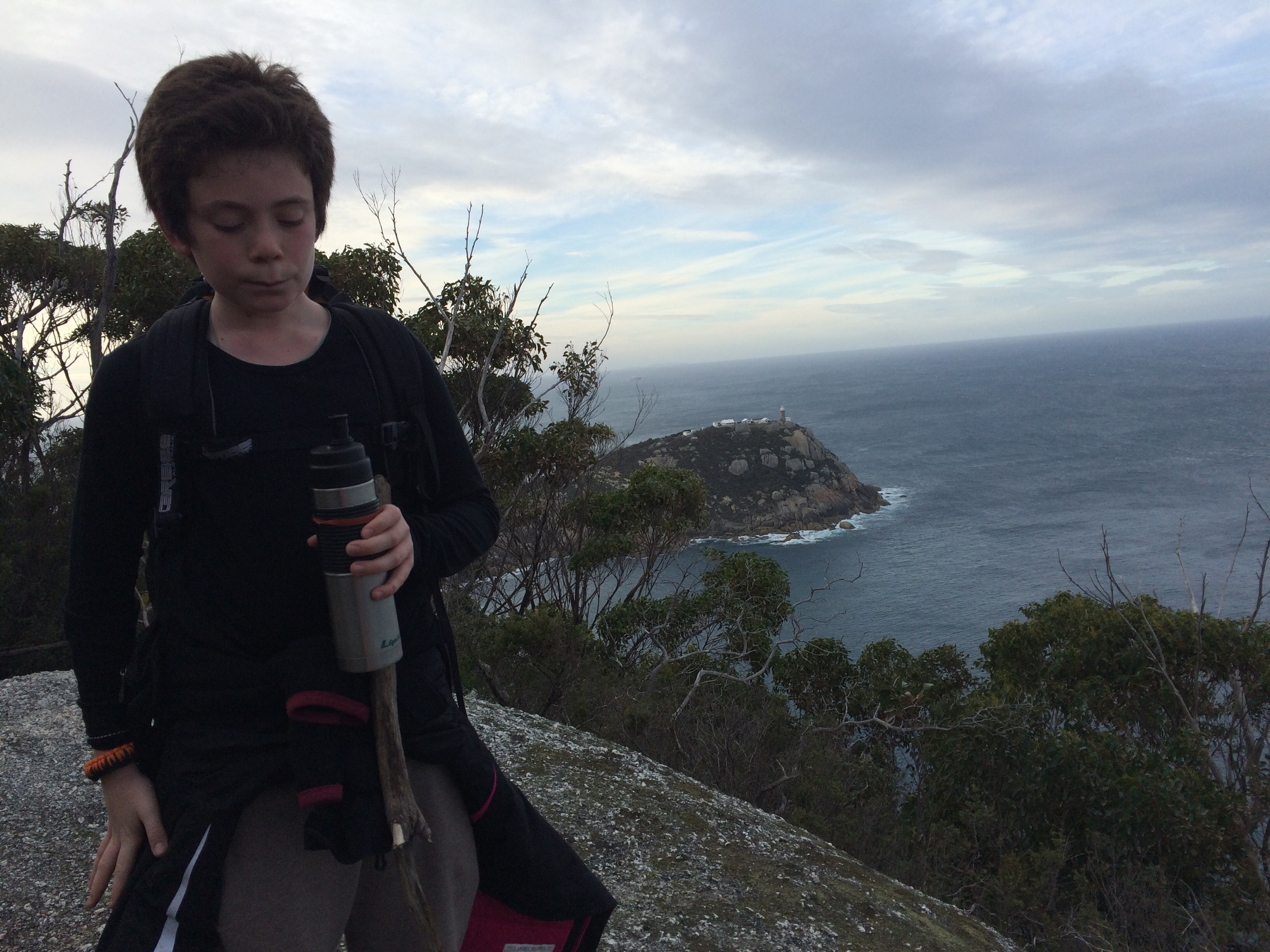
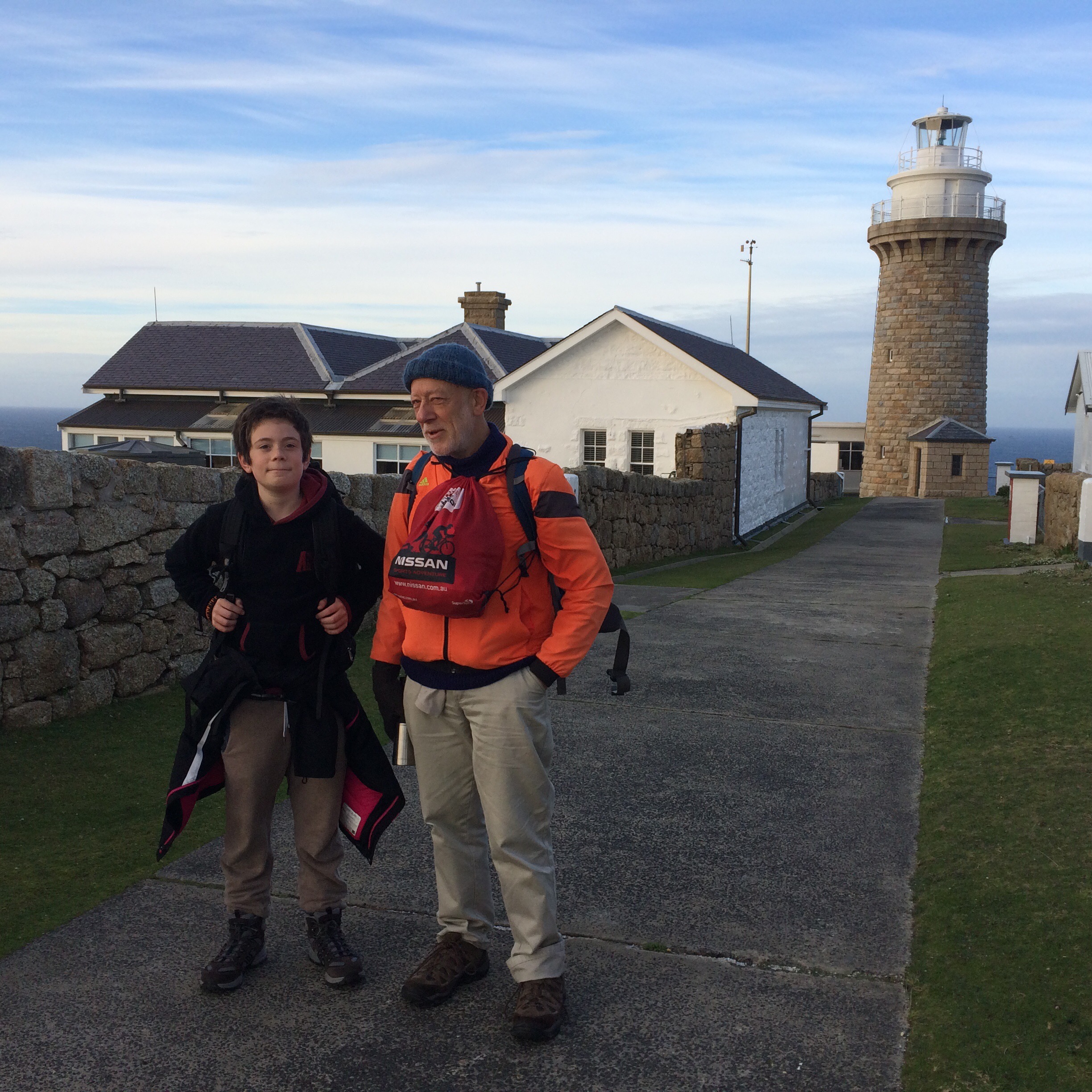
Early Sunday the boy revisited his wounds: his bruises padded with multiple bandaids, his knee now moving without pain, his stiff back tolerating a (lighter) pack, he said, ‘I should be able to walk.’ The old man said, ‘The stiffness and soreness will probably disappear once you warm up a bit.’ Before they left the lodgekeeper insisted on taking photos of child and man standing with the lighthouse in the background. ‘To prove to everyone you actually made it’, he said.


 The walk back was just as beautiful, just as long, just as tough as the walk out. After an hour the old man asked, ‘How’s your back, Mister Pie?’ ‘I haven’t been noticing, Saba.’ The boy greeted every new vista with delighted recognition. The top of every rise, each mossy stone, every leafy dell, every rugged prospect, he claimed them all as new old friends. He owned the track, his by conquest. Every so often the boy would turn to the old man in his train and repeat, ‘Isn’t this wonderful, Saba? Thank you so much for bringing me here!’

Over the hours of the return hike the boy never asked, ‘How far have we walked?’ Pressing hard on the hills, the boy asserted a sort of mastery: he had done this walk before, he’d do it again now. There was no doubting his ability.

Ahead of them rose the final four kilometres of unrelenting hills. Between the two and the hills a pair of colourful shapes moved in and out of focus. The boy said, ‘Asteroids. There’s a couple of asteroids ahead of us.’ Neither spoke it aloud but both decided they’d overtake the colourful figures ahead. It took them seventy minutes but they did so. The boy declined the old man’s suggestion of a break for lunch. A quick stop for drinks and fruit and upward and onward they went, again tacitly resolving they’d beat the asteroids to the carpark. As on the outward walk the boy attacked the closing uphills. Cruelly illusory, every late bend offered promise of an end. Time and again a tough slope led the eye upwards towards a seeming opening, as one would see at trail’s end. But time and again the boy ploughed on, leaving disappointment behind, his head down, breathing hard, with the old man following in his wake.


The sun found its way out of cloud, the greenery took on a lighter shade, the day gleamed. Sweat beaded the boy’s small face, the pink of his cheeks overlying a strange circumambient pallor. ‘Take a break, Mister Pie. Let’s drink.’ The boy took the bottle without words, sucked, passed it back and climbed wordlessly on.


One of the illusions of an end turned out to be the fact of the end. The boy strode into the clearing, staggering a little now on the flat asphalt. His grandfather went to take a snap to record the moment of triumph, but the boy, sickly pale, waved him away, gasping: ‘No photos, Saba.’


A little later, in the car, the boy said, ‘I’ll take my son on this walk one day – or my grandson.’