Farewell, Farewell

I used to run six days a week. No longer. I used to run marathons. No longer. Farewell, farewell, a long farewell to all that.

I ran before work; sometimes I ran to work. I ran every day but Saturday, the Sabbath. I ran because I could, I ran because I needed to. I ran up the hills of Wattle Glen, up the endless alps of Kangaroo Ground, and along the river at Warrandyte and Kew.

I ran marathons in Traralgon, on the Gold Coast and in Alice Springs. I ran in the New York Marathon (thrice – never won it – home town decisions, obviously) and four times in the world’s oldest modern marathon, in Boston. The 2013 Boston was my last. I never crossed the finish line, turned back by the police at the 41 kilometre mark. At 67 years I was too old, too slow to be harmed by the bombers.

I ran in the World Veterans’ Games Marathon, and I was a Spartan at Melbourne. About 8 years ago at Traralgon, I became the Victorian Country Marathon Champion (Over Sixty, Male). There was one other sixty year old bloke – a patient of mine. He ran with an injury that I had fortunately not cured. I entered my title – Vic Country Marathon Champ – on my resume.

I ran in Havana and Amsterdam, in London and in Oxford, and on the golden stones and basalt cobbles of Jerusalem. I ran up and down Masada and in Galilee. I ran in Buenos Aires and in Capilla del Monte.

In fifty Aboriginal communities I ran to feel country, running fast to keep ahead of mobs of hungry dogs.

Through all this running I discovered strengths I never dreamed of and weakness I’d always feared. I extended my being, I joined in the joyous commonwealth of comrades that is a marathon.

I ran and I wrote what was a metaphor for my life – a passage, undistinguished, through space and through time, made rich by those I ran with and those I ran for. And always I ran with a doctor’s calibrated sense of risk. I ran with my younger daughter’s instruction ringing prayer and warning: Have a good run, Dad, and don’t come back dead.

I ran carefully, knowing if I did die I would leave wife, children, and latterly, grandchildren, grieving and aggrieved.

I ran and I gave thanks that my body held up for so long. I knew joy and pain and the joy of pain transmuted. I knew my lands and the lands of others intimately, physically. And in the stiffness and the glad soreness that followed a hard run, I knew pride, I knew joy.

***

An Australian boy knows it is in the sporting arena that his worth is measured. Excellence at sports trumps beauty and wealth. Brains lag last, far behind all. As a little boy I was timid, both physically and spiritually. A large brain served me only to imagine fearsome possibility; it was no asset in sports. Introduced to both cricket and football, in which I overcame fear sufficiently to try bravely, I achieved and sustained a modest mediocrity. I might have achieved more but for two discoveries: the hard cricket ball, travelling fast, hurt the fumbling fingers; and the elusive football, fiercely contested by other boys bigger and less timid than I, led me only to painful and fruitless collisions.20130411-184933.jpg

By virtue of very little, I rose to captain the Second Eighteen in footy and captain of the Second Eleven in cricket. My highly academic Jewish school quickly won fame for academic excellence, while earning only a reputation for awkward strangeness in inter-school sports. Generations of Jewish history had equipped Jewish boys well for debating, mathematics and playing the violin. Our ancestors in Europe learned to run only from fire or pogrom. So the best teams this post-Holocaust Jewish school produced were try-hard failures. And I was never good enough for the Firsts. Captain of the Seconds at Mount Scopus was the ultimate backhanded compliment in sports.

But at the age of fifteen came the discovery of distance running. The annual cross-country run over three miles of hilly scrubland sorted the tortoises from the hares. At the gun all the glamour boys leaped into the lead and quickly disappeared between bushes at the first bend in the course. I chased as hard as I could, my breath burning my throat, my chest aching. In a failure of the imagination I never thought of stopping or slowing. I kept going. Abrupt hills, uneven terrain, a finish line that was nowhere in sight, all conspired to daunt and defeat our gazelles of the track, our hares of the field. But I kept running. I don’t think I slowed at all. Eventually the astonishing sight of my idols bent double, gasping at the trackside, unable to respond to greeting or commiseration told me I was among the swiftest of the tortoises. I finished in the top ten that first year, improving to fourth, and eventually to third place, in the years that followed.

The barren years of sporting opportunity after school saw me gain a medical degree (summa sine laude), a wife and a bunch of little kids. And about five kilograms in weight. I was now a sedentary family man, short in stature, with a small pot belly. Then a schoolteacher friend took me running on the hills of Diamond Valley. He tired me out and he puffed me up, saying, “You have a nice running style, Howard.” One day we ran ten kilometers together. Breathless with achievement I looked at the distance – nearly a quarter of a marathon! – and with fine naivette I said to myself: I can run a marathon. And I did.

***

Seven months ago I drove for six days to and from an outback locum. My left thigh ached and it still does. Two months ago I fell onto my left knee from my bike. It screams with pain whenever I run a single step. The MRI of my spine resembles a bombed railway track – you can recognise the pattern of the original structure but you wouldn’t want to travel on it.

I used to run. Now it’s over.

Where Else But Alice?

Where else but Alice Springs can you run through Honeymoon Gap (part of the Macdonell Ranges, not part of the body) and see the world ablaze as the sun rises, greeting a file of self-selected marathoners with silent fanfare?
Where else than Alice can such a mediocre runner place fifteenth in a marathon? (There were only seventeen starters that year).
Where else than Alice do the volunteers – endlessly cheering us, feeding us, hydrating us – outnumber the runners?
Where else in the running world can you run through air as pure as crystal and finish your marathon in the mild golden glow of mid-morning?

Alice has the best kept secret in the world of marathon running. I’ve done Boston (four times), New York (thrice), Traralgon (ten times), Melbourne (15 times) – and Alice just as often. I come back for every third Sunday in August. My wife is suspicious: she should be: Alice Marathon is my secret love.

So Foul and Fair a Day

Howard at the Boston Marathon 2013

Howard at the Boston Marathon 2013

When I solicited funds as a charity runner in the 2013 Boston Marathon I promised to write a report on the race and my donors’ ‘investment.’ The moment the race started I started to compose my report. The mood was light, the crowd a united force of love, the events and sights all affirming a shared humanity. This would be a report of smiles. The serious counterpoint would be the 26.2 long miles.

At 2.07pm the mood changed. After that the playful response would feel profane. But I did promise a race report.

I slept on the matter. The evil was great and real, certainly. Real too was the goodness. Both demand to be written.

***

Does any runner sleep well the night before a marathon? I don’t. To prevent dehydration on race day I drink plenty through the previous day and every cupful demands its exit through the night. I am excited, nervous, a kid before his birthday party. Boston, after all, is to marathoners as Wimbledon is to tennis players. An enormous privilege, unearned by any effort of my legs, paid for in thousands of donated dollars.

The playful mind must be carried by legs that are 67 years old. Some prudence surfaces. The sixty-seven year old prepares methodically. The experience of forty past marathons insists I vaseline my second toes (which always blister), my armpits (which chafe), my nipples (which bleed) and my private bits (none of your business).
To prevent my shoelaces untying over the distance I double knot them: a trivial detail? No, not in Boston, for it was at the start line of one Boston Marathon back in the seventies that the favourite, noting his arch rival’s single-knotted shoes, bent down and double-tied them.

Continue reading

Nobody Doesn’t Like a Song

I

Whenever I wanted to read a poem to my father he’d make a face. He claimed he didn’t like poetry. I suspect it was the ambiguity in a poem that frustrated him. In fact Dad loved poems, the poems he committed to memory in his schooldays. He recited some of these often enough for them to take seed and grow inside me.

Now Dad is gone and it is I who recites his lines, learned at school around 1925:

Blow, blow, thou winter wind

Thou art not so unkind

As man’s ingratitude…

Thy tooth is not so keen

Because thou art not seen

Although thy breath be rude

I see Dad’s wry smile as he continued with lines that border on the cynical.

Sing Hey Ho, Hey ho unto the holly

Most friendship is feigning

Most loving mere folly

Dad was not cynical. So what appealed to him about this snatch from ‘The Tempest’?

I think it was the music.

Lots of people think they don’t like poetry. They would never read a poem – not willingly, not wittingly.

But they listen to songs. And a song is just a poem hidden inside music.

Think of the Beatles. Think of ‘Till there was you’. Think of ‘Elinor Mackenzie’. We loved those songs, not least for their poetry.

Nobody doesn’t like a song.

Continue reading

376,000 Footsteps in the Sisterhood of Man

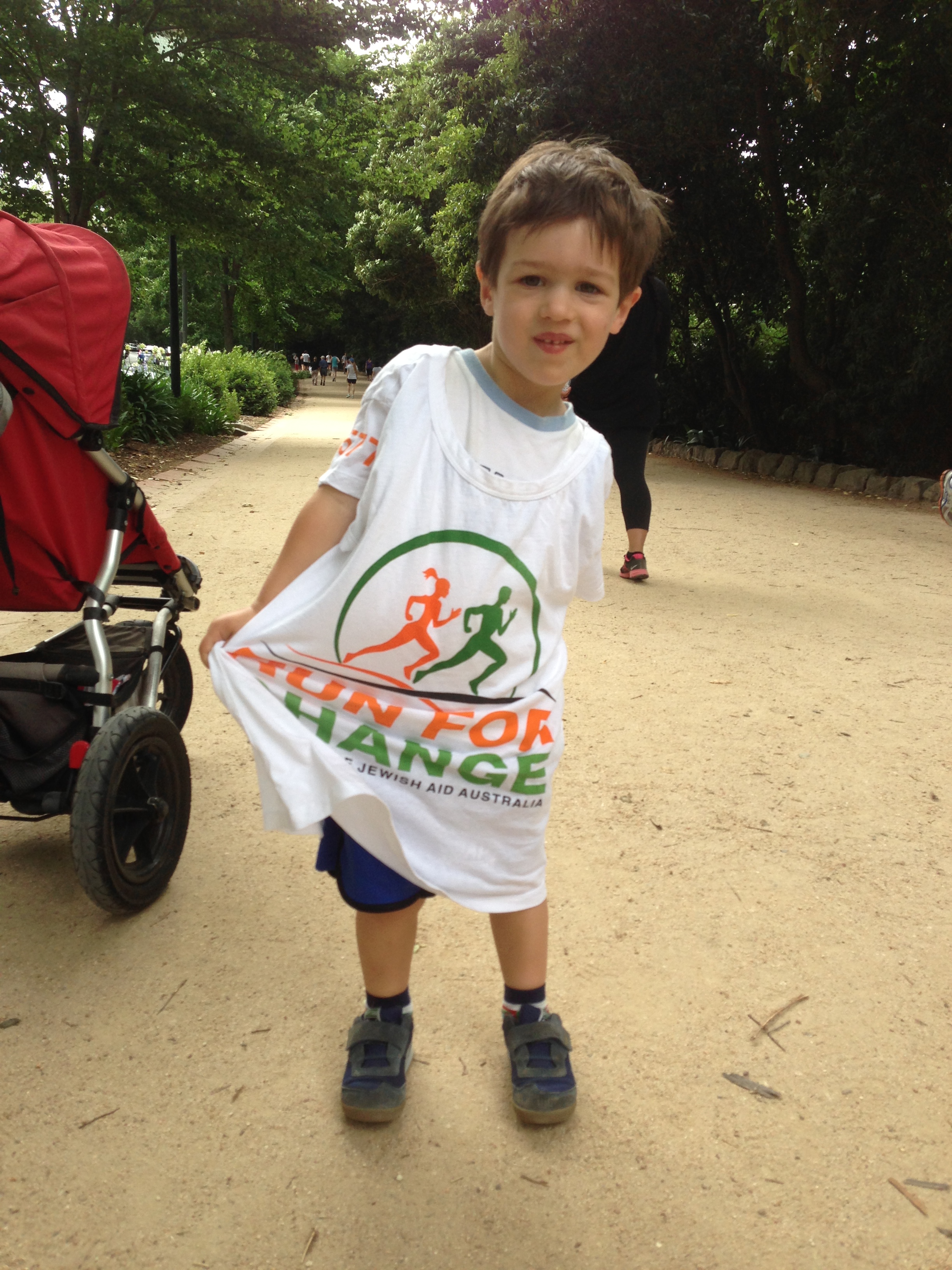
It was the running of the Jews. Not in Khazakstan but at Melbourne’stan.

Historically, you only saw a bunch of Jews running if there was a fire or a pogrom. But yesterday hundreds of Jews were afoot, an infrequent event since the original Fun Run across the Red Sea. (On that occasion all the Israelites crossed the line. The Egyptians failed to finish.)

We Jews were not alone at the Tan: joining us were Africans from the Horn and from Mandela country; a pair of Iranians, a smiling Swiss, sundry Catholic Australians; the odd Chinese, a couple of Argentines and their Australian born progeny. And my wife and my not-very-old oldest grandchild.

If a kilometre is one thousand metres and the average human pace is one metre, and the circumference of the ‘Tan’ is 3.76 kilometres, then a single lap represents 3760 paces. Yesterday saw 376000 paces in the sisterhood of man.

My team, “Queue Jumpers”, named in honour of those disgraceful individuals who do not go through the correct channels, raised about 1800 dollars. The entire event raised in excess of $20,000, to be spent in two struggling Aboriginal communities in far north NSW and in a Community Centre for queue jumpers from Darfur.

Over coffee, before the event Akbar the Persian storyteller told a story. Akbar has elevated my runs over 25 years – ‘one quarter of a century’, he observes – with folktales from his homeland. Yesterday’s story: The revolution was coming in Iran. We knew people, Bahai, whose houses were burnt by militants. A friend said to us – do not stay in your house. It is not safe. They will burn your house next.

We decided to leave. We went to a cousin’s house. But another warned – ‘this house will be burned tonight.’

We had to leave. We all ran from the house but a man with a big automatic weapon stood outside. He said: ‘Do not go. They will burn this house only when my body is dead.’

That man was Savak. Secret Police. But we did not wait. Instead we ran. We ran to the house of the parents of this young woman…

Akbar here indicated his niece, Paloma. It turns out that Paloma -‘dove’ in Spanish – speaks Spanish fluently. This dove was born in Bristol. She takes up the story: My father was in America. He bought a red Ford Mustang. I sat in the back; there were only two doors. He brought the Ford Mustang to Bristol and he drove us, Mother and me and Father, to France, then all across Europe, all the way to Iran. I was four when we left Bristol, but I remember the red car, I remember I sat in the back.

Akbar takes up the story: We ran to the house of Paloma’s father and mother, all of us – myself, my parents and my cousin. Paloma’s family took us in and we stayed. We stayed in their house for nine months and we were safe.

And then we came to Australia.

Akbar smiled. He said it was time for a real Persian story. He told a folk story, of Mullah Nasruddin. Akbar’s story took us to a different age, a different place. We sat in the sunshine and watched and listened to the genial teller of tales as he smiled and talked.

Then we arose and ran, we Aussies, we Jews, we Muslims; we Africans and Catholics; we old and wrinkled ones, we new and sprightly ones; we arose and ran 376,000 footsteps in the Sisterhood of Man.


Let Me Tell You a Story

It’s about the Melbourne Marathon.

I know, I know, there’s nothing more boring to a non-runner than the idea of someone putting one leg in front of another about 42,000 times. And, yes, I did try to your patience with a little marathon piece a few days ago. Yet this is a nice story…

Last Sunday I ran the Melbourne Marathon. The weather forecast was for a horrible day – wild winds, light rain, thunder, more wind, hail. Hail!

We lined up for the start at 0645 and the weather was overcast, still, mild. Perfect for running. The forecaster lied. An attractive young woman approached me: Hello Howard. Remember me? You used to come to my shop in the city.

I don’t really remember: Yes, of course I remember! But I’ve forgotten your name…

Jeanette. Beaming, dimples in full flight: You helped me have a baby.

What a thought.

Jeanette continues: One day at the shop you asked me if I wanted kids. If I did I should not waste time. Thirty five was better than forty, you said, and twenty five was better still. I was thirty five. I did want children, we were trying, not succeeding. You sent me to the right people. We have a child, one only. IVF failed when we wanted a second. He’s wonderful. He’s Lucca, he’s six now. I work closer to home, Closer to Lucca.

I do remember now. I remember Jeanette serving in her shop, that smile, those dimples flashing above her burgeoning tummy.

We wished each other luck for the marathon and lost each other among the thousands.

The promised rain started at 25 kilometres, the slightest fall, a runners boon, like the quality of mercy ‘that droppeth as the gentle rain from heaven upon the place beneath’Still no wind. Blessed weather.

By 35 kilometres the quality of mercy had been eclipsed. Heavy rain, rising winds attacked slowing legs, cooling bodies. Brutal conditions for the final, always testing phase of a marathon. If self pity is the sincerest of human emotions, then I was desperately sincere at the 35 km mark.

Running a little ahead of me in St Kilda Road a young couple, both tall, slim, both wearing black, caught my attention. The young man leaned down and across and kissed the woman slowly, a tender kiss, gentle rather than passionate.

I slowed and the two disappeared ahead of me.

One kilometre later I came upon the young blackshirts again. They were walking, the man’s arm around the woman’s shoulders. As I drew alongside I saw she was weeping. Are you hurt?

A shake of her head.

Can I help you? Is it medical?

The man answered: No… Thanks for offering. She’ll be okay.

I jogged on, pondering. The marathon injures your body and your spirit. Tired, deeply deeply tired, cold, unable now to run, perhaps this girl is simply sad.

My own spirit had suffered bruising as I saw my target of four hours disappear, then my fall-back aim of 4.20. Even 4.30 was beyond my moral strength as I allowed the pacemaker lady to glide ahead. One resolution – to finish. Another – not to chase, not to torment myself.

The wind redoubled its force, the rain soaked us, we lifted slow feet in their Nikes, their Asics, their New Balances, which were once lightweight running shoes, now receptacles of water. We moved forward towards a Finish that we could not see.

An hour later? An age unmeasured, the MCG at hand, the Finish somewhere inside and a small lady just ahead of me carried her little flag that identified her as the 4.30 hours pacemaker.

Wise resolutions forgotten, I raised my knees, I swung my arms, I lifted my head, I raced. Through a tunnel, onto the MCG, following the armies in their soaked flags, I raced. Huge breaths sped my new legs. Around a bend, leaning into the curve, chasing my wild legs, I raced. And crossed the line, gasped, managed not to vomit and looked at the digits on the clock that said: four hours, thirty minutes and 18 seconds.

It was a long and shivering walk of four kilometres to my car. Enjoying the sincerest self pity, I was disturbed by a young lady on my right, who exclaimed: Dr Goldenberg! Do you remember me?

The same lie: Yes, of course.

Remember I came to you when I couldn’t get pregnant? You sent me to Dr Raphael and – look in the pusher – there’s Chloe!

Chloe, her round face pink and warm inside her rain spattered shelter, slept peacefully. I thought of my newest granddaughter, Ruby. Same age, same round face.

Yes, I do remember.

Marathon Thoughts, 13.10.13

Today I was to run the Melbourne Marathon, my 15th(?) Melbourne and my 43rd marathon altogether. Last year I injured a calf (leg, not poddy) and had to pull out at seven kilometres. I had never failed to finish before. It was a painful moral injury; the calf recovered but the moral wound did not. Today was to be my chance at redemption.

Forty three is a lot of marathons. Enough to learn quite a lot. I’ll list what I know for you. You never know when you might used them.

Running a marathon is hard. There are 42.195 kilometres to complete, equating to about forty two thousand steps. My car gets tired after 42.195 kilometres. The tough news is that every one of the 42,000 steps needs to be run.

Double knot your running shoes. Then they won’t come undone.

Apply Vaseline to toes, groins, armpits, scrota and nipples. Especially nipples. (Runner’s Nipple is one of the more dramatic running injuries. The nipples haemorrhage spectacularly. Why? Well, the nipple is an erectile little gadget. As you run, your skin heats up. Sweating follows, then evaporation of the sweat. Evaporation cools the skin, the nipple leaps to instant and enduring attention and the salty residue of the sweat on the nipple rubs against fabric. Forty two thousand wobbles of a breast result in a nasty dermatitis. Bleeding follows. Pain attends.)

Apply a curved line of Vaseline across your forehead, thus creating an eave, along which sweat can run to your temples. This spares your eyes hours of sweat sting.

Don’t run a marathon.

Having disregarded the last piece of advice, you’ll understand its compelling good sense. Corollary: if you run more than one marathon you are a person who persists non-sensible behaviour. Spouses and families will point this out to you.

Running a marathon damages your body. Within days or a week or two, your body will usually recover (The exception is the case where you die running the marathon, as happened to Pheidipides of old.) Do not imagine you are doing this for your health.

Running a marathon requires a lot of training. Racing a marathon – quite distinct from merely running to complete the event – requires a shit load (that is the technical expression) of training. Spouses (see above) do not generally like this. Sometimes you come back from a marathon to find the spouse has gone.

Running a marathon requires courage.

The marathon humbles everyone who attempts it.

The marathon runner discovers something about herhimself every time shehe runs it.

The marathon is an extreme test. Its extremity evokes extremes of feeling. Tears can flow.

The marathon runner who is forced to pull out due to injury within a few kms from the Finish is a tragic sight. In horse racing a steed that is injured can be shot on the track. A quick gunshot is an expedient that would be welcomed by both the injured party and those runners who witness that colossal grief.

(Death by gunshot is readily available in the USA.)

Plan to have a poo before you run. The runner has consumed megabites of carbs the previous day and all things come to pass. The alternative to evacuation prior to the run is to do so during. This wastes valued time. Unless, like the woman winner at Boston about twelve years ago, and like De Castella at Rotterdam three decades ago, you don’t stop when it starts and you go with the flow. In the case of the brave German girl, diarrhoea and untimely menstruation coincided. Unlike the runner herself, it was not pretty.

Although it must occur to about one in five females on a given race day I have no advice to offer regarding prudent management of marathon menstruation.

Trim your toenails a week before the event. Otherwise the nail might leave your toe somewhere between Start and Finish.

That is the totality of the wisdom I have to impart.

I did run today, I did finish – in brutal conditions – and I am requited. A little bit proud, self-amazed, a bit sore (I’ll be at my sorest the day after tomorrow), weary and happy. And very, very thankful.

Virgin from Christmas Island to the Mainland

A man walks into my consulting room with a bouncing limp. He is tall and upright. He bows slightly and shakes my hand. The familiar courtesies.

I greet him: Salaam Aleikhum.

He responds: Aleikhum Salaam.

We exchange names. His name is Ahmed. He says: “My foot is painful. Please excuse me. I am afraid I must remove my shoe.”

His problem is visible through an opening in his sandal: the left great toe is infected. The flesh of the nail bed is hot and red, a crescent of swollen skin surrounding a sunken island of nail. The skin is shiny, stretched to bursting. A promising eyelet of pus peeps from beneath a corner of the cuticle.

The infected nail bed is about to burst in a flow of laudable pus. The pus will stink, Ahmed will feel better and so will I. Finally, a patient telling me a straightforward story. Finally a patient I can cure.

I treat the infection, dress the toe and ask Ahmed to return tomorrow to renew his dressing.

“I cannot come tomorrow.” His manner is politely regretful. “I will leave here tonight.” He speaks softly, practicality competing with swelling happiness: “I have my visa.”

Ahmed’s smile is a field of waving daffodils.

As it happens I will fly out tonight too. After three weeks of seeing patients here, Ahmed is the only one I meet to win a visa. The remainder reside in trailer parks of hope and despair.

Continue reading

Overdue Recognition

The time has come

To say fair’s fair

The time has come

To pay your share…

Taking my cue from the Oils, I have decided to honour my pledge to donors/investors in Pheidipides’ Foolproof Investment Opportunity.

In case this seems obscure to any newer reader, I refer you to the original post, reprinted at the foot of this.

In March I wrote a light-hearted and whimsical (not to mention extremely witty) invitation to contribute to a truly obscure charity in a small town in Massachusetts. My motive was to raise $2000-$3000, which would buy me a place in the field of the Boston Marathon.

Well, you bought me that place. I ran in Boston on 15 April. And I visited the Michael Lisnow Respite Centre before the race. It is hard to know which of the two experiences left the greater impression upon me. (I’ll remind you of how I felt about the race, by republishing Patriots Day 2013 on this blog – a piece I wrote a few hours afterward.)

You, my readers, my investors, my benefactors, raised $5202 for that respite centre. I walked its halls and I read its walls; I met its workers and its clients and its founders. I met people who cannot run, people who will remain forever children; and parents who will age and die before they cease to care for them. And to my surprise and relief none of this was harrowing. I was ambushed by the circumambient joy.

At the finish line a different ambush waited. And in all that horror, all that profound and unreadable human blackness, a kinder light was seen . Somehow I left Boston thinking better of humanity. Your money brought me close to death and into that light.

A few hours after the race I arrived at my niece’s home in Boston. Soon after there was a knock at the front door: a five year old neighbour heard people had been hurt in the race. She wanted to help a runner – any runner. She brought me a plastic cup of water.

No-one makes jokes at airports nowadays. And America’s Homeland Security guys are deadly serious jokers. Anticipating a grimmer grimness at Logan Airport, I allowed extra hours for my departure. But the security guys showed unwonted tenderness, gentled by the bastardry of the previous day.

***
So many of my readers gave so much. If you are one of those who donated fifty dollars or more, I need your snailmail address and a phone number so I can fulfill my promise to send you a copy of My Father’s Compass. Please reply to this post and I’ll contact you to get your address.

One anonymous reader donated $750.00. I promised a signed and inscribed copy of my novel, “Carrots and Jaffas” to the biggest donor. The novel is with Hybrid Publishers as I write, being tamed, tapered, disciplined and beautified into shape. The biggest donor must wait until early 2014 for that signed copy. (A second munificent reader sent three hundred dollars: Jan, you’ll receive a copy of C and J too. Contact details please.)

Earlier Post (5 March 2013):

A unique offer

I write to invite the reader to participate in a remarkable opportunity. It all starts in the village of Hopkinton, 26 miles from Copley Square in Boston, Massachusetts. It is the Boston Marathon, which I will run on 15 April, 2013. My purpose – apart from winning the race and driving the Mercedes home to Australia – is to raise funds for the Michael Lisnow Respite Centre. The who?.

The Michael Lisnow Centre is, briefly put, a place of joy. As you will see.

All told I have run the Boston Marathon three times and I have never won: a clear case of home town favouritism.

I am coming out of retirement to give it another crack this year because the Michael Lisnow Respite Centre has captured my cold old heart. Haven’t heard of them? Neither had I until someone sent me this short short youtube. Have a look at it: http://www.youtube.com/hopkintonrespitetv

Take a peek at “In 2012”

This program, both modest and magnificent, is located in little Hopkinton, the world’s most famous village on this one day of the year. On the remaining 364 days, in perfect obscurity, the miracles continue.

The deal is this: I do the running, you make the cash investment. I am instructed to raise US$5000.00 by exploiting my friends.

Now I expect many of you are reaching for cheque books and credit cards as you read this, wishing to provide the entire $5000.00 yourselves. I invite everyone who feels a pang of delight at the youtube above to make a modest investment.

Although I lack a Securities Advisor License, I believe I am qualified to comment on this opportunity. This is a BLACK CHIP INVESTMENT, something unique, a guaranteed, dead set, one hundred percent secure opportunity. Unlike other funds, shares, projects and speculations, the fate of your contribution is beyond doubt: you will never see a cent of your money again. Neither will the Tax Office get a share of the funds. Nor will inflation chew away at them.

Every penny goes for the care of these kids. Donors in Australia will not receive a tax deduction in return for their goodness. Finally, I undertake to provide donors with an Investment Report after my return from Boston.

All you need to do to say goodbye to your money is to sponsor me in the Boston Marathon.

Time is short: the marathon will be run – as always – on Patriots Day, falling this year on15 April, 2013. Please send your donations directly through this link– http://www.razoo.com/Pheidipides-Foolproof-Investment-Opportunity

It is just possible that I not win the Mercedes, but together we will certainly improve the life of some lovely children and adults.

Help me to help them, please.

Sincerely

Howard (Pheidipides) Goldenberg

Patriots Day 2013

The Boston Marathon is the oldest and most celebrated of the mass marathons. You need to qualify. Twice I qualified and ran. in 2005 I ran again, this time as fundraising runner. I never won the race: hometown decisions, I guess.

Today’s Boston was to be my fourth. I was running as a fundraiser, this time for the Michael Lisnow Respite Centre. This morning I visited their HQ in Hopkinton, near the starting line. I met people who face their colossally difficult lives with genuine joy. I met the fundraisers who punctuate their serious marathon training by devoting themselves for months to help fund this small enterprise.

Why am I going on at this length about these small matters in the face of the bombings?

You need to be in Boston on Patriots Day to appreciate the celebration that is the Marathon. A city of less than one million comes to a stop; people take their chairs, their picnic rugs, the treats they will give to the runners; they line the 26.2 miles and stay all day, cheering on every runner; they hold banners – everything from “You are all Kenyans” to “Kiss me, I’m flexible”.

Picture Melbourne on Cup Day or Grand Final day without the booze.

Boston is high on its marathon and the runners. Patriots Day is the time to enjoy the embrace of the people of Boston.

If you have the good fortune to be a charity runner, you run at the tail of the field, feeling that embrace, the surges of love for the people – usually young – who are supporting local causes. Often the fundrunner commemorates one lost or saved or suffering the disease she runs for.

One young woman survived melanoma; another is in remission from her leukaemia. I have close relatives saved from those diseases. So, apparently, do hundreds in the crowd who roar their gratitude.

One, a spoonerist, runs with the words: Cuck Fancer. The crowd echo her sentiment.

Someone else came to the Marathon today with a different purpose than to celebrate. Someone whose malignity exceeds his knowledge: his bombs exploded near the finish around the four-hour mark; in an elite marathon like this, the ‘bulge’ – the greatest concentration of finishers – occurs 30 to 60 minutes earlier. The terrible toll might have been much heavier.

I plodded to the 22 mile mark, when a spectator offered me a slice of orange. His kindly young face looked troubled. “There have been explosions near the finish line. The marathon has been temporarily suspended.”

Naively I ran on. Perhaps they’d resume the event.

A mile further on, I was one of very few still running. Police and runners were mingling on the course, faces troubled. Hands held mobiles, sending text messages; local phone coverage was out. Some wept wrenchingly, their features distorted in grief or shock or anxiety for others ahead on the course. Many had relatives waiting near the Line.

My progress from mile 22 to 25 was slow. The crowds fell quiet. Overhead, helicopters gathered and clattered. Police vehicles racing everywhere, ambulances, sirens shrieking, tore between barriers as the crowds melted out of their path. Not for the first time, the matter of placing one foot in front of another felt slight. Here was immediate danger and evident bloodshed.

Police turned back those of us who were running into danger. I needed to contact family – in Boston, in New York, in Israel, in Australia (where I had bled my friends to donate to the Respite Centre). I had no phone. Strangers handed me theirs, refusing my offers to pay. I asked a teenager for directions to the Citgo sign, a local landmark, where my relatives would collect me; the teen insisted on escorting me the mile distance to make sure I found it.

As I waited, strangers seeing this stranded runner, stopped to offer help. One bloke, himself a (non-marathon) runner, wanted to give me his jacket so I wouldn’t get cold. Passers by touched me, or took my hand to shake. One stopped, gazed at me, shaking his head. He said, “I am sorry.”

Boston silenced, in shock, in grief. Its citizens reaching out to each other in spontaneous solidarity,as we see repeatedly in Israel following such atrocities. More than that, people felt implicated in a wrong, embarrassed: their guests had been hurt, frightened, frustrated. They turn their goodness upon me and I feel like crying.

A terrible beauty born.