From the Heart 2

Silent Companion


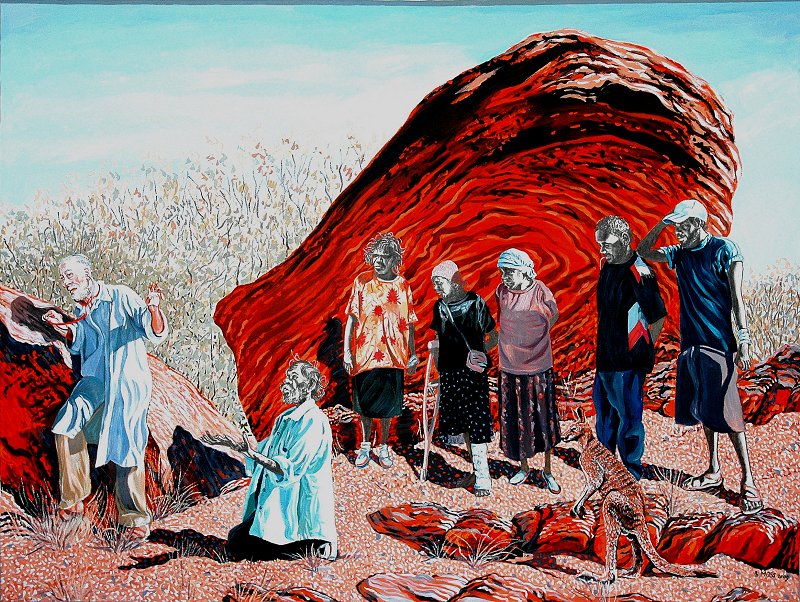
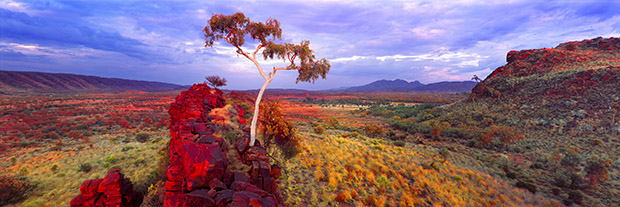
I approach as the sun withdraws. There are only two of us, the Rock and me. I glance upwards: gorgeous parabolas of stone, ferrous waterways etched in rust. One convex curve of curtained rock is fretted and tinted, purnu, an Aboriginal wood carving.


Around me all is still. I feel as I did as a child when I intruded into my grandparents’ bedroom. No-one found me, but the stillness nearly undid me.


I park the car, hide my keys, and set out, running clockwise. The rock is my companion, watching me, looking down from steeps and heights, not austerely, not unkindly nor yet tenderly. Keeping me in sight, keeping an eye on me.


Everywhere I go on earth I run; I feel the place then, I connect with its earth. I breathe its air. Well, no, not quite everywhere: not in sacred places – not on the Temple Mount, not at the Shrine of Remembrance.


The first time I came to Uluru, I drove here with my Dad. I parked and leaped from the car, crying, See you soon, Dad. Just going for a run to the top.

On the way up I discovered no-one ‘just runs to the top’. Too high, too steep, too tough.

On the way down I encountered an old old man, torturously creeping, pulling himself upward hand over hand by the safety chain. The old man looked up and our eyes met. He smiled. I said Hello Dad.

Preposterous ambitions. Absurd.

Only after descending carefully to the car park did we find the Notice: Anangu prefer that you do not climb the Rock.


Over the twenty years since, I have come here and run, again and again, always to find myself surrounded by crowds drawn to the celebrity rock, the “icon”. The thought grew in me that I was running around a cliché.

But this time I am alone and – beyond doubting – the great silent rock is real, sanctity manifest. 

Only self doubt now: Is this alright? Do I offend?

I run alone but doubt keeps pace: What are you doing here?

My day’s work done, my afternoon prayer said, I come at sunset, the day’s dying moment, its moment of truth. That fragment of suspended time when a great peace settles upon the wild places. The earth exhales, blows out the light. And waits for evening.


Your complexion, pitted and scarred. What was your youth, your birth? Those gouges – what violence tore out such chunks? The battered old face, past vanity, gazes down, mute. You don’t say nothing/You must know something…


Ahead and above, a gracile arc of stone, seventy metres high, five metres wide, a bow stretched by the Archer a small way from the mother rock, admits a beam of last light from the vanishing sun. It is a benison, a gift to one alone, an old plodding jogger, come to pay respect.


Around the first bend now, the late sunlight dims behind me, I run deeper into silence. The road, the paved human arteriole that links me to my comfortable world, is long behind. No-one who passes along that road will dream I might be here. Alone, with the great rock. 


The walls of stone, fawn in late sunlight, chocolate as I set out, darken, deepen, solidify. The Rock, too dense now for colour, is pure form. Bulky, tremendous, powerful beyond my thought or racing fear, my companion is sheer presence. And I, grateful ant, scurry about its foot.


I can barely see the path at my feet. The stars are a carpet of light, unspeakably ancient. The sliver of new moon, a lovely silvery skullcap that sheds no light. This new moon marks the start of the month of Tammuz and the season of lamentation for Jewish people. I look at the great wall on my right: What sorrows do you weep for?


Onward, racing for heat to fight the settling chill, I hear my hard breathing, louder than my soft footfall. Onward, beyond fear of the dark – that one element left to me from distant childhood – I run. I run because I can, I run now because I must; to stop invites dangerous cooling. And were I to stop I’d hear the bush, its frightening noises.

I run, hoping not to stumble and fall and fracture a weight-bearing bone. One fall, one small break, a night alone, a body frozen and still, to be found in the morning by innocent early tourist or earlier, by carrion-feeding raptor.


The stars show me my way, I run on and I do not fall.


Shapes loom at my shoulder on my pathless left side. Unseen, the remainder of the planet keeps pace with me in darkness.


I lose the path and run blindly on. I stumble at speed, my thoughts rush before me, the sloping earth, ragged here and jagged, rushes upwards at me, my skin shrinks in foreknowledge of the tearing, the scraping. But my downhill-speeding legs keep pounding, one past its brother, now brother past the other, and legs connect to feet that hold. I do not crash. I breathe my thanks, and I slow, get my bearings and trot chastened limbs towards mother rock.

Yes, this is a mother place, sacred for women, the Mutitjulu Pool, ever green and cool, in all heat and glare. 


I look up. The great bowl above me is crowded with stars. One patch alone of unlight, upon my right. Casserole shaped mammoth, you alone, you starless immensity, you must be Uluru.

You kept me company. You brought me home.


Traralgon Marathon Report

Given the event took place over a week ago this report is pretty tardy. The truth is I have nothing to report.
If you’d asked me for my report thirty-nine years ago, I’d have leaped into print. Likewise had you enquired in June 1990, I’d have been bursting with news. In 2000 I reported on my run with Fidel. Even though he rode much of the way in my car, Fidel was awarded a Finisher’s medal as First Dog across the line. And in 2007 there was news of a different order.

But in 2017 I have nothing to report.

The Traralgon Marathon is Australia’s senior event. This year marks its fiftieth running. As well as being our first marathon, Traralgon is Victoria’s Country Marathon Championship. All in all a pretty lustrous affair. Competing under his nomme des jambs of Pheidipides, Howard Goldenberg ran his maiden marathon at Traralgon thirty-nine years ago. That year 181 runners started and 141 finished. I still have the official printout of the results. At the foot of the second of two roneoed sheets of paper (this report antedated the internet), you’d read: In 141st place, Pheidipides Goldenberg; time: 4 hours, 31 minutes, 31 seconds.

Every time I run a marathon I write one. That simple passage through time and space, so simple, so elemental, you mightn’t credit it worthy of remark. But every running feels remarkable to the runner. In the marathon the runner encounters the sole self, discovering some things that are unwelcome and others that make the runner feel a little proud. In a marathon, as Zatopek remarked, we all die a little. The event is charged with significance for this runner because the essentially solitary passage through time and space always involves encounters with others. It is the comradeship, the fellow feeling, the respect that elevate our experience. In that sense the marathon is a metaphor for our lives.

A watcher of the Barcelona Olympic Marathon might have caught images of the leading bunch of five as they passed their drink stop with seven kilometres to go. They had, running in intense humidity and heat, slowly outpaced a score of household names from Kenya and Tanzania and Korea and Japan and Australia. These five were the bravest of the brave on that particular day. One of these five, one only, would become immortal. Four of the five grabbed their special drinks at the 35 KM mark. The fifth grabbed and missed. And ran on, turning back being out of the question. The four drank and ran and drank again. One of those four passed his unfinished drink to the fifth. I do not recall whether the drink-giver won the event – I fancy he did not – but in that moment he joined the Immortals. In such small moments we see the glory of the marathon.
All this reads a bit portentously. Most running – and all of mine – is more comedic or shambolic than deep. In the field of my third Traralgon I sighted at the Start the esteemed and beloved Cliff Young, Australia’s most famous potato farmer, a previous winner of the Westfield Sydney to Melbourne Ultramarathon. Cliffy used to go on his training runs wearing his hobnail work boots. If he needed a haircut he’d trot the thirty kilometres from his farm to Colac, then run back home again. That day in Traralgon I wondered if I’d manage to get close to him. Around the three KM mark my legs became over-excited and accelerated and I hauled him in. Running a couple of paces behind Cliff I admired the light lacework of his tracksuit material. I drew closer. The lacework was in fact the work of a legion of hungry moths. Through the mothholes I could see and admire the pale skin of those spindly old legs.
‘Old men forget: yet all shall be forgot/But he’ll remember with advantages/What feats he did that day.’ Thus Shakespeare. It was in Traralgon that I ran my best marathon time. In those better years I’d usually finish in three and a half hours – not flash but respectable. Around 1990, everything went well. By the twenty km mark the field was well strung out, each runner alone with his thoughts and his hopes and his faltering strength. Somehow on this day only my shoelace faltered. I heard a slap, slap, slap – one slap at every second stride. I looked down; my right shoelace had untied itself. I stopped, resting my foot on the lower timber of a little footbridge. I tied the lace and cursed myself for the loss rhythm. 

Where strength falters it is rhythm that lulls the unthinking legs with metre that beguiles like music or poetry. I straightened and placed one foot forward, then the second, now the first, now the second. And here, quickly, rhythm returned. I ran on and on. I passed a browsing cow. She looked up and gazed at me, ruminating. I passed a lonely church. I counted cars parked on the verge, calculating numbers of worshippers.


Approaching Traralgon on the return loop I saw the smoking chimneys of the power station blackening the winter blue with coal smoke. Crossing the river I was welcomed by a pelican gliding overhead in his landing approach. I blessed the bird of good augury. After that I think I thought of nothing. At forty kilometres I felt weary and I cursed the distance remaining. I slowed, realising I was about to ruin everything. I never recovered my pace. I cursed my feeble will.

A short time later that felt like a long time I crossed the Line. My time of three hours and fifteen minutes and thirteen seconds was to be my best ever.

Four weeks before this year’s Traralgon I ran a brisk 6.2 kilometres on unforgiving concrete. I thrashed along, full of surprised pleasure in my pace. Later, when I checked the elapsed time (35 minutes) I was reminded how, nowadays, mediocrity is beyond me. After the encounter with the concrete my right knee started to hurt. The after-pain of running always reminds me of the achievement that brought it about. Pain always passes but while it lasts I smile with small pride.

In 2007 my elder brother Dennis, always thirsty for my company, offered to come along with me to Traralgon. With him Dennis brought a hitch-hiker, his flatmate and devoted companion, Sahara the Hound. Sahara was a dog I never managed to like. In this I came closer than most. For Sahara was a raucous, snapping, yelping creature, anti-social, sociopathic in fact. Sahara yapped and snarled her way into the rear of the car, lay down on the seat, growled a bit and fell into silence, then into sleep. For the duration of the two-hour drive Dennis and I spoke as brothers do, of nothing and of everything. We arrived, I registered and showed Dennis the Finish Line. ‘I estimate I’ll get here in four to four-and–half hours,’ I told him. My estimate was incorrect; I crossed the line in 3 hours, 45 minutes, beating the only other sixty-plus-year old male by a handy margin. In disbelief I checked and rechecked my time.

As ever, Dennis swelled with pride at the achievement of his younger brother. Here I was, 2007 Traralgon and Victorian Country Marathon champion (male, sixty-plus). I duly added the achievement to my Resume.

During the drive home, Sahara slept again. Again Dennis and I chatted. Dennis told me of a question he’d been mulling: ‘ I’ve decided: I’m going to have the operation, Doff. I’ll lose weight and I’ll be able to exercise. I’ll have more energy because I won’t have sleep apnoea anymore. The doctor says I’ll be cured of my diabetes.’ I misgave but said nothing. ‘Doff, I know you’re super-cautious. I’m the opposite. I’ll have the operation and I’ll get my life back!’ I hoped he would. Dennis went on: he’d complete his MBA in a month or so, he’d graduate then he’d have the surgery. After recovering from the operation Dennis said he’d revive his business.

Two months later Dennis graduated at the head of his class, with High Distinction. In September he underwent bariatric surgery. Fourteen days later he died of complications. Every June the Traralgon Marathon comes around and I remember.

In 2017 my training was the best for years. I entered, paid, arranged to travel with a support team comprised of a friend and his 11-year-old son. We booked overnight accommodation in Traralgon and I saw my physio about the oddly persistent knee ache. My physio, a gifted and devoted torturer, rubbed and pressed and stretched me. She prescribed exercises, with which – to our mutual surprise – I complied. And my knee hurt more. I had an x-ray that showed a pristine joint and a panel of four physios gathered in conclave before the light-box to advise me. I rested the knee as they suggested. I took the dicey non-steroidal anti-inflammatory medication that threatened my remaining kidney function. My physio taped my knee. I rested further and lost fitness. Two days before race day I could not walk to the toilet without pain. We cancelled the accommodation. The good people at Traralgon Harriers gave me a rain check to 2018.   

In 2017 I have nothing to report.


Footnote (kneenote, really): my knee feels better every day.

Men, Today we Die a Little

Emil Zatopek spoke those words to his rivals at the starting line of the Olympic Marathon, in Melbourne in 1956. Throughout his career Zatopek regarded every other runner as a comrade. He talked to everyone everywhere he went. He befriended everyone, including his opponents, chatting with them as they raced. In this respect Emil and I are brothers.

On that marathon day, a Saturday in early December 1956, I was nearly twelve. I had worshipped Zatopek for some time. Later generations do not recognise that name but aficionados – among them Australia’s Ron Clark – remember Emil Zatopek as the greatest Olympic distance runner of all. (What? You don’t know who Ron Clark was?) The marathon course took runners from the stadium, out along Dandenong Road to Dandenong, where they turned for the run back to the MCG. Standing with my mother at the foot of my street in suburban Oakleigh, I picked out Zatopek as he approached, short, balding, a ball of muscular effort. He was not among the first three or so. I ran alongside my hero, racing him from the nature strip. I beat Zatopek over one hundred metres then left him to his devices. Long past his best, injured, unwell, he completed the marathon, finishing in sixth place. 

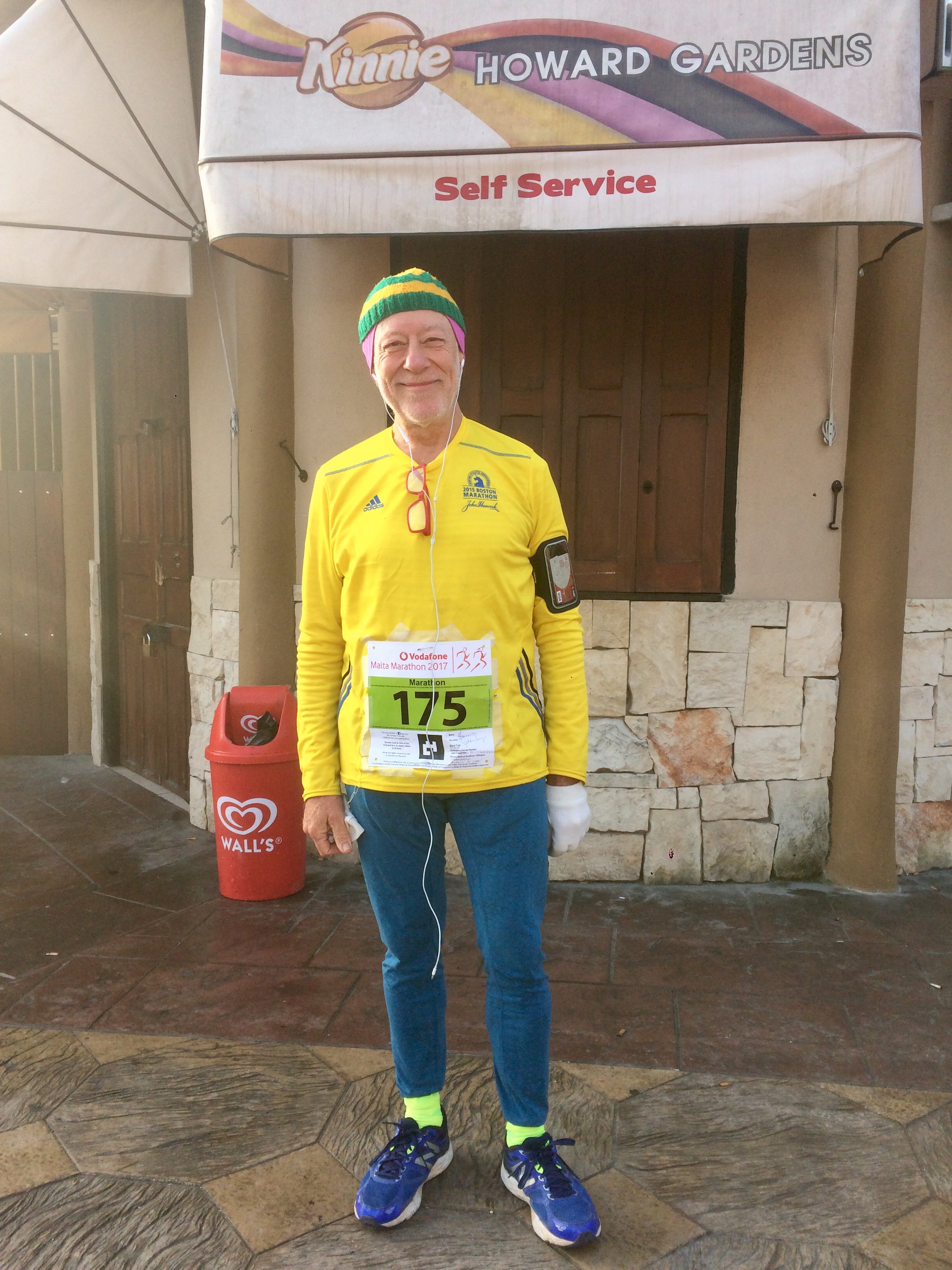
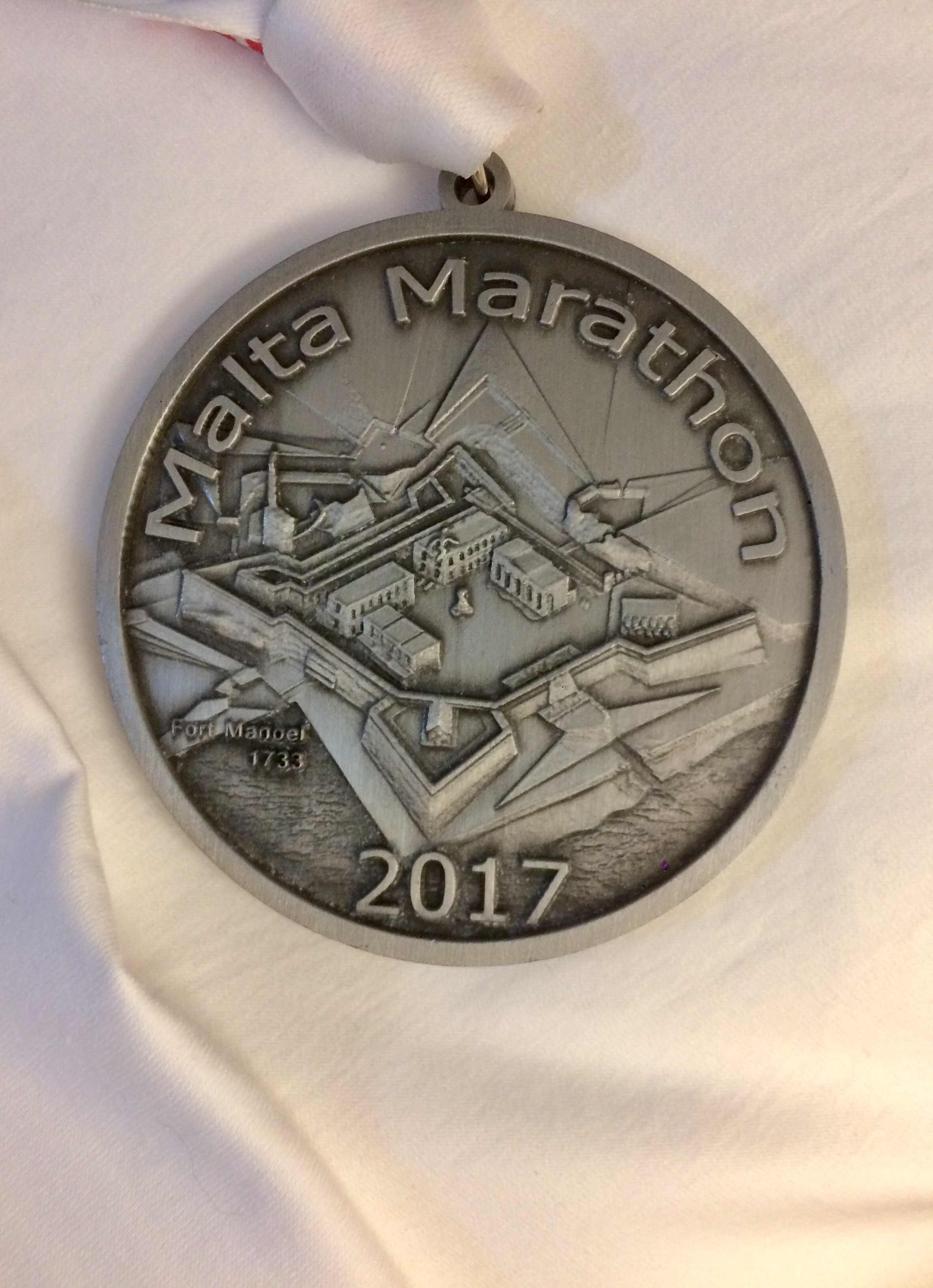
Sixty years later, in Malta, I was prepared to die a little. Malta was hilly, the roads uneven and hard, the weather brutally clement. Add to that my very late decision to run, and my token training, and I deserved to die more than a little.

I set my alarm for 0445 hours. I booked my cab for 0545. I lay down and sweet sleep enfolded me. My alarm never rang; sleep abruptly forsook me at 0300, leaving me to wrestle with a now hostile pillow and futility. At 0330 I gave up, got up and switched off the redundant alarm. I contemplated the coming day sourly. If you run a marathon with a sleep debt the late miles will claim settlement; effectively you fall asleep on your feet, concentration falters and resolution slumbers.

So I did what any drug addict does. I brewed and drank a thunderbolt coffee. Then I recited my dawn prayers. Then I did what any drug cheat does. I drank some more strong coffee. It was a thoughtful cheat who drained that second cup. There would be no more caffeine until after the race. In every other marathon runners deposit their personalized drinks before the start. These drinks are marked with the runner’s name and the relevant kilometer mark. As we approach every 5K mark we know our drinks await us. My drinks always contain Coca Cola, which, so the label informs me, contains only natural ingredients. The natural ingredients that interest me in a marathon are water (check) sugar (double check) and caffeine (check, check, check). Malta has no provision for personalised drinks – water and a sports drink only – and as I was to learn, even these might fail. So there’d be no further euphoriant chemicals to carry me through Zatopek’s valley of the shadow.

Being awake so early I bolted a slug of sustaining bircher muesli I had prepared a couple of days earlier. Over the couple of days my bircher had set into the consistency of drying cement. The cement sat in my gullet, a solid and present companion that would keep me company well after the coffee stopped working.

The cab dropped me at the ferry terminal in Sliema. From there our prepaid buses would take us to the start in Mdina. (Have you been to Mdina? You must. Around the Mediterranean, ‘mdina’ – derived from the semitic word ‘medina’ – signifies the old city. This particular old city sits atop hills, a fortress from its inception, its honeyed stone walls shining in the sun. I have visited and loved and gone mad time and time again in Jerusalem’s old city, a city most particular to me; and yet I have to declare, by narrow aesthetic criteria, I find Malta’s Mdina Jerusalem’s equal. And in both cases, the city’s geography is its history. Situated at strategic geopolitical crossroads, both have been loved, contended, changed hands again and again, and remain beautiful, beloved and blood drenched.)

Before the Marathon


The bus slid through the dying night. Runners from everywhere chatted in the dimness. I heard African accents, Asian, singsong Italian, German, and Eastern European tongues heavy in consonant and intensity. Regional British accents all around, French too, somehow always a whispering music. Four thousand would run, but only 900 of these would run the full 42.195 kilometre event. Of these Maltans are a small proportion. I suspected Pheidipides Goldenberg constituted the entire Australian contingent. 

The race information booklet advised the oldest male in the full marathon was one Giuseppe Balzarini. At 78 this fellow would be seven years my senior. A skeleton in a bright yellow shirt stood suddenly before me. His face of olive skin hung in deep stubbled folds. He had some teeth, not many, but all of them flashed me a brilliant grin. His right forefinger extended, nearly touching my own yellow shirt: You. How many?

Seventy one. My own index finger came into play: Which country?

The face showed incomprehension. His palms opened interrogatively: How much?

I showed the man seven fingers, then a single digit.

Ahh! Huge smile. The man indicated himself: Me…he showed me seven fingers then eight. His teeth were overjoyed. Then the man – the name on his shirt read not Giuseppe but Edouardo – did something unexpected. He extended his right hand once again, and brought it close to my cheek. Once, twice, Edouardo soft palm patted my cheek. An uncle could not have touched me more tenderly. Of course, my own hand rose to Edouardo’s face and did the same. Chest to chest, smile to crooked smile, we were two Zatopeks. We stood for a moment, then he was gone. I hoped I’d see him again.
Naturally we had arrived at the Start an hour before starting time. Naturally we all used the Portapotties. Mildly grotesque and richly comic are these lines of runners waiting to discharge some of the surplus we have so purposefully taken in. We stand or jiggle or dance, all of us declaring publicly a quite private intention. We wait and we wait, none of us knowing in what condition we will find the accommodation. (Beyond silently thanking my obsessive precursor I forbear here to report.)

But I can tell you on emerging I found it pretty cold up there on that hilltop, the wind rising from the Valetta plain, coaxing gooseflesh from my limbs. I found the numbered van corresponding to my race number and deposited my bag of possessions in the back. Then, sneaking around the front I let myself into the driver’s cabin, tried to make myself invisible, and let my flesh thaw.

The race was to start at 0730 hours. At 0710 my solitude was disturbed: You alright?

It was the driver. Yes I was alright, thanks.

Is OK. Next time you ask?

Yes. Next time. Thank you.

At 0720 my bladder had an afterthought. Back at the Portapotty queues a fair-haired runner named Michelle provided entertainment for us latecomers. A stocky young person, Michelle did not look African lean. I doubted she’d last the distance. (I was wrong.) But as a sprinter she was quite good. As soon as a Portapotty door swung open Michelle would race forward, only to find opportunity snatched from her. This open door was for males only, that open door was the same, this other one opened all right – exposing the buttocks of an occupant who wasn’t expecting company. Michelle danced on the spot, whether to warm up or to maintain continence, the effect was to divert us from our private concerns.

At 0725 the Public Address summoned us to the Start. At 0729 and fifty seconds the PA voice said ten seconds to go. Let’s all count down! Nine hundred voices complied. Zero! – cried the nine hundred. Go! – cried the PA. And we did. Tragically the first kilometres downhill from the citadel of Mdina were downhill. Utterly seduced, my legs flew. For the time being my body, cement bircher included, was weightless. Of course I could not catch my breath. And my sanity fled far away, not to be overtaken for twenty kilometres.


What followed in the next five hours will not hold your interest. I recall it all, of course, but wish to forget it. The marathon organisers warned runners the event would conclude at 1300 hours – fully five and a half hours after the start. After that, runners would receive no medal, their finishing times would go unrecorded and unreported. I thought five-and-a-half hours long enough to have a birthday: surely I’d beat the deadline. I had drawn up my plans, dividing the 42.195 kilometres into hopeful ‘quarters’ of 11 kms, 11 kms, 10 and 10.195 kms. I allowed these splits 70, 75, 80 and 90 minutes respectively, totalling five hours and fifteen minutes. A finishing time that would rank with my Personal Blushful Worst.

Of course everything transpired otherwise. Too fast in the first stanza, too undigesting in the second, too beaten up in the legs by Malta’s rocky roadways in the third, too thirsty in the fourth. Thus reads my list of excuses. 

It is true that the shabby mobile kiosk at 28 kms was emblazoned with the sacred words: Coca Cola. But the bewhiskered vendor had no change of my twenty Euro note. He offered me the drink gratis, but I waved his offer away. Even an addict would not rob the poor. It is true too that the water stations at 30 and 35 kilometres ran dry before my arrival at the tail of the field. I felt grumpy for a bit, a new sensation in a marathon. My uncharitable feelings quickly evaporated in the glorious sunshine – unseasonable, given Malta’s weather patterns for late winter. From the five kilometer mark onward I ran bare-chested, bare-bulging-bellied too – not a flattering look but a practical one.

The 30km mark


The final stanza of the course passed through a light industrial estate, a place barren of cheer or cheering crowds. There were none of the uplifting musicians of the first stanza. Thirty-two bands were named in the race brochure. Of these most of the final sixteen were packing up by the time we of the tail reached them. The brochure promised clashing drums, blasting brass, oompahing tubae, and so there were initially. But I could see the matter from the viewpoint of the musicians. By the final kilometres individual runners were spread out, separated by up to 200 metres. A band numbering eight musos might feel a bit absurd playing to one struggling runner.

How different, how soul nourishing was the raven-haired beauty who sang to me at the thirty-seven kilometer mark. (Yes, I appreciate your scepticism here – had it been a veritable Gorgon playing a guitar and singing I’d have felt an uplift. But truly she was beautiful.) The young woman might have been about twenty. Seated alone in a wilderness of concrete, on an ordinary kitchen chair, long black hair falling heavy behind her, guitar on her knee and a mike in front, she gave voice. Sounds issued from her throat that soared upward to the heavens whence they surely came. A moment of joy. When I think of it now – sober, rested, replenished of fluids and foods, and yes – of caffeine, that joy returns. It remains, a treasure to which I can return, long after my week of days in Malta.

38 Kms, read the sign at the roadside. At sea level now, tracing the shoreline of the bay I could not wait for the finish. I shuffled past that sign alone. In the near distance ahead a stocky form and a fall of fair hair told me how wrong I had been in underestimating Michelle. Yet I knew I would overtake her. Surely. Light footsteps behind, a flash of bright yellow far to my left, and this was Edouardo, plowing on, on, looking neither right nor left. I decided I would sneak past Edouardo. I would be the first septuagenarian to cross the line. I moved to the far right of the course, where my rival might not notice my challenge. I drew ahead. Then I looked at my watch – I had 28 minutes for less than four kilometres. I could do that comfortably. Then comfort undid me. I stopped that loathesome running and I walked.

Now Edouardo drew abreast of me, now inching past, he left me behind, a moral ruin. I resumed running, without conviction, without really trying. Michelle receded. Edouardo flowed on. I plodded, I walked, I ran. I lacerated myself with self censure. Around a bend, I looked in vain for the finish. Around another bend, two bright figures, walking in the opposite direction, waved and cheered me on. I recognised the tall woman in her thirties and her male companion, she from Sweden, her husband British. Both wore Finisher’s Medals. I had made their acquaintance at the seven kilometre mark. This was their first marathon, their training had been nugatory. We’d exchanged hoped-for finishing times, we wished each other luck. And now the tyros had shown the veteran how it was done. The encounter lifted my spirits. From that point on – perhaps the 41Km mark – I mainly ran.

Around one more bend, I lacked the courage to look up for the Finish Line. But the crowd noises told me I was close. And the Public Address blaring: and here comes another runner, Ladies and Gentlemen. Cheer him on, help him beat the cut-off time.

I lifted my feet, raised my head, pumped my arms, achieving an ugly sprint. The crowd roared, quite deceived into thinking I had been trying my best. The numbers on the clock astonished me: five hours, 28 minutes. I plunged across the Line.

A banana and a bottle of water materialized in my hands, a foil blanket covered my too hot shoulders, and a medal – the medal – hung heavy from my neck. I shambled forward a hundred metres or so then settled down on a concrete kerb to negotiate nausea. A pair of brown legs approached, stopped within a metre. It was Edouardo. With all my heart I congratulated him. Once again I asked, From what country do you come?

Italia! – and that smile again. We shook hands. The better man had won and I loved him.             

And that was number fifty.
 

Empty, Empty and Desolate the Sea

I can’t see Manny anywhere. I stand and fret in St Kilda Road. The spring gale blows a clatter of discarded plastic drink cups along the great boulevard. The cups fly and land and take flight again, baffling the redshirted volunteers who try to arrest them. In all the great sweep of road it is only the volunteers who run, no others: the marathon field has swept past me as I keep my watch and ward, as I wait and wait for Manny.
 

It is eight thirty-five. The marathon runners have passed, the half-marathoners too. Where is Manny? We’d arranged to meet at seven thirty. When we saw each other a week ago Manny told me he could run only two hundred metres without breathlessness. I was treating him for the respiratory infection that he’s prone to: whether it’s his cancer therapy or the cancer itself or a recurrence of pneumonia, he’s been unable to train. ‘Until the other day’, he says hopefully, ‘I did 10K on the treadmill.’ Then he concedes, ‘I had to walk and jog.’


Last night Manny sent a message: I’m hoping miracles do happen. This will be my thirty-ninth Melbourne Marathon. I am determined to start. I don’t want to embarrass myself. I hope I make it to the five kilometre mark. I’ll meet you there around seven-thirty I hope.


I have been watching since seven-fifteen, searching faces, peering into the throngs for sight of Manny’s familiar features, his labouring body. The road has been full, but empty, empty and desolate. So Manny has been defeated at last. After running thirty-eight successive Melbourne marathons, one of only eight people who have started and completed every one, Manny has admitted defeat. And it is not the event that has defeated him, but his illness. The wind howls in my ears, dust flails my face. I am almost relieved that Manny does not have to run into the gale.


I turn for home then look back over my shoulder. At the extreme of sight two figures are dimly seen. Their bodies are shapes, undefined. They seem to move: are they moving towards me or away? I wait. Yes, two figures, moving slowly, making slow progress in my direction down St Kilda Road. Can this be Manny and another, a support person? I wait my turn to become the next in Manny’s chain of supportive escorts. The figures approach, they gain definition. They move comfortably, they laugh and wave. They are young, female, they are not Manny.


Sombrely I jog back, keeping pace now with some lagging half-marathoners. Sloggers, these, a sub-sub-sub elite, united in dour resolution. These runners have the Manny spirit, the spirit that brought him through and home in the last two full Melbourne Marathons.


Back home I try to call Manny. No luck. I call his devoted son – all his relatives love and cherish him: no answer. I leave an anxious message. Restless, I await news. Day ends without word. I send an email.

Finally the following arrives: With help from my wonderful family I did the impossible and finished the thirty-ninth Melbourne Marathon.

I did the Cliffy Young shuffle and someone was with me all the way to help me along. I’m feeling very sore and tired.

I’m sorry I missed you. Hopefully we can run together next year.

‘Next year’. Two years ago Manny’s cancer doctor warned him against running: You fractured a cancerous rib just by coughing. You might have cancer in any of your bones. You can’t afford to run. But Manny did run. In 2016 with the same warning echoing, he asked his GP what he thought; this GP said, I’ll run at your side. And that was our plan again this year. But I missed him.
I missed him but Manny ran. He shuffled through the spring gales and he completed the full forty-two kilometres, plus the final terrible two hundred metres. And I missed witnessing one of the great athletic feats, one of the triumphs of the spirit over the flesh.


Next year, Manny, next year.


THE MCG STANDS EMPTY, THE SOLE RUNNER, LIKE PHEIDIPIDES OF OLD, ENTERS ALONE

An Easy Run in the Desert

Warning: running a marathon is an endurance event; writing the marathon likewise; and the reader won’t get off lightly either.

Arithmetic calculations: the marathon distance is 42.2 kilometres. That’s a long way. My car gets tired going that far. If my running speed over forty-two kms averages eight minutes a kilometre, the run should take me around 337 minutes – just under five hours and forty minutes.

The event starts at 0630. My plane home from Alice Springs leaves at 1230. It takes 20 minutes to drive from the Finish Line to the airport. Something will have to give.
I write to the President of the Alice Springs Walking and Running Club: will you allow me to start 30 minutes early?
I have run this particular marathon so many times they treat me like some sort of fixture, an ancient site that happens to move. Slowly. The President, good bloke, Collingwood supporter, writes back: shouldn’t be a problem.
Even so it will be tight. So I book a later flight, this one not direct – not ideal for a blistered person, jaded and aromatic in his marathon clothes, and badly in need of a shower.  
Final arithmetic calculation: the earlier start and the later flight home are seven hours and ten minutes apart. Should suffice.

They are predicting rain. In Alice Springs? Absurd! The Weather Prophet on the ABC says it will rain. From her residence deep within my slim phone, Siri agrees. It’s never rained in any of my previous dozen or so marathons here. 
Arriving at the Start at 0515 I present myself to the Race Director to confirm the earlier start. Race Director, pleasant man, youngish, shakes a head full of brilliantined hair: O no, I’m terribly sorry, but that won’t be possible. O no. Duty of care. No Course Marshalls in place at that hour, no drink stations. Not possible, sorry. Duty of care, you understand. I do understand – not a Collingwood supporter. I understand too that care and marathon running are antithetical notions. Hence the Waiver all runners are obliged to sign. That waiver says, I know it’s a long way. I don’t care. I know it’s tiring, I know I will encounter everything about myself I have ever feared. I don’t care. I know I haven’t read this Waiver. I don’t care. Just let me run. 
I hand over my many bottles of restorative drink, each of them labelled in lipstick pink with my running name, PHEIDIPIDES. I will drink this elixir at the 15 Kilometre mark, at 18, 21, 24, 27, 30, 33, 37 and 40 Kms. Inspired by Russian success at recent Olympics I have decided to employ chemicals to aid my efforts. My drinks contain my familiar drugs – caffeine, sugar, caffeine, water, caffeine – as well as electrolytes, some more caffeine, and brown boot polish. In total I will consume four litres of this concoction, known to the retail market as Coca Cola. 
Just before 0630, the Hour of Dutiful Care, a lady marshalls us forty-plus starters. I look to the heavens. In the dark they keep secret any rainy intention. So far, so dry. Steve Monaghetti will be our Starter. Monaghetti the unforgettable. Mona – to his country an ornament, to fellow runners an inspiration, his name an amulet. My mind goes back to the Barcelona Olympics, where Mona finished in the top ten. As he did in all three of his Olympic Marathons. In the steam and heat of that day in Barcelona, numerous fabled runners simply failed to finish. The famed Kenyan, the feared Japanese, the mystic Korean champ, all were defeated by the heat and the steeps of Montjuic. But Mona finished. Ten seconds after Mona crossed the line the man from Aussie TV poked a mike into our man’s face. Pretty tough out there today, Mona?
Yeah, pretty tough.
The TV bloke listed the eminent Did Not Finishers by name. Then he asked Monaghetti: Did you think of pulling out yourself?  
Mona’s eyebrows shot upward. He looked at the interviewer as if he had addressed him in a strange language. Shaking his head slightly in wonder, Mona replied: No mate. Running for Australia mate!

A slight figure in a yellow running shirt glows in the half light of an Alice dawn. Kenyan slim, Mona takes the mike, speaks: Runners! I salute you. Today you will achieve something significant, something most people will never do, will never even contemplate… Anyone here running their first marathon? A slim arm rises falteringly. Addressing the young woman Mona says: You will never forget this day. I admire you. I admire you all, I respect you all. Good luck, enjoy your run. I’ll see you at the Finish.
BANG. Eighty-two legs break into a run and cross the Line. Two legs attached to a slowly moving fixture come to a stop as Pheidipides fiddles and fusses with his phone. He activates the new running App which will record his run. He starts again, again stops. The App has defeated him. Hapless, he resumes his run, Appless, philosophical.
***

 
So easy these first kilometres. A worry, all this ease, as my caffeine-charged legs race around sluggards, skip through gaps in the field. I know my legs are running the lip of the Crevasse of Euphoria. At the bottom of that crevasse I have buried many marathons past.
 
I take stock of my fellow runners, my comrades. They range in age from mid-twenties to mid-fifties. The oldest of them is a string bean striding oddly in front of me. The runner is tall, his left elbow swings back towards my face then forwards, back and forth, fixed in semi-flexion. I spend some time in clinical contemplation of his oddity. Is this spasticity perhaps – a relic of stroke or of injury at birth? Yet the Bean moves efficiently, maintaining his lead as others fall behind us. Running through parkland I lean into a bend in the track and, surprised by ease, slide past the Bean. I will not see him again until the 10K mark.

 
Turning out of town now, the field thins as we file towards the first of the water gaps in the encroaching MacDonells. Here in the half dark, glowering over us, looms a mighty bulk of rock and crag. Truly named Ntaripe in the original Arrente, the Gap is ‘Heavitree’ on the tongues of us newcomers. 


Heavitree?
 
Idle googling traces the name to an English town outside Exeter in Devon. The name appears in the Domesday Book as Hevetrowa or Hevetrove, a name thought to derive from heafod-treow – old English for “head tree”, referring to the tree on which the heads of executed criminals were placed. Apparently this was an execution site. The last executions in England for witchcraft took place in Heavitree in 1862. Here the Bideford Witches met their end. The women had names – Temperance Lloyd, Mary Trembles and Susanna Edwards.
The names humanise Google’s dry history.
 
 
Thoughtfully I plow onwards, on toward Emily Gap which will announce the seven-kilometre mark, and to Jesse Gap which will welcome me to the halfway mark and the turn for home.   


I pass a couple of young women. They smile delightfully. All of the females running today have delightful smiles. Later I will ask myself: are their smiles truly delightful or am I simply delightable, caffeine-struck, euphoric, singing wetly as I run, ‘hello skies, hello clouds’? Who knows? I recognize one of the smilers; she is the slender girl blessed by Monaghetti. His words come back to me: ‘You will achieve something significant today.’ What does all this signify, all this sweat and Vaseline, all these hundreds of training kilometres, these thousands of airline kms, this gathering in the dawn, this nervous excitement?


During this time of philosophic enquiry a praying mantis appears at my side. I recognise him – he’s the Lean Bean with the crook elbow. His pace and mine settle into sync. Breath for breath we run together in intimate silence, a silence sociable and equable, two veterans, comfortable with silence. At length one of us speaks: ‘Have you run this one before?’
‘How many have you run?’
‘Where are you from?’
These civilities flow naturally back and forth between us, two old dogs sniffing each other’s bottoms.


Straight away I’m glad we spoke. Ralf – that’s his name – comes from Germany. This is his first visit to Alice. He’s sandwiching this event between marathons in Brisbane and Perth. He averages a full marathon every two weeks. He’s done this for the last few decades. My mind shrinks from the arithmetic.
 
 
Ralf tells me he’s run marathons on all six continents. ‘How was the Antarctic Marathon?’, I ask. The Bean shakes his head: ‘No, not in Antarctica. It is artificial, such a run. I run only where it is natural.’ Ralf’s natural marathons have coursed across the Americas (both of them), through Europe, in Africa, Asia and of course Australia. He’s run the great city marathons and he’s run events in towns smaller than Alice. He ran in Norway, along the country’s northernmost road until he came to its end. Beyond him lay permafrost and ice. This was the halfway mark. He turned and enjoyed a solitary time on that road to nowhere. Alice, I realise, is just another run in a desert of a different sort. Another quiet event shared with the few. (‘We few, we happy few…’)
 
 
Our conversations meanders with our route. I learn how this quietly spoken, hugely achieving man looks upon the world: ‘When a man loves his country, this I respect. When he declares his nationalism I feel tremors of a competitive love, one that can easily express itself in aggression.’ Like many German people I have met, born after WWII, Ralf is sensitive to such things.
Wondering, I ask Ralf: ‘Do you recognise the man who fired the starting gun?’
‘Yes, of course. Monaghetti. A great man. He won the Berlin Marathon in 1990. The year the Wall came down. His time was fast, two hours and ten minutes.’

For all my admiration for Ralf’s achievements he shows a surprising respect for my own – vastly lesser – and for my dilettant commitment. His best time of two hours forty-plus minutes beats my historical best by half an hour. (He reassures me: ‘These days I am not so fast. Perhaps four hours, perhaps more today.’) Ralf’s tally of marathons is approaching five hundred, literally ten times mine. Why should he respect my efforts? Is it the hoary head? I do not think so. Ralf respects the marathon, the foe we share; his respect for me is self-respect, deflected. That significance, that meaning, the gravumen, hard to pin down, lies behind our weird seriousness.
‘Ralf, how did you injure your elbow?’
‘Pardon? I have no elbow injury.’
‘Oh, is it your shoulder?’
The lean face looks at mine, puzzled. ‘Only my knee is injured – not too badly. The medial collateral ligament.’
So much for my clinical eye. But his left upper limb does move funny, with a sort of clockwork rigidity where all else is fluid. 
 

Ralf’s long legs draw him ahead. With every stride he opens a small gap before checking himself and slowing. Such courtesy! ‘Ralf, don’t wait for me. I’ll see you at the finish.’ He glides easily away. And now a new companion, equally welcome, greets me. It’s the rain. Cooling, a light sprinkling, a benison. Running a marathon in light rain is like swimming with flippers. Everything feels easier. 
 

At the fifteen kilometer mark a volunteer hands me my potion. I sit down in the folding chair she has vacated. Aaaah, water. Aaaah, sugar. Aaaah caffeine. Cheered, plenished, I am ready to run, but Ms Volunteeer has a question: ‘How do you pronounce your name – is it Feedip Ides?’ ‘
Actually I pronounce it Fie-Dip-Id-Ease, but I don’t speak Greek so I’m not sure.’
‘Oh, you don’t look Greek.’
The lady deserves an answer: ‘Pheidipides ran the first marathon.’
‘Did he win?’
 
I shake my head and run on. Did Pheidipides win? Did he lose? Does any finisher lose?
 

At the 18Km mark another drink of Coke, another sit down, another pheidipidean lecturette. And so it goes at every Coke stop. Everyone wants to know about my strange name. I astonish them with my story of the brave Athenian of Marathon Field.  
 
What is the alchemy that brings me to the turn without pain? I run, I meet and greet my fellows, hailing and congratulating those who’ve turned for home before me. I run, I drink, I tell my story of the running hero I have worshipped since I was seven years old. Half a marathon has fallen in my wake and my familiar marathon foes – doubt, fear, fear of pain, dread of all that lies ahead – have not assailed me. How can this be? Being – for the time being – Greek, I recall Cavafy’s ‘Ithaka’:
 

As you set out for Ithaka
hope the voyage is a long one,
full of adventure, full of discovery.
Laistrygonians and Cyclops,
angry Poseidon—don’t be afraid of them:
you’ll never find things like that on your way
as long as you keep your thoughts raised high,
as long as a rare excitement
stirs your spirit and your body.
Laistrygonians and Cyclops,
wild Poseidon—you won’t encounter them
unless you bring them along inside your soul,
unless your soul sets them up in front of you.
 
 
In short a rare excitement stirs my spirit and my body. I cannot tell whether it is the spirit of storytelling or the spirit of Coca Cola. The world is a quiet blanket of cloud. The tight skein of the start has unraveled. Two score runners snake silently along. Our slow ballet moves across the backdrop of unchanging crags and ridges. The MacDonells stare at us mutely, their aged faces unreadable. All of us runners alone with our thoughts or – as in my case – our lack of thoughts.
 
 
At 24 kilometres a friendly face waves me down. The volunteer hands me my pink-labelled potion and asks, ‘What’s with the name?’ I take a seat – hers – and I tell her the tale. It’s a tale I tell my grandchildren, it’s the tale I read in our thin textbook of Social Studies in Third Class. I read then of Pheidipides and I felt inspired. The story remains alive within me. When I run today it is to save Athens from the invading Persians. Three hundred millilitres of my gentle intoxicants later, I rise and run on in euphoria – aptly originally Greek for ‘the power of enduring easily’.
 
 
And so it is at 27K, at 30, 33, 36, 39 and 42 K’s, I drink my Pink Label and I tell my tale. And this is the tale I tell:
 
Once upon a time, a long time ago, when ancient Greece was young, there was a fast runner in the city-state of Athens. His name was Pheidipides. Athens was a city great for learning, for the arts and beauty. It was different from Sparta, which was famous for its physical culture, for the arts of war.
 
The elders of Athens learned that Persia was sending a great army in a fleet of ships to conquer Greece, one city-state at a time. Athens would be the first to face the feared Persians. The elders sent for their best runner, Pheidipides and asked him to run to Sparta.’ Go to their leaders and elders and say to them, “The Persians want to fight every city-state alone. They want to beat us one by one. But if the armies of Athens and Sparta join together, we can defeat them and save all of Greece.”’
 
 
Pheidipides knew Sparta was a long way away. He knew he’d have to run if he was going to be in time to save his people. Pheidipides said, okay, and started running. He ran all that morning and all the afternoon. He ran when the sun began to set and he kept running when it became dark. He ran through the night. He only stopped to drink at streams then he ran on. He ran through the second day and through the second night. After three whole days Pheidipides reached the gates of Sparta. When the city guards stopped him he explained his urgent mission. The guards took him to the city elders. The elders called their wise men, their necromancers, their haruspicators, their soothsayers, their moongazers and their magicians. The wise men conferred and gave their answer to the elders. The elders called Pheidipides and said, ‘Sorry, Pheidipides old chap, the stars are not favourable for a battle just now. Another time, perhaps…’
 
 
So Pheidipides ran home to Athens with the bad news. He ran for three days and three nights, pausing only to drink at streams on his way. He reached Athens at dawn and told the elders there would be no help from the great fighters of Sparta. Athens would have to face the Persians alone.
The elders said, ‘Well, our army is just about to march to Marathon Field to face the enemy. Will you come and fight too?’ So Pheidipides put on his heavy armour, took his shield and his spear, buckled on his great sword, and marched with the army to Marathon. The distance was forty kilometres. My car gets tired driving that far.
 
 
When the Athenian army met the great Persian army at Marathon it was still early morning. They fought the enemy from morning to late afternoon, and as the sun began to sink in the sky, it was Athenians who carried the day. The defeated Persians ran to their ships and sailed away.
 
The Athenian General said to Pheidipides: ‘You are our best runner. Run back to Athens and tell the people the city is saved.’ So Pheidipides ran back to Athens. As he approached the city the old men who stood on watch on the walls saw a lone figure approaching. They recognised Pheidipides and threw open the city gates. And Pheidipides cried to the old men and the women and the children – Rejoice my people! Ours is the victory! 
Then he fell to the earth and died.
 
 
I drank and I ran and I told the story. Just after the forty-two kilometer mark a thin man, Kenyan thin, wearing a yellow jacket, stepped towards me and shouted, ‘Great Running! Unbelievable!’ And with Monaghetti’s words in my ears and Pheidipides in my mouth I plunged for the finish and as I crossed the line I might have shouted, ‘Rejoice my friends, ours is the victory!’
 
 
POSTSCRIPT:
 
After the finish a praying mantis wearing a smile, a stiff elbow and a finisher’s medal, approached me. It was Ralf. He’d finished 30 minutes before me. Thirty minutes! My own time was thirty minutes faster than last year’s. There being no other runner in my age group and Alice being the sole marathon in the Northern Territory I declared myself “Northern Territory Marathon Champion (male, over seventy), 2016”, and duly attached this to my Resume. 

After Boston

There is nothing sensible about running a marathon. It is a difficult thing to do. There appears to be a physiological upper limit of tolerance to distance running. At some point around 35 kilometres most runners experience a steep falling away in efficiency. Sports physicians suggest humans were not made to complete a marathon distance, which is a little over 42 kilometres.  
 
People die running marathons. While most do not die, or even suffer serious or lasting harm from the marathon, even a single death is one too many, given that there is no need, no practical purpose, to completing the full distance.
 
Running marathons is not even an efficient means to attaining physical fitness; you can achieve equal fitness with brisk walking as with running, and the risk to life and joints is far lower when you walk.
 
Earlier in my own marathon running ‘career’ (a suggestive term: it isn’t a career in the sense of something I do for a living; something that runs off the rails is said to ‘career’) I had the opportunity to go for a training run with the great Rob De Castella in Boulder, Colorado. Earlier I had discussed with sports doctors my experience – common among marathoners – of slowing radically over the final 7 kms of the race. The physicians had suggested that human beings weren’t meant to run that distance: there was the physiological limit I referred to earlier. De Castella, himself a sports physiologist, was educated by the Jesuits at Xavier College in Melbourne. 
After our run, exquisitely taxing at that altitude, I put the same question to De Castella. It was the Jesuit rather than the physiologist who answered: “If human beings gave up just when something became difficult we wouldn’t achieve very much, would we?”
 
That is the answer. In that nutshell is the reason that Paris and London will see tens of thousands compete in their respective marathons next weekend. It is for that reason that we love to do what we hate. I have run and hated and loved forty three marathons, in places as diverse as Boston and Alice Springs. I hope to run more.
 
If the marathon runner defies physiology the marathon watcher defies sense. In all weathers she stands outdoors and watches an endless, anonymous train of athletic mediocrities, watches for hours on end, feeding these strangers everything from jelly snakes to orange segments to fried snags. At her side her small child claps everyone who lumbers past. Her teenage daughter holds a placard that reads: YOU ARE ALL KENYANS.
 
My mother knew nothing of sport. Her lack of knowledge stood her in good stead for the marathon, indeed for any sporting event she witnessed. At the time of the Melbourne Olympics Mum took us kids to the fencing. She knew only that the swords were not lethal weapons, that the fencers’ precious eyes were safe. Those facts were enough for Mum. She barracked for the victor, she urged on the vanquished. She loved them both equally and generously.
 
IN 1956 the Olympic marathon course led from Melbourne to Dandenong and back to the MCG. The route followed the Princes Highway, which passed the end of our street. Mum stood and cheered every contestant on the way out and waited for their return. By that stage the runners were jaded and strung out. The leaders too were well separated. As the runners passed our street an American was leading. Coming second or third and looking tragic (in a way I came to recognize in my adult life) was a New Zealander. “Good on you, Kiwi”, were Mum’s words from the empty kerbside, a distance of only a couple of feet from the runner. Mum’s sweet urgings encouraged the runner, who visibly accelerated. Later Mum would say, “I helped him to win.” In fact the Kiwi did not win – Mum was no stickler for small facts – but she put her finger on a larger truth: he was a winner: he finished. He did his best.
 
It is in Boston that the runner and the spectator most truly meet. There the amateur runner is embraced by the uncritical spectator. She too is an amateur. She hasn’t a clue who is favoured to win; she has twenty seven thousand favourites; she loves them all. A literal amateur. Extraordinary statistic: of a population of three million persons in the greater Boston area, one million spectators come out to watch the race. The spectator comes out and she remains there, cheering, clapping, waving placards, uselessly feeding, encouraging every last pathetic struggler, every finisher, every champion. These three, as she well understands, are one and the same.
 
She was there, this ignorant dame, when I sailed past her, full of hope, energy, crowd fever and coffee early in last year’s race. She was there as I struggled up Heartbreak Hill. She was there in Boylston street to see the winners – man, woman, wheelchair champions (both genders) – as they crossed the line. She was there when the first bomb went off. Was it the first bomb or the second that took her life? I do not know. 
 
I know this: she will be there again this year when the race is run again; there in her thousands at the start, in her tens of thousands in the middle, in her weaving, praying throngs through the weary late stages, there among the ecstatic crowds that squeeze joyously at the kerbside as crazed runners find speed for the final gallop along Boylston Street. She’ll be hoarse and weeping as the untalented race along those cobblestones in their ragtag glory, arms pumping, heads high, fists aloft as they cross the line.
 
And what of the runners? We are wiser now. Inevitably, sadder. Running – that senseless frolicking of supposed adults will never be the same.
A record field will contest Boston in 2014. Terror will enjoy its limited success – some attention for a cause, or as seems likely in this case, no clear cause; some increased security, some minor oppression of amenity and civic liberty – but the lovers of Boston will meet and embrace as they always do, at this, their festival.
Running, our ceremony of joy, now sanctified, will always be the same, that familiar pointless folly. 
 

The Delinquent Chromosome and the Marathon Runner 

Most of us have no intercourse with our forty-six chromosomes. They perform their work honourably in intracellular obscurity and we leave them alone. Not so for my friend Manny Karageorgiou: his Chromosomes Numbers 13 and 14 have conspired to mutate. This mutiny came to light late in 2013 when he broke a rib without trying. He simply breathed or coughed or heaved a carton and the rib quietly cracked.
 

What Manny has tried to do – what he has managed to do every year for 37 years – is to run the 42.195 kilometres of the Melbourne Marathon. Manny is one of a tiny and diminishing band of brothers to achieve this feat. This, their 38th year, they number only eight.


When Manny’s rib cracked he consulted his doctor. In their shared innocence, patient and doctor initially believed they were dealing with a painful area in Manny’s chest, a mere nuisance, an impediment to running: and Manny had a marathon to run. The Marathon would call him. Come October Manny would obey the call and run. Always the Melbourne Marathon, always and only Melbourne. Athens too, has called Manny. Deep in his Greek heart’s core he hears that call. He feels aeonic tremors, he hears echoes across time of Pheidipides at Marathon field. Manny feels, he hears and he yearns to join the runners in Athens; but year after year that marathon clashes with Melbourne’s.


Manny could not run both. Melbourne held him: captive of his love for the Melbourne, of his obligation to its history, of his loyalty to his old comrades, Manny stopped his ears to Athens in October, he turned his back on the Aegean and, busted rib and all, he ran Melbourne. That was last year. For a period of time between the fracturing of the rib and that Sunday in October, my colleagues filled Manny’s body with poisons – thalidomide, dexamethasone, bortezomib – in their attempts to put down the chromosomal mutiny. The short term for that poisoning is high-dose chemotherapy. 


When I wrote of Manny’s marathon in 2014, runners from around the world responded in awed respect of the man who’d run thirty-seven Melbournes, and who’d prepared and run it this time with a diseased rib and a poisoned body.


All that was in 2014. Since then Manny has undergone autologous haemopoietic stem-cell transplantation. The chemical savagery of this procedure – doctors have to poison every blood-producing cell in his body – can cure or kill. It did not kill Manny. But the mutiny grumbles on, bones everywhere are eroded, they await their moment of innocent impact or small tumble. One crack and a marathon runner will have run his last.


Manny’s haemato-oncologist, a compassionate and scholarly man, forbids running. He knows too well Manny’s disease. My guess is he has never run a marathon, is innocent of the joy, has never known the intensity of that blood-filled, tear-filled passage through space and time to self-realisation. For his part, Manny knows little about his proliferating mast cells, rogue daughters of his body’s revolution; he knows less of the osteoclasts punching holes in his bones; and nothing of the dysregulation of an oncogene translocated to his perfidious chromosome 14. But Manny knows enough. He understands the doctors do not speak of cure, he accepts the unending medication, he understands the risks of running. But he takes the occasional light run.


I haven’t asked Manny, ‘Do you run to live?’ I sense that the occasional light run is the answer that Manny’s mind or body drives him to. When Manny asks this family doctor, ‘Do you think I can run the marathon again this year?’ – the question I hear is: ‘Am I permitted to live before I die?’ And who am I – captive of my own marathon dreaming – to deny Manny? I decide I will run Melbourne at Manny’s side.


***


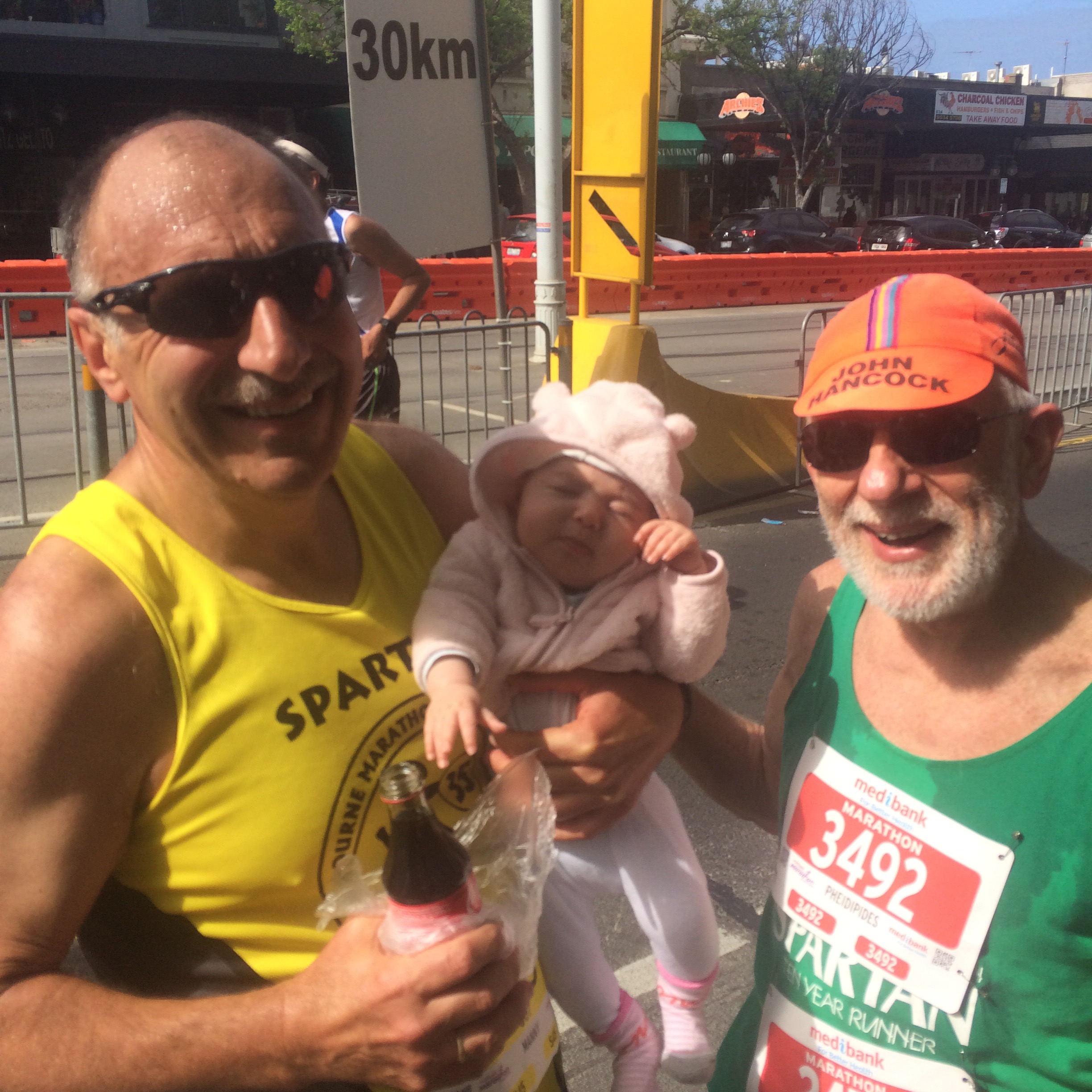
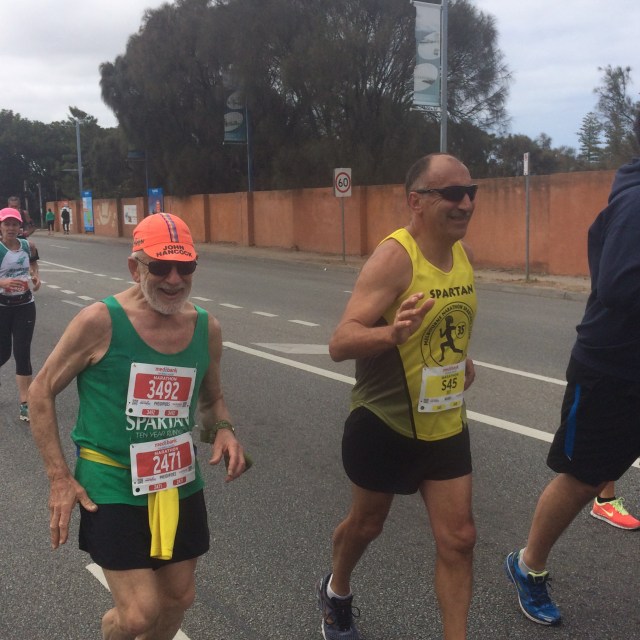
Lining up at the rear of the field of seven thousand dreamers before the Start, Manny implores me for the seven thousandth time: ‘Promise you’ll leave me behind once I’m too slow for you, Howard. I don’t want you to sacrifice your time for me.’ Manny never dreams he’s honouring me. But even before the gun sounds, runners reading the rear of Manny’s shirt salute him: ‘Legend!’ – they cry – ’Thirty-five Melbourne Marathons! Amazing!’ They clap him on the back, not realising Manny’s shirt sells him short by two marathons. Manny does not correct them. The same people spill glory and goodwill onto me in my Spartan’s shirt: ‘Go Spartan!’


A beautiful morning for running. Beneath low cloud a light breeze cheers and cools us as we snake along boulevards and run spirals through Melbourne’s parklands. Manny’s prudent pace suits me. I search for bodily pains to fret about. Nothing: silence from the supposed stress fracture in my left foot, nothing from the torn right calf muscle that I have rested from four weeks. The opposite calf sends alarms, but these are false. Pheidipides Goldenberg has no complaints.


Running half a pace behind Manny I take him in, not as the indoor person I have known, but Manny as runner. His build is not classic Kenyan: Manny is constructed of old materials, a series of chunks assembled one on top of the second. Impressive that he has lugged this unpromising torso through thirty-seven marathons. Projecting below that torso are the legs which are Manny’s secret. Beautifully muscled, elegantly defined beneath skin shining with vitality and sweat, Manny’s legs look decades younger than he as they pump smoothly, rising, descending, devouring distance.


Approaching the thirteen kilometre mark, Manny grinds on steadily, shouting out greetings to figures who come into view and earshot, his comrades, these, fellow members of the hallowed eight. To a man they look old. And calm. The marathon is their familiar foe. It holds no terrors, no surprises for them. Not for the first time, I recall Tennyson’s Ulysses as he looks upon his comrades:


Souls that have toil’d, and wrought, and thought with me –

That ever with a frolic welcome took

The thunder and the sunshine…

You and I are old;

Old age hath yet his honour and his toil;

Death closes all; but something ere the end,

Some work of noble note, may yet be done…   


With a cry of a different temper, Manny swerves, his voice joyous. He mounts the kerb, sweeps a good-looking woman into his arms, kisses her face, her hair. She pushes him away a little, looks at him searchingly. Satisfied, she smiles: ‘You look good, darling, you look wonderful. You’re running smoothly.’ The good-looking woman is Manny’s wife Demetra. She plenishes us both with cola and kisses, promising to find us again ten kilometres down the route. Manny releases his wife, takes a step, turns back, grabs Demetra again, crying into her hair, ‘I love you, darling’, and sets off again. I look down and try to deal with a lump that has risen in my throat.


Heading out toward the beach now we are bathed by sun and cooled by the breeze. Aaah, blessed day. The first Kenyan, having turned and now heading homeward, glides past us on air. Shouts of wonder rise from all throats as runners and spectators alike react to this shock of the beautiful. 


‘That’s my street there, Howard, Number 141. Please join me and my family at any time from 3.00. Bring your wife. Please.’ I want to join Manny and his family. If I finish in time I’ll certainly be there. Until now, Manny has spoken little while I have spoken more. A quieter person, he places one foot before another, repeatedly, steadily, and runs inwardly. I ask from time to time, ‘How are you going, Manny?’ ‘Not great. Not as good as last year.’ Not feeling great but not complaining either. As we swing out along the beach road and past Café Racer, a bunch of bystanders suddenly flows onto the road in our path and Manny’s face relaxes and falls into a wide smile. Hugs, handshakes, claps on Manny’s back, kisses on Manny’s face from two toothsome young women, and Manny keeps smiling and keeps on running. The interlopers pump sunshine up Manny’s arse and run alongside him. For the best part of an hour we run with the posse and through all that time Manny is smiling.
We come to the turn and the posse whoops and cheers as Manny turns for home. Manny is brother to one, uncle to a couple, second cousin to a few more, godfather to another. The kissing females are godson’s girlfriend and her girlfriend. The brother is shorter than Manny, genial, younger, rounder and pretty fit. He stays the distance for the full hour as do godson and one of the kissers. Others, out of shape or out of condition, fade away and re-join us later. Finally, with farewells, more clasps and shakes and blessings the mob falls away. ‘See you at my place, darling!’ ‘See you after three, Manny!’ The mob loves Manny and he them. Afterwards he tells me, ‘They’re here to meet me every year. Every year at the same spot. They never fail.’ A little later Manny says, ‘Dem and I are taking the whole family to Athens next year…it won’t be at marathon time of course.’

Increasingly I relish Manny’s invitation to join him and the family. These people run to the beat of a familiar drum.

  Back on the road, unescorted by Manny’s family, I have a question: ‘Manny, are you Manuel or Emmanuel?’

‘Manuel. They call me Manny. Also Manoli.’ 

Manny, Manoli – these affectionate diminutives are the aural furnishings of a life. Cushioned at every mention of his name, the man lives his life in relation, in connection, not alone, never – so long as these names are heard – alone. Back on the road, the solid road, returning from my abstractions, back with Manny-the-person I notice him struggling wordlessly. What silent erosion within his skeleton, what deposition of para-proteins in his kidneys, what mischief in his marrow, hampers this champion? Conversely (and most striking), how remarkable the redemptive effect of the loving presence of Manny’s family!


Around the corner and into Fitzroy Street where the crowds thicken and the cheering is a roaring without end, we allow ourselves a fifty-metre walk up the ugly little hillock placed here for the torment of the tiring runner. I reckon we’ve run better than two thirds of our 42.195 kilometres. Manny bursts into joyous shouting: ‘My baby! My baby!’ Emerging from the midst of the thronging cheerers is the adoring Demetra, bearing encouragement and affection and more Coke. And a baby! – their first grandchild. Manny cradles the pink bundle, adores her like a Magus. To me Demetra passes chocolate! I’m dubious about this; I’ve never eaten chocolate in the middle of a run. Will I like it? Will it like me? Too late – it’s melting in my sweaty paw. Now it’s inside me, followed by a bottle of Coke. Supercharged with caffeine and sugar and fluid I am invincible. In Demetra’s arms, holding his pink grandbaby, Manny looks the same, but once around the corner and out of sight, he looks and feels utterly vincible.


Around the corner now and into St Kilda Road, the broad thoroughfare closed to traffic in honour of us marathoners. The sun shines, the day has warmed, everyone who is not running enjoys the balm. Runners enjoy the painful raising of knees, the heavy hurt in the thighs, the weight of weary, weary bodies that started running almost four hours ago. The 32 – kilometre sign tells us there are only ten kilometres to go. Only ten kilometres to go feels to a runner as welcome as only ten more years might sound to a prisoner serving life. The experienced runner knows the second half of a marathon starts at 32K.


We plod in the sunshine. The field has thinned as faster runners leave us behind and others – the broken, the breaking, the bleeding, those limping – fall behind us. Here to one side of us, runs Eeyore, a young woman from England. She runs smoothly ahead then stops, bends forward in apparent pain, and breaks into a slow walk, and soon she is at our side again. Eeyore replies to my clinical enquiries morosely. I encourage her, I pump sunbeams, I tell her she should be proud. I should shut up and allow her to enjoy her misery. Eeyore and Manny and Pheidipides keep company intermittently until the final few hundred metres. Just ahead and to our left runs an aged, arcuate Japanese runner. His age might be anywhere from fifty to seventy. He clings to a line, a crack visible in the road’s surface where one layer of tarmac meets its neighbour. Dourly, silently, mute to my greetings, his spine twisted into a boomerang convex to the left, Japan runs the lines. His speed is no better than ours but I bet he could run all the way to Hokkaido without stopping.


A soft sound issues from the female who runs half a pace ahead on our right. The slight sound recurs – the grunt of a person in pain? – pulls me close. No not a grunt, it’s a moaning, the woman’s lament for her suffering self, her threnody sung for self-comfort. She’s about forty, shapeless, pale, a moving emblem of tortured humanity. The moment brings me back to the Olympic Marathon (I think it was at Barcelona) where a Swiss or French runner, whose name I seem to recall was Dominique Something approached the Finish. No-one who witnessed the sight of this tall, thin woman, faltering and staggering in her final lap of the stadium will forget her in her extremity. The brutally hot day, the merciless steeps of Monjuic in the approach to the stadium, the criminal timing of the event in such heat had all but undone her. She lumbered into view, slowed, stooped, seemed to recover herself and advanced. Time and again she seemed at the point of falling. Officials were seen to move toward her, then to retreat. Appalled viewers on screen and in flesh begged wordlessly for it to end, but Dominique stumbled on. Twenty, thirty metres from the Finish she fell. Officials came to her aid and in so doing ended her chance of completing the Olympic Marathon. It is Dominique whom I hear now as this woman moans.


It is no disrespect to acknowledge that we belong to the dregs of the marathon world: among the select who run marathons, possibly the most resolute and vigorous of people, our sub-group group is the most enfeebled. And all the more honour to us who persist. On we go, pausing for drink every three kilometres, enjoying the excuse to walk twenty, thirty metres. Then up again with weary legs, up and back into the slow steady tread that our heartbeats allow us, that is all our breaths and our body salts and our fluid reserves and our moral reserves can support. We walk, we pause to walk thirty guilt-free walking paces, then on again we run, and on. Manny and I negotiate small contracts: we’ll run without stop to the top of this short rise, then we can coast down the farther side; we’ll run and not stop until we reach the next drink stop, then we’ll reward ourselves with cool fluids and a splash of water; we’ll run now and will not stop until we reach the MCG, and then…


We enter the great stadium side by side. The huge grandstands tower about and above. We insects crawl the margins below. At my left Manny says, ‘It’s magnificent, isn’t it?’ It is, it is indeed. We swing our arms, pumping our reluctant thighs into action, we raise our heads, then hoist ourselves onto our toes for the final 150 metres. Two aging men, one with an intact skeleton, the second much ravaged, swing around the bend. We pass the bent man from Japan: his face, transmogrified, is a rising sun; and Manny and I are sprinting, and sprinting we fall across the Line.
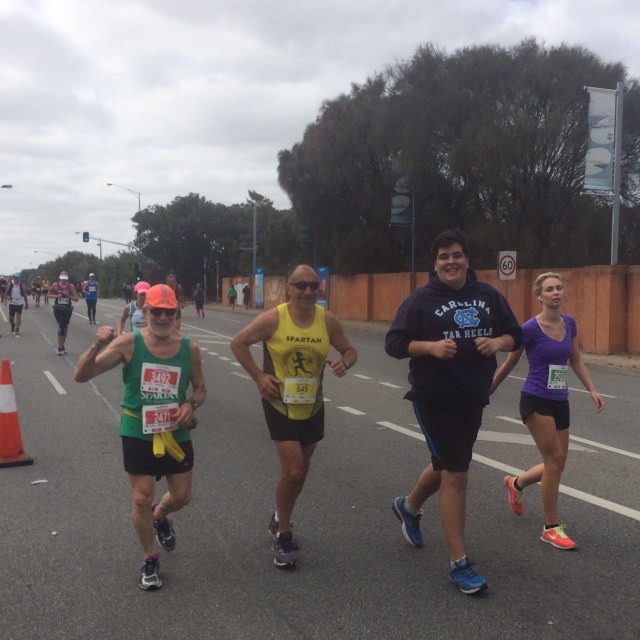


POSTSCRIPT: I have written elsewhere of my inadvertent double entry (and double payment) in this year’s Melbourne Marathon. I duly wore two bibs – each with its distinct number – and with them, both electronic timing chips. I had speculated that Pheidipides Goldenberg might record a finish in both last and second-last places. If you google Melbourne Marathon Results 2015 you will see how closely I anticipated the result. And you’ll find, ahead of me by one second, Manny, Manuel, Manoli Karageorgiou. 


All this Juice and all this Joy

The first signs, mere hints, come creeping into our lives. Mornings aren’t so dark, the air doesn’t bite, birds sing their old early songs, bobbing figures are sighted in the streetscape. The wind turns northerly, bearing scents and pollens. Gardens burst into sudden colour, the sky seems higher, its lowering grey gives way to – to what? Can this be blue? We don’t readily trust these auguries, for this winter has frostbitten our trust in nature’s cycles. But soon it is undeniable: spring, SPRING is here!

Runners come out of hibernation; it is they whom we sight bobbing up and down on our streets, all of them preparing for the Melbourne Marathon. They bob but I bob not. My wretched, traitorous right calf locks and bites with every step, hissing at me, Pheidipides, you can forget the Marathon this October.

Meanwhile two identical envelopes arrive in the mail, both addressed to Pheidipides Goldenberg, both from the marathon people. I open the first and find my runner’s bib and the electronic chip that will time my run. A wry pleasure, these, tokens of a challenge that might yet defeat me before I start. The second envelope contains a second electronic chip and a second bib with PHEIDIPIDES printed across it with a runner’s number below. That number is not the same number as on bib Number One. What can this mean? Am I two persons? (Come to that, am I one person?) My I.T. skills being as they are I must have completed an entry form, hit ‘pay’, sent it off, forgotten I’d done it and repeated the entire process. So here I am, a runner torn, forlorn, with two identities.

This Melbourne Marathon will be – would be – my forty-eighth. Not a novelty then, but yet entirely different. Come October 18 I won’t run for myself but as a companion, a support person to a true hero, one of the very few runners to have completed every single Melbourne Marathon. I wrote of this hero last year: how, recently diagnosed with a serious condition, then treated with rays and our medical poisons, he ran and managed to grind out a finish despite his disease. To accompany this modest man will be a privilege. He responds to my self-invitation, Howard, I can’t allow you to sacrifice your marathon for mine. I’ll slow you down…

Inwardly I laughed. This man who knows fears and deeps far beyond my knowing, cannot know my capacity for running a new Personal Worst. And with two electronic chips, each secured to a running shoe, and each uniquely linked to a bib number, I will follow myself over the Line and finish both last and second last.

A Run in the Desert

The Alice Springs Marathon takes place on the third Sunday in August. Forgetting how cold the nights are in the desert Melbourne people marvel: ‘Oh, how can you bear to run in that heat?’

The temperature at 0630 this morning is three degrees. I manage that terrible heat rather well. But by the time I finish the day is warm, gloriously warm. Is there a more lustrous town in winter than Alice? The skies are blue – I am searching for an adjective – a blue to banish the blues. In winter, no haze, just light. The Macdonell Ranges dominate every prospect. Rugged, richly red-brown, frequently blanketed heavily in green, the colours mutating with the changing light. From one side colossal heaps of burning honeycomb, from the far side purples mauving to pinks, greens to slake a thirsting soul.

You look up and up, the walls of colour so close, so steep above you; you feel like singing praises; you shake your head at these ridges that dominate a town. Such immensity, such liberality, so close!
We runners set off in the last of the dark. The rock still black and near-blacks that will kaleidoscope and explode as we run.
As ever, on marathon eve, I made plans, plotted strategy, devised tactics. I wrote of these to John, my illustrious runner-in-law in New York: ‘This time I’m not running for survival, not running passively, aiming merely to finish. I’ll attack the marathon. I’ll run for a time: after my worsening Personal Worsts of Boston (five hours and nine minutes) and Traralgon (5.14), I want to beat five hours.’ I laid out my plans: dividing the 42.2 kilometres into four quarters, I would run as follows: first 11 kms in 70 minutes; second 11 km in 70 minutes; the next 10 kms in 75 minutes; and the final ten in 80 minutes. I concluded my letter to John with the words, ‘Man tracht, Gott lacht’ – ‘Man plans, God laughs.’
As in all my forty-six previous marathons I gave God a good chuckle today. He might have smiled as early as 2.48 AM, when sleep died and, with an excitable bladder, I arose early for early, and my day began.

IMG_0842
***
My younger daughter Naomi invariably issues two instructions on the eve of my marathons: ‘Have a good run Dad, and don’t come back dead.’ This year she adds, ‘Know with every step how I love you.’ Her anxiety peeps out and shows itself as I age.

I knew I’d have to harden myself against pain and fatigue. I would remind myself, whenever the going got hard, ‘It’s meant to be hard. That’s why we do marathons.’
As usual the field was rich in tattered and scarred males, blokes weathered and tempered by marathons run all over the country; and young women, girls really, all looking too tender to be serious. Yet I knew from experience these girls from Alice, outwardly delicate, are inwardly wrought of gristle and gut; I knew of old how they’d whip me. And today the Army turned out. A contingent of soldiers entered the race.

***
Last year I was injured. In my absence from the race they changed the course. Too deaf to follow this morning’s briefing, I know I’ll be in trouble if I find myself leading. Prudently I avoid that pitfall. After the Race Director finishes whispering his instructions, he raises his pistol. Bang! I’m not too deaf to hear that and I set off near the tail of the bunch to attack the Alice Springs Marathon.
After only two hundred metres, my breaths come fast and hard. I recall my mantra: ‘It’s supposed to be hard. It’s a marathon.’ One after another, runners pass me, as they should. My place is at the tail of the field. But I keep up my attack. In the course of my first two ‘quarters’ it will not be my watch that guides me but my breathing. I resolve to run hard enough to remain always short of breath.

And so I do.
Have I mentioned the beauty of this place? After only six winding kilometres we have left behind the town of Alice and run through Emily’s Gap. Like Honeymoon Gap, the name sounds rude, but the rich deep chocolate rocks grab my spirit and I have no thought for anatomy, none even for respiration; it is glory that transports me.

australianphotography.com

australianphotography.com

Past the ten km mark, I search for the end of my first ‘quarter’. I say to myself – I conduct lots of self-conversations during a marathon – ‘That’s a quarter of the distance done.’ But I reckon I’ve spent much more than that fraction of my strength. I find no comfort in these calculations.
Around the 20 km mark a blur approaches at speed from the opposite direction. Is this a duststorm? A willy-willy? No it’s my midget colleague and new friend Roxi, motoring fast on the homeward leg. This kid can run. She completed the famed Comrades run in South Africa while pregnant. Now lactating, she carries her biology lightly.

Continue reading

Not Running with the Devil

The longest night in the southern calendar, June 21, gave birth to a splendid and frigid morning in Traralgon. By the time we started running the temperature was four degrees celsius, a good deal cooler than Boston where, a couple of months earlier, self-pity and hypothermia had congealed within me. Wiser this time, I enclosed myself in layers. A Michelin Man, I set off, discarding layers as I warmed. The layers were, I realised, like geological striae, those stripes in a rockface that are time’s memorial. First to go at twenty five metres in was the remarkably ugly tangerine rain jacket (discarded in Boston by another runner who decided wetness and cold were preferable to Adidas’ ugliest.) Next to go were the elegant little white gloves that cocooned my fingers during winters in the eighties when we’d run the alps of the Diamond Valley. (Ahh, my friends, my friends…) At the twenty kilometre mark I left my stripy thermal top (Kathmandu, 2014) and the Stepping Strong top that honours Gillian Reny, the young dancer whose legs were shattered by a Tsarnaev bomb (Boston, 2013). At 35 kilometres I divested the Miles for Michael shirt (Boston 2013). This left a salted wreck whose overheated genitals must abide within undies (Leigh Creek supermarket, c. 1999), olive green tights (Kathmandu, 2000) and New Balance running shorts, veterans of seventeen marathons (Leigh Creek, 2008). 

In the dawn no wind blew. Silent and shapely, six plumes rose pink against the indigo sky. Delicate and pretty the smoke of Loy Yang poisoned my world. 


I ran the first half hard with legs confident from last weekend’s fast training run from Babinda to the Boulders and back, a distance of fifteen kilometres, longer than one third of a marathon. My wristwatch read 74 minutes. This absurdly quick time suggested I’d regained some speed. I reckoned in Traralgon I’d take a full hour off the Personal Worst that was Boston. I ran first with Leanne, a shrivelled fifty-year old, light of step, a lean machine. I kept up with her, keeping myself honest. Leaving her behind I chased a rounder matron who took a bit of catching. She said, I just want to finish. We swapped names; the matron’s name was Marlene. Keeping pace with Marlene did me good – in the moral sense. I had to reach deep for Nobility and Courage. After Marlene left me behind with benediction, I ran alone for a while, this time on a stony dirt track. Mother earth beneath my feet, hard but fair, took me back to childhood in the country. My reverie – have I been dreaming, have I slowed? – was interrupted by busy footfalls pattering behind. Light of foot my pursuer spurred my own feet and I worked to stay ahead. Three kilometres later the pattering feet drew alongside and they belonged, not as I expected, to a female but to a bloke named Duc. We exchanged the lead a few times before I sent Duc on ahead with my blessings.


Next came Sam. Short like me, bearded like me, his fleshy face a crop of smiling peaches, Sam didn’t look like he was made for distance running, his well-fed body the antithesis of the ascetic distance runner’s. But Sam too left me behind. I would see him again as I approached the turn and once again, much later, as I staggered past the 41 kilometre mark; Sam, smiling still, had finished a full hour earlier.


At the halfway mark I met the Devil. In fact he’d run with me all the way, quietly waiting his moment. (In Judaism the Devil is not personified much; if anything he is The Adversary. He lives, not in hell but within us as desire, ‘the evil inclination’, which is ordinary, domestic, human weakness. As such the Devil doesn’t really earn his capital letter.) The devil was up and about early in Traralgon.


With my friend Nick and his febrile son Darcy waiting for me with love and drinks at the Half, I paused. The sun shone in a windless sky as the devil murmured in my ear, congratulating me on my time, which, while not the blinding brevity of Babinda, was quickish, respectable even. The devil suggested I needn’t knock myself about so much. He counselled me, drink slowly, recharge your energies. It might be wise, he insinuated, to hold something in reserve. He whispered something to my bones, to my thighs, something I didn’t catch. He reminded me the turn wasn’t really halfway; the second half doesn’t start until 32 kilometres, when you’ve got ten more to go. The sun was soft now on my face. It felt good. And so I jogged. 


Jogging isn’t running. When you run you leave the devil behind. Jogging along past kilometre marks that came and went agreeably, time did not count. I looked at the sky and followed the flight of ducks. I looked long at the smoke stacks of Loy Yang, pondering my own complicity. I smelled the cows. Runners passed me and we’d exchange congratulation and encouragement. A large vehicle came up behind, slowed and swerved close. Two female faces shone with enthusiasm and screamed you are awesome! Never mind these words have been bled white of meaning in a million million facebook ‘likes’, these girls transfused the words back to life. I felt wonderful. Just ahead the girls called the same to a much speedier runner who just grunted. Wonderful girls, aren’t they, I said. He grunted again, his face a mask.


I jogged on. When I turned into Black But Road the devil slouched over to me with some advice: the stones underfoot here on this unmade track can hurt your feet. Best to walk here. A little walk can’t hurt… Over the remaining fourteen kilometres I enjoyed a number of little walks. They didn’t hurt at all.


I turned back onto the Traralgon-Maffra Road where busy cars sped past at their full entitlement of one hundred kilometres per hour. I crossed the Latrobe River, where, in all twelve of my previous Traralgon Marathons, my skyscanning eyes have sighted a sailing pelican, my white bird of hope. Always, gazing across to the chimneys, I’ve thought of the Ancient Mariner:


Nor dim nor red, like God’s own head,

The glorious Sun uprist:

Then all averred, I had killed the bird

That brought the fog and mist.

‘Twas right, said they, such birds to slay,

That bring the fog and mist.


Today, for the first time, I saw no white bird.


At thirty five kilometres I sighted the white car of Good Friend Nick. He accepted my sweat-laden shirts in exchange for my drink of Coca-Cola-and-orange-juice. This dysenteric-looking concoction contains sugar, potassium salt, sodium chloride and caffeine. And water. Ever since the turn my dry lips had been telling me I forgot to load up with water before the race. Now I loaded up with every molecule known to aid a depleted body.

Darcy, no longer feverish, looking at me, wanted to know, is it hard? His Dad looked at me and laughed. I said, yes Darcy it is. That’s why we do it.

Running slowly ahead of me, his aged body skew-wiff, his pace dogged, we sighted a Spartan as he pressed steadily onward. Over the next seven kilometres of straight road I saw his singlet of emerald green, a flag of courage that reminded me of my own lack of that quality.


Nick drove off to hide my final bottle of dysenteric elixir for me at the 40 km mark before hurrying back to Melbourne to watch his elder son play footy .


Now walking, now shuffling, now jogging, I pressed on. I knew a full-bodied run would hurt intolerably. I knew this because the devil told me so. Runners continued to pass me, every one of them urging on this bent wreck. Voices said, looking good. And, great effort. Not long now…


A small parcel of sinew and strings drew alongside. I recognised the woman’s face, full of years and resolve. I recognised the voice that hectored me for ten kilometres in 2013, before its owner hurried away to assist others with her wisdom. Now the voice said, I know you. I ran with you here once before. Today she didn’t not linger to advise, or assist, or direct or instruct me. Perhaps it was something I said.


I felt the caress of fingers dancing lightly on my left shoulder. I looked up to see an able body, young, upright, light of foot. I saw a face buried in a forest of auburn beard. In the depths of the forest I saw a smile and from them a voice blessing me, extolling me, praising my effort. The dancing fingers left a sensation that abides still, twenty-four hours later.


Here and there the Traralgon-Maffra Road undulates. From the 38 kilometre mark to 39 kms in a flat marathon course the road rises steadily. As I sailed downhill early in the outward half I marked this well, resolving I would not stop, nor even slow, during my return. Brave promises those, the promises of legs that feel fresh, of resolve not yet tested. Walking now I saw the road rise ahead of me. I stopped and took a deep breath and cranked my limbs into a shuffle. And then a slow run. Putting the devil behind me I ploughed uphill. I reached the top and turned and started the downhill run home. Now my legs started cramping. Earlier, when they’d have excused me from trying to run at all, I’d have welcomed these cramps, but not now. I decided to ignore them.

I ran studiously down the hill attempting a judicious balance between speed and cramp. Footsteps behind me, soft voices, closing on my left shoulder. The runners drew alongside, a bloke in his fifties, and a much younger female. Her face had the puppy fat of childhood. They saluted me and passed. I saw the child wore a pair of floral shorts. The freshness of her being, the stream of approval and encouragement flowing from her father, the sweet amity and unity of the two, these lifted my spirits and distracted me from pathetic thoughts and tremors.


Approaching the 40km mark I decided I wouldn’t stop for my drink. Here I was, maintaining a precarious run; if I stopped I mightn’t start again. So it was with mild puzzlement but no regret that I sighted no bottle at the 40 km marker. Ahead a marshall smiled and directed me to the second last turn, calling, you’re doing well, Howie. “Howie”. How did she know me? Now her little boy approached me, near to blocking my path. His outstretched hand held a small bottle of brown fluid.

Small kindnesses, these, potent with grace. I recalled other moments, over my previous forty five marathons. Crossing the Line at the finish of the New York Marathon in 1988 I heard a sweet voice singing. It came from a fellow runner, a student of opera at the famed Julliard School. He asked my name: Pheidipides.

Ah, Pheidipides. Reverting now to Greek he recited that runner’s dying words: ‘Rejoice my brothers, ours is the victory’.


On Patriots Day in Boston, Athens of the New World, a river of grace flows during its Marathon. Of three million Boston citizens fully one million come out – and stay out – to cheer on the runners, both the fleet of foot and the unfleet. They cheer us, they feed us – everything from bananas, to segments of orange, to candies to barbecued sausages dripping fat – they love us. When two explosions destroyed the ceremony of innocence that is a marathon, overwrought Bostonians overflowed with tender concern for their thwarted guests.


Together with every runner in the world I watched the telecast of the Olympic Marathon in Barcelona. In the final brutal kilometres as the runners raced up the slope of Monjuic, one of the lead bunch of five missed his drink at the drink stop. With a medal in sight and no time to be lost, he ran on without it. A rival passed his bottle and the two shared it.


I was one of a generation inspired by John Landy’s act in the 1956 National 1500 Metres Championship. A young Ron Clark fell at Landy’s feet. The champion stopped to assist him than ran on and won.


I ran my first marathon in Traralgon. On that occasion achilles tendonitis and unremitting cramps forced me to walk from the 30km mark to 40kms. I contrived a pathetic run for the last stanza, hobbling into view of the football club where all the other 140 finishers were enjoying refreshments. One caught sight of Pheidipides approaching in the gloom. To a man, my fellow runners abandoned their scones and passionfruit sponge cakes and sausage rolls to applaud the runner who ran on an hour after they’d finished.


After my mother-in-law-in-law survived Auschwitz she dedicated her life to fighting racism. A tiny woman of immense will, she was never scared to take me to task. She challenged me once with the folly of the ‘disordered’ (her term) pursuit of marathon running. Shortly afterwards I ran the New York Marathon and found my answer: my life is a marathon, an undistinguished passage through time and space; it is a passage made rich and significant by the people who run their race at my side.


Postscript: Yesterday in Traralgon I set a new PW of five hours nineteen minutes. My time of 5.13, Boston was a sprint in comparison.