My Mum

My mother is dead. This is not news to me nor to an attentive reader of my musings on the net; Mum’s been dead since 2009. But the fact precedes the realisation. I feel the pleasure of being her son every time I think of her. That pleasure persists, felt it in the present tense. Especially today.
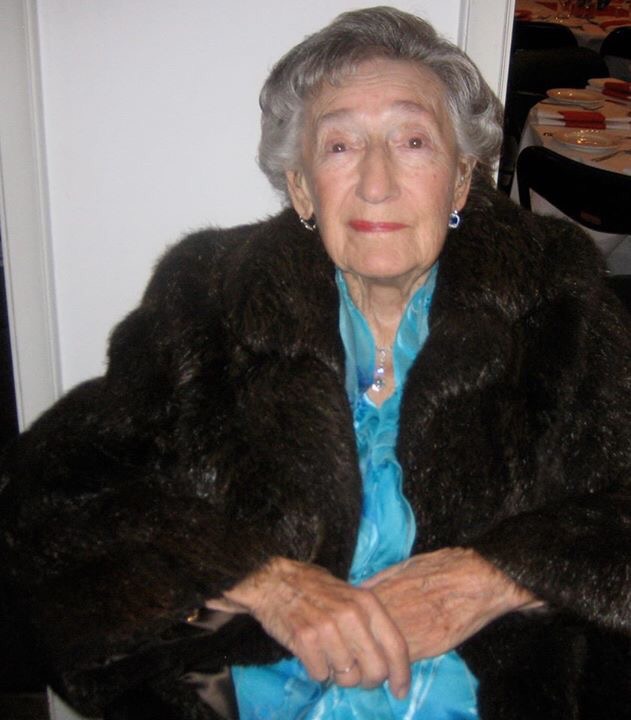
  To know my Mum was to smile. She was both vague and humorous, almost daffy, at least in respect of the weight of the world.

Mum knew sorrow. She lost both parents to natural causes in her childhood. She survived the death of her husband (‘he was a lovely man’) and a few years later, the death of her firstborn son, who lived, it seemed, solely to bring pleasure to Mum’s last years. A few days before her ninety-second birthday, battling the heart failure that would kill her only a few days later, Mum literally laughed at death. Already breathless, with fluid pooling suddenly in her lungs, she suffered a coughing fit, gasped, gasped more deeply, turned grey and slumped. A few milligrams of hero molecules and some litres of oxygen later, Mum awoke and grinned. From behind her mask she chuckled and gasped: ‘They thought I was going to croak, but I didn’t!’

Dad’s heart started to play up in the months preceding his demise. I felt a doctor son should warn my unworrying mother: ‘Dad’s heart disease could kill him, Mum.’

‘I know that darling. That happens to old people.’ And to comfort and prepare me, she added, ‘Death is part of life.’ 

Mum’s acquaintance with sorrow seemed to leave her unharmed. Events always had their brighter side. You could always laugh.

I wondered about this. This was not a shallowness. Mum loved generously in a way that would be reckless in any normal person. She’d invest in love, lose the entire capital and somehow end up liquid.

What was her secret?

Did she learn something early in life that helped her to surf, ever buoyant, upon the waves and dumpers?
All I have to account for my mother’s lightness of being are my memories and her stories.

Of her father: ‘Daddy was at sea on his lugger for weeks at a time. He’d spend the idle hours carving mother of pearl and tortoise shell to make jewellery for Mummy.’

‘Daddy used to give concerts at the Town Hall on his one-stringed violin. He was very artistic.’

Mum’s face is alight as she speaks. Her father is always ‘Daddy’, the affectionate diminutive bright in a daughter’s smile and lilt of voice. ‘When Daddy was dying the nuns asked the whole school to pray for him.’

‘Daddy carved this brooch from the mother of pearl and pearls he brought from the bottom of the sea. He made it for Mummy when they were sweethearts.’

‘During the Depression Daddy went bankrupt. He worked for a real estate agency after that.’ Mum points to a black and white photograph of the staff of the Agency. Four stiff middle-aged men and one commanding matron stare at the camera. As old as any but much the youngest in facial expression, my grandfather smiles impishly.

‘Then he got lung cancer and died.’

Driving past Brighton Cemetery, with a wave of a hand, ‘Daddy and Mummy are in there – just next to John Monash.’ A six year old boy cannot reconcile that champagne voice with the terrible intelligence of the death of parents. I wonder at first if ‘Mummy and Daddy’ might by some magic still live, ‘in there’.

Mum pronounces the famous surname, ‘Moanash.’

In my university years I need to correct her; ’Mum, it’s Monnash, not Moanash.’

‘No darling, it’s Moanash.’

‘Mum, three thousand people go to Monash Uni every day and they all pronounce it Monnash!’
‘Do they darling? I must be wrong then. It’s just we knew the family and they pronounced it Moanash.’
Of her mother: ‘Mummy died three years and three days after Daddy. She died of a broken heart.’ For Mum rheumatic heart disease is translated to a love that killed but never died.
‘Mummy was extremely elegant. She made her own clothes. If you look at her pictures you’ll see she always wears a half sleeve. Mummy’s arm was burned above the elbow and she always covered the scars.’ 

Of her philandering uncle; ‘Harold should never have married Grace. They lived perfectly happily while he kept her as his mistress. Once they married, Grace couldn’t tolerate his lady friends. After Harold took one lady friend on a cruise to Tahiti Grace never forgave him.’ Mum’s voice expresses wonder at the anger of a woman scorned. ‘So she tried to poison him by tampering with his heart medication. When that failed she removed the tacks from the carpet at the top of the stairs. Harold fell all the way down but he wasn’t hurt.’

Lots of stories, lots of memories, all recounted lightly. Did Mum have no bad memories? Or did she simply lack that faculty when to remember would create sorrow?

There was one. When Mum told me this in my own early childhood I felt swamped in vicarious grief. We were walking at the top of Pine Avenue in my home town of Leeton Mum paused outside the toy shop. ‘Howard I want to buy you a present. It’s important. You have to let me buy you something.’

Surprised by this; I didn’t need to be persuaded.

Mum went on: ‘When I was a little girl I didn’t allow Daddy to do that. He wanted it so much and I didn’t let him. It was a doll. Daddy took me into the toyshop and we both saw her. She was nearly as big as I was. I saw her and I loved her and I wanted her. I wanted her enough to burst. Daddy said, “Would you like that big doll, Yvonne?”

I wanted her so badly I felt it must be greedy to say yes. I shook my head. “Really?” – said Daddy. “I’d like to buy it for you. Say ‘yes.’” But I couldn’t say yes. Because I’d already said no. If I said yes now Daddy might think I was only pretending not to be greedy. He’d think I was greedy and bad for not saying what I truly wanted.

Daddy kept trying to persuade me. I kept shaking my head. Daddy looked hurt. My pride hurt Daddy and my foolishness hurt me. We left the shop, Daddy sad and confused and I too sad to cry. We left and I knew I would never have the dolly.’

One clear memory of sorrow. Clear, sharp, unbearable for the listening child. I said nothing because the sadness was stronger than my words. The only story of sadness I ever heard from my mother’s lips. All the rest – one day short of ninety-two years – is sunlight.


In an era where corporal punishment of children was everywhere and unremarked, Mum only ever smacked me on the bottom on two occasions. Afraid she’d hurt me, she didn’t have her heart in the job. On the second – and final – occasion Mum gave up when both she and I were overcome and helpless with laughter.
 
Here’s my best guess: her father (‘Daddy’) dies after a horrible illness; her mother (‘Mummy’) dies after a long, long illness. Aged fifteen she looks about her life. She sees Doreen, her younger sister, and ‘Gar’, her mother’s mother who moved in after ‘Daddy’ died. If that’s the worst life can do to her, she decides, life is worthwhile. There is still love.
In this all-female domesticity Mum learns from the example of Gar – herself an emancipated widow – that a woman ought be confident and fearless – of men (who are lovable and inferior) and of death. And Gar’s dictum, ‘what I cannot cure, I must endure,’ shapes the girl’s life.
 
Less than a decade later the girl will lose family in the Holocaust. In her seventies and eighties she will suffer stroke after stroke, culminating in a haemorrhage that tears her brain; she will lose fluency and clarity of speech, she’ll inhale perilously as she swallows, her gait will be shattered and continence lost. She will tell this son, ‘I’ve never been happier because I’m surrounded by people who love me.’ And as an afterthought, ‘I really think I could still drive, darling.’
 
She reviews her life: ‘I’ve never achieved any status, never followed a profession, never been well-known for anything. But I have four children who love me and that means something.’
Each one of the four feels so truly and well loved, we all feel morally certain we must be the favourite. All four of Mum’s children inherit, to a greater or lesser degree, Mum’s temperament. Of the four, it is Dennis whose life is most difficult, but he lives through loss and disappointment, ill health and frustration, buoyantly.
 
 
Today is Mum’s ‘yahrzeit’, the anniversary of her dying. In the Synagogue last night and again at dawn this morning, this son – this unmourning orphan – leads the congregation in prayer, recites Kaddish, and lights the memorial candle. He sheds no tears in remembering but he gives thanks.

My Sister Margot


May thirteen 1949 my sister emerged as the sun set and the sabbath arrived.


The doctor from the next town, nineteen miles distant, did not arrive – the Murrumbidgee had broken its banks and a sea separated Narranderra from our town of Leeton.

Dad was an accomplished accoucher.  The other doctors in our town did not come up to his standards so Mum had to give birth to her firstborn and to me in the City.  Third time around Dad had chosen that doctor in Narranderra – apparently he was competent enough to bring Dad’s children into the world.

But the waters held him distant.

So Dad delivered my parents’ third child, their first – and as it turned out – their only daughter.


She had red hair and she grew freckles, but my parents overlooked those abnormalities and rejoiced.

The baby’s name was Margot.

I look at the watercolour portrait of Margot that we grew up with and I see now she really was beautiful.


I could not see her beauty back then. She attached herself to her older brothers and wanted to go everywhere with them. One day when she was fifteen months old Dennis and I had urgent business at Iano’s Milk Bar. Margot, mother naked, wanted to come. We said no, closed the gate behind us and set off, ignoring her cries. 

At Iano’s someone said: Is that little girl your sister?

Margot had run across wide Wade Avenue and chased us three hundred metres. Here she was, unclothed in her girl way, and embarrassing. 

I said, I’ve never seen her before.


Margot grew taller and her golden hair grew longer. Eventually it hanged down to her freckled bum. The photographer from Melbourne Herald sighted all that flowing splendour and the photo appeared on the front page of the paper.


Margot married. In her innocence she was unaware her husband was a genius. She could not foresee how his talent would drain them from Australia to America where successive chairs in neuropsychopharmacology awaited his brains.


When Margot removed to New York our mother did the maths: a year was a twelvemonth; Mum had four children. Twelve divided by four equals three. Mum would spend three months of every twelve with Margot and the tribe she was creating in America. 

Dad stayed at home and worked and missed his freckled girl.


In my novel, ‘Carrots and Jaffas’ I create a titian-haired woman with freckled, sinewy legs who lives by the Hudson in Riverdale, New York. She runs like the wind and never tires. She is good to her brother.


She’ll turn sixty-six this may thirteenth.

He Wished to be an Inmate at Auschwitz

“I was born in mitteleuropa. You would say ‘central Europe.’ I had a happy life. I still have a happy life.” The man’s smile is wide, unmistakeable through the oxygen mask.

“When the War came I was a boy. My father and his partner had a business, so although there was war we had enough. But then the Nazis came and claimed my country. The great German Volk needed more livingsroom.” A smile, no bitterness, the smile of a man who sees the joke that is nationalism, the extended joke that is human history.

“The Nazis made lists, they liked lists. They made one list of Jewish businesses. My father’s business partner was Jewish, so the Nazis found it necessary to confiscate the business. My father found work as a clerk. It was not much but we got by for a while until one day they took my father away. I was at school when they came for Father. My older sister had to stop her studies. Later she disappeared, then Mother. There was just me. I stayed at home until a friend of Father said to me, ‘They will come for you tonight.’ I ran and I stayed with a friend in the country.

“This was, I think, 1942. I was bigger, still a boy, but big enough to work, big enough to become a slave for the Nazis. The Gestapo found me and were taking me on the trolley bus to their HQ for questioning. The trolley slowed for a corner and I jumped and ran. I was fast and small and I got away.

I took a train to a town where we used to ski in the mountains. I knew that place, we had friends there.

“But the Nazis found me. They put me into slave camp.

Work I don’t mind so much. It is hunger that is bad. Hungry slavery, that is very hard. They give us only one hundred fifty grams of bread a day. You know how much is one hundred fifty?”

The man shows me how much is one hundred fifty with his hands. His thumb and forefinger describe the thickness of a slice for a slave of the Nazis, something under a centimetre. His right forefinger sketches the outline of the slice on the palm of his right hand.

The small hand and the fine fingers are pink and soft. The skin has forgotten and forgiven the slave years. As he speaks the man leans forward, his neck muscles and his upper thorax working hard between phrases as he sucks in gulps of oxygen. His ribs rise and fall with his phrases. When you listen no tide of incoming or outgoing air is heard. The lungs have been burned away.

“People said slaves at Auschwitz received two hundred fifty grams. Two hundred fifty! I wished I would be taken to Auschwitz.”

The smile has not ceased. Does he need the widened mouth to get a full insuck of air? – I wonder.

“They did transfer some of us, on a train. I did not know to where we would travel, I decided I would escape again. I went to the toilet and opened the small window. The train travelled passed through snow close to forests. As we climbed a hill I jumped. The snow was soft. I ran to the forest and joined the fighters. For more than one year we fought the Jerries.” Behind the mask the smile widens in happy recollection of fighting ‘the Jerries.’

“I knew that country from our skiing holidays. I went to a farmer I used to know and his wife left food for me in the forest. I fought against the Jerries. They never came looking for us in the forest. They were too frightened, they did not know those forests as we did.

“After the War I returned to my hometown. And my father and my mother were there. And my sister. Later I came to Australia and we” – he nods towards his wife – “ we found each other and married. That was in Brisbane. We have been together ever since.”

The man and the wife live in the last house in a street that ends at the foot of a mountain. Forests of dark green stretch up the nearby slopes. When I phone to arrange my visit it is the wife who answers. Her voice, clear and steady, speaks in distinctly Australian accents. I follow her directions and find a derelict-looking building in ancient rendered cement. I approach a tall grey structure with glassless window frames. Inside a clutter of ancient debris. And silence. Clearly the wrong place.

Walking back towards my car, I am startled by a steady, clear voice: “Come around the side. Be careful as you climb the stairs.”

The stairs are steep and uneven, the building high. Surely a barrier for any aged couple, certainly an impossible mountain for a man with no lung tissue. The voice guides me up a second flight and there, on a concrete deck, at an alarming elevation above the buffalo grass below, stands a tall woman in a long navy dress, her face deeply wrinkled, her smile of good, original teeth and outstretched hand bidding me welcome. The dress and the face arrest me; the dress rises from ankle height, a deep blue teepee speckled with small stars of wattle; the face a roadmap of antiquity charged with vitality, lit withal by that smile. A woman attractive enough to haul any man up those terrible stairs.

We sit and I listen to reminiscences of a life. The man pauses and works his breathing as his lung remnants fight for oxygen. The smile never fades, never loses its expressive energy. When memory slows the woman prompts him: “Tell Howard about…” “Did you mention the time…?”

We look across sunlit mountain forest as the man breathes and speaks. He says, “My life has been a happy life. It is a wonderful life, this is a wonderful world.”

No-one Likes Poems.

My father said, “I don’t like poetry.” But he recited whole stretches of Shakespeare and odd fragments he learned at school. They shaped his thought and ferried it forward until he died, more than threescore years after his schooling ended. And Dad loved song, singing sea shanties to us through the hours of boat trips and long drives in the country. Dad imagined song was not verse and persuaded himself he ‘didn’t like poems.’

Many feel the same: confronted with verse they shrink and expect to be baffled by this often complex, always dense mode of expression.

Some poems however are quite straightforward. In First Class at Leeton Public School, Mrs Paulette announced, “Today we will learn a new poem. It is ‘Ding, Dong, Dell.'” I raised my hand: “I know that poem already.”
“Good, Howard. Please recite it for the class.”

“Ding, dong dell,
Pussy’s in the well:
How can you tell?
Go and have a smell.”

“Howard, leave the class immediately.”

Whether in the original version, that features Little Tommy Thin as the malefactor, or in the Howard version in which putrefaction proceeds, the lines race along in straight lines from straightforward beginning to clear ending. The charm is in the music and in the energy-packed compactness. Next to a picture and a graph, a poem is often the most efficient mode of conveying experience.

If you are like me, you might be daunted by lengthy poems. Try this one, a shorty:
I, Too, Sing America
Langston Hughes, 1902 – 1967
I, too, sing America.

I am the darker brother.
They send me to eat in the kitchen
When company comes,
But I laugh,
And eat well,
And grow strong.

Tomorrow,
I’ll be at the table
When company comes.
Nobody’ll dare
Say to me,
“Eat in the kitchen,”
Then.

Besides,
They’ll see how beautiful I am
And be ashamed—

I, too, am America.

I know too little of American verse, but the phrase, ‘I sing America’ rings a bell. I think it was Walt Whitman who wrote a poem by that title. Here the poet claims American folk memory – together with Emily Dickenson, Whitman is said to be the most original of American poets – and with graceful economy and marvellous power, protests against his exclusion to the kitchen of America, ‘when company comes.’
If you like that, try the even shorter, “The Negro Speaks of Rivers.”

I found both poems in ‘The Great Modern Poets’, edited by Michael Schmidt (Quercus). The CD enclosed inside the front cover features all the poets – from Yeats T S Eliot to Plath – reading their own work. Langston Hughes sings his lines with a jazz rhythm and in an accent faintly redolent of the Caribbean. Buy the book, listen to the CD and weep for beauty.