Where Innocence Died

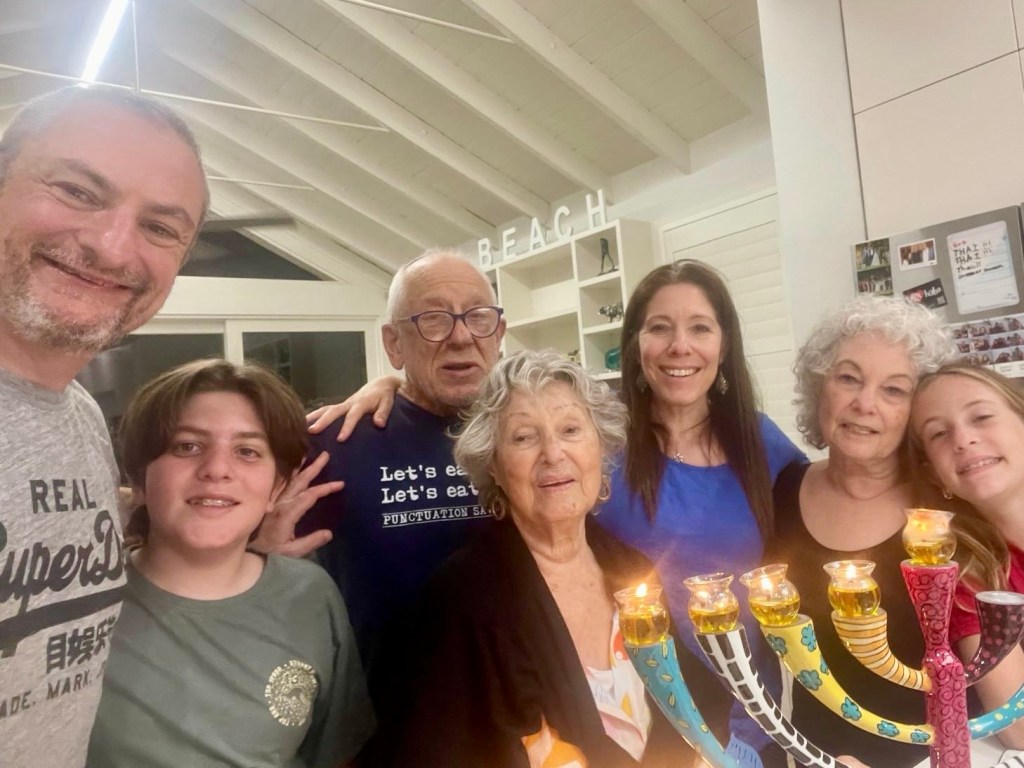
I wandered down to Bondi Beach, having no particular plan. Arrived in Sydney for a quite different purpose, long-planned – to celebrate a birthday – I felt myself drawn now to the fatal site. Once there, I found flowers in heaps, tributes and cards. There were candles in clusters. A Hannukah candelabrum stood before the Pavilion. Families were there, some clearly Jewish, many more of them miscellaneously human. 


I fell into step with a Jewish youth wearing Chabad costume. His congregation lost a rabbi last Sunday, a young father. I asked the youth, Whattefillah* do we say?

Say what your heart prompts you to say.

We exchanged names: Levi

Zvi Yehonasan.


I wandered on. Here were two young women wearing tunics emblazoned, MENTAL HEALTH. I paused by the tributes, bowing to read, The World Rests on Three Things, on Truth, on Justice and on Peace. This was pencilled and illustrated in a child’s hand. I wept, sobbed actually, rocking as I cried, undone by innocence. I felt the close presence of someone. It was Mental Health in the person of a young Chinese woman, proffering a Kleenex. I said, Weneed to believe people are good. She said, We do. At our side a colourful sign read, Celebrate Waverley.


I wandered on. Here was the footbridge.Over the past four decades I’ve jogged across this little bridge many times as I completed a run. Last Sunday evening two figures in black used the bridge. This morning I looked at that familiar little landmark with new eyes. I bethought myself of the Arch of Titus in Rome. Graved into the stones of that arch are images of Judaean slaves, taken captive in the sack of Jerusalem in the year 70CE. They carry holy objects, trophies of destruction. Among them is the great candelabrum of the Temple in Jerusalem. An arch of triumph for ancient Romans, it has ever stung Jewish eyes. Traditionally Jewish people make a point of not walking beneath Titus’ Arch. Today I detoured around the Bondi footbridge and took a long cut. 


Police were everywhere to be seen this morning. Police cars were positioned to limit vehicular access to the site. Insteadpeople walked freely, streaming from all sides, down towards the memorials. Young people walked, drained of gaiety. Children too, somehow solemn in the general pall.


Down by the candelabrum, a trio of women in uniform garb. I think they were nuns in summer garb. Here, a younger man, tall and well made, formally dressed in a grey suit in the bright sunlight, stooped to listen gravely to someone explaining, pointing, what happened just here, what just there. The man bowed and took his leave. I guess he was a politician.


Here was an aged lady, lipsticked, dressed colourfully, her face deeply wrinkled. She seemed old enough to recall the War. She was deep in conversation with a younger person. She looked through her companion, her gaze fixed on some other place, some other time. I fancied she might be a survivor of similar attacks. She appeared oblivious of the person filming her.


Photographers and news crew everywhere, today uncharacteristically decorous. Trying to orient myself, I approached a young police officer. Diffident, reluctant to distract him, I asked which directions were the shooters aiming. He listened, conferred with a fellow officer and gave me answer with a most tender seriousness, as if I myself were among the wounded and must be gentled. I thanked the officer, turning away with my tears. Undone again, by kindness. 


I took my meandering leave. I was struck suddenly by what was not at the site. Hundreds and hundreds were there, in all ages and conditions. But missing was haste. Absent from here was noise. Hedonist Bondi, transformed into a secular place of sanctity.


I left the place and wandered on, up the hill. The sun bathed the scene. Sydney balmed, just as it was around 6.30 pm last Sunday. I walked on, asking myself whether people were in fact good. Down the hill, in an endless stream, came people bearing flowers. This family carried two large bunches, florist-wrapped. This teenage girl carried but three large roses, home-picked. 


At the top of a long hill I rested in the shade. A man approached with a dog, which he secured by a lead to a post. A dog of middle size, his coat a golden bronze, he turned and watched his master enter the adjacent fruit shop. Wondering whether a dog experiences wistfulness, I made way for a boy just a little larger than the dog, walking with Grandma. The boy sighted the dog, left Grandma’s side, and trotted over to the dog. The child rubbed the creature’s neck and fondled his ears. He bent far forward until his brow rested on the dog’s. For a short interval, the two were a single organism.

Then the boy trotted on and caught up with Grannie.


*tefillah is Hebrew for prayer.

A Man Died Today

Kylie says Ernie died.

Her face is tight, closed. She was Ernie’s only friend.


Ernie

Ernie was a sad person. He saw doctors and they prescribed tablets for his sadness. He said he felt a bit better on the tablets, and then said he was worse. He stopped the tablets.


Ernie lived alone. I visited him once in his rented house. His dogs greeted me. I found Ernie in his dark bedroom, in bed, blinds drawn, in mid-afternoon. He said he wasn’t crook. Nothing to get up for, he said. Only the dogs.


Kylie said he was paying $350 a week in rent for the mean little house on a back road in the country. She reckoned Ernie was past caring.


One time Ernie spoke a little of his childhood. Dad abused him violently. Mum didn’t care. After a couple of short sentences, his old face hanged from his neck, wordless, wrought with injury remembered. 


Doctors encouraged him to join Men’s Shed. He wasn’t interested. The visiting nurse was worried. He didn’t answer calls, he’d be grouchy. Then he became confused. No, he wouldn’t go into the local hospital. His dogs would pine.


The day came when he couldn’t speak. His mouth couldn’t make words. He found himself on the ground in his yard, with no memory of going outside. The dogs licked him into awareness.


He was taken to the big hospital two hours distant, where doctors found him recovered from a mini-stroke. They told him to go home. Unable to drive, alone, at night in winter, he lay down on the floor of the hospital’s unheated waiting room. Kylie called to check on him, then drove to the big town and brought him home.


From time to time I’d sight Ernie talking with Kylie. She’d sit quietly, leaning forward, allowing Ernie’s words to find their way out of him. The words would stop and start, like a streamlet wending around rocks, hard obstacles of pain interrupting the flow. In their cave of trustI’d see Ernie smiling.


Kylie

Three days ago Kylie said, Ernie’s in hospital. He’s got pneumonia. The old man’s friend. Kylie visited him that day and again two days later.

Today Kylie said, Ernie died.

A Small Child, a Shirtless Man

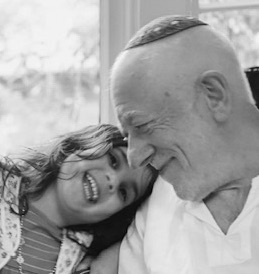
The child peers at the headlines in the newspaper. She has become interested in letters that make up words. She points at a letter:

That’s an N.

And that one is A.

Her grandfather joins her and looks at the ‘paper.

The image of a man standing bare-chested in the open in midwinterseizes his attention. 

And that is Z!

And that’s an I. 

What is that word, Grampa?


***


Grandfather feels sick as he reads the headline.: “Nazis march in Melbourne”. The image shows a powerfully built man with his back to the camera. Grandfather notes heavily muscled arms clenched aloft. He sees in the posture defiance, menace. In the grey streetscape, the man’s exposed skin is very white.

What is that word?

It’s a name, darling.

What does it mean, Grampa?


How do you explain Nazism to a child of five?

How explain it at all?


Darling, that man doesn’t like Jewish people.

Puzzled, she speaks: I’m Jewish…

He doesn’t want people in Australia who have dark skin.

I’ve got dark skin, Grampa. And Mummy…


The five-year old brain whirrs.

Why isn’t he wearing a shirt?

Perhaps he wants to show people he’s tough. He wants people to be scared of him, I think.

Does he scare you, Grampa?


***


Grandfather would prefer not to answer. Is he scared? No, not for himself. But for the little ones, yes. What Australia will this Jewish-Sri Lankan-Australian child grow into? 

No darling, he doesn’t frighten me.

Darling, most people are kind. 

This man feels angry. 

Perhaps, inside, really deep, perhaps he’s scared.


Grandfather feels dissatisfied with his replies. The child looks up andsees his look, careworn and sad. She comes close and throws her arms around his legs.


Nicky


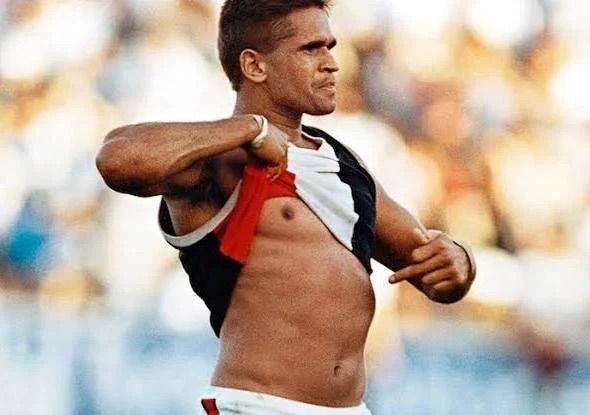
An old man who should know better runs through the drizzle. In his wrong season sunhat and his non-lycra, he’s an odd-looking figure, a lulu and a lemon. Walking toward him is a taller man, perhaps half his age. The man is well built, his face dark. At the sight of the quaint old man, that face breaks into a smile.


This happens quite often to the older man, younger people smiling at him when he runs. Nowadays the run is more a shuffle, the limbs jerking and creaking arthritically. The smiles signal a sort of surprised admiration, with a bit of amusement, a touch of sympathy for something at once pathetic and brave.

The smiles always warm him.


Today there’s all of that, but something more. The smiling face looks familiar. The runner stops and turns and calls a name. Nicky! The smiler turns and walks back to the old man. He smiles again.


Nicky? Nicky Winmar?

Yeah. That’s me.

Nicky, I saw you on the cooking show. 

I want to say something to you. You changed Australia – that day at Victoria Park. I’m a Collingwood supporter and I was ashamed that day. You pulled up your shirt and you showed yourself and we started to learn. You helped Australia to change.


The tall man’s smile deepens, goes inward inward. He steps forward and throws his arms around the older man and pulls him close and holds him. The men unclinch. The black man extends a hand to the old bloke. The grip is firm,the clasp is warm. The smile has widened. They shake and part.


And I run on through the light rain.


Photo by Wayne Ludbey

Flying the flag


My father was the eldest of three brothers growing up in the then Jewish suburb of North Carlton.


That suburb boasted synagogues, a thriving playhouse, a choir, houses of Torah study and a dedicated Jewish segment in the nearby Melbourne General Cemetery.


That Jewish enclave was sufficient to itself. But every shabbat morning, Dad and his little brothers walked the five kilometre round trip to the East Melbourne Shule.* They didn’t choose East Melbourne, their father did. I think Grandpa’s choice was driven by social climbing. East Melbourne was less foreign, more English, hence advantageous.


That social climb would always remain too steep for Grandpa, who arrived in Australia alone in 1898, as a twelve-year old, a refugee from Palestine, a boat person, speaking only Yiddish and Arabic. But Grandpa wanted his boys to ascend. So they went. Grandpa himself did not walk the five kms. My Dad explained, ‘Father’s knee was bad on Saturdays.’


Have you ever visited the East Melbourne synagogue? (They hold open days and host school groups. In these days of smaller congregations, the cumulative total of visitors might well exceed the tally of worshippers.) If you have seen East Melbourne Shule, you’ll feel sad as I do about the attack. For the shule is beautiful, a small Jewish gem surrounded by the august institutions of Christendom.


In conjunction with St Peter’s Eastern Hill, the rabbi at East Melbourne set up a feeding initiative for hungry people in the locality. I’ve been a friend of that rabbi since his family moved in around the corner when he was a boy of four. Nowadays he’s the Jewish Chaplain in the Australian Military Reserve. He takes his flock on a trip to country, guided by Aboriginal custodians. He’s a bloke with a beard who wants to help.


This then is the story of a bunch of very foreign foreigners who find their place in Australia. It’s an Australian story, replicated in thriving immigrant enclaves all over this land. And all of us non-Aboriginal groups are new arrivals, all of us more or less recent immigrants.  This is the Australia that nurtured me, the home I cherish.


Last Friday night a person attacked that Australia. Since then, solicitous friends who are not Jewish have reached out to us in shock and anger and kindness. They ask are you alright? I reply I feel sad more than I feel scared. I feel sad for Australia, for my Australia, for this place that I love so dearly.


***


Last week I wrote the following little piece for the newsletter of my current congregation:

“Readers will not know, and certainly couldn’t care less, about the principles that underlie my daily selection of headgear. But permit me to suggest you should know and care, and ponder and decide. ‘Way back in history, there existed in the western world the phenomenon of Jew-hatred. For a good while it went out of fashion. It got a bad name in the 1940’s. 

About the middle of that century, I popped up, and I lived in a world that execrated antisemitism. I walked the halls of my university beneath my kippah and encounteredonly warmth and respect. In Aboriginal Australia, I was a celebrity. The blackfella mob said, ‘You mob, you got your culture, you got back your language, you got your land. Us mob need to be like you mob.’ In whitefella Australia, I prowled the wards and corridors of greater and lesser hospitals and met only honour. 


Honour? This was unexpected. For what? – I wondered. If I read the great Australian character aright, we Aussies respect oddity, wherever we sense authenticity. I think Aussies, often ignorant of history, generally devoutly secular, looked at me and thought, this bloke looks funny, but I reckon he’s fair dinkum. 


About the year 2000, I began to hear antisemitic whispers. It took me a while to learn these were not whispers or mutterings but a swelling to a roar on social media, a world to which I am a stranger. From that time, when I ventured outside, I began to cover my kippah with a secular hat. I still looked odd, but not so Jewish. I was no longer living my proud Jewish Australian self. 


From the time of the Opera House riot of October 9, 2023, I have resumed wearing my public kippah. My kippah asks Australia a question. It asks, ‘Is this old Jew still welcome in your world? Or does he need to piss off back to Palestine?’ 


I spend most of my days in gentile company. Wherever I go beneath my kippah, Australia shows me neither surprise nor hostility. Often strangers flash warm, wide smiles of surprise and recognition. Here and there an ockker delivers a small oration: I hate this antisemitism! Or, I stand with Israel. Or, Burning synagogues! That’s not Australia! 


In a coffee shop well outside the ghetto, I meet my son for coffee. He wears his Let Them Go t-shirt. In Carlisle Street, flowing beards and peyot (side curls) are all the go, stout Lubavitch Hassidim waddle in their Kapottehs, and broad-chested Adassniks flash their vast public ritual fringes. 


I think we all, wittingly or otherwise, are asking the same question. I think the kippah, the beard and sidelock, the pectoral tzitzith, the t-shirt all fly the flag. The flag asserts Jewishness in Australia. It’s not aggressive, but it is challenging. Thechallenge to Australia is that of diversity. Pauline Hanson rejected diversity, and Australia has largely rejected her. I urge readers to consider how you can fly this honest, and decent and respectful and proud flag.”


*** 


As antisemitism came out of hidingaround 2000, I suggested to my adult children they owed it to their own children to listen and watch, and decide whether the time had come to flee. They laughed then.


First the Opera House riot, with cries of Fuck the Jews. That night a carful of young men drove around Melbourne, stopping repeatedly, shouting to passers-by, Where’s the Jews? Where’s the Jews? Policeintercepted them and talked them down. Soon cars and fences burnedin Sydney, then Adass Israel Shulewas burned out. Now the attack atEast Melbourne. 


The copycat is at large. Anyone who sets fire to a building with people inside is willing to harm them, to burn them, to see them die. 


First, come the words of hate. Inert governments, passive police sit on their hands. The words set fire to hands; then schools burn, then a Jewish MP’s office, now sacred places.


The pace of hatred accelerates, the acts of menace mount to violence against property. We have now – following the synagogue fires -crossed athreshhold. Next comes the taking of life. 


My children are not laughing today.


*Shule, a Yiddish term derived from the German word for school, has come to mean synagogue, always a place of religious instruction and learning.


From ‘Jerusalem Notes, 1967’. 

I was born in 1946. The State of Israel was born in 1948. I cannot remember a time in my own life when we did not have the Jewish state. Mine was one of many religiously observant families at the time whose experience of Zion was one of a longing that defined us. Jerusalem was our dreaming. Our emotions had not caught up with history. In 1967, I visited Israel for the first time. I went to pray at the Wall. It was a Thursday, market day in ancient Judea, a weekday when the Torah is read, both in ancient times and today. As a descendant of the priestly line of Aaron, although a visitor, I exercised a prerogative and gave the priestly blessing. Soon after it was time to read from the Torah. The layman conducting the service called: Let the Cohen come forward. Arise, Z’vi Yehonatan ben reb Melech hacohen. 

He was calling me first, using my patronymic, linking me with my preceding generation, choosing me – for my caste – to witness the reading of the Torah. It occurred to me that here I was, the first in my family in 1900 years to serve as a Cohen at the site of the Temple. It was a moment of déjà vu: I had been there before. I felt I was part of history and history was part of me. A light feeling and a deep one. 

The next afternoon, I returned to the Old City. I followed its narrow winding ways and realized after a while I was lost. I accosted a young man coming out of a house and asked, in Hebrew, directions to the Wall. He was about my age. He wore a dark suit and carried a cheap attaché case. He asked me in English: ‘From which country do you come?’ ‘

Australia.’ 

‘Australia! So far! Will you honour my house by coming inside for refreshment?’ 

I came inside and the young man introduced himself: ‘Yousef.’ I told him that was the name of my grandfather, who was born in Petakh Tikvah. ‘He never came here to Jerusalem. It was not possible for a Jew. Now I am here for him.’ 

Yousef ushered me to a narrow stairway. It was dark. I followed the stairs to a sunny balcony, where he sat me down and excused himself. I could see the Wall now, its stones creamy in the sunshine. Behind the Wall and looking down on it, was the Dome of the Rock. Beguiled, I sat in the sunshine 

and forgot who I was and who Yousef was. And who each of us was not. 

Footsteps behind me brought me back. Yousef carried coffee that he poured into a little cup. It had a muddy look, but it smelled good and tasted sweet. ‘What is that aroma, Yousef?’ ‘Cardamom. You do not like?’ 

‘I do, very much. Thank you.’ Next Yousef bought a large bowl brimming with baby mandarins.‘Clementinas. Please take, eat, drink. Please forgive me that I do not partake: it is Ramadan.’ 

Yousef told me he was a school teacher, but he was not teaching today on account of the Fast. Throughout my afternoon tea, Yousef was smiling. I must have smiled too. He wore a cheap suit and he carried a cheap valise, but he knew himself rich, living in Jerusalem and extending to a cousin the hospitality of Abraham who is Ibrahim, our father. Eventually, I left, my head swimming with Yousef’s directions to the Wall. As we parted, Yousef asked me to visit again next time I was in the Old City. I said I would. On numerous return visits, over the late months of 1967, and over decades since, my eyes would roam about the Old City, looking for a house with a balcony and a parapet, and a man of my years, with suit and valise, smiling. Yousef and I never found each other again. 

*** 

After taking my leave of Yousef, I set off for the Wall, striding after the setting sun. I soon got lost in an alleyway. I climbed an outer wall, and recited the Mincha prayer alone, in the late sunshine. I was reciting the Amida, the silent prayer, when a clattering disturbed me; stones were landing on a roof, around me and just next to my feet. I realized that someone was throwing these stones: someone did not welcome me here.

Play Nicely Together, Children

The Hebrew patriarch Abraham raises a blended family. He fathers two sons; the elder by thirteen years is Ishmael, the younger, Isaac. The boys have different mothers and the mothers don’t get on.


When the younger boy is about three or four, he is weaned.Abraham, as is customary, throws a great feast for all the friends and neighbours. Ishmael, the elder, feels miffed. He starts to torment Isaac.


Abraham says mildly, Play nicely together, children.

But they don’t.

Perhaps they can’t.


Abraham, sore distressed, separates his sons, sending Ishmael away.

God comforts Abraham, promises Ishmael will become the father of a mighty nation.

That nation is the Arab people. 

God also promises Abraham that Isaac will be his heir. 

Isaac becomes the father of Israel.


Just as the father loves both his sons, both sons love the father. Upon the death of Abraham, the sons reconcile and bury their father together, in the sepulchre at Hebron that Abraham had purchased on the death of Sarah.


Two nations born in discord, cannot live peaceably together.

When separated, peace prevails.

Following bereavement, they unite in shared grief.


Bibas

That name haunts me. Images of that family haunt me. Weeks have passed since we learned the news that wasn’t news, that they were dead, em al habanim, mother upon children, as the psalmist phrases it. Weeks have passed since we learned not just dead, but in the case of the four-year old and the one-year old, murdered with bare hands by their captors. Weeks have passed since scenes were shown of triumphant crowds jeering at little coffins, parents bringing their own live children to mock the dead. 

Although the mind was haunted, the pen was stilled, the tongue silenced. These were known facts but the mind needed to unknow them. The mind rebelled. As if to give them voice, to write the words would bring the inadmissible into admission, the unthinkable into thought.

The mind reverts to nightmare: to kill with bare hands? A babe requires no great force of hand, only the extinction of love (of self-love actually, for the human impulse to nurture the littlest is instinctiveand mighty); but the four-year old – what might, what main? – what grunt, what strain? To pen the imagined is to write filth. I might delete the words, but not the thoughts, the horrific wondering. The things that are known do not belong in the realm of the human. If these be facts, if these acts be the work of human hands and human minds, what might my hands, my mind devise?

No, no! The mind rebels.

But we do know it. What now to do with that knowing? Beyond wailing, beyond raging, what light can the human flame show? In two separate but concurrent polls conducted in Israel, Israelis gave answer. A majority was ready to countenance the Trump proposal to clear Gaza of Gazans. At the same time a majority still favoured a two-state solution. The flame of revenge burned bright, butstill the flame of hope flickered.

Last Prayer

I might die tonight

I don’t expect to

But I might…

I’m old.

I have my diseases.

I could go tonight, 

I’m eligible;

It’s not terrible.

We all must leave,

But before I leave

Just in case it’s tonight

Here’s my last prayer.

Hear me, I pray:

Hear me say

shema yisrael

Thanks for today

And yesterday:

Thanks for the mother,

the father in our Tabernacle

of love

And the sister,

The brothers

In that Tabernacle

Of love

Thanks for Annette, 

my love, my wife,

for her lovingkindness.

Netti, you are in my mind tonight.

My children so dear, 

Do you feel, do you hear

The pulse of my love

Tonight, 

As every night?

To the children of my children

You will not know until

Your own children

Have children

How you’ve sweetened 

This, the evening of my life.

If I’m to depart tonight

Let me today spare

For one in need

A kind face,

A kind deed.

Let me leave to my world

A smile, a laugh

As an epitaph.

Keeping Faith with Nick Cave: Day 551.

An age ago a woman of my acquaintance surprised me when she suggested I listen to the music of Nick Cave. Nick Cave, the disreputable? The woman was not young, not a member of any of the alphabet generations, old enough to be shocked. Listen to his love ballads, she said.

I trusted her. I googled Nick Cave love songs and came upon ‘Into my Arms’. Moved and much surprised and not a little abashed, I became a Cave fan, and in time my informant became premier of her state.

It is 551 days now that sons and daughters are dying in the war. 551 days since sons and daughter and mothers and fathers were taken hostage, some already dead, most of them alive. Only a few days since we learned how the captors of two smallest hostages killed them with their bare hands; just days since the small coffins were paraded by Hamas, jeered and mocked.

I listen to Cave in his wrenching interviews. I listen to him speak openly of the deaths of his two young sons. I read his ‘Faith, Death and Carnage’. I listen to Ghosteen. I need Nick Cave today. I’ve needed him these 551 days. I need him to show me his path from the further shores of grief. I need him too, as a model of holding on to belief. I want to hold on, to believe in humans, after humans have killed hostages and disgraced their remains before cheering crowds.