A Lime

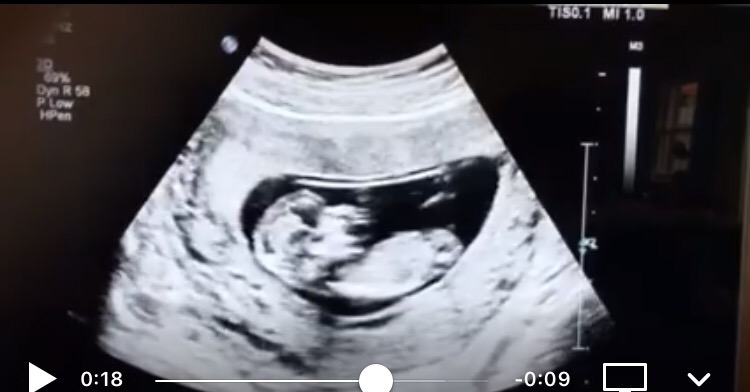
The doctor showed them the spine, the limbs, the minute digits. The heart in its cage, beating, beating, beating. Kidneys, liver, lungs, all manner of organs, organised and working against their day.
The watchers watched and listened and wondered. Their unborn, unknowing it was watched, moved, metabolised and grew. This watching, this lovecharged voyeurism through a window that opened only half a century ago. They saw their unborn, alone, confined, silent, breathing bathwater, drinking sewage, content withal. The watchers felt awe and hope. The man leaned over and held the woman and came away sticky with gel.
 
The doctor said, it’s the size of a lime. The man and the woman closed their palms against a mental lime. They saw with their hands how big, how small was their unborn. The woman giggled with delight.
 
They told me and I thought of the days I delivered babies – that age before ultrasound, when mother, father and doctor looked on the baby and the baby looked on them in equal discovery. Ultrasound alters human relation. Now fathering starts thirty –four weeks before the father is born into fatherhood.
 
I thought too of Judith Wright and her secret love and her poem:
Woman To Man
The eyeless labourer in the night,

the selfless, shapeless seed I hold,

builds for its resurrection day—

silent and swift and deep from sight

foresees the unimagined light.
This is no child with a child’s face;

this has no name to name it by;

yet you and I have known it well.

This is our hunter and our chase,

the third who lay in our embrace.
This is the strength that your arm knows,

the arc of flesh that is my breast,

the precise crystals of our eyes.

This is the blood’s wild tree that grows

the intricate and folded rose.
This is the maker and the made;

this is the question and reply;

the blind head butting at the dark,

the blaze of light along the blade.

Oh hold me, for I am afraid.
 

The Mufti at the Synagogue 

Rachid Imam lives in Diamond Creek, where I used to live. We both raised our families there. In a country town of white faces there were a very few Maltese, the odd Italian and the Chinese wife of my medical partner. I was the Jew on the Main Road and Rachid was the Muslim on the hill. For many years we ran together. As we ran we’d speak of our families. Rachid told me he was the second of three brothers, the black sheep.

He spoke tenderly of his Mum, born into a Christian family, who fell in love with Fehmi El Imam, formerly of Lebanon, since 1951 a resident of Melbourne.
Rachid told me how his Mum left Melbourne, travelling to London where she applied herself to the study of Islam. There she converted to that faith, returning to Melbourne with that as her surprise gift for Fehmi. They married and eventually brought their black sheep into this world – a sheep pale enough to do the pilgrimage to Mecca with his Dad and his daughters. I greeted him with, ‘Salaam, Hajji Rachid!’
Rachid and I had been friends for years before he said with quiet pride: ‘Fehmi came here as a young scholar. The community needed a teacher. Now he’s Mufti of Australia.’
After nearly thirty years the time came for me to leave Diamond Creek. The local Methodists lent their hall for a communal afternoon tea. Rachid made a speech. He mentioned my offer to circumcise his child (how was I to know she was a girl?), he mentioned my tendency to arrive for a run before six on a Sunday morning, waking him and his sleeping girls. After he finished reminiscing he called me up on to the stage and he kissed me – twice – once on each cheek. Then he took the microphone and declared, ‘I’ll run with you anytime, anywhere, my Jewish brother.’
Some years before I met the Sheikh my elder daughter married. At her wedding I watched with delight the son of Australia’s Mufti dancing a hora with the President of the Zionist Federation of Australia.
Yesterday Rachid’s father died. 
I knew Sheikh Fehmi’s health was failing. I’d heard of his stroke, I knew his wife had died years earlier. Today Rachid and his brothers and his sister will observe the rituals of burial and receive condolences from their thronging community, from high dignitaries to the Muslim in the street. All those familiar old rituals, all those echoes of the mourning I observed with my brothers and my sister after our father died.
I met the Sheikh but once. It came about like this: my family has belonged to the Melbourne Hebrew Congregation since 1853. Like most members of that grand synagogue, I seldom attend its services, but I remain a member. Every so seldom the Congregation runs a communal cultural program. Around the year 2000 my brother asked me if I’d ask Rachid if he’d ask his Dad to join a Rabbi one evening and each would address the members on the question, ‘Do we Need to be Afraid of Islam?’

photos courtesy Destiny Magazine Melbourne Hebrew Congregation


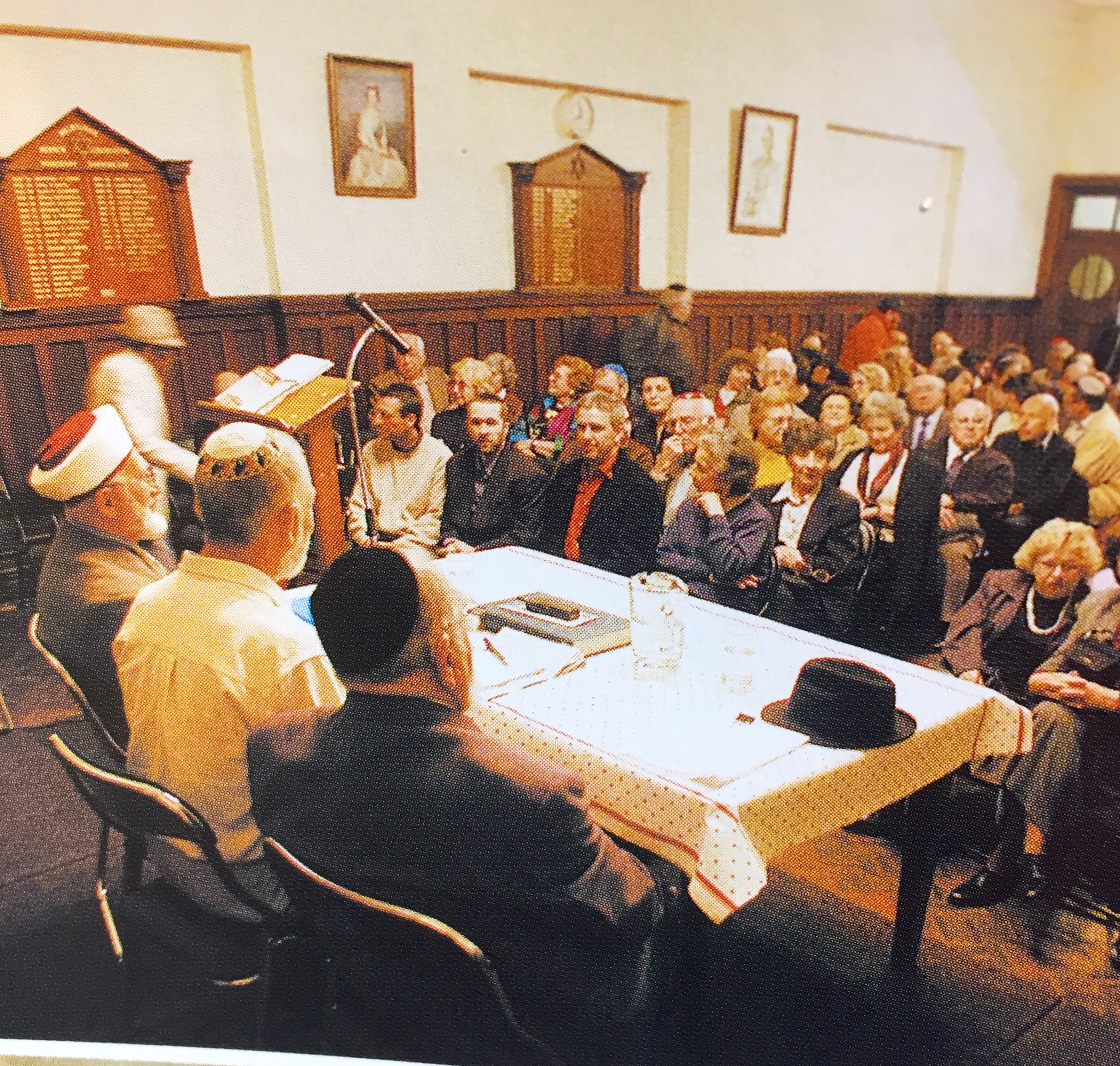
I agreed, Rachid agreed and Sheikh Fehmi agreed. Were we foolhardy? I imagine we all heard the same challenge, unspoken, inescapable: if not us, then who? On the appointed night Rachid met me on the footpath and introduced me to his father and to his brothers. The brothers stood either side of their father. It was clear they were there to support him – and if need be – to protect him. The Sheikh wore a traditional head covering. One son wore a kaftan.
The clergy were to speak in the Social Hall. I offered to show the Sheikh the synagogue’s interior. He was interested. I found some light switches, we entered and I saw the place – a little emptier than usual – with new eyes. I took in its splendor and I sensed from the Sheikh’s reactions the Mosque in Preston was a more modest affair.
We went upstairs. The clergy were introduced to each other and to the audience. The hall was full, people were standing in the aisles, the atmosphere was intense. I saw faces I knew, some of them of people I knew to be mistrustful of Muslims. I was to be the moderator. I welcomed the reverend gentlemen and I reminded all present that the Rabbi and the Sheikh were our guests and I would insist we conduct ourselves on our shared principles of Abrahamic hospitality.
The rabbi spoke uncontroversially on the history of Jews and Muslims. The Sheikh spoke diplomatically on the principles of his faith. He explained the precept of Jihad: ‘Every Muslim must practise Jihad. Jihad, simply, is struggle. It is not warfare. It is, fundamentally, the struggle within to live a godly life.’ The voice that spoke these words was unemphatic, mild, genuine – a teacher’s voice rather than a preacher’s.


Questions followed. Mistrust found its voice. Fehmi never raised his voice. He spoke with quiet dignity. Abraham took a bruising that night at the synagogue, but his hospitality was not broken. Sheikh Fehmi’s bodyguards did not need to rise to his defense.
After our evening at the synagogue I never met Fehmi El Imam again. Later I askedWaleed Aly how the Sheikh was regarded in his community. ‘He’s a very gentle soul, widely respected, he wants a convivial relationship between the faiths in this country.’ I wondered how the Mufti avoided the sectarian conflicts of his diverse community: ‘Fehmi has been around as an Imam for some fifty years, he has an Order of Australia, he is very widely respected and highly regarded. He’s untouchable,‘ said Waleed.


Yesterday Rachid’s family lost a patriarch. His grandchildren lost their Jidoo. The Australian community lost a peacemaker. An asset increasingly scarce has passed. He leaves, within the breast of this infidel at least, an abiding resolve, a personal ‘jihad’ for peace and harmony. The Islamic Council of Victoria said: ‘Former Mufti of Australia, Sheikh Fehmi Naji El-Imam moved to the mercy of God this morning.’

Bob in Starbucks 

I’d like a soy chai latte, please.

Grande? Venti?

A shake of my ignorant head.

The young man explains.

Grande please.

Marker pen raised above paper cup: What’s your name, sir?

Howard.

Pardon me?

HOWARD.


Next time, a different Starbucks: what’s your name sir?

Howard.

Pardon me?

Bob.

Sure, Bob. Won’t be long.


Bob loiters and in truth it is not long before he is drinking the curiously tolerable blend of sugar, sugar, sugar, spices and soy.


My name has always been plastic.

I keep at home a newspaper cutting from ‘The Murrumbidgee Irrigator’ of early January 1946, announcing the birth of Yvonne and Myer Goldenberg’s second child: ‘Myer and Yvonne Goldenberg are delighted to welcome their second child, Adrian. Brother to Dennis.’

Friends flocked to the Leeton District Hospital to congratulate Myer and Yvonne and to commiserate with Adrian. Horrible name, they said to my parents. Do you really hate him that much?

Ben and Ethel visited, bringing their four-year old boy, Howard. Mum looked at Dad, Dad looked at Mum and Adrian became Howard.


I got used to Howard. The softness in Mum’s voice as she spoke the name, the pride in Dad’s, convinced me Howard was good. I used it for a long time.


I came to Melbourne, became an adult and learned to drink coffee. I patronised Universita Café where a short, round young waitress named Theresa asked me my name.

Howard.

Pardon?

Howard.

OK John, I’ll bring your cappuccino to your table.

She did, John drank and the coffee was excellent.

John patronised the Universita for twenty years.

One day I bumped into a man there whom I knew. (I had his baby son’s foreskin at home, but that is another story.)

Hello Zev.

Hello Howard.

We sat down.

Theresa brought our coffees. Handing me my cappuccino, she said, There you are John.

Zev said, Who’s John? This is Howard.

Theresa looked confused. Mortified actually.

I never had the heart to return to the Universita.


I reverted to Howard for a further score of years. And remained Howard. Until I broached the threshold of Starbucks.


Blue Label

My brother Dennis presented me with a blue carton containing a bottle of whiskey. I had never heard of Johnny Walker Blue Label. Whiskey did not interest me. All I knew was I couldn’t afford good whiskey, I didn’t like cheap whiskey and I couldn’t tell the difference between cheap and uncheap. 

Dennis died ten years ago but the box and the bottle survive, unopened. Dennis died poor and intestate after forty-five years working in Finance. Dennis didn’t drink whiskey either. Strong drink was not his weakness. His loves were his weaknesses. One of his loves was for this brother, the one who survives him, healthy and unpoor.


I picture my firstborn brother in an airport palace of luxury items for sale duty free. He looks around for something good, something precious to buy for his loved brother. His instinct draws him to the most expensive items. A man of the world, Dennis recognises the blue label. He takes the box in one arm, reaches for his credit card, approaches the cashier. He makes the purchase he cannot afford, with funds he does not yet own, for the brother who will see no occasion to drink it.


To paraphrase O Henry’s closing remarks in ‘The Gift of the Magi’:


The magi, as you know, were wise men—wonderfully wise men—who brought gifts to the Babe in the manger. They invented the art of giving presents. Being wise, their gifts were no doubt wise ones, possibly bearing the privilege of exchange in case of duplication. And here I have lamely related to you the uneventful chronicle of an unwise child who most unwisely sacrificed for the brother other the greatest treasures of his house. But in a last word to the wise of these days let it be said that of all who give gifts these were the wisest. O all who give and receive gifts, such as they are wisest. Everywhere they are wisest. They are the magi.
 

Taxi Driver in Jerusalem

The cab driver’s clothing smells of cigarette smoke. He looks about seventy but I tell him he is too young to smoke. He asks, ‘You are doctor?’His throaty voice is the ashtray of a thousand smokes.

I confess I am a doctor and the driver changes the subject. He drives with dash and confidence, like the tank commander he used to be, a few wars ago.


He detects my foreigner’s accent in his own language and asks: ‘From which country you come?’

‘Australia. You?’

‘Here. Born here, in this city. Only here.’

‘Here’ is Jerusalem.

The driver starts to sing a love song to his city, the song of a faithful son sung to a mother. 

I listen to the words and as the singer’s voice thickens I take a peek. Tears glisten on the driver’s cheeks as he sings his song.

‘All my life in this city. I live in the house I born. Never leave, never change address. This my one home.’


The song ends as we approach our destination, the fruit and produce market. ‘You maybe visit other places, maybe Tel Aviv?’

‘Yes, we’re going there in a couple of days.’

‘I take you. Only 260 shekel.’

The price is fair. We agree. I give him the address and he will pick us up at 8.30 am.

‘I am best taxi in Jerusalem. My mother tell me I am best. Not my wife say this.’ A hoarse smoker’s laugh.


Eight-twenty we sit at the kerbside, two old tourists and two thirteen-year old grandchildren and four suitcases and sundry packages. Eight-thirty, still sitting. Eight-forty, a bit restless. I call the best taxi driver in Jerusalem. The recorded voice invites me to leave a voicemail. I do so. Eight-fifty, no driver, a new voicemail with a bit of an edge to it. At nine, no driver and my voicemail is choicemail. I end with, ‘Would your mother be proud of you this morning?’


A man pulls up in a brand new cab, a squat little vehicle with a raised ceiling, a sort of minimaxicab. Yes, the driver will take us to Tel Aviv. His price? ‘Two hundred forty. Is OK?’ Is more than OK. The cab smells of new car. The driver hums with the pleasure of his new vehicle and the vehicle hums up and down the great hills that surround the city and the driver tells us what we are seeing. Hill follows hill, hills unfolds into yet more hills and every hillside is dotted with dwellings and farmland. Yaakov – that’s our driver’s name – gives a quick history of every community. ‘This one settled by Hasidim from Rumania, that one is collective, built by kibbutzniks, you know, communists? This one – you see minaret? – a Muslim community. That one a “moshav”, cooperative farm, Palestinians and Zionists together, in one community. Down there, old tank, burned out, from the first war.’ And so the drive goes on, every hill telling a story, the same old stories, sad stories of conflict, stories of hardship, of failure, of success.


Yaakov’s phone rings, a woman’s voice. He listens and answers: ‘Yes, we arrive soon. I meet you at the beach. Yes, I drop customers, I come and we meet.’ Yaakov smiling, the smile a grandfather smiles on his way to a picnic on the beach with his daughter and the grandchildren.


The land flattens, the traffic slows and thickens, green gives way to cement, here is Tel Aviv, sparkling by its beaches, the light a blaze. We alight and pay and take Yaakov’s card. We will ride with him again.


The best driver in Jerusalem is forgotten. Two days later my phone rings. A voice thick with smoke says, ‘I miss your call. You want me?’ It takes me a moment to recognise the voice of the lachrymose singer of Jerusalem, his mother’s pride. Not his wife’s. I remind him of our arrangement.

’O yes, something happen. Family…’

I remind him of my family. I remind him he has a phone and our number.

‘Yes. Sorry for that.’

I ask, ‘Would your mother be proud of you this morning?’

The man’s voice, softer now, says, ‘No.’

I tell him he has shamed his city. ‘Do better next time.’


Smoking the Peace in the Middle East

We stand on the Tiberias to Tel Aviv highway waiting or the early morning inter-city bus. As we anticipated the bus is crowded with soldiers and civilians returning to work after the Passover
holiday. My wife and the two grandchildren struggle into the bus, informing the driver that we have four suitcases that we’ll need to stow in the luggage compartment below. The driver activates a switch and a hatch opens. The luggage compartment is too full to fit a sandwich. I stand on the pavement with my four suitcases and a thoughtful expression. A soldier just old enough to grow a few whiskers has a backpack to stow. He leans deeply into the luggage compartment, bending his slim back, hefting, pulling, piling, jamming items of baggage together. He has created ample space for his backpack.

But he steps over his own luggage towards my array, grabs a suitcase in each hand and thrusts them into the space he has created. Again he leans, lifts and shoves. Somehow our cases are all aboard. I hoist the soldier’s backpack, find an interstice and widen it, shove the pack in and hope. The hatch closes and we two ascend, the last of the riders. I pay the modest fares for the 170 kilometre ride for four passengers. The driver apologises: regulations require him to charge the two thirteen-year olds full fare. He is sorry, what can he do? – he asks with a raised shoulder.
Inside the bus all seats are occupied. Three young soldiers lie in the aisle, one sleeps while the other two busy themselves with their screens. From the rear seat a figure in civilian red rises, beckons to me, indicates the seat he has vacated. I must sit.

Amused, grateful, mildly embarrassed, I tell him I’m alright mate.

No, he says, I must sit.

I shake my head.

‘Please sir, sit. Next stop, I descend.’

Three recumbent soldiers in the aisle rise with good grace and make way for the old man with his bulky backpack.

We emerge from the two-hour bus trip at Tel Aviv’s Central Bus Station. Passover has just come to an end and we are looking forward to eating leavened breads again. We emerge from Security and see before us a huge array of croissants, bagels, seeded rolls and pastries. I take the family’s orders and approach the squat woman behind the counter. ‘Two double espressos, one croissant, one chocolate turnover, one danish pastry, please.’ The woman maintains a studied silence. I stand for a moment, nonplussed. Has she not heard me? Is it perhaps, self-service? Is she perhaps deceased?

After a good time the woman passes me three paper bags. She manages to do this while turning her back to me. She has not spoken. Feeling like a semi-licensed thief I fill the three bags. Mrs Pastry now leans over her ranks of post-paschal breads in my direction, proffering coffee in a paper cup. A second follows. Still, no conversation. 

‘By what sum am I indebted to you?’ – I ask in my courtly, non-colloquial Hebrew.

The oracle now speaks: ‘Forty.’


Ellie looks up and laughs through her mouthful of chocolate yeast turnover: ‘Look Saba, Savta!’

We look towards the tee-shirt shop next to Mrs Pastry’s, where Ellie indicates a shirt in pink with the text:
DON’T WORRY

BEYONCE.
‘Ellie, would you like shirt like that?’

Ellie would like a shirt like that.
Ellie and I enter the tee-shirt emporium. Hundreds of tee-shirts of modest price and quality hang from cords suspended from the ceiling. All the shirts are suspended high, beyond human reach. Safe from theft they are also unpurchasable without human help. We look around us. Moving browsily beneath the display a handful of humans considers the merchandise. One sits, cross-legged on stool, like patience on a monument, entirely still. This person is slim, petite, elegantly presented.Her lips are the colour of venous blood. Her skin and hair are of midnight black. I approach her. She does not speak or move.

Hazarding a guess, I ask, ‘Do you work here?’

The merest of nods.

‘My granddaughter wants to buy the BEYONCE tee-shirt.’

Movement now as a slim arm emerges from behind the slight torso. Between two fingers of the hand at the end of the arm sits a cigarette.

The confessed employee inhales deeply and silently.

No verbal response. Perhaps we have visited her workplace during her sabbatical.

‘Can you help us?’

The Queen of Sheba points her cigarette over our heads. We turn and look up and backward for the shirt. We cannot sight it. 

We gather we have made our visit at a time when the spirit of enterprise is not active.

Ellie, richly amused, decides she can be happy without beyonce.

Instead, chuckling, she takes photos of the the tee-shirt in the display.  
At ‘Abulafia,’ the Palestinian bakery in the ancient port city of Yaffo, men in pious black yarmulkas queue to buy pastries from Palestinian men in tee-shirts.

In Hebrew and English the shopkeepers wear tee-shirts reading, ‘Jews and Arabs refuse to be enemies.’ Others wear shirts that read, ‘Headquarters of Israel-Palestine peace.’ As shopkeepers the peacemakers are indistinguishable from Jewish Israelis in their generous disdain towards customers. My wife, an attractive grandmother, speaks a clear and correct Hebrew. The bakery boys affect not to understand her menu enquiries. One shrugs and directs Annette to his colleague. He too affects non-comprehension. He winks at his colleague and turns away from Annette, his face closed.
When a second customer approaches, Annette’s two refuseniks compete to serve her. This newcomer is forty years Annette’s junior. 
Now I try my luck. ‘A toasted pita please, with salad filing.’ The man I address does not look in my direction. Like a magician, he flicks an unseen cigarette from nowhere into his mouth. Exhaling dragon-like he grunts something indistinguishable. I look around, find myself the sole customer and ask, ‘Pardon?’

‘Harif?’

Harif is the Hebrew term for shrewdly intelligent. In fast food places it means, ‘spicy.’

‘A little, please.’

This is the second time I have spoken the P-word. ‘Please’ gives me away as surely as it betrayed Annette. Despite our better than serviceable Hebrew, we have revealed ourselves as that least assertive of all tourist species, the Anglo-Saxon.

A second smoker materialises, slides my pita into a toasting oven, smoking all over my lunch in transit.  

Moments later, seated on ‘Abulafia’s’ dusty stone steps we enjoy our smoke-toasted borekhas, pitot, and pastries. Too hot to handle, ridiculously inexpensive, memorably good. 


Going to the Wall

My family used to be employed in Jerusalem. Unfortunately our family business was disrupted for a time by conflict and conflagration. In what appeared to be arson, on the ninth day of the month of Av in the year 70 of the Current Era, our office was burned down. 
The office I refer to was the Holy Temple where my forebears would officiate in rituals of sacrifice, in mediating and arbitrating disputes, in quarantining suspected carriers of contagious disease and in blessing the people. As the reader will realise we worked as lawyers and doctors and priests. After the burning my family was unable to go to our office for nineteen centuries. Then in 1967 we returned. The other day I went back to the office where I resumed working in the family business. 
It happened like this.
My two eldest grandchildren, both aged thirteen, accompanied my wife and me on our current visit to Israel.
The boy, a pretty secular fellow whom we’ll call Jesse, walked down to the Wall with me. He understood the antiquity of the Wall and something of its sanctity. Praying is not his specialty. ‘What will I do, Saba?’
‘I pray there, Jesse. Some people write their prayer on a slip of paper and insert it into a crack between stones.‘
‘What should I pray for, Saba?’
‘Think of the thing that you most want in the world, Jesse. Ask for that. It could be some deep and secret thing, something you wish for yourself or for someone else.’
Jesse has seen suffering. Earlier he saw a man begging. Well made, about the age of Jesse’s father, the man requested small change, blessing anyone who donated. The man walked on a distance from Jesse, turned away and covered his face with his hands. His shoulders shook.
At the Wall, Jesse pressed his lips against the glowing stone. He leaned his forehead against the Wall for some time, his lips moving. Then he posted his slip of paper into a tiny eye socket in the stone.
As we walked away backwards, Jesse stopped me and threw his arms around me. He said, ‘That was a really important experience, Saba. Thank you for taking me here…I love you, Saba.’
We rejoined my wife and Jesse’s cousin, whom we’ll call Ellie. They too had prayed at the Wall. Ellie’s fair features glowed: ‘Saba and Savta, that was wonderful.’ My hands twitched, a spasm in unemployed muscles. I recalled I was a Cohen, a lineal priest: I was in the blessing trade. I rested my palms on Ellie’s head. My fingers splayed and I searched for some voice. The voice shook as I recited the ancient words: ‘May God bless you and keep you…’ Here I was back at the old workplace, here was Ellie, flesh of my flesh.
I had waited 2000 years to get back to work. I annointed her fair head with my salt tears. 

Jim is Dead

December 18, 1969. A large moon rises before me in the geriatric wing of the Royal Hobart Hospital. This is unexpected as we are indoors and it is noon. The moon shines across the room in my direction. Beneath the bright disc sits a white clerical collar. Just below the disc’s equator a set of white teeth smiles widely. The smile advances, a pink fleshy hand extends and a voice says, ‘Hello. I’m Father Jim. I’m a chaplain here. Call me Jim.’ The hand is warm and kind. I am a new doctor. Today is my first day in my first job. All around me old people drool and gibber in a manner to overwhelm a new doctor.

The moonfaced Friar Tuck is delighted to meet Howard Goldenberg. He says, ‘You’re new here Howard? Welcome to the Royal. I hope you’ll be very happy here.’

Fifty metres distant stands the weatherboard shack which houses the new doctor and his new wife. The new doctor says, ‘Jim, will you join my wife and me for lunch? We’re going to eat soon. Fish…it’s an Indonesian recipe.’ Jim would love to. Thirty minutes later Jim and his new friends Annette and Howard are seated in the shack eating a luncheon of fish bones and curry. Jim fossicks for flesh among the fine bones, eats up and does not complain. And Annette and I have made the first new friend of our married lives.

April 6, 2016. My Facebook-facing daughter forwards the following:

Dear Howard, I am sorry to have to post a message like this via Facebook but I am sad to say that your good friend Jim Smith has died this week, here in London. My name is John and I am his partner, Jim & I met you in North London when you were visiting your family, I think in 2014. Jim had a stroke last year and I was caring for him at home, he had to go into hospital with a pulmonary embolus and then had complications which led to his death on Sunday. I know he always enjoyed his conversations with you, if you have any special memories you would like to send me I can include them in a JimMemory book I intend to put together. I will let you know when the funeral is, if you would like to light a candle and say a prayer for him.

PS RIP Jim! He was quite comfortable and free of pain (he had some back trouble) at the last. John

Jim is dead. Faster than tears an image flashes before me. I see a black and white photo in a family album of a moon-faced man seated outside our rustic house in a village outside Melbourne. The large face is crowned with a white handkerchief knotted at its corners. Upon the lap of the large man sits a small child, our angel Raphael, aged not many months. A perfectly ordinary image: no collar, no ecclesiasticals, no pretence; just a man nurturing a child. The image says enough. A man, a child. Poignant as a Pieta the image drives me from my screen to Annette. My voice disintegrates as I tell her the news. I ring my daughter who is tearful too.

Father Jim Smith married hundreds of heathen nurses to hundreds of pagan doctors in his days at the Royal. All those unbelievers flocked to this man who seemed to personify something missing from the lives of those science-infested people. But around 1990 Jim quit marrying. He said, ‘I marry them, they make vows, then they divorce.’ He felt the losses, each by each, personally. ‘It’s as if their marriage meant more to me than to them’, he said.

Father Jim introduced us to his partner in goodness, Jim Turley. Now we had two Father Jim friends. The two – together with a non-priest – created what might have been Australia’s first refuge. They called it St Michael’s Priory and to it flocked beaten wives, beaten children, lonely people, people mad and broken. All were taken in, housed and fed, and where possible, repaired.

The Priory rested upon the slender incomes of the three and upon donations from parishioners, who brought laying hens, a milch cow, produce – and a pair of Nubian goats. The Jims took us down to shed and showed us two sleekly beautiful creatures. Their coats of Nugget Dark Tan shone on the backs of their aristocratic bodies. Shy, their slender faces darting, their small ears rising and turning to sound, they looked like deer. ‘Meet the Goldenbergs’, said Jim Smith. He was addressing Annette and me, not the goats: ‘This one is Ruth and this is Naomi. They’re pedigreed. We were told we should register them. You could register them by name, so we chose from the Bible. Then Jim and I said, “Ruth and Naomi are Jewish names. Let’s give them Jewish surnames”. So we called them Goldenberg, after our Jewish friends.’

Years later Annette and I gave our third child a Biblical name. She became Naomi Goldenberg, named after a relative at St Michael’s Priory in Hobart.

The Jims used to come to our shack in Gore Street, for Shabbat dinner on Friday nights. They’d stand silently in their yarmulkes while I’d recite Kiddush. Afterwards they’d make a fair fist of translating odd phrases from the Hebrew, to which they’d been introduced during their studies in Divinity. One Shabbat eve one of the Jims – I don’t remember who – challenged the second: ‘Jim, I don’t sense you are making any effort at all to convert the Goldenbergs.’ The other Jim confessed: ‘That’s true.’ And the second Jim nodded and admitted he too was remiss. And one said: ‘I don’t feel any call to change the Goldenbergs.’ That moment love shimmered before us at our Shabbat table: two men of God had each found grace sufficient to deny abstract vocation in favour of human feeling.

Eventually Jim Smith left the Royal, left Hobart, said goodbye to the Priory and to his celibate brethren. It might, for all we knew, have felt like dereliction. Today I picture it as burnout, as an escape from accumulating vicarious trauma.

Jim took a job in Melbourne as chaplain at Pentridge. There his parishioners were prisoners and warders. He sat and he listened to their confessions and to their unconfessions, their lies and their rationalisations. One godless murderer habitually visited Jim on the pretext of spiritual need where he simply craved intelligent conversation. That man had forced his way into a hairdressing salon where he splashed lighter fluid over his rejecting girlfriend before igniting it. The woman survived her horrible burns. Her hairdresser did not.

An equally godless, notoriously brutal warder used to seek Jim out in the Officers’ Mess. He’d ask Jim, ‘Do you mind if I join you?’ Jim decidedly did mind but avowed the reverse. The man, loathsome and unctuous, habitually chose Jim as his companion. Jim couldn’t say which of the two – the murderer or the officer – he liked less.

On one occasion the murderer made a singular confession: boastfully he declared, ‘When we want to punish a warder, we do. We have our ways.’ Jim, genuinely curious, asked –‘How?’ He regretted the question instantly. The prisoner said, ‘We piss in their tea.’

Some time later Jim went to the Officers’ Mess for lunch, took his seat at an isolated table and said, ‘Yes, of course’ when the warder asked to join him. Shortly a prisoner arrived to take their meal orders. Jim ordered his lunch, the warder ordered, the prisoner noted their requests, then asked, ‘Beverages, gentlemen?’ Jim requested tea, the warder said, ‘Same for me.’

Jim sat and enjoyed the warder’s conversation until a second prisoner arrived bearing their food and drink. This prisoner was none other than the murderer. He handed Jim his food, passed the officer his, then said, ‘Here’s your tea, Father.’ He walked around the table and, standing a little to the side and behind the warder, passed him a second mug. Winking hugely at Jim he said, ‘And this is yours, sir.’ Jim sat and watched and kept his peace.

Once again Jim and we were living in the same city. Often he’d would join us at our Shabbat table and at Passover Seder and he’d report on what he called, ‘my time in gaol.’

Later, with his usual genius for vocation among the desperate, among those who were losing and those who were lost, Jim became chaplain to Intensive Care at a major Melbourne hospital. In ICU something like one patient dies of every four who enter. The rates of loss are higher than in a theatre of war.

Eventually Jim retired. Amazing us all, since he’d been resolutely republican and a pronounced proletarian, Jim settled in Britain. Here he found love, a partner in John, and diabetes – the lot of many Friar Tucks.

Every Passover and every Jewish New Year a letter would arrive addressed and written in the child’s block lettering that was the Jim Smith calligraphy. The letters told us of the Jewish roots of Jim’s belief. They’d include clippings from the newspaper columns of ‘my favourite religious writer, Rabbi Jonathan Sacks’, soon to become Chief Rabbi of the British Commonwealth. In his long London epoch Jim read widely and deepened his sense of following a Jewish Jesus. His pleasure in our friendship grew deeper and eventually he crossed the world to attend our eldest daughter’s wedding in Melbourne.

Jim lived with John, sharing travel with him as well as musical theatre, which he loved. A man great in his levity, Jim radiated a softness that healed, attaching him to old friend and to new. When I visited my daughter Naomi (the goat’s child) and her husband and children during their domicile in London, Jim, frailer now, crossed the great city with John for a visit. It was Shabbat and space and time had shrunk. Here was Jim, here were his old friends, here were our tender little ones. Jim was still Jim. The spark of joy still shone. But I wondered if we’d meet again. The moments passed.

And now Jim is dead.


Happy Concatenation

Mr Menzies, as he was then, used to report to Parliament upon his return from
The Prime Ministers’ Conference in London. He’d introduce his report with, ’By a happy concatenation of circumstance I happened to find myself in London for the Conference at precisely the time of the Cricket Test Match at Lords…’
I read this in the ‘Age’ newspaper and looked up ’concatenation’. I have kept the word close, generally unused, for the half century since.
 
By a singular concatenation of circumstance, today Jewish people around the world observe Shushan Purim on precisely the date of Good Friday. Yesterday we had the concurrence of Purim with Shrove Thursday; and the previous day the Jewish Fast of Esther coincided with the fast of Ash Wednesday. That’s how calendars concatenate.
 
By a happy concatenation of circumstance, while riding home through the park yesterday I overtook another cyclist, emerging into Commercial Road just as she did. From a long way back I saw first the yellow jacket. Gaining, I noted her tall, erect carriage in the saddle, her fair pony tail, her fair skin. Emerging from the park, with eyes only for the vehicular traffic ahead I had no time to sight her face.
I crossed the road and halted, waiting for the red light to turn. A voice emerged from a blur of yellow: ‘Howard? It is Howard, isn’t it?’ I had time now to take in that fair face, to recognise the features and that voice. A voice of a singular quality, a soft voice, with a sweet self-echo, as of a bell. I knew that voice.
‘Hello, Camilla.’ My voice would have carried surprise and delight.
‘Where are you heading, Howard?’
I indicated.
‘Me too,‘ she said, ‘I’m headed to St Lucy’s to pick up Joe.’
Our ways were the same and we rode together and caught up on the events of ten years: the growth of her son Joe (one of my babies), the decline and deaths of her parents and mine; and the premature loss of a brother, in each case only a little older than ourselves.
 
 
I told Camilla about Dennis. I mentioned the regret, my uncompleted mission, that marked my time with Dennis and that surfaces years after his dying, in my dreams. When I spoke of my brother’s dying Camilla’s face fell. Her voice a deeper bell.
 
‘I lost a brother too. I loved him.’ Camilla’s voice thrilled and her face shone as she spoke of her brother. ‘His name was Tom. He was a twin. He lived to forty-nine then he died. I don’t know what of. He was disabled. I loved him. We spoke on the phone every day. Every single day.’
‘What was his disability, Camilla?’
A smile, a half shrug: ‘Do you know, I can’t say exactly what he had and I don’t know what he died of. I suppose now you’d call it cerebral palsy. He was born with it. He was just my brother and we loved each other. We were together every day as children, back in the Mallee. Then I left and studied and moved interstate, but it was still the same. We spoke every day. I loved him. Often we’d speak a few times in the one day.
‘Tom was the second twin, you know. Second twins are often sicker…but you’d know all about that.’
I wondered about Tom’s disability: ’Was it physical or intellectual, or both?’
‘It was both. Do you know, I’m buying the old family home. In the Mallee. It’s a sentimental thing, a bit silly really.’ Camilla laughed: I’m buying out the other twin. I want the house. Tom and I lived in it, Tom lived there all his life.’
 
We arrived at St Lucy’s. Children thronged in the grounds, ignoring the scores of parents who waited outside. They played and shouted and pushed and grabbed each other in the high spirits of the coming holiday, while Lucy’s eyes searched for Joe and my mind played on brothers loved and lost. On a brother who called me every day, often two, three times a day.
 
Shouting goodbyes children drifted from the gates to their parents. A tall child, erect and fair, came into view. He greeted Camilla in a sweet voice, soft, with a sort of self echo.


[I wish readers variously a joyous Shushan Purim, a holy Easter, and always, always – happy concatenation.]

The Departure Lounge 

Driving my sister to the airport earlythis autumn morning I looked about me and took in the mists and the mellow fruitfulness. My younger sister is not young. Shortly we would embrace, say goodbye, we’d look forward to next time and we’d both know, ‘next time carries no guarantee’.

I recalled a trip I took to that airport with Mum. I described it to my sister: “This all happened before Mum suffered her strokes. She was not young but could still travel independently. My plane to the outback was due to depart at 10.00. Mum’s inter-city flight was scheduled an hour later. I dropped Mum off at her lounge in a shower of kisses and embraces, and raced to my own lounge. Over the Public Address I heard, ‘The flight to Woop Woop has been delayed. We expect to board passengers at 11.00 and to take off soon after. We regret the inconv…’ I raced back to Mum.

‘Hello darling. How lovely to see you!’ Mum’s face was lit by a smile of mild astonishment. Time’s exigencies always surprised Mum. I began to explain and she took my hand and began to stroke my volar forearm. She said, ‘Aren’t we lucky, darling.’
I felt lucky: here we were, quiet together among the hubbub, heads bent to each other, tasting our found time. A thought came to me: ‘Mum, we two have always been sitting in our Departure Lounges, waiting for our separate flights. We both know one day we’ll have to leave, we just don’t know when. And we can’t really know who’ll leave first.’
Mum nodded. Her walking fingers patrolled from my wrist to the inside of my elbow, back to the wrist then back again. Her touch was light. I thought of early memories of Mum’s touch, of the times when she bathed Dennis and me. We both spoke at once; ‘Your skin feels so soft and smooth.’ 
  

As our hour melted away we didn’t say much.
The Public Address commanded us to part. Knowing and accepting, we parted in gentler shower of kissing and holding. Knowing and accepting and feeling very lucky, we took our separate flights.”