Teaching an Old Dog Old Tricks


“Good morning, Doctor.’ The good-looking man is new to my practice. He offers a hand, shakes manfully, breaks no bones but leaves none unfirmed. His smile launches a promising relationship. ‘I’m new to Melbourne, doctor. Just moved here – for my studies.’


The man looks a young forty. I check his date of birth; he’s forty-nine.

‘What are you studying?’ – I ask.

‘Philosophy. Classic Philosophy, the greats, you know, Plato, Aristotle, Aquinas, Maimonides…’

He’s won me.


‘I used to be a lawyer. Made some money, made a family, four kids. Now it’s time for me. Time to pursue wisdom.’

‘Share it with me when you find it,’ I say.

He smiles.


‘Doctor, I wonder if you can help me out. Awkward situation. I’ve left my tablets in Sydney. They’ll arrive Monday next with the family. My doctor prescribed a short course of Temazepam for sleep. Exams next week and I can’t sleep. If I don’t sleep, I’ll fail. If I fail I’ll never find wisdom.’ The winning smile again.


 ‘What are the tablets?’

‘Temazepam, the weaker ones, the tens. I’m scared of anything stronger.’

‘Very wise. They’re habit-forming.’

The man looks shocked: ‘Habit-forming? Really? My doctor never mentioned that. I just want enough to get me through these exams. I finish in three weeks.’


The man and I spend a little time discussing Temazepam, natural remedies, his own preference for a long hard run (‘Wouldn’t you know, Doctor, my running shoes are still in Sydney?’) The man looks up at the marathon photos that cover my walls where other doctors show their degrees.

‘Are you still running, Doctor? Marathons? Really? Amazing!’


The man leaves my room with his limited prescription, leaving behind his protestations of delight, his vows he’ll be back, how lucky our paths crossed, he’s found a disciple of Maimonides, he wants me to be his new doctor.


A couple of patients later the receptionist buzzes me and pricks my balloon: ‘That new patient, do you know what he said about you, Howard?’

‘No.’

‘”What an amazing doctor! Still running marathons!” Says you are a scholar, an expert in Greek Physiology.’


‘You know what else he said?”

‘What?”

‘He said he left his wallet in his car. He said he’d be back in five minutes to pay. I asked him for his Medicare card, but that was in the car too. But he knew his number, he said, and I took it down. Thirty minutes and he’s not back. I rang Medicare: there’s no such number and they have no record of that name at the Sydney address he gave. I rang his mobile. “Optus advises the number you have called is incorrect or has been disconnected.”


Three years pass. Three years are not sufficient to heal a wound in trust.

Last week a new patient registers with Reception. He presents his Medicare Card, asking a series of questions:

‘What doctors are consulting today?

‘Who will I be seeing?’

‘How long has he been at this practice?’

‘I just need a prescription. I’ve lost my tablets and my wallet too. Can I pay with my credit card?’


The relatively new receptionist was not with us three years ago. She calls me: ‘Are you with a patient, Howard?

‘No.’

‘May I come in and talk with you?’

‘Certainly.’

The young woman is shaking: ’I think your next patient is lying. I think he might be the man who came here a few years ago and lied to you to get tablets.’


A phone call to the Doctor Shopping Line at Medicare. I give the Medicare number of the new patient. ‘We suspect he’s a doctor shopper’, I say. I give the new patient’s stated name. The Medicare person confirms the validity of the card and the truth of the name given. ‘We have records of that patient’s recent prescriptions. He’s had eighteen prescriptions since March first, every one of them for twenty Temazepam tablets, each prescription from a different doctor in your area. You might like to inform the patient of these facts, Doctor.’


A Guest of the Emir

Recently I enjoyed the hospitality of the Emir of Dubai. Overnight Qantas flew me from Australia to the Emir’s desert airport where I boarded one of his aircraft, bound for Malta via Larnaca. At 0720 I found my seat in the very front row of Economy. As we were not due to take off until 0750 there was sufficient time for me to recite shacharith, (literally, the dawn prayer).


I looked around. I saw no other yarmulkes. On the other hand, there were no hijabs either, nor keffiyehs. I pulled out of my backpack all the elaborate paraphernalia of my morning prayer – tallith, tefilin, siddur and stood for a moment, irresolute. I recalled the prayers of my family on the eve of a previous Emirates flight: ‘Dad, you can’t do all those rituals on Emirates. It’s provocative. It’s not safe. Please, Dad, don’t do it!’


I unfolded my tallith. Not just any old prayer shawl, this was the final gift to me of my father. Very late in Dad’s life I took him to Gold’s where he bought this tallith for me and I bought one for him. An absurd exchange? Possibly so. It was one we had ritualised over a couple of decades: at the kosher grog shop, I’d shout Dad to arak or slivovitz for Passover and he’d buy me a brace of claret and Kiddush wine. Happy to enhance the other’s observances we’d grin and embrace and bless each other.

I looked at the tallith and felt the fall of many curious eyes. I thought of Dad and I wrapped it around my head and stood, enfolded, for a few moments of remembrance. Then I showed my face.


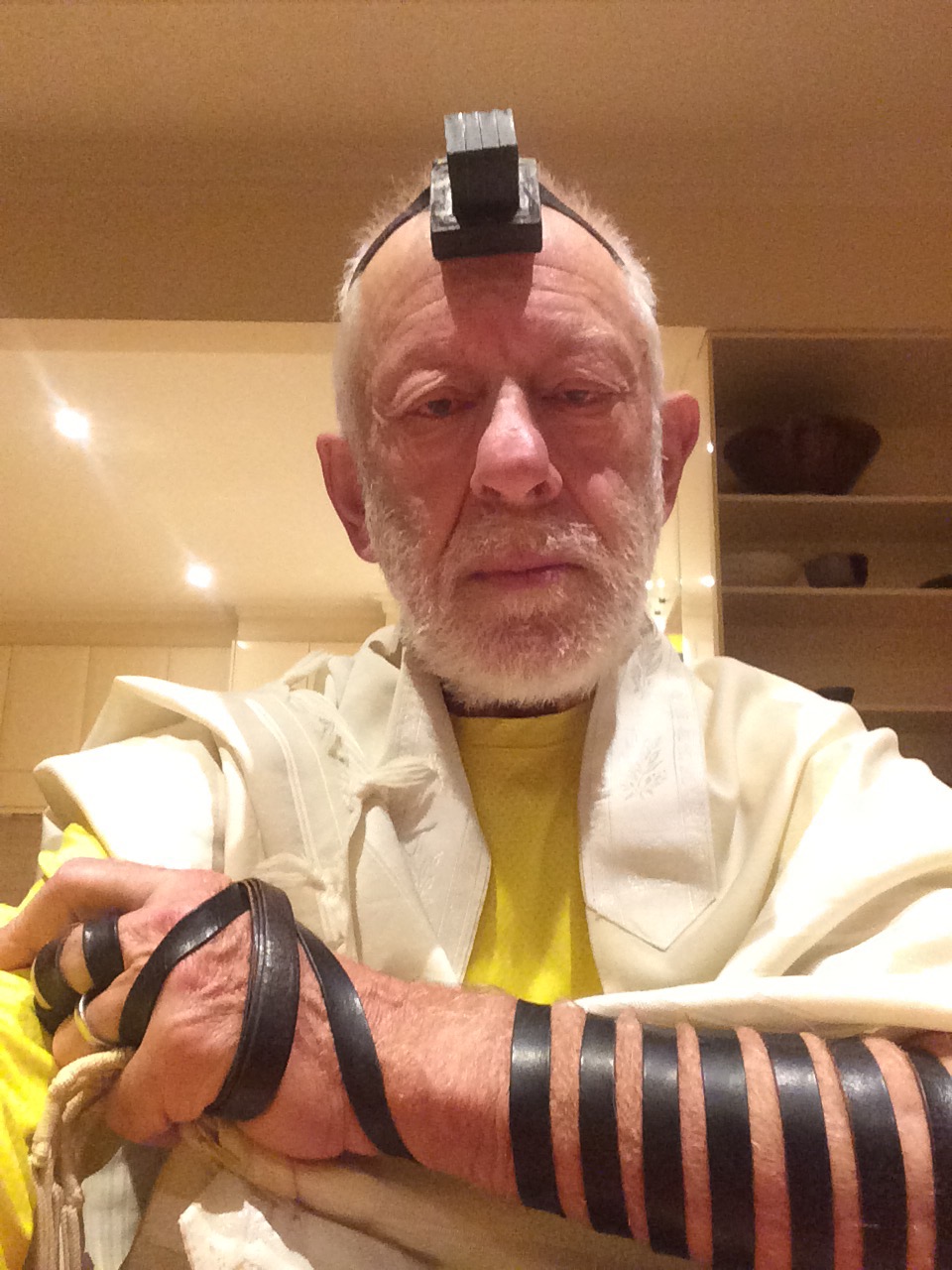
Standing in my seat in Economy I realised I was providing a live show for the roughly 160 gentile persons filing slowly past my seat at the front, en-route to their own. I had more colourful display in store for them. I pulled out the small bag of royal blue velvet that holds my tefilin. These small black leather boxes, fashioned after an ancient craft, contain Torah verses meticulously inscribed on vellum. Tefilin symbolise key rememberings that are mandatory every day upon every Jew. Attached to the little boxes are long black leather thongs by which I bind one box high on my left arm and another to the centre of my forehead. The verses thus are bound to my heart and my mind.


The unfolding of tefilin, the minute and precise steps of the placing and binding, punctuated at prescribed intervals by the reciting of rabbinic and prophetic words, constitute a dance no less exacting than the mating of brolgas. Three hundred and twenty eyes took in the old choreography. 


Upon completing my devotions I removed one leather box, kissed it perhaps a little more reverently than usual and coiled its straps. I did the same with the second. Finally I folded my tallith. The ceremony of prayer at an end, I took in my fellow passengers. We were Filipinas, Chinese, Occidentals, and a fair smattering of persons of Middle Eastern appearance. No-one had raised the alarm, no-one objected to my sectarian display.


When at last I sat down, the man next to me asked: ‘Where do you come from?’

‘Australia. And you’re from Korea?’


A large smile. Surprised, happy to be recognised, he nodded. He and his wife and his volleyballer-tall daughter were heading for Malta, as I was. ‘For our holidays’, he said. And what was it that drew me to Malta? The Conference of Arts and Sciences, certainly. And yes, the marathon. But before all that I was coming to listen for the voices and hear the stories of dead Jews.


A Backward Country 

There’s a problem here. Police officers wander around singly, unadorned by bullet-proof vestments, no gun at their hips. I took the ferry to Gozo. No-one searched my bag or my body. Same when I entered the bank, the same at The Grand Hotel Excelsior. The same at the Biblioteca National. 

People seem relaxed. A citizen trusts her neighbour. 

The place is full of foreigners but no-one seems to care. We are just across the water from Libya and no-one is afraid. Negligent governments have not sown mistrust. Is everyone here asleep?

A backward country, this. I met Malta’s number three cop. A gentle sort of fellow, he seemed about as menacing as a powder puff. Where were their blokes who swagger around the borders and within them, like the Border Protection Force that keeps all us Aussies feeling so safe?

I went to a barber shop. Hidden up a staircase above a (not very) supermarket, and around some corners, it was a narrow establishment, its proportions little bigger than our guest powder room in my home. I hesitated at the threshold. Something faintly seedy about the joint, hard to pin down. A scent of tobacco breath mingled with barbershop smells. There were two chairs, one occupied. A tangle of odd black electric cords hung from a power point, metal implements lay scattered as if some disturbance had been and passed.
 

A young man with olive skin and a spade-shaped black beard looked up from the head he was trimming and waved me in. He was lean and tall, his black hair falling in wild waves about his narrow head. I guessed the young man might be in his late twenties. He looked lithe and coiled – Caravaggio before a brawl.

A second young man seated in the depths of the room rose as I entered. He too was tall, but better fed, perhaps a few years younger. His head was crowned with tight black curls pulled back into a pony tail, his jaw covered in a curly black spade. I thought I caught a fugitive smile. He waved me to the second chair, stood over and close to me, and raised an eyebrow. It was a question. I answered with a question: Can you make me beautiful?

I no English much.  

I pointed to my own chin, scruffy with whitish undergrowth. Zero, I said.

He nodded enthusiastically.

I pointed to my scalp, an arid garden.

Two, please.

More nodding, a big smile.

I sat back and considered. Flowing beards are all the go here, but it’s the barbers not the barbered who wear them. I looked around for a cut-throat blade, sighted none, sat back again and relaxed. The two young men were engaged in jovial conversation with a third, the customer in the first chair. I wondered what the joke was. Perhaps it was me. I listened for words I might recognise. The local language Malti is Semitic. It sounds quite a bit like Arabic, from which it traces its origins, with plenty of words similar to Hebrew which I can speak tolerably fluently. As the men conversed I sensed this might be street Malti, pretty rough and ready, perhaps untroubled by grammar or syntax. I listened some more. Lots of words were familiar, too many: this was Arabic, not Malti.

In all the flow of camaraderie and good humour, my barber man concentrated hard on my hair. His movements were gentle and deft. In the mirror my scalp rose into view from its sheddings; a wide and empty plain surfaced where I was used to seeing hairs. Two was shorter than I expected. Given the intimacy between me and the barber man, I felt we should be on first name terms: 

What’s your name?

Asraf.

My name is Howard.

Hawa?

How-wad. 

How Wad.

I nodded and grinned. Good to meet you, Asraf. 

From where you come?

Australia.

Asraf digested this: Much far.

Yes. Where do you come from Asraf?

Tripoli.

Libya!

Yes.

Asraf grinned and resumed operations.

My artist spent a lot of time and close concentration on corners and in nooks where I seldom gaze. Nostrils were explored, earholes broached, ear perimeters subject to hair-by-hair extirpation. Finally he straightened, turned, laid down his electric instrument, and advanced bearing a cut-throat blade. I felt a tremor. My misgiving derived not for Ironbark but Sinai: the biblical prohibition echoed -Ye shall not round the corners of your heads, neither shalt thou mar the corners of thy beard. For some reason the naked blade is held to violate this Law while the electric trimmer is accepted – by some. I waved away Asraf’s trusty skibouk: Not this one. I like electric. After a further fifteen minutes of electric search and destroy Asraf was content there were no escapees.  
Asraf removed the tarp from my torso. I rose and together we surveyed my remains:

Shukran, I said.

How you know Arabic?

I produced my yarmulke and applied it to my naked scalp.

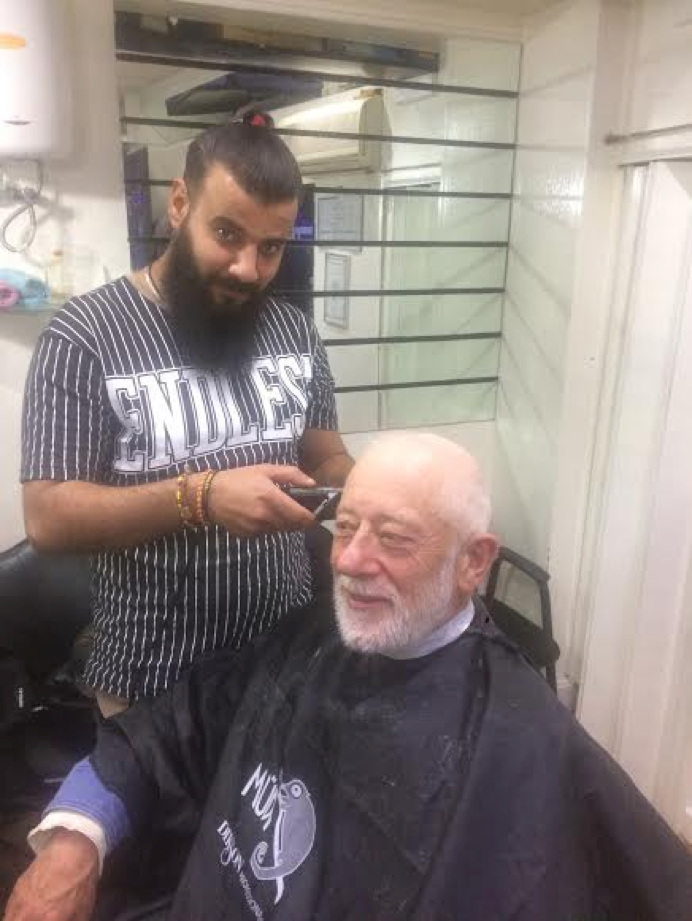
Asraf’s grin was huge. Reaching for his phone he leaned and wrapped his arm around me and took a photo of us both. A modest sum augmented by an immodest tip changed hands. We shook, I left and went to buy groceries next door. Exiting the grocer’s a few minutes later, I nearly bumped into Asraf and Carravaggio. They’d gone outside for a smoke. Whenever I see someone smoking I feel a pang, and I ask myself, Why? 

I waved as I passed by my friend from Tripoli and guessed the answer to Why? might lie in what he’d seen, what and whom he’d left behind. 


I Read the News Today, O Boy

I read this news report today. You probably missed it as mainstream news media don’t print this sort of news.
“Mourners are streaming to the central Israel city of Tira to comfort the family of a nineteen year old woman killed by ISIS. Lian Zaher Nassser was one of 39 people killed by an ISIS gunman at a New Years celebration at an Istanbul nightclub.
She was laid to rest at a funeral attended by thousands on Tuesday, just over a week after another Israeli woman, Dalia Elyakim, was buried. 

Nasser, an Israeli Arab, was on holiday in Istanbul with three friends, one of who(m) was injured. Elyakim, killed in the Christmas market attack in Berlin, had been travelling with her husband Rami, who was badly injured in the attack.

In the Nasser family’s sorrow, it found help from an unexpected source – ultra-orthodox Jews. The parents wanted to get their daughter’s body back to Israel as quickly as possible, but ran into difficulty as she was not insured, and in the end enlisted the help of the Haredi-run rescue organisation, ZAKA. ‘ZAKA is an international humanitarian organisation that honours the dead, regardless of religion, race or gender,’ said the organisation’s chairman Yehudah Meshi-Zahav.”

People react differently to this sort of report. For some the news comes as a salve, a corrective to the bad news tsunami. Others read it and say, ‘Yes, but…’

Working at the Children’s Hospital recently I treated a child who wore a pink hijab. She did not look mid-eastern, nor African. Her surname was unusual. I wondered a bit then hazarded a guess:’Are you from Albania?’ Her dad was amazed. ‘How did you know?’ 

Then, ‘Where do you come from, Doctor?’

‘Australia. I was made here – with all Australian parts.’

I removed my whimsical hat, exposing my yarmulka.

The father practically whooped with delight:’ You are Jewish! How wonderful!’

Then, ‘Do you know the story of my people and your people during the Second War?’

I admitted I knew it but dimly.

Father filled me in: ‘Albania was one of the few nations to give Jews shelter. We hid them and protected them. And after the War, the Jewish Holocaust Centre here – in this city of Melbourne – honoured my people.

And do you know, Doctor, our mosque was Melbourne’s first?’

Some will read this and feel the salve. Some will react, ‘Yes, but…’


At the Fragrant Church

 
I went to the church today
Not, I admit, in order to pray –
Rather you might say,
To pry,
To spy.
 
Outside the church
In desert sun’s scorch
Littering the porch, lay
Gum droppings, eucalypt
Bark, twig, in mad disarray.
 
Silent the shrine,
White, quiet, fine,
And a smell rose up,
And spoke: ‘breathe deep,
Take pleasure, take, keep!’
 
Is it camphor?
In all candour
I cannot say, but can report
The heated gum odour
Lifted me wholly in transport.
 
The river gums here –
“My aspens dear” –
Grow, persist, survive,
Through rains, flood, mud
And when long droughts arrive –
 
And they speak to me
And say, ‘Wrinkled man, grey,
Gaze on our bark, ridged too
And stark, and keep good humour:
Breathe deep, deep, inhale our aroma.’
 
And so I do. And on church porch did today
Despite the heat, one hundred Fahrenheit,
To read what and when – I never dreamed if –
Services there’d be, on twenty-fifth. And confounded,
Found nought; no report. Really? Reel, sniff –
 
That sweet fragrance’ll
Endure by chancel,
By happy chance,
Though town’s broke and townsfolk
Leave with parting glance.
 
The church stands, white,
Quite quiet. And by it –
All around, littering the ground –
Pragmatic, aromatic, lies gumbark,
Fruit of time’s wound,
Immanent, permanent
And profound.

The coal resource exhausted, the town on death row, the mining townsfolk have drained away to seek their separate fortunes elsewhere. Too few faithful remain for a quorum or even a service on Christmas Day.

December Seventh

As I left my house this morning, my hand drifted up, as it often does on my leaving home, to touch the mezuzah on the doorpost. I kissed my fingers, as I often do, but this time quite consciously. I was visited by unexpected thoughts: I hope this house is still here when I return. Will I find my loved ones safe and well this evening?


Musing, I walked to the tram.


It’s December seventh today. Indelible date. A baby in my arms, born three months ago, named Aviva for the season. Small, pink, warm, her lips a rosebud. We return from a week in the wilderness, wife, the two older children and the baby, two days ago. Back at home the hot water tap runs cold. And stays cold. We call the plumber, he calls the electrician, he replaces the thermostat.


December seven I am up first. I go to wash for the dawn prayers; a clanking in the pipes, steam issuing from the hot tap. I think little of it. Back in the bedroom I remove the wedding ring that bears Annette’s inscription: ‘Howard, with love, Annette. I enfold myself in ritual gear and recite sleepy prayers. The family is up now. Annette sits in an armchair, breastfeeding springtime baby, while the three-year old and the five-year old sit and wait for Sesame Street. Kisses goodbye and I am off to work, leaving my wedding ring on the dressing table. The hands on the bedside clock point to 0745. 


Work is busy, absorbing. Quickly I slip into country doctoring. Families, wives, children, snot, cut legs, bruised feelings, breaking hearts, then a phone call from our neighbour: ‘Howard, I think you’d better come up home. There’s been a small explosion.’ I know the neighbour, an excitable person. There’s no rush. I see a few more patients before a voice says ‘go home’. I do so.


It’s sunny and pleasant. The warmth beguiles me as I drive up the unmade road that twists and turns on the way to number 43, Deering Street.


I turn into the steep driveway. Ahead I see the carport, tall, stout, ugly. The carport is empty. To the left I see the brick walls of our home lying flat on the rough grass. Grey oblong bricks, Besser Bricks, they call them, I don’t know why. The wooden house frame hangs drunkenly, the roof sits skew-whiff above the frame. A moment of amazement. Then a warming, a drenching flood of relief. The carport is empty. No-one is home. Annette, the kids, they’re safe. We have lost a house but I have lost nothing.


In the hours that follow I trace Annette to her sister’s house and tell her. She has to drive, to arrive, to look, to sift through rubble before she understands the import of the excitable neighbour’s ‘small explosion.’ A mother has lost her children’s nest. Our son loses speech for the next six months. One goldfish has lost its life, the second survives in the millimetre of water that covers the floor next to the shattered fishbowl.


In the bedroom the bedside table is a shatter of toothpicks. Of my wedding ring, no trace. Ever.

He Contaminated the Language

When he said he groped women, when he said he grabbed them by the pussy, when he said when you are a star you can just go right in and do those things, he fouled the way humans communicate with each other.
 

Our words flow from our bodies, through air, through cyberspace, through waves. They emerge from our embodied minds, they bear our thoughts and our feelings, our fears and joys and dreams. They connect humans as only humans can be connected – unless you include angels that sing hallelujah and God who speaks from a burning bush or a mountain top, or in the wilderness in still, soft voice.


Language now lies soiled, tarnished, filthied. Who can use it without tasting that distaste? Who can write of man with woman, of humans with neighbours, of differing colour or creed or country, without feeling estranged from our fellow?


He has soiled our prized human heritage of words. He has broken wide the bridged divides. He has strewed our ravines with contempt and vulgarity.


He leaves us with dance, perhaps with music. Let us dance now, let us sing without words, let us strum and hum. Let us reach out, let us flail and wail for all whom he’d estrange. Let us bring them in whom he’d drive out. For they are us.


The Mufti at the Synagogue 

Rachid Imam lives in Diamond Creek, where I used to live. We both raised our families there. In a country town of white faces there were a very few Maltese, the odd Italian and the Chinese wife of my medical partner. I was the Jew on the Main Road and Rachid was the Muslim on the hill. For many years we ran together. As we ran we’d speak of our families. Rachid told me he was the second of three brothers, the black sheep.

He spoke tenderly of his Mum, born into a Christian family, who fell in love with Fehmi El Imam, formerly of Lebanon, since 1951 a resident of Melbourne.
Rachid told me how his Mum left Melbourne, travelling to London where she applied herself to the study of Islam. There she converted to that faith, returning to Melbourne with that as her surprise gift for Fehmi. They married and eventually brought their black sheep into this world – a sheep pale enough to do the pilgrimage to Mecca with his Dad and his daughters. I greeted him with, ‘Salaam, Hajji Rachid!’
Rachid and I had been friends for years before he said with quiet pride: ‘Fehmi came here as a young scholar. The community needed a teacher. Now he’s Mufti of Australia.’
After nearly thirty years the time came for me to leave Diamond Creek. The local Methodists lent their hall for a communal afternoon tea. Rachid made a speech. He mentioned my offer to circumcise his child (how was I to know she was a girl?), he mentioned my tendency to arrive for a run before six on a Sunday morning, waking him and his sleeping girls. After he finished reminiscing he called me up on to the stage and he kissed me – twice – once on each cheek. Then he took the microphone and declared, ‘I’ll run with you anytime, anywhere, my Jewish brother.’
Some years before I met the Sheikh my elder daughter married. At her wedding I watched with delight the son of Australia’s Mufti dancing a hora with the President of the Zionist Federation of Australia.
Yesterday Rachid’s father died. 
I knew Sheikh Fehmi’s health was failing. I’d heard of his stroke, I knew his wife had died years earlier. Today Rachid and his brothers and his sister will observe the rituals of burial and receive condolences from their thronging community, from high dignitaries to the Muslim in the street. All those familiar old rituals, all those echoes of the mourning I observed with my brothers and my sister after our father died.
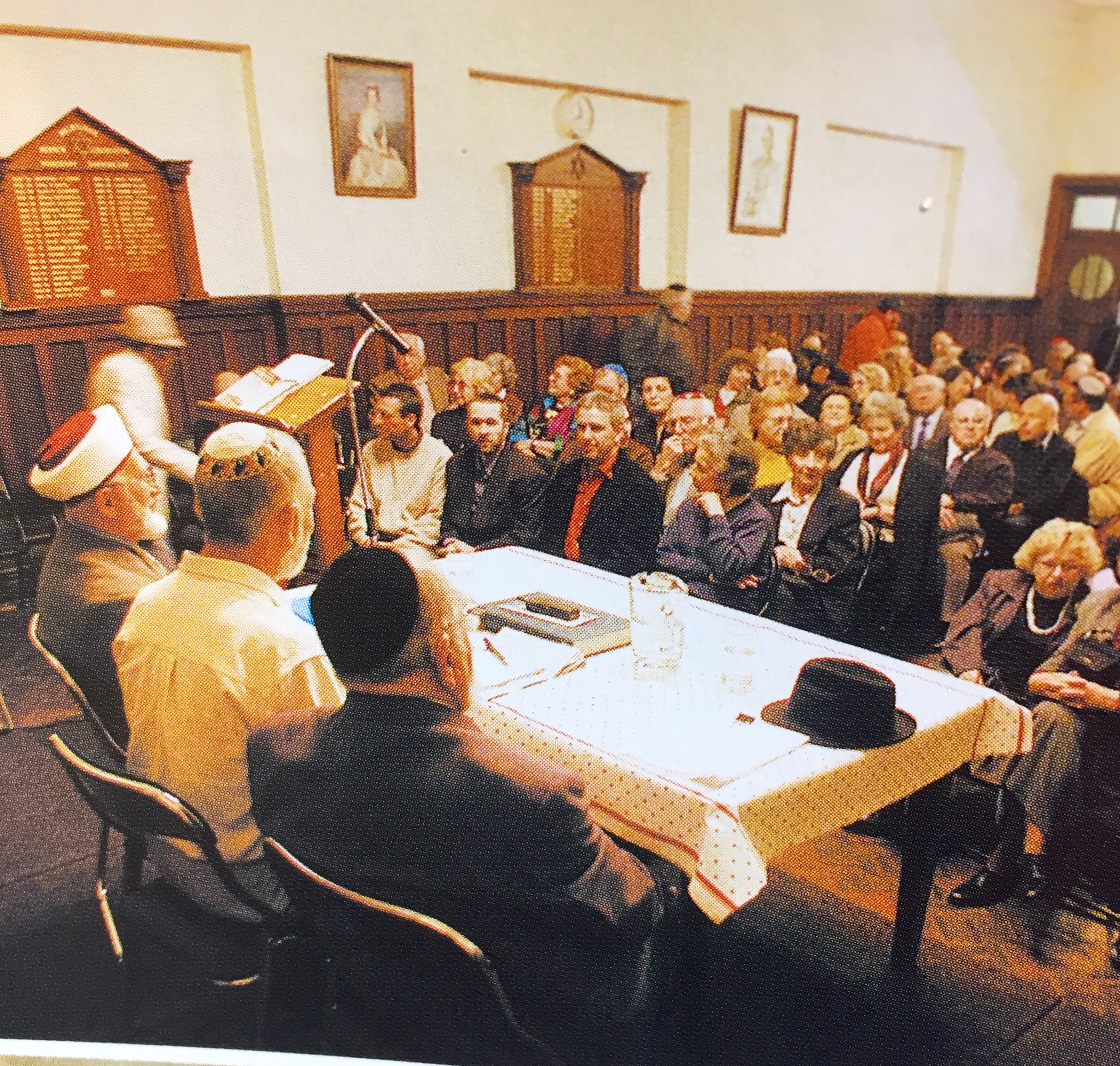
I met the Sheikh but once. It came about like this: my family has belonged to the Melbourne Hebrew Congregation since 1853. Like most members of that grand synagogue, I seldom attend its services, but I remain a member. Every so seldom the Congregation runs a communal cultural program. Around the year 2000 my brother asked me if I’d ask Rachid if he’d ask his Dad to join a Rabbi one evening and each would address the members on the question, ‘Do we Need to be Afraid of Islam?’

photos courtesy Destiny Magazine Melbourne Hebrew Congregation


I agreed, Rachid agreed and Sheikh Fehmi agreed. Were we foolhardy? I imagine we all heard the same challenge, unspoken, inescapable: if not us, then who? On the appointed night Rachid met me on the footpath and introduced me to his father and to his brothers. The brothers stood either side of their father. It was clear they were there to support him – and if need be – to protect him. The Sheikh wore a traditional head covering. One son wore a kaftan.
The clergy were to speak in the Social Hall. I offered to show the Sheikh the synagogue’s interior. He was interested. I found some light switches, we entered and I saw the place – a little emptier than usual – with new eyes. I took in its splendor and I sensed from the Sheikh’s reactions the Mosque in Preston was a more modest affair.
We went upstairs. The clergy were introduced to each other and to the audience. The hall was full, people were standing in the aisles, the atmosphere was intense. I saw faces I knew, some of them of people I knew to be mistrustful of Muslims. I was to be the moderator. I welcomed the reverend gentlemen and I reminded all present that the Rabbi and the Sheikh were our guests and I would insist we conduct ourselves on our shared principles of Abrahamic hospitality.
The rabbi spoke uncontroversially on the history of Jews and Muslims. The Sheikh spoke diplomatically on the principles of his faith. He explained the precept of Jihad: ‘Every Muslim must practise Jihad. Jihad, simply, is struggle. It is not warfare. It is, fundamentally, the struggle within to live a godly life.’ The voice that spoke these words was unemphatic, mild, genuine – a teacher’s voice rather than a preacher’s.


Questions followed. Mistrust found its voice. Fehmi never raised his voice. He spoke with quiet dignity. Abraham took a bruising that night at the synagogue, but his hospitality was not broken. Sheikh Fehmi’s bodyguards did not need to rise to his defense.
After our evening at the synagogue I never met Fehmi El Imam again. Later I askedWaleed Aly how the Sheikh was regarded in his community. ‘He’s a very gentle soul, widely respected, he wants a convivial relationship between the faiths in this country.’ I wondered how the Mufti avoided the sectarian conflicts of his diverse community: ‘Fehmi has been around as an Imam for some fifty years, he has an Order of Australia, he is very widely respected and highly regarded. He’s untouchable,‘ said Waleed.


Yesterday Rachid’s family lost a patriarch. His grandchildren lost their Jidoo. The Australian community lost a peacemaker. An asset increasingly scarce has passed. He leaves, within the breast of this infidel at least, an abiding resolve, a personal ‘jihad’ for peace and harmony. The Islamic Council of Victoria said: ‘Former Mufti of Australia, Sheikh Fehmi Naji El-Imam moved to the mercy of God this morning.’

Flea Market

A hazy day in Jaffa. The Old City is full of blind turns and all turns are the right ones and no crooked street or alleyway disappoints. Galleries abound and every one repays our curiosity. The blaze of sun and the blue of sea have penetrated the local artists like an inoculum. Helpless, they turn out vivacious works bursting with colour. Over a number of hours we come across nothing that is dull or derivative or second rate.
 

Every so often we tumble from a narrow and twisting descent into an open space crammed with broken bric a brac. By one such space, a dusty shop manned by a torpid, pear-shaped man sells old art works of varying mediocrity and unvarying neglect. Here in this luminous place I come across a stark photograph. The image in black and white shows a cinematic scene that surely predates all cinema. In the picture a large man in a formal black suit stands at one side of a square like the Jaffa square at our shoulder. He faces a group of men who wear white suits. These men stand in a rank with rifles raised and trained at the man in black.     


We are about to witness an execution. As witnesses we cannot escape the victim’s aloneness. As witnesses we become complicit in something awful, something we cannot comprehend. The photographer has caught the moment, snapping the scene from a vantage above and behind the riflemen. They wear hats that would previously have been white like their suits, but the white is soiled. On closer view the suits do not appear pristine. The faces of the riflemen cannot be seen.


Our simple sympathy for the one, who, unarmed faces the many, gives way to complexity. The soiled suits and grimy hats hint at long labour in the field. The raised guns of the executioners rest on slack, uneven shoulders; these weary men are not ready to fire. Do they identify with their victim? War-weary, do they wonder whether when the guns will be trained on them? Do they perhaps reverence the man in the black suit? The victim who stands uncowed, the man who stares at his killers, the human who was sufficiently free only that morning to dress himself with such sober dignity looks older than the riflemen. Is he the father of one of them who fights for an opposing force in some civil war? Is he a burgher, or perhaps (as he too is hatted) even their rabbi?


I gaze at the photograph that captures so much. It stands loosely affixed to its frail wooden frame, grimy with age, eloquent of truth. And, importantly to me, the truth here is not easy. Fertile with hints, arid of certainty, the photo invites enquiry. How long has the image waited for its interlocutor?


I know I want this photograph that has so much to say to me. Can I afford it? Where in our artcrowded house will my wife allow me to hang such a miserable scene? How will I safely bring that frail and awkward thing home to Australia?


My granddaughter dwells in sunshine. She wonders, ‘Why on earth would you want a picture like that?

‘Why not, darling?’

‘It’s cruel, Saba.’

‘What if the man had to be punished, darling?’

‘Saba, do you believe in capital punishment?’ – she shakes her blond head, shocked by her grandfather’s response.

‘No darling, I don’t. I don’t believe in easy answers. And war asks hard questions, this picture asks hard questions.’

Another shake: ’ What, Saba? You know they make mistakes!’


I look around. Here is the photo, here the dusty premises, open, apparently abandoned; where is the vendor? I race through the doorway into an adjacent shop with my breathless enquiry. ‘Next door’, says that vendor. Slingshot back to the first premises I collide with the cushioning belly of Homer Simpson. No it’s not Homer. The face above the torso is stubbled grey.

‘How much is this picture?’

The man looks at my shoes, running shoes, tourist shoes. He calculates for a while, silently measuring, calibrating opportunity and innocence. He names a sum of astonishing modesty. ‘Fifty?’ – I ask, incredulous.

‘Alright, forty shekels.’

I hand the man his forty pieces of silver.


Hours later my mind floats and thuds to earth. Another sunny outdoor scene, one I witnessed myself in 1995. The location of the latter scene from real life was unambiguous: in the grounds of Yad Vashem, Israel’s Holocaust memorial, I paused while ascending a slope to read the inscription beneath a cattle truck perched at an angle on a section of rail line.


I read a Hebrew text explaining it was in such trucks that millions were crammed during their journey of some days to the extermination camps. There they died, ‘al Kiddush Hashem’, in sanctification of the Name.


Labouring up the slope towards me an older couple, aged, I guessed, in their seventies, puffed and sweated. They took a breather at my side. The man, plump and snowy haired, read the inscription and scowled. He grunted angrily. Between breaths he managed to declare: ‘There was no sanctification. I was there. I know!’ In the face of that knowing I stood silent. The man’s wife, younger than he, tried to calm him. Turning to me she apologised; ‘He always gets upset here. He always comes here on the first morning in Jerusalem. Always here in the morning, then the Wall.’


By now the man had recovered breath. ‘Nothing holy there. Nothing…’ He looked up: ‘Except once. One time only I saw sanctification. I was in the camp, one of hundreds, all of us there, all hassidim, with our Rebbe. The SS officer ordered soldiers to strip the rabbi. Violently, they tore all his clothes off him, that holy, holy man. His hat they threw down. We looked away from the rabbi, we would not see his disgrace. The SS man screamed, ‘Any one who turns away will be shot!’

We knew they would shoot. We knew because they shot anyone who would not look while they hanged our people in the ghetto.


The officer screamed orders to the soldiers who raised their guns ready to shoot our Rebbe. The rabbi turned to the officer. We heard his voice: ‘Will you give me one minute to bless my people?’ The officer laughed. He mocked the Rebbe. ‘You want a minute? Have two minutes old man.’


The Rebbe turned away from the officer and the soldiers. He turned to us, his hassidim. He raised his arms and he called out, ‘’How goodly are thy tents O Jacob, your dwelling places O Israel.” Then the soldiers shot him while we watched.’


I remember the year of that visit precisely. Two days later an Israeli patriot shot dead his country’s prime minister.


Going to the Wall

My family used to be employed in Jerusalem. Unfortunately our family business was disrupted for a time by conflict and conflagration. In what appeared to be arson, on the ninth day of the month of Av in the year 70 of the Current Era, our office was burned down. 
The office I refer to was the Holy Temple where my forebears would officiate in rituals of sacrifice, in mediating and arbitrating disputes, in quarantining suspected carriers of contagious disease and in blessing the people. As the reader will realise we worked as lawyers and doctors and priests. After the burning my family was unable to go to our office for nineteen centuries. Then in 1967 we returned. The other day I went back to the office where I resumed working in the family business. 
It happened like this.
My two eldest grandchildren, both aged thirteen, accompanied my wife and me on our current visit to Israel.
The boy, a pretty secular fellow whom we’ll call Jesse, walked down to the Wall with me. He understood the antiquity of the Wall and something of its sanctity. Praying is not his specialty. ‘What will I do, Saba?’
‘I pray there, Jesse. Some people write their prayer on a slip of paper and insert it into a crack between stones.‘
‘What should I pray for, Saba?’
‘Think of the thing that you most want in the world, Jesse. Ask for that. It could be some deep and secret thing, something you wish for yourself or for someone else.’
Jesse has seen suffering. Earlier he saw a man begging. Well made, about the age of Jesse’s father, the man requested small change, blessing anyone who donated. The man walked on a distance from Jesse, turned away and covered his face with his hands. His shoulders shook.
At the Wall, Jesse pressed his lips against the glowing stone. He leaned his forehead against the Wall for some time, his lips moving. Then he posted his slip of paper into a tiny eye socket in the stone.
As we walked away backwards, Jesse stopped me and threw his arms around me. He said, ‘That was a really important experience, Saba. Thank you for taking me here…I love you, Saba.’
We rejoined my wife and Jesse’s cousin, whom we’ll call Ellie. They too had prayed at the Wall. Ellie’s fair features glowed: ‘Saba and Savta, that was wonderful.’ My hands twitched, a spasm in unemployed muscles. I recalled I was a Cohen, a lineal priest: I was in the blessing trade. I rested my palms on Ellie’s head. My fingers splayed and I searched for some voice. The voice shook as I recited the ancient words: ‘May God bless you and keep you…’ Here I was back at the old workplace, here was Ellie, flesh of my flesh.
I had waited 2000 years to get back to work. I annointed her fair head with my salt tears.