Two Doctors in Doomadgee

Letter from Doomadgee

27 January, 2014.


Dear Australia,


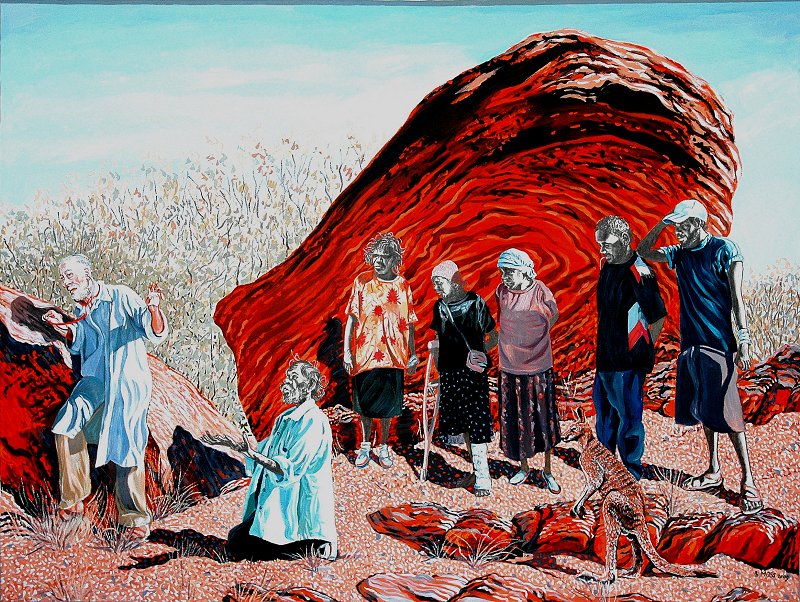
Before I arrived the only thing I knew of Doomadgee was the name; that was the surname of the man who died on Palm Island. That name seemed compounded of doom and tragedy. But of the community itself I was glad to know nothing in advance of my arriving.


Steve the factotum drove me from the airfield. The aged street sign said:


Welcome to Doomadgee

Population 1200


Steve said: “More like 2000.”

I met the young Aboriginal doctor. He said: “More like 3000.”


A road sign said:


NT Border 103 KM.


The weather forecast said: Cloudy. Maximum 34 degrees.

That night the nurse said:” It felt hot so I looked at the thermometer on my verandah. The thermometer said: ‘52 degrees.’”


I said to the young Aboriginal doctor from Mt Isa, himself a grandson of respected elders of this community: “I’m the wrong doctor. I don’t have the language, the cultural currency…You are the right sort of doctor.”

He said: “There are nearly one hundred of us now. There were quite a few of us in my year at James Cook.”

The two of us spent most of Saturday together indoors. Between snatches of cricket and tennis on TV and poring over Murtagh’s tome on General Practice, he wanted to talk about religion (his new found Christianity, my old found Judaism), about work, about vocation. He asked me to name my favourite story from the Bible.

He told me his. I waited for a parable. Instead he said: “Jephtah and his daughter. I read that story and I put the book down and I said, ‘Lord, I need time to come to terms with this.’”

We spoke of our families and our upbringing, how he hankered for some city life while knowing his destiny lay in the country – on country – this country, this country his father had shown him and taught him and inculcated into him from early years; and I told him of my lifelong hankering for life outside the city while knowing my destiny lay there.

I said: “I wrote a book about my father – he was a country GP – and about my childhood in the country. And another book about my experiences working in remote Aboriginal communities. You can get copies of those books if you’re interested.”

He said: “No. I don’t read books. Only medical textbooks.”

I looked at him.

He conceded: “I did read two other books. My teacher said if I didn’t read them I couldn’t pass English.”

I looked at him again. I said: “I know you read. You read all the time – the Bible.”

Yes. Yes, that’s so. I’m always reading the Bible. But books, they’re not in my background. We didn’t have books at home.”

After hours of searching conversation my colleague posed a question. He preceded it with a statement. He said: “I want my work to mean something. I want my working life to improve the lives of Aboriginal people.” He swallowed the consonants whenever he spoke that word. He softened the ‘g’ in ‘Aboriginal’ so it was like a triple ‘n’, gutturalised. He paced and paused, paced again. He said: “I want to ask you a question. You’ve been a GP for a long time; I am just starting. What should I do? I mean what should I do now, while I’m completing my training? What particular field should I try to master? What will be most useful for Aborinnnal people?”

I offered some answers, thinking aloud, feeling my way through a variety of ideas. Eventually I said: “Any answer I give will be less important than the question.”

What do you mean?”

I mean, you aren’t asking a casual question. This is a quest. So long as you keep asking I think the quest will lead you where you need to go.”

Then I said: “You know we whitefellas do our best but we never achieve what we set out to do. I think the answers won’t come from whitefellas alone; some of the changes have to come from blackfellas. It will be like cancer – you don’t find the cure, the single thing that wipes out the entire problem; you find an improvement here, a sectional breakthrough there. So the Pearsons and Yunipingus and Langtons and the others, they’ll come up with some initiatives; and some of those will take root and some might bear fruit.”

My friend nodded hard. He said: “Exactly!”


***


On Australia Eve, the rain belted the roof all night. Australia Day dawned bright, cooler. We went down to the river. At the spillway the Nicholson flowed a kilometre wide. Warm brown water, shallow. Steve had said: “No big crocs here. Only little snappers – freshies.”

I trusted him. I waded with the younger doctor through warm shallows down to the waterfall. Everywhere we went in those shallows Aboriginal toddlers paddled, babies sat on the laps of slender young mums. The Nicholson flowed a thin caramel around and over shiny brown bodies.

The young doctor spoke to all he met. All were, one way or another, his kin. He said: “Hello brother”, and “Hello sister.”

He said, “Hello Aunty”, and “Hello Uncle.”

He knew what to say, how to say it. He found connections with strangers.

He knew his country; he was the right doctor; he had the language.

Wandering

My father’s father’s name was Joseph. Born in 1886 in Petach Tikvah in Turkish Palestine, Joseph Goldenberg stowed away on a ship at the age of twelve, passing his Barmitzvah date without celebration before disembarking alone in Australia. Papa, as his grandchildren called him, arrived here with five shillings, a working knowledge of Yiddish and Arabic, and no English.

He left his home and his family as a child, remaining an observant Jew throughout his lonely years until his marriage, and beyond, through a long life.

Dad used to say his father was like Joseph in the Bible, a faithful Jew from childhood to old age, steadfast through long exile and separation from his home and family.

Dad found lifelong inspiration in his father’s example.

My own father, Myer Goldenberg (z’l), grew up in Melbourne, married and took his bride, Yvonne Coleman, to the small Riverina town of Leeton, where the couple lived for 14 years, raising four children as knowledgeable and observant Jews. Dad never thought this was remarkable, but it was an unusual achievement and it certainly inspired this son.

Indelible memories come to me from time to time as I recite the Shema, of Dad teaching me to read and to translate every word of this, the first and the last prayer of our Jewish lives. I would sit on his knee, Dad holding his worn and oft-repaired siddur in front of me, his finger showing me each letter and his voice speaking these words time and again: and you shall teach them to your children, and you shall speak of them when you sit in your house,and when you walk by the way, and when you lie down and when you rise up…


A Jewish education of this intensity and intimacy is a rare and precious thing. It left this son with the unorthodox confidence that I could live an orthodox life fully and independently anywhere, with or without a community or a congregation to support me. My father’s example assured me that my own observances, my Jewishness, were proof against distance. Dad had taught me how to be a Jew as I walked by the way.

Dad never had any delusion that distance was a good thing. Well before we reached Barmitzvah age, Mum and Dad had resettled the family in Melbourne, where Dad showed (through his subsequent scores of years of service to Shules,) that the question was not whether he needed a congregation, but what could he contribute to one.

But the ‘harm’ was done. By the time we left Leeton, I had absorbed my father’s aberrant example of distance-proof faithfulness; and ever after I have lived a maverick belief in walking by the way, to remote places, well off the Jewish trade routes, taking with me the observances my father taught me. Over the decades, that phrase in the Shema has come to hint to me that a Jew should actively go bush – as Moses did in his shepherd days, as Elijah did while on the run from the king – to find God.

How did I know about Moses and Elijah? How too did I know about the midnight walk in the wilderness of Jacob; and of his encounter with the wrestling angel? It was Dad’s fault, of course: it had been Dad who brought these heroes of the spirit to life within me.

And so it was that I’d bake challah (read damper) in Leigh Creek, read Megillath Eicha by candlelight in Arnhem Land, host the Jewish residents of Alice Springs for Shabbat meals, discuss Zionism with a knowledgeable Elder in the Ngaanyaatjarrah Lands, sing Hebrew songs with one of the Strong Women at Galiwin’ku, sound the Shofar in Ellul at Wamoom; and celebrate Shabbat in the Andyamathanha wilderness with one of Melbourne’s leading rabbis.

(And so it was that I was been absent so often and so painfully from shules, from tolerant children and perplexed grandchildren, from a neglected wife and from a lonely mother.)

All of this unorthodox conduct had some unexpected results. I found what Joseph finds when sent by

his father to “see the peace of his brothers”. Wandering, lost in the wilderness, Joseph meets a mysterious stranger who asks – in a singular phrase – “what will you seek?”

Joseph replies, in a sentence that is equally pointed

syntactically, “(it is) my brothers (whom) I seek.”

The brothers whom I found are the first Australians. In encounter after encounter over a decade or more I have met and worked with Aboriginal people in the outback, discovering much about them, more about my

Jewish self, and writing, writing all the time of these experiences.

(That writing gave birth to a book, Raft, launched at Melbourne Writers festival in 2009.)

And deeply moving to me were those experiences as a practising Jew, when alone in God’s creation, I’d wrestle with the angel, and where I’d catch the echo of a still soft voice.

And, morning and evening, as I’d rise up and lie down in those far places, I’d recite the Shema, that prayer of portable Judaism that my father taught me.

A Pogrom in Islamdom

2013 has been the year of the burning church. Throughout Islamdom churches burn. 

It started before 2013. For over a decade I have seen my Coptic patient from Egypt beside himself with grief and anxiety as he watches his relatives trapped in fear, paralysed like a kangaroo doe in my headlights, unable to resolve – to flee or to stay?
He sits, this large man, in my consulting room and nurses his ulcer. Gaps, lacunae of silence in the consulting room and his eyes fill with tears as the silence falls and swells.
At present Egyptian Copts burn bright and hot enough to hit our papers. Syrian Christians burn.
Elsewhere, in Iraq, the oldest Christian community in the middle east convulses. In 1991, Christians in Iraq numbered 1.3 million people; today they number 300,000 to 500,000. Catholic Chaldeans, Nestorians, Orthodox, almost all Iraqi Christians are ethnic Assyrians. Assyrians speak Aramaic, lingua franca of Jesus. From time to time I meet a Christian from Iraq in the Children’s Hospital where I work. When I address him and his family in my rudimentary Aramaic (which is, of course, an inherited language for any Jew who has ever opened the Talmud), their faces open in disbelief, in joy, in homecoming from linguistic exile.
(While liberal Christian groups turn a blind ear to the slaughter of fellow Christians there exists but one country in the middle east where, as Gabriel Nadaf, a priest, declares, “we feel secure”. Guess which country.)
Last week 34 Assyrians died in a church bombing in Baghdad. In 2010 a series of ‘suicide bombings’ (call sign of the hero martyr, history’s adolescent crying LOOK AT ME! LOOK AT ME!) killed 58 people. There have been 71 church bombings reported in Iraq since 2004.
So much, so normal, so historically unremarkable. So much blood: thirty four here, fifty eight there. Have you seen how much blood there is in the body of but one human being? (I have. Cain did. God called to him saying: “The bloods of your brother call out to Me from the earth.”
Why bloods – in the plural? Because, explains the commentator Rashi, no-one had seen a human die before Cain. No-one knew how much blood
there was in one human brother.)
We know now about the blood of the human person. We cannot plead ignorance.
I remember another time – it was recent, only November 1938 – when houses of worship burned, when the bloods of my brothers cried out.
I remember the shameful silence of the decent civilised world. I remember the silence of churches, governments, communities in Australia
following the great pogrom that was the night of broken glass. I remember how my people was forgotten. I remember the silence.
I remember William Cooper and his Aborigines Advancement League raising the sole protest in Australia against the pogrom.
There are pogroms occurring throughout Islamdon. There is a great silence here.
Do we need to wait for another Australian Aboriginal leader to awaken this nation, to rouse its parliaments, its churches, synagogues and mosques, its noisy Boycotters, its pious Divestors, its smug Sanctioners, to cry: “I am my brother’s keeper?”

Giving Thanks

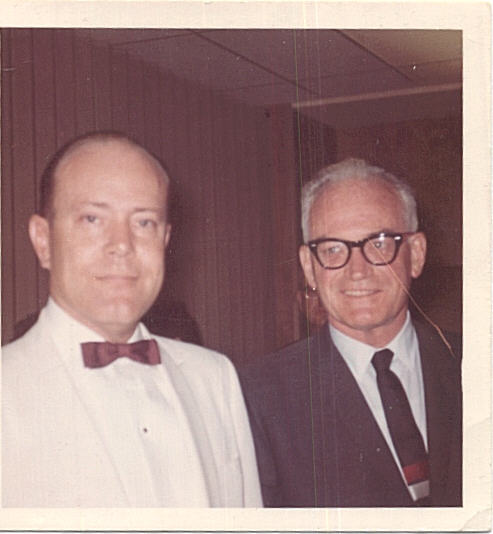
Barry and Paul (in the tux)

Barry and Paul (in the tux)


Howard and Paul

Howard and Paul

My old and cherished friend, Paul Jarrett, writes from Phoenix Arizona:

 
“Thanksgiving is the day we reserve for giving thanks.
When I was small, every meal was preceded by “returning thanks” which was “Grace” before meals.  It was “returned” by my father if present, or mother if not.
This brief prayer was to express gratitude for God’s many blessings and to ask for His continuing guidance.  We did not eat before the “Blessing” was asked.
While it is true that when small I was impatient to get this ritual over so that I could scarf down my meal, it is also true that I can hear Dad today in my mind’s ear reciting the blessing and realize how important it was to him, no mere gesture or formality.
Once in awhile in a restaurant I see a person asking God’s blessing on the food they are about to eat, but very seldom.  I must admit that I do not do it myself so as not to attract attention.  For that matter I do not “return thanks” when I am by myself at home, a matter that I shall correct.
God doesn’t need these rituals, we do.”
 
Paul is exceedingly old and exceedingly wise. In his time he has been a military surgeon, an aviator, a morbid anatomist.  This means he could fly you to hospital, operate on you, and should you be ungrateful enough to die, Paul would, without hard feelings, carry out your autopsy. 
 
Paul describes himself as conservative. He claims to be to the right of Barry Goldwater. He shows a photo to prove it.
Nowadays, Paul cuts neither the living nor the dead. He contents himself with wise and sometimes splenetic observations about a world and a nation going to the dogs.
 
Paul’s reminiscences are always evocative. His recollections of Grace evoked this memory of my own:
Dear Paul
I recall growing up in a country town in new south wales where our family were the only Jews.
my closest friend’s family were Presbyterian.
like my friends the jarretts, the wanklyns provided kosher meals so i could eat with them.
dulcie wanklyn prefaced each meal with: FOR WHAT WE ARE ABOUT TO RECEIVE THE LORD MAKE US TRULY GRATEFUL.
i recall sitting through this small ritual, head down, in quiet uncharacteristic decorum.
i’d gaze at the linen napery, each napkin held furled inside its collar of china or silver or pewter.
it all seemed holy.
no-one ate, no-one spoke, until AMEN was heard.
it never occurred to me that the benedictions  my father taught me and which we recited before and after every meal, were likewise, Grace, and likewise holy
the problem with an everyday ritual is ritualisation, the normalisation of the quite audacious idea of finite man reaching with words towards infinte God
mrs wanklyn never made Grace feel mundane
love,
Howard

Exultation is

Exultation is 

The going out

Of an inland soul

To sea

The train leaves Southern Cross right on time at 7.10. No queueing, No Security. No fumes.

The price of a cup of coffee at Southern Cross does not amaze the buyer nor does the drink disgrace the bean. (The cup is of paper; you can’t have everything.) Once aboard, no safety sermons, no-one forbidding standing or moving about the cabin, no weight limits, no serpentine lines of tired, tense travellers with toddlers to repress.

How old fashioned this iron caravan. The carriage rolls, moving in its jazz rhythms forwards, side to side, moving as it did in the rides of childhood, in those long slow rides across time, across the wide, dry land, singing clickclack past silent mobs of kangaroo, putting to flight soundless pink-grey clouds of galah, slipping past indifferent cows looking at me in philosophic enquiry, rolling past stands of eucalypt, no two gumtrees the same, every one the same – whether elegant, smooth and pastel, or scarred, twisted and greygreen – every gum tree declaring I am Australia, I survive, I thrive, I endure, every gumtree bearing, proffering vital knowings.

Only the cabinet has changed. Gone is the sign requesting passengers not to use the appliance while the train is standing at the platform. A press of a button, an airliner’s hiss, and everything disappears without trace.

The twenty-first century city, where they’ve gone about as far as they can go, the city, with its looming concrete overpasses, its car-teeming freeways and tollways, its roar and bustle, its gouging, its uprooting, its foetid air and gritty, its smoking and choking, its babel towers rising up to the heavens, its pavements grey; this great, enfolding and alarming home to millions and to me; this violence, this violation, this nature denying, this horizon hiding, this coded mute cry, this city slips away. And I ride.

The ride beguiles. It seduces. It invites nostalgic romancings of the past, endless retrogression, convenient forgettings of how railways were themselves violators of countryside, the out of control, accelerating agency of dangerous change.

The train to Albury accelerates, exhilirates into the green.

And for all that nostalgia is malignant – 

acceleration is/the going out/of an inland soul/to sea

Past the houses, past the headland/to deep eternity…  

A nod to Yeats, a filching from Paterson and a bow and apology to Emily Dickenson.

The Reunion

We met in the grounds of our old school. Cars drew up, old faces emerged, old bodies, sagging here and there, supported by stiffening joints. Faces lit in recognition or knitted in puzzlement – I can’t place you – then opened upon discovery. Older faces, stiffer frames – these were teachers, old and treasured. The pleasure was of a novel sort: it was as if one discovered an aged aunt or uncle not seen for fifty years; and the aged one was as delighted we were at the encounter.
Fifty years. A large chunk of time in anyone’s lifetime, an epoch unimaginable when we left in 1963.
We toured the school, the new and the old. The dunnies hadn’t changed except they were clean.
Afterwards we gathered in the dining hall.
I volunteered to speak about the lost eleven of our classmates. I didn’t want the ninety survivors of the class of 1963 to bee-suck on nostalgia and leave the dead unsung. So I read the following:

Here we are fifty years on.
We have become, I realise, walking memorials to those we have lost.
We travel the roads and the paths of our lives and our minds register: Aunty Sylvie lived in this street…Dennis used to walk his dog in this park…that’s the Shule Dad and his bothers walked to when they were kids…this is the street where my grandparents lived…

Now, gathered here at Scopus again, in this dining hall, beneath this roof, shadows of old friends, old rivals, flash across memory. Teachers we loathed, teachers we revered, those we mocked, those we feared, all move across the mind in their chalky academic gowns. They lived, they did their work and they passed on. And we – we who were once seventeen, eighteen years old and full of wonder about the future – we approach threescore years and ten, full of amazement about the years past.

But we have left some behind. I name them now.

Manny Olian, dead in 1964.
Faye Broons, dead only a few years later – in 1971.
Ephraim Bergner – died early – I haven’t been able to track down the year.
Leon Fust and Suzanne Gescheit in 2006;
Miriam Hamer, Norman Stern, Shareen Fremder – all in 2007;
Joe Serwetarz in 2008.
Zelda Slonim in 2009.
Michael Kowadlo, just over a year ago, in 2012.

The names are the bones. Some I can clothe in the flesh of concrete recollection.

Manny Olian.
Many memories, warm, smiling memories of a thin, manically funny boy, a stranger to malice, a friend who stood out from our glorious contemporaries for his originality of mind. Manny was the source of extraordinary insights that always astonished me. I see Manny holding a pen, grabbing a footy, his fingers spidering, hyperextending, exclamation marks at the extremities of a boy at the extreme.
Manny was a pioneer in death by drugs. During a trip on LSD, Manny stepped off a cliff in England and died.

In my imaginings I see Manny’s parents in 1946, at the time of his birth. They look upon their firstborn and they choose a name. The parents see their child before them and put the unspeakable past behind them. They called him Menachem, “comfort”. Eighteen years later, in 1964 – what comfort do they find?

Fay Broons.
I hardly knew Fay. I wonder how many did know her. Pretty, quiet, shy, ladylike, almost ephemeral at school, Fay was a mother of three little kids by 1971. She started the last weekend of her life in good health and was dead 48 hours later – of fulminating infection, or a brain haemorrhage? – even her family does not know to this day.

Ephraim Bergner.
Ephraim, Effy – that gifted, creative, wild child. Those fabulous good looks, that innocent disconnect from the rules, from the mundane, from consequences.
Our class’s James Dean.
Who was surprised that Ephraim’s life ended early?
Only the exact year, and the precise drug escape me.
What shadows, what secrets, what ghosts, was Ephraim escaping?

Leon Fust, skinny, nimble, fearless on the footy field, subtle and gentle in his thought; I last saw him in an Australian bank in Piccadilly, in an impeccable suit and a bowler. Leon looked the epitome of an English gentleman.
Never sighted again, what did Leon die of? Whom did he leave to mourn him?

Sue Gescheit, her kidneys failing after decades fighting off her viciously severe diabetes; Miriam Hamer, marrying for the first time at sixty, marrying for love, knowing her lung cancer had already spread to her brain; Norman Stern, one so jovial, often an innocent magnet for mischance, Norman, whom I had not sighted since school; he and Joe Serwetarz – the tall, the gregarious, the good looking, athlete – both of them, following just before or soon after Miriam and Sue.

Zelda Slonim – I think I knew her. Did I know her?

Shareen Fremder – I’m sure I didn’t know Shareen.

What does it mean that one passes and passes unknown?
Who knows? Who mourns?
Who carries their memory?

Finally, Michael Kowadlo, passing in 2012.

My first memory of Scopus is of Michael. This big friendly kid takes this very lost, very strange new kid –Howard Someone – from the country! – under his wing.
A week or so later I am climbing the steps of the slide when a bunch of interlopers races up the steps, pushing me aside. My face collides with the steel rail, a tooth chips, my mouth fills with blood and Michael, Big Michael, steps in and pushes the interlopers away. I take my turn and slide down. I meet and enrich a dentist. I become closest of friends with the principal slide aggressor – great to see you again Tommy – and Michael becomes a dentist.
The last 100 times I saw Michael occurred when we both spent a year reciting kaddish in memory of loved ones.

I want to recite kaddish now, and I invite everyone to stand and join with me, in memory of all our lost friends. In memory of Manny – “after the first death there is no other’’, as Dylan Thomas reminds us – in memory of youth, in memory – and in forgiveness – of our lost selves…

Yitgadal ve’yitkaddash sh’mei rabah…

***

After I delivered that sombre material, my voice dying at the end, I looked up. Fifty serious faces looked down. My schoolmates, silent for the first time in our twelve school years and in the following fifty years, did not meet my gaze. Gone was the buzz, the gaiety of moments ago. I had spoiled our evening. Or so I feared.

Mount Scopus College was born in Melbourne just after the end of the War. Fiercely partisan community leaders in their congregations and their factions came to historic agreement to bury difference and to create a school. The compromise they made was without precedent or subsequent. The leaders, the secular with the devout, the Yiddishists with the Hebraists, the political with the cultural, agreed on one thing: this ragged remnant of Jewry must educate its children if Jewry were to survive. So Mount Scopus was born at the same historic moment that we, the class of ’63, were born.
What did we know of the Shoah, what did we learn? Precious little at Scopus, only dark and unspoken shapes and silences from our parents. We did not realize until later that ours was a generation without grandparents.
Our Jewish teachers, burning with an intensity that burned us, cared unaccountably that we learn, that we incorporate the burden of their scholarship; while we, dull and distractible, remained unforgivably innocent, even indifferent to the heritage they were transplanting. Only in Rabbi Schwartz was truth writ clear in the body: his throat, a terrible terrain of wound and scar, remained red and swollen these years later. Somehow we all knew – the Nazis had pulled out his beard.
We are the result, their fruits, this class of 67-year olds, gathered again in the old Scopus dining hall that was also assembly hall and concert hall and community banquet room. Was I the only one to gaze about the room and to marvel at the achievement of Scopus, at the fruits of our parents’ sacrifice? The room crawled with professors, with doctors a dime a dozen, with lawyers, teachers, psychologists, with businesswomen, artists, computer greats. I could see how middle-of-the-roaders in our Scopus class rose to enduring distinction in the wider world. Truly the fires of the fathers had kindled huge drive in the children. Starved parents raised a generation hungry for success. We took our opportunities. Some seized the future, becoming pioneers and creators. We flamed, we made our mark.
Most of us had married Jews and produced Jews. Many of us had sent our kids to Mount Scopus. Making the real sacrifices needed for this costly schooling we endorsed the vision of the founders. Some of us had grandchildren at Scopus.

***

The class of ’63 has been decimated in two quite different ways – one in ten has died; one in ten has emigrated, made aliya – literally ascended – to Israel. Of these latter, three classmates have journeyed here solely for this occasion. It is a long and costly trip; why have they come? Why have others travelled from Western Australia and Queensland? Why have the remaining fifty-odd Melbourne residents bothered?
In the course of our four hours together clusters form and drift. Old intimates greet each other but do not linger, instead moving on to find others less known, less loved. A genuine thirst for connection, a tenderness, a respect – the things we all needed and often begrudged in those rougher days.
In place of the empty phrases of everyday greeting, men and women shake, hug, regard; they take in faces that have ripened and withered and deepened; they see and they don’t need to ask; the face of the other is the face they see in the mirror, a face stricken, blessed, stripped by the years. No-one is measuring, no-one comparing: that which we are, we are…

Four hours, equivalent to half a school day, long enough to discover

Equally interesting to me: why have others chosen not to come?
Two, I know, are disabled by mental illness. A third, with whom I am closer now than fifty years ago, told me she could not imagine a more distressing experience than to return to the terrain and personnel of her schoolday trauma. Having rebuilt herself from her remains, she has retreated to another state where she rusticates and has some peace. She begged me not to press her to come. She forbade me to explain. The committee was to erase her contact information. This friend would be astonished to know how many missed her, how many wondered aloud about her. In the face of this goodwill it was difficult for me to hold my peace. I fed friends scraps: She’s doing well…she couldn’t make it…
In the course of the reunion, another – likewise closer in adult life than in school days – turned up unannounced and stood at the rear, listening to the few speeches. The longest speech was my elegy for the lost. Upon completion of kaddish my friend turned and left in silence.
Not everyone won academic laurels. Not everyone had a stellar career. Some of those present at the reunion, vibrantly present, knew their unsuccess didn’t signify. As we toured the school, one removed his adhesive lapel tag and placed it between the names on the Honour Board. There he was, Dux of Mount Scopus College, now, after fifty years. There he was among us, huge in his mirth and delight.
There would be some who decided not to attend, conscious of ‘failure’ – in career, in material status, in family – unaware that no-one measures any more, no-one judges. We missed them.

***

What is the measure of the years? After fifty years what does it mean? I imagine the survivor of the Shoah washing up on this godforsaken Jewish wilderness, this godspared paradise, looking around, looking forward, never backwards, no never back to those places, those times. He stands, he mates with another survivor. Together they work, they scrape, they venture, they struggle and persist. They raise a generation, often of one only child – the previous children lost, burned – they find the tuition fees, they send the child to Scopus…

The Scopus of today dazzles. I venture to suggest there exist university campuses in Australia which would envy the facilities and the faculty of this school.

In all the vivacity of this evening, the buzz, the energy of this still radiant class of ‘63, in all the softening, the love, there abides among us grandparents the uneasy understanding that a Scopus education is beyond the means of many of our children to provide. Some of my contemporaries, I know, quietly pay their grandkids’ fees. Others work for the school, raising funds for scholarships and bursaries.

What would the founders say? Would they count Scopus a success if the rising generation were locked out?
Do You Believe?

Do you believe in the theory of evolution?

Do you believe in man-made climate change?

Do you believe in creation science?

Each of these claims the status of scientific respectability.

At the risk of hurting your feelings, I suggest that belief in the first is scientifically unsound. Likewise, if you believe in man-made climate change, your belief is unscientific. So too with creation science.

How can they all be wrong?

I didn’t suggest that any of them is “wrong”. What is wrong is believing in the truth of any scientific theory. A theory is never proved correct: we can never hold firm to scientific truth. We can demonstrate only that the data to hand are consistent with a given theory. Tomorrow’s datum can – and generally will – force us to modify our theory – or to ditch it. Kepler, my hero in science, loved his perfect model of a geometric planetary system, a truly beautiful, enormously intricate offering to his God. It was a Ptolemaic system in which everything orbited the earth. Kepler heard that Tycho de Brahe had a better telescope than his own, so he went off to Bohemia to check out his observations using Tycho’s ‘scope. He noted minor discrepancies. He checked and rechecked. And ditched his own observations, ditched his own theory, discarded his life’s work and started again.

I learned and embraced and soon loved Newtonian physics in high school. I still love it. But Einstein and Heisenberg damaged Newton at the edges, so, with an intellectual courage that I can only call Keplerian, I ditched Newton. As a belief.

I went to school with a remarkable classmate called Robert. It was in sixth grade that Robert wrote an essay on the nature of knowledge, the need for scepticism and the matter of knowing. Our teacher honoured the essay. He asked Robert to read it aloud. I remember still its final lines. Verbatim they ran: I suggest there is no such thing as ‘believe’; there is either proof or there is not; either you know or you do not. Robert was the Galileo of Sixth Grade.

Recently my younger brother, assuming that I claim to be both a practising Jew and a scientist, challenged me: Does God exist – yes or no?

I said I could not answer in those terms.

You’re an Agnostic then.

I said I would never claim such a lofty status.

So you’re a smart arse and an Agnostic. 

I suggested I could have constant faith with inconstant belief.

That sort of faith is just wishfulness. 

I told him science didn’t provide me with a reliable answer to his initial question. It couldn’t.

So, why worship when you can’t even say you believe?

I asked him to consider music: I could listen to music and experience a knowing that eluded proving, that rose above and beyond science, that transcended measurement and observation. In similar vein, moments of knowing come to me – sometimes in the depth of the poetry of prayer, at other times simply as a lone human in a vast landscape.

That’s not knowing. That’s just romantic love.

Precisely. And speaking of love – it is in some similar way I know I love my wife, and I know I love my kids (yes, all of them), and my grandchildren too… and the Collingwood Football Club…

I build my life upon some values – that kindness is better than cruelty, that justice must be pursued, that freedom and equality are human rights. I cannot prove these values to be valid – indeed, in some cases they show signs of Darwinian invalidity. The more valid my sort of moralism, the less firmly it can attach itself to scientific evidence. My moral life, with the lives of all non-machiavellians, is built upon those unshifting sands.

But all that knowing, that value system, all that is distinct from proof.

Do you believe in God?

Do you believe in fairies?

Do you believe in Santa?

Do you believe in naturopathy? 

Do you believe in scientology?

We are entitled to believe but science won’t take us there. In these matters our knowing must be made of different stuff. And our knowings will often attach themselves to strong feelings of identity, feelings that are passionate in intensity. That is part of the reason that you only raise climate science at a dinner party if you are prepared to wreck the evening. After I have done that my wife rises from the table, apologises for my rudeness and takes me home. Works every time.

The Messiah Dancers

I went to Hotham Street today to look for donkey droppings. There were none. Would the dancer/s be sad or discouraged?

There were two dancers this morning – Springheel Jack, closely shaven, waving his smiley face flag; and a shorter man, bearded, rounded, waving a Messiah flag. This man was aged perhaps fifty. I stopped and talked with them.

Blogberg: Good morning, gentlemen. Would you mind telling me about the older dancer who used to dance every day – the one with a white beard? I haven’t seen him for a while. Is he well?

Springheel – in ocker accents: Thank God, he’s very well. He’s staying home to look after his mother.

Blogberg: Golly, she must be old.

Springer: She’s older than he is.

Your blogger – Berg: Please excuse my curiosity – do you mind if I ask – why do you dance?

Springman: The Rebbe – you’ve heard of the Rebbe?

Berg: Certainly.

Dancer Jack: The Rebbe says it’s time to dance. The time of dancing is here. It’s time to be happy.

Berg: That’s why you have the smiley flag?

Jack, nodding: That’s why.

Berg: You do this for an hour a day, six days a week, you must be the fittest Lubavitcher in Melbourne.

Jack: Some days it’s only half an hour…

Berg, addressing the shorter, rounder, older man: Your flag reads ‘Moshiach.’ So you’re dancing to bring the Messiah?

Shortman, smiling benignly, speaking with a light Russian accent: Oh no, Moshiach arrived. We dance because of happiness.

Berg, diffidently, to Jack: You dance here in the mornings. How do you spend the rest of your time?

Jack: I care for my friend. Full time. Also my grandmother.

Berg, not short of chutzpah: What is your job? I mean does someone pay you? Do you eat?

Jack, unruffled: Thank God, I eat. No-one pays me. I dance and I care because it’s good.

Berg: You do it all, ‘lishma’ – for its own sake.

Jacko: Yes.

Berg, to Shortman: What about you? When you aren’t dancing?

Shortman: I am a dental prosthetist. I make dental appliances.

Berg: Well it’s been a pleasure to meet you. Thank you for talking to me. G’mar Tov (a seasonal benediction).

Both, cheerily: G’mar Tov.

Jogging home, chewing on food for thought, the image returned of the Messiah Man of Juneau, Alaska. A lean and straitened man, he stood in the grey of an autumn day in Alaska, unprotected from the thin rain, speaking aloud of Redemption. At his foot a placard advised: Jesus is Lord. Choose life eternal.

The man addressed the public at large bearing Good News in his thin voice. Actually it was a public at small: Your blogger was the entire public.

Blogger, Berg: Do you mind if I speak with you?

Messiah Man: Why?

Berg: I am interested. It looks like a hard thing, to stand in the rain and bring your message.

Silence from M Man.

Berg: I don’t want to disturb you. I mean no disrespect.

M Man: I am called.

Berg: How do you live? I mean, you aren’t soliciting funds…

Messiah Man: A few good people make contributions. And they don’t bother me as I do my work.

Berg: Please excuse me. I won’t trouble you further.

As the Rebbe of Bratislav said: Mitzvah ge’dolla li’h’yot be

simcha tamid. (It is a great and holy thing to be in joy perpetually.)

My impressions: it’s an easier gig working for the Messiah in a warm temperate clime than in Alaska: it’s easier to be happy in Melbourne.

Dancing for the Messiah

There’s a bloke in Hotham Street who dances to bring the Messiah. Tall, fair, the dancer elevates himself onto a pair of Pritorius springheel devices that boost him from his natural six foot four to about eight feet. That’s before he starts to dance. As he jigs his head bounces higher than the fence behind him. He bounces there for an hour or more at peak times, waving his large yellow Messiah flag, for the traffic to see and to know his good news. In advance of the coming.

In past times a Messiah Dancer here waved a flag that read: HONK FOR MOSHAICH. The honking brought an early start to the day of Hotham Street residents who preferred devoutly to sleep in.

The springheeled one dances alone nowadays. A year or two back he danced with two fellows, one a short guy with a brown beard, the second a wide man, not young, white of beard, his movements minimal of amplitude, his girth more than ample, waving his flagless hands at passing cars. Small children in cars called out “Merry Christmas Santa!”

Many were this dancer’s years upon the earth, but these past weeks he dances no more. With luck it will turn out to be a temporary disability like a sore ankle or a new great-grandchild that has taken him from the streets and from the bringing of the Messiah.

Equally possible is that Messiah arrived quietly – noted by the two retirers* but unknown still to Springheel Jack. Certainly it is noticeable that nation currently does not lift up sword against nation. But lions and lambs need checking before we should allow little children to lead them.

Over history Messiah followers have had their hopes raised in dark times only to see them dashed and the times darken. In Jewish tradition the Messiah will arrive on a donkey. So far no donkey sightings in peak traffic on Hotham Street.

Messiahs are of course sometimes secular: Melbourne supporters welcomed theirs last week in Paul Roos; Liberal stalwarts were redeemed a few days ago. Richmond and Collingwood supporters might as well gather around Springheel Jack and wave their own flags.


*’retirees’ is a term to be reserved for persons who retire against their will.

Whom* By Fire, Whom* by Knife and Fork

The High Holydays are almost upon us. Jewish people are reflecting on their ways, repenting, seeking forgiveness from those whom* we have wronged, resolving to do better in the coming year.

The seasonal liturgy lists an intimidating list of “who’s” – fire, water, hunger, thirst; who in his allotted span and who before his span; who will be at peace, who will wander; who will pass in quietude, who in agony.

It makes you think.

The liturgy does prescribe antidotes – prayer, sincerely remorseful penitence and charity.

On the eve of Rosh Hashanah Jewish families gather to overindulge. We will be fifteen at our table and we’ll consume one bottle of wine and three sheep, numerous hens and sundry kine. We eat too much and drink too little. Next day, following a synagogue service lasting about five hours we go home and gorge ourselves, thereby putting ourselves at risk of “whom by knife and fork.”

We eat apple dipped in honey and we take honey on our round loaves of challah (read brioche, the “ch” in challah being like the final throat-clearing sound in Bach; the ch in brioche the same as in douche). The honey suggests the wish for a year of blessing. In our case that sweetness resides in the grandchildren who will throng and riot around our table, ensuring our New Year commences not in quietude but in full throated life.

My wish for my reader/s is that you might find this blog rewarding in the year to come, that you might buy the books that I’ll flog to you (a novel – Carrots and Jaffas – in early 2014; and A Threefold Cord – a novel in 67 chapters for 8-10 year olds, also in 2014, if not before.)

More disinterestedly, I wish for peace in the Middle East, a Collingwood premiership – at the moment both appear equally likely – and a year of euglycaemic health for us all.

Expressed as Shana Tova u’metukah

Sincerely,

Howard Goldenberg

*I realize that Leonard Cohen sings “Who by fire”. Likewise “Who” appears in the English translation of the Hebrew prayerbooks. However, I am persuaded on grammatical grounds that it is not what you know in this life that matters but whom you know.