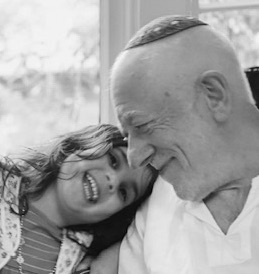
A Small Child, a Shirtless Man

The child peers at the headlines in the newspaper. She has become interested in letters that make up words. She points at a letter:

That’s an N.

And that one is A.

Her grandfather joins her and looks at the ‘paper.

The image of a man standing bare-chested in the open in midwinterseizes his attention. 

And that is Z!

And that’s an I. 

What is that word, Grampa?


***


Grandfather feels sick as he reads the headline.: “Nazis march in Melbourne”. The image shows a powerfully built man with his back to the camera. Grandfather notes heavily muscled arms clenched aloft. He sees in the posture defiance, menace. In the grey streetscape, the man’s exposed skin is very white.

What is that word?

It’s a name, darling.

What does it mean, Grampa?


How do you explain Nazism to a child of five?

How explain it at all?


Darling, that man doesn’t like Jewish people.

Puzzled, she speaks: I’m Jewish…

He doesn’t want people in Australia who have dark skin.

I’ve got dark skin, Grampa. And Mummy…


The five-year old brain whirrs.

Why isn’t he wearing a shirt?

Perhaps he wants to show people he’s tough. He wants people to be scared of him, I think.

Does he scare you, Grampa?


***


Grandfather would prefer not to answer. Is he scared? No, not for himself. But for the little ones, yes. What Australia will this Jewish-Sri Lankan-Australian child grow into? 

No darling, he doesn’t frighten me.

Darling, most people are kind. 

This man feels angry. 

Perhaps, inside, really deep, perhaps he’s scared.


Grandfather feels dissatisfied with his replies. The child looks up andsees his look, careworn and sad. She comes close and throws her arms around his legs.


Bibas

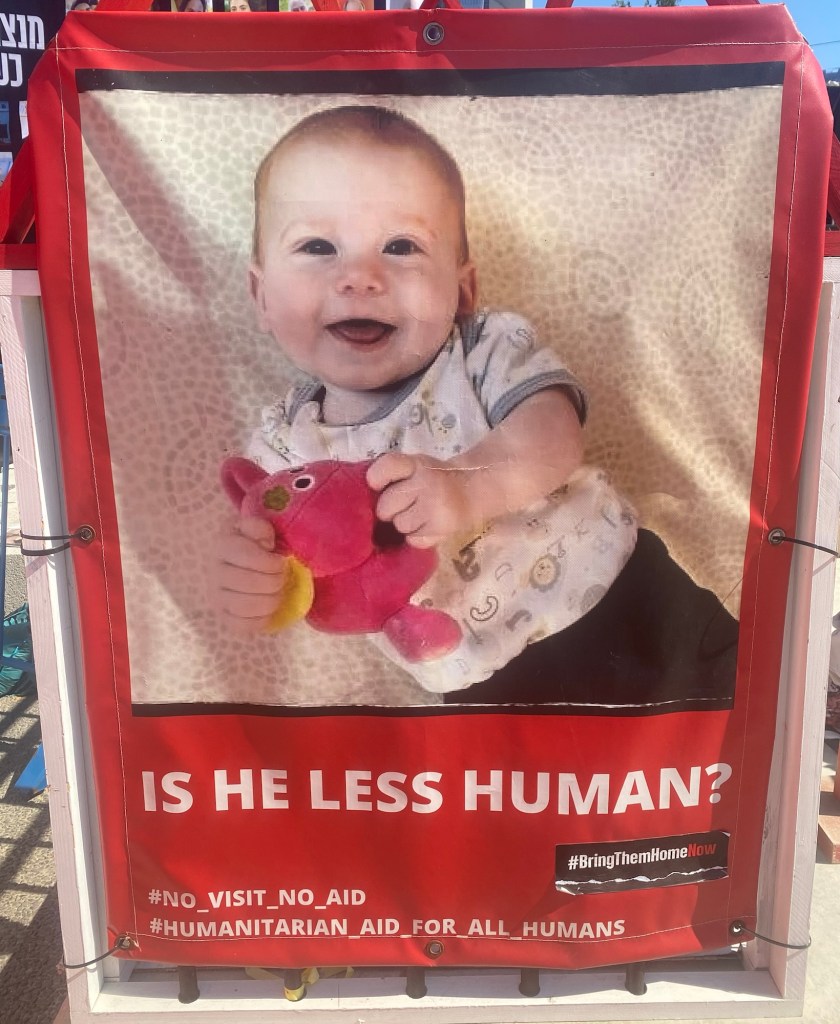
That name haunts me. Images of that family haunt me. Weeks have passed since we learned the news that wasn’t news, that they were dead, em al habanim, mother upon children, as the psalmist phrases it. Weeks have passed since we learned not just dead, but in the case of the four-year old and the one-year old, murdered with bare hands by their captors. Weeks have passed since scenes were shown of triumphant crowds jeering at little coffins, parents bringing their own live children to mock the dead. 

Although the mind was haunted, the pen was stilled, the tongue silenced. These were known facts but the mind needed to unknow them. The mind rebelled. As if to give them voice, to write the words would bring the inadmissible into admission, the unthinkable into thought.

The mind reverts to nightmare: to kill with bare hands? A babe requires no great force of hand, only the extinction of love (of self-love actually, for the human impulse to nurture the littlest is instinctiveand mighty); but the four-year old – what might, what main? – what grunt, what strain? To pen the imagined is to write filth. I might delete the words, but not the thoughts, the horrific wondering. The things that are known do not belong in the realm of the human. If these be facts, if these acts be the work of human hands and human minds, what might my hands, my mind devise?

No, no! The mind rebels.

But we do know it. What now to do with that knowing? Beyond wailing, beyond raging, what light can the human flame show? In two separate but concurrent polls conducted in Israel, Israelis gave answer. A majority was ready to countenance the Trump proposal to clear Gaza of Gazans. At the same time a majority still favoured a two-state solution. The flame of revenge burned bright, butstill the flame of hope flickered.

Keeping Faith with Nick Cave: Day 551.

An age ago a woman of my acquaintance surprised me when she suggested I listen to the music of Nick Cave. Nick Cave, the disreputable? The woman was not young, not a member of any of the alphabet generations, old enough to be shocked. Listen to his love ballads, she said.

I trusted her. I googled Nick Cave love songs and came upon ‘Into my Arms’. Moved and much surprised and not a little abashed, I became a Cave fan, and in time my informant became premier of her state.

It is 551 days now that sons and daughters are dying in the war. 551 days since sons and daughter and mothers and fathers were taken hostage, some already dead, most of them alive. Only a few days since we learned how the captors of two smallest hostages killed them with their bare hands; just days since the small coffins were paraded by Hamas, jeered and mocked.

I listen to Cave in his wrenching interviews. I listen to him speak openly of the deaths of his two young sons. I read his ‘Faith, Death and Carnage’. I listen to Ghosteen. I need Nick Cave today. I’ve needed him these 551 days. I need him to show me his path from the further shores of grief. I need him too, as a model of holding on to belief. I want to hold on, to believe in humans, after humans have killed hostages and disgraced their remains before cheering crowds.

My Friend from Rwanda

My friend from Rwanda has been a teacher to me. I listen to his beautiful voice: his words, exquisitely chosen, percolate unto my being. In those moments I am in harmony with my friend and with my essential self.

My friend from Rwanda lived through war in his homeland. He lost a brother in war. He watches TV images from Gaza. Children climb through the rubble.

I was one of those children, he says.

My friend from Rwanda watches TV and he sees children dying.

He cannot see Hamas putting the children in the way of harm. 

My friend does not see self-defense. He does not see intent. He only sees genocide, where I am convinced of the opposite intent.

When my friend from Rwanda sends us footage that uses language of ethnic cleansing, of colonialism, he hurls me into a distance that neither of us wants. He cannot hear my words. Drenched in blood memories, clad hard in his own pain, he cannot know mine.

Distance, silence, alienation.

And yet we love each other.

The Sounds of Two Silences

Since its inception, this blog has proceeded on tiptoe. Ever since my own inception as a person conscious of myself, this blogger has walked on the tips of his toes. We have been moderate, fair, civil, politically correct. This blog and I don’t like stridency. Not for us the megaphone,but the voice of sweet reason. We’ve been progressive, we’ve been likeable, and we’ve been liked.

Until we ceased being likeable and started to appear tribal. Tribal is not so likeable. This blog has not been liked much since… well, since October 7 last year. Over that period we tiptoed less.

Allow me to explain what I mean by tiptoe, and why we do it. By ‘we’ I mean Jewish Australians. But I could just as easily refer to minority Australians of all stripes. We walk on tiptoe, careful, so careful not to tread on the toes of others. We walk on tiptoe as an act of self-humbling, as an act of apology really. We understand how a turban or a hijab or kippah marks us as different. We understand how difference piques discomfort. We don’t wish to offend or confront. We tiptoe so we’ll be excused for being not entirely the same. 

From very early in our lives as minority Australians we know we represent our tribe. As children starting school, we know that all of us Sikhs, all of us Moslems, all of us Jews, all of us Africans, Asians of every origin, all of us Indigenous people – we all must behave nicely in public, because we kids stand for all of us. If one of us misbehaves or offends or speaks our foreign language too loudly in public, we all will be judged. Our entire group will be judged by the worst of us. Speaking only for myself, this self-consciousness has weighed but lightly. It feels good to behave likeably because Australian people broadly reward us with affection.

There’s a very good reason for anyone – for everyone – in Australia to tiptoe. Once they see past the difference, once they see you’re just like them, Australians embrace you. You feel the love, you return the love. 

Over the decades that I have worked among AboriginaI people I have witnessed much conduct that seems placatory in nature: voices normally loud, lowered for the whitefella; rage directed at their own people rather than at the dispossessor; humble acceptance of the Gap that never closes. It’s at once excruciating and absurd that a First Owner might feel obliged to live a life of apology.

Tiptoeing can be detected, I think, in highly unexpected places. Have a look at photos of women in public life. Note how many face the camera with head held a little aslant. You don’t see this posture in the public male. When I see this, the woman’s face is invariably smiling. The posture and the smile win trust; they say, ‘Yes, I am successful, I am known, but don’t worry, I’m not a threat.’ In a country where a woman dies every week at the hands of a man, such tiptoe might be ingrained in childhood. I like the images of a woman facing the camera squarely, without the obligatory smile.

Until the turn of this century, my tiptoeing was unnecessary. If I tiptoed, I did so, not on account of outside hostility, but on account of my own native timorousness. Until about the year 2000, I had tiptoed beneath my public kippah. But tremors, intimations, opinions, voices, all drove my kippah into hiding. I walked the ways and byways of this beloved country with my kippah in hiding beneath a non-sectarian hat. Only within Aboriginal communities was my kippah nakedly seen. My mob was much honoured by their mob. 

Was I being over-sensitive in the mainstream? Possibly so. But come October 8 last year, when the mob outside the Opera House howled and burned flags and hunted Jews, there was no mistake. Look online where hatred of Jewish people has found its voice, where all shame has been shed, and know why I might walk on tiptoe. 

But I’ve stopped apologising for being Jewish. My kippah can be seen again wherever I go now. It asks Australia a question. And Australia answers with a nod or a smile or a pat on the back, as I guessed it would. But not so on this blog: I suspect I have confused my readers, whom I guess are mainly of progressive mind. Since October last year I have written as a Zionist – albeit as a supporter of Palestinian aspiration – and I sense progressive peoplefind this confronting. I think my readership feels nonplussed. Hence the likeable bogger is no longer ‘liked’. I imagine also that my gentle readers wish to protect my feelings by their reticence. 

Hence, silence.

But I’m not afraid of civil debate. We can agree to disagree. Most days I disagree with myself.

Awful conflict in the Middle East has polarised Australians. A hush has fallen. For many, feelings are too strong for calm utterance. I understand this, because my own feelings are so strong and so painfully conflicted. But that conflict on other shores need not silence us on racism on our own shores. I feel confident the silent majority of Australian people detests anti-semitism. The majority is nonplussed, often offended and irritated by this hatred and wishes us well. The great problem here is the very silence of the silent majority. Anyone who is offended by racism and who remains silent misses a precious opportunity to protect and repair harmony in our community.

Remembering at the Wall

Jerusalem in high summer. We awaken at 4.30, depart the apartment at 5.00 and already the sky is blue, cobalt blue.

Jerusalem is quiet. The roads are quiet. Quiet is rare in this city that teems with the pious, the fervent, the urgent.

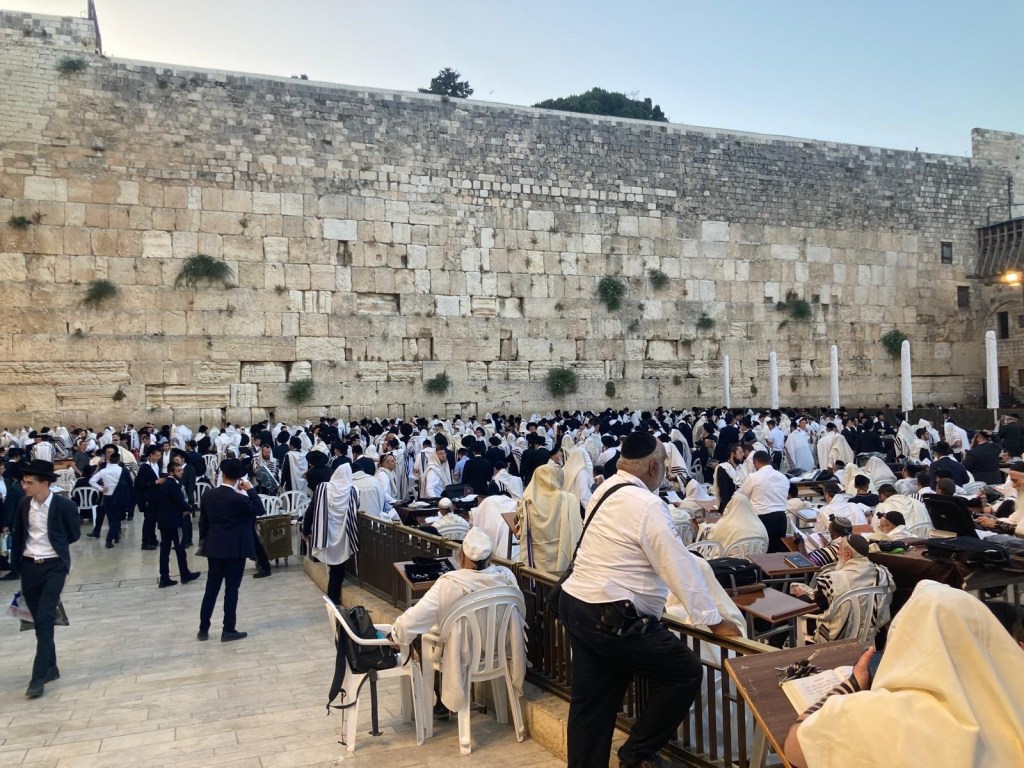
Wondering whether we’ll find people enough at the Wall for a minyan (quorum), we walk with fast steps along twisting ways. We need a quorum in order to recite Kaddish, the mourner’s prayer. Erupting from an alley into the broad square we sight the Wall. Before it, in their many hundreds, the devout, already at prayer.

We three are not in mourning, we are here to remember. We are our mother’s surviving children. An indispensable fourth is her son-in-law John, devoted to Mum now as in life. The remembering starts with the first sighting of the Old City’s perimeter wall. How ancient, these creamy stones, mutely dramatic, forever contended. So many conquerors, so many defeats, such passions, stones soaked in blood.


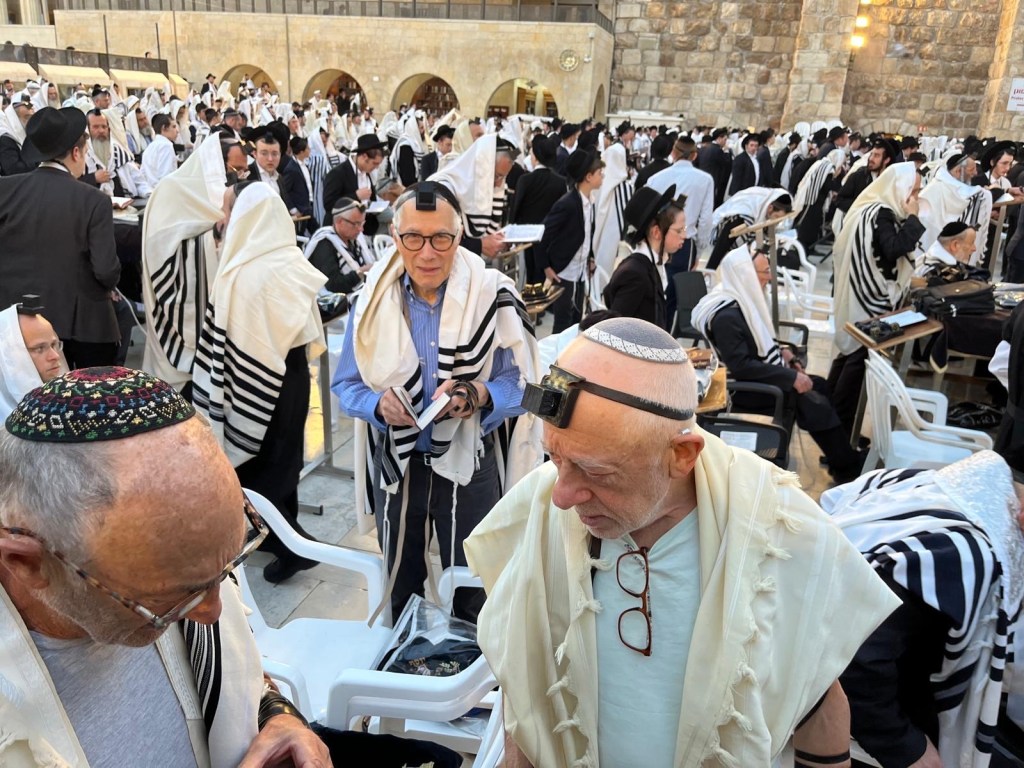
From the plaza, we sight many minyans of minyans, male bodies cloaked in tallithot (prayer shawls). Some wave and sway, others shake metronomically, all moving to intensify intention. One youth in front of me flings his arms to the heavens, his hands clench and unclench in his entreating to God. May his prayers be answered for the good.

Past the beggars, past worshippers of all stripes, past Haredim Caucasian, and Haredim North African, past modern orthodox, past the odd Ethiope, past a pair of the pious deeply asleep, my brother and I wind and wend to the far side where, separated by less than one metre, our sister will hear us recite kaddish.

A memory of my first visit. November 1967. It’s afternoon in early winter, the air crystalline, the skies blue. An impromptu service is in progress. I attach myself to a congregation that is the chance aggregation of the moment. Those elect who are of the line of Aharon the High Priest offer their hands for a Levite to wash, prior to giving the priestly blessing. I raise my washed hands and intone: May the Lord bless you and keep you…

An afterthought lands: here I am, delivering this blessing at the Temple. This my forebears did for centuries until the Temple was destroyed, almost precisely nineteen hundred years ago. My people went into exile. At some stage in the 1800’s my grandfather’s grandparents returned to the land, settling in Petakh Tikvah, the Gateway of Hope, far to the north of here.

Is it possible that I am now, in 1967, the first lineal priest in my family to officiate here since the year 70 C.E.? 

Today, together with my brother I will offer that same blessing. The blessing concludes: May the Lord lift up His face unto you, and give you peace.

Peace!

Our mother was a serene soul. She lived a long life of love, somehow happy through all of life’s losses and afflictions. Today, I remember her and honour her, without sorrow or pain. Late in her life, Mum said to me, You know I never did anything remarkable or distinguished. I never was famous or exceptional. But I did give birth to four children and I raised them and they all love me. So I suppose I was successful.

Mum, you don’t know the half of it: so well did you love us four, that every single one of us felt sure that we were your favourite.

Mum lived her life of peace. I can imagine her in no other state than peace. She went with heart at ease. My tears today are not for Mum. I shed a few sweet tears for this son who misses her. But many are my tears for my people, detested today, deserted by fair weather friends, threatened today, abroad and at home. There is tension in the air, fear too, appalled pain and grief. And mighty resolve.

But here, at this hour of pure air and quiet, Jerusalem is at peace. Have I ever attended prayers so quiet, so ruly? We hundreds recite the words, a soft hum rises from many lips. Until the Amidah (the silent devotion). Quietnessnow, perfect and complete. Torsi swing, sway and shake, hands clench and unclench. 

Prayers completed, kaddish recited, Mum honoured, I make my way to my sister Margot. We fall into a fierce hug that does not quickly end. My body heaves with sobs. I’m a good sobber. There’s much to shed tears about. Tears for the present pain, tears of hope for the future good.

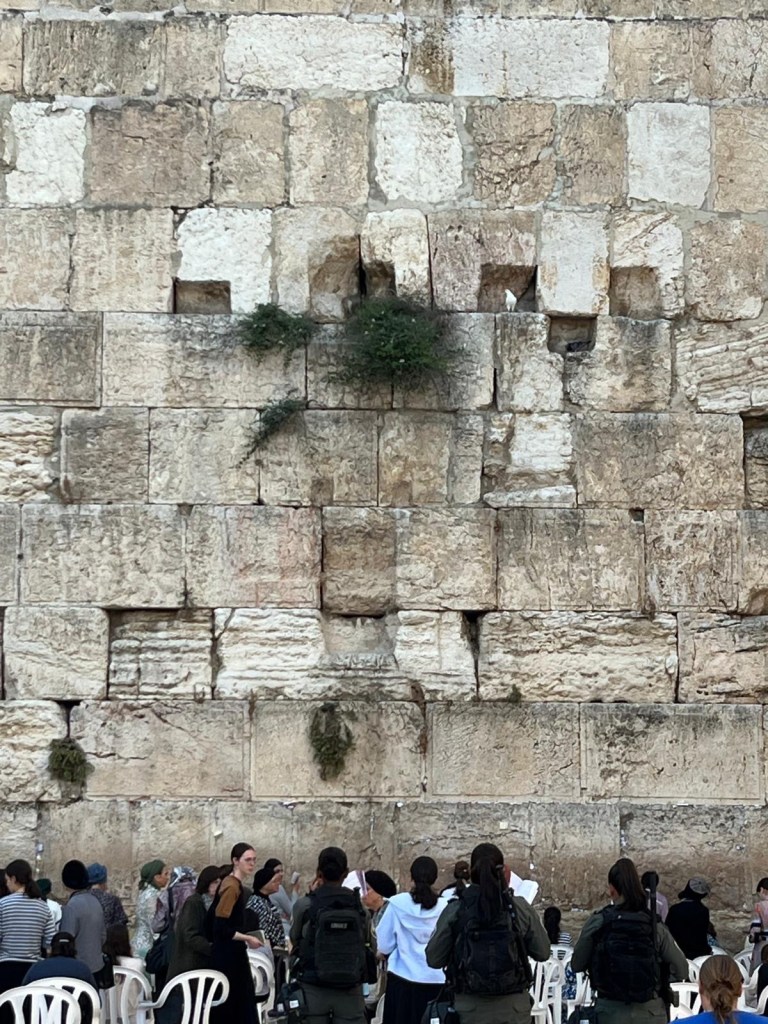
White dove high in the cleft of the Wall

Little Old Lady

You’d see her on the high street every morning, pushing the walker that she really doesn’t need.

She’d walk the 1.2 kilometres to her coffee shop where the staff would welcome her as a sort of celebrity.

At the age of ninety-seven she looks good wearing fashions of women two generations younger. Her white curls are cropped short, her still pretty face opens into a smile that brightens the day. A waiter pulls out a chair for her: What will you have, Helen? The usual?

The usual is coffee and a pastry. If you asked Helen what sort of coffee – a caffe latte or a flat white – she’d look puzzled. I like it how they make it, she’d say, gesturing vaguely in the direction of  the barrista.

Her morning yoga session, a practice of seventy years, keeps her joints moving smoothly. After coffee she’d head back up the high street and make her way to the supermarket. The old lady was heading cheerfully towards her centenary.  

A long life has delivered its burdens. She’s buried partners, she’s watched her daughters grapple with their cancers, there have been the hip fractures, the blocked arteries, the eye that will not work. These burdens she has set aside. Other burdens, burdens acquired in childhood remained buried deeply. 

The old lady kept herself active and cheerful. There were her children and her grandchildren and their little ones. A total of twenty-three descendants lightened life’s burdens. Sons in law and grandsons in law joined her tribe and she embraced them all. The old lady saw her generations, saw her futurity, and life shone. She drank her coffee, she practised her yoga and she walked and walked.

Until the day following October 7 this year. That day she read how the mob in Sydney cried Death to the Jews! Gas the Jews!  Her eldest great-grandchild had told his hijab-clad workmate he was a Zionist. She had replied, You deserve death. On the TV news the old lady watched the mob in Dagestan hunting for Jews.

Now the wounds of childhood in Danzig burst open, an abscess of humiliation and terror. The old lady said, I can’t remember a single happy day in those eleven years… We were the lucky ones, we caught a boat to Australia. All my cousins who remained, perished. Cousin Josephina was burned to death in the Synagogue. And now they’re burning Jews in Israel!

If you walk the high street today you won’t sight the little old lady with her walker. She’s not to be found in her coffee shop. She awakens to a day of heaviness. The news appals. Her mind swims and fails. The new griefs and the old griefs literally drive the old lady out of her mind. She says, I have nothing to live for. There’s nothing for me to look forward to.

Little Old Lady

You’d see her on the high street every morning, pushing the walker that she really doesn’t need.

She’d walk the 1.2 kilometres to her coffee shop where the staff would welcome her as a sort of celebrity.

At the age of ninety-seven she looks good wearing fashions of women two generations younger. Her white curls are cropped short, her still pretty face opens into a smile that brightens the day. A waiter pulls out a chair for her: What will you have, Helen? The usual?

The usual is coffee and a pastry. If you asked Helen what sort of coffee – a caffe latte or a flat white – she’d look puzzled. I like it how they make it, she’d say, gesturing vaguely in the direction of  the barrista.

Her morning yoga session, a practice of seventy years, keeps her joints moving smoothly. After coffee she’d head back up the high street and make her way to the supermarket. The old lady was heading cheerfully towards her centenary.  

A long life has delivered its burdens. She’s buried partners, she’s watched her daughters grapple with their cancers, there have been the hip fractures, the blocked arteries, the eye that will not work. These burdens she has set aside. Other burdens, burdens acquired in childhood remained buried deeply. 

The old lady kept herself active and cheerful. There were her children and her grandchildren and their little ones. A total of twenty-three descendants lightened life’s burdens. Sons in law and grandsons in law joined her tribe and she embraced them all. The old lady saw her generations, saw her futurity, and life shone. She drank her coffee, she practised her yoga and she walked and walked.

Until the day following October 7 this year. That day she read how the mob in Sydney cried Death to the Jews! Gas the Jews!  Her eldest great-grandchild had told his hijab-clad workmate he was a Zionist. She had replied, You deserve death. On the TV news the old lady watched the mob in Dagestan hunting for Jews.

Now the wounds of childhood in Danzig burst open, an abscess of humiliation and terror. The old lady said, I can’t remember a single happy day in those eleven years… We were the lucky ones, we caught a boat to Australia. All my cousins who remained, perished. Cousin Josephina was burned to death in the Synagogue. And now they’re burning Jews in Israel!

If you walk the high street today you won’t sight the little old lady with her walker. She’s not to be found in her coffee shop. She awakens to a day of heaviness. The news appals. Her mind swims and fails. The new griefs and the old griefs literally drive the old lady out of her mind. She says, I have nothing to live for. There’s nothing for me to look forward to.

The Man said to the Woman

The man said to the woman, look how beautiful is the wide blue sea. The woman looked at the sea and saw what the man saw. She saw how the sea sparkled in the light of beginning. She saw its beauty and she knew this was what she wanted. She wanted to share it with the man. She felt something in her hand and when she looked she saw the man’s hand was holding hers. The two hands looked comfortable and strong together.
 

The woman said, yes, it’s very beautiful. It looks like it has no end.


The man said, we’ll need to build a boat. The man and the woman looked down and both saw how each hand held the other; how the hands were comfortable and strong together. The woman said, we can build this boat together and we can sail it together on this sea that has no end. And the man said, we’ll build our boat and we’ll care for it together and we’ll sail on the endless sea together and we’ll never stop.


The woman and the man understood it would take a long time to build a boat. They had long dreamed of the beautiful voyage that had no end. In their dreams their longing moved to their lips, and one murmured about the beautiful sea, and the other murmured about the voyage that has no ending, and the murmurs entered their sleeping ears and when they awoke they both knew they would build and sail together.


They knew too a boat must be safe and strong. They both knew that the beautiful sea could become fierce and dark and stormy. Their boat would have to be strong enough for great storms, for hot weather and for cold, for rain and for long dry times. Their boat would need high walls to keep out the sea, especially if children might come aboard.


The man and the woman worked hard and patiently. In childhood they had floated sticks in the rain that ran down the gutters into the great drains and they had pretended their sticks were sailing ships. But neither had never built a real boat before. They chose the good stout timbers of the kauri tree. They weathered the timbers and after one year the timbers were ready for shipbuilding. The man and the woman measured and sawed and glued and soon their timbers took the form of a boat. Then the man and the woman caulked the gaps between the timbers, and they daubed the inside with tar. Finally they painted the hull with marine varnish, and below the waterline they applied anti-fouling to stop barnacles from spoiling the stout kauri timbers.


The boat was ready to float. The man built a cabin to keep the sun and the rain and the wind from his crew; and the woman built bunks inside the cabin and a galley where food would be made for the crew.

The man and the woman slipped their boat into the water and they saw it floating and their faces shone like the sun that blazed upon the bright blue sea.


The final task was to create a crew. This took time and care. The crew arrived one at a time. They were very, very small. The woman placed each one gently onto a bunk that she had made. After a good many years the man and the woman had a full crew of small children, and the children knew no home other than their good safe boat and they grew there and became strong on the face of that shining sea. The woman looked at the crew, all hale and bronzed from the sun, and she said to the man, let’s set sail on our journey of no end.

The journey took them years. The children grew bigger and stronger. All of the children suffered falls and cuts and bruises and burned in the strong sun, but all of them healed. The man and the woman steered their boat away from storms and pirates, away from icebergs and reefs that might crash or tear their boat apart. Together the man and the woman and their crew visited islands and ports, from Mombasa to Saskatchewan. They saw volcanoes from Vesuvius to the great extinct Mount Erebus. They saw the great leviathan that leaped and blew, they loved the merry dolphins that escorted them, they knew the flying fishes and the jelly fishes, the octopus, the inky squid, the dignified seahorse. Their strong boat housed them and moved them and kept them afloat and the crew and the woman and the man knew their planet as they knew their boat, which was their world.


Sometimes a sudden tempest would arise. The children would cling to their bunks as the waves threw the craft high upon crests then plunged it deep into troughs, and the winds shrieked in the sheets and the rain fell in torrents that ran down the decking and into the sea. The children looked at the great waves of dark green and the foaming crests of white and their world was angry and unkind. Deep inside themselves they feared their boat would break and they’d all be lost. And they felt a mighty fear for the man and the woman who made their world and kept it afloat. The children wept but their cries could not be heard over the scream of the wind and the thunder of the skies. And the woman did not come and the man did not come and each child feared and cried and shivered alone.  


And as suddenly as the squall arose it would subside. The sun shone upon a gleaming world and the terrified crew came up from below and joined the man and the woman who commanded their boat. And in that sunshine the world was at peace, the craft sailed on and the crew recovered.


In every storm the children knew those fears. And in every storm they understood the man and the woman could not comfort them. But luckily, after a few frightening storms the children found their own way to feel safe. The biggest child opened his eyes just as the boat climbed up, up, up a mighty wave then down, down, down the far side, and he saw the smaller crew weeping through closed eyes, and he sang to them. And as he sang the smaller ones heard snatches of sweet sound, a lullaby, and they opened their eyes and saw the singer was their big brother and they managed to smile. From that time, when storms came the crew would all climb onto the big bunk where the man and the woman slept, and they would hold each other and sing or hum and all knew they were not alone.


After every storm the children came out and looked anxiously at their boat, but the boat looked sound and the children mostly lost their fears. But the eldest child worried: how much violence, how many storms could the boat sustain and survive?


The storms came more often and they went on longer. The howling winds and the crashing seas were slower to make peace, and the children clung to each other and sang and hummed as they trembled and tried not to show their fear.


From time to time the man and the woman would steer the craft to a port and put in for repairs. And the boat’s invisible tears and strains and cracks and leaks were glued and tarred and caulked, the barnacles were sanded off the kauri and the hull repainted as before. And the boat seemed safe and strong. And the crew and the man and the woman continued their voyage.


One day the crew awoke to a frightful storm. They heard roaring and screaming. It was the voice of the wind that screamed and the voice of the sea and the thunder that roared. And the boat shook and the small crew members saw cracks opening between the timbers and water pouring in. The biggest little crew man grabbed a bucket and the smaller crew grabbed cups and bowls from the galley and all the small people filled their cups and bowls and bucket with the sea water and threw it over the side. Each of the crew filled and bailed and threw the waters away, each of them sensing they had to be the one who would save the boat. But it was no use: the waters came up through the floor boards and up to their ankles, then their knees. Now the woman came below and the man came with her and they told the crew what they already feared. Perhaps they already knew. Perhaps the sea waters had told the young crew that their beloved boat could no longer take them on their journey safely.


The woman spoke kindly and the man spoke gently. The man said, we will always protect you, and you will sail again in peaceful waters. The woman said, you will always be our crew even when we no longer sail this boat that was so beautiful. And as the two spoke gently and kindly, the children realised the screaming and the roaring had stopped. And the small ones thought, no, that’s not going to happen; this beautiful boat will be made better and we will all sail in it again. But the biggest crew child looked at the boards, all swollen and splintering, and he knew the boat would not sail again.


The boat did not sink straight away. The brave man and the sad woman steered it and sailed it to a safe place. The bow of the boat rested on dry land, and the man jumped ashore and the woman lifted the children from the broken boat and passed the crew, one by one, to the man who set them down on the shore. The smallest crew person wasn’t used to the feel of sand and grass underfoot, and started to cry. The other crew tried to comfort the smallest one, but they could not speak; their throats were full of a great ball of sadness, and when the man and the woman tried to cheer the sobbing child their throats blocked too. Suddenly all found voice and the voice they found was the voice of sadness and they wept together. And when at last they all finished weeping they looked one last time towards the boat they loved. But the boat had gone. Only a swirl on the surface of the sea marked where it had been.

My Ever Fertile Meadows

In the early years of my life I dwelled in a paradise called Leeton. Leeton is a small country town in south-west New South Wales, designed by Walter Burley Griffin. Irrigation and imagination provided the infrastructure for small boys to live a life of freedom and adventure. However, quite abruptly, at the age of nine-and-a-half years, I was kidnapped by my parents and transported to a city where I have lived in captivity ever since. 


It never occurred to me until recently that this abruption might be a trauma. But ever since I have contrived to escape the city for short intervals, to breathe cleaner air, to look at horizons, to listen to the silence. It is during such an escape that I am writing this. This escape is different from the many which have preceded it; my beloved is here with me. 


Together my beloved and I have journeyed around the sun almost fifty-three times, but it is only today that we will visit my hometown together. It was here, in this small town that I spent my seed time. Here the seeds germinated; it is from this soil and this sun that the shoots of my whole life spring. The roots persist and grow and they sprout, ever green. This town, those times haunt me. They haunt my loved ones too, to their puzzlement.


Today, perhaps, my beloved will feel her own enchantment. And perhaps she will not. A small town in the country is, after all, a commonplace thing. You can walk the wide streets and find them empty of sound or movement, unremarkable and untouched by charm. Perhaps the charm lies solelyin memories which I have watered and cherished and improved over a lifetime of years.

What will I show her, my beloved? How to water her imagination?


Of course, we’ll visit the old house. The new owner gave us permission to explore alone, trusting us with his own new love. She’ll see the bathroomwhere, behind a locked door, we played Murder in the Chookhouse. I’ll show her the hallway where my younger brother was circumcised. She’ll see the space where we sat in the Succah and celebrated Tabernacles. On the front doorpost we might find the scars of Dad’s mezuzah. I’ll show her the odd, circular window high in the wall of Dad’s old consulting room. That’s how the light got in.

But the obvious landmarks in town, such as the school, the kindergarten, the hospital, the olive oil factory that Dad built, do not call to me as loudly as certain unexpected sites. Will we visit the railway bridge under which we chose to play, drawn by the special allure of the forbidden?  Here we’d come into the domain of the locomotive, hot and blackand noisy, the very embodiment of implacable power. On one occasion we were playing under the bridge as the train entered, with its noise and its smoke. Too thrilled even for terror, we spent perhaps thirty unforgettable seconds in intimate relation to the monster, amazed dumb. I’ve never spoken of this escapade. My beloved will learn of it before you who read this.


Before we sight Leeton, we’ll pass Wamoon, where I’ll stop and we’ll walk across the bridge over the fatal canal. What will she see, what will she feel, this person who knows me so deeply and so long?

I’ll take her into the great park across the street from the old house. I’ll show her where the man lounging on a picnic rug with his girlfriend and a bottle of beer accepted my challenge to wrestle, one slow Shabbat afternoon. Here he pulled down my shorts. I’ll show her the Police Station just around the corner, where, a few days later, I went to report that strange event. Sergeant Stewart walked me to the spot and bid me look around. He asked, ‘Can you see the man you wrestled with?’ I could not, but to oblige the sergeant I pointed to a man at random. Sergeant Stewart observed: ‘Making a false accusation is a serious matter, Howard.’ The officer enlarged my vocabulary.

I’d like the two of us to climb the high boundary wall of Number Two Jarrah Street and peer over into the odd, kite-shaped backyard of my first friend’s home. That home was as much a refuge and a place of love for me as my own home, twenty yards distant. Through one rare day of soaking rain, that friend and I played in a room filled with enormous cardboard cartons, large enough to walk in. When, years later, that house was stolen and became a pizza shop I knew the meaning of sacrilege.


On the morning of our departure in 1955, my friend’s mother stood on her front step and took me and my elder brother into her arms and embracedus. She held us there and she delivered her benediction: You two boys have the duty to become the finest Jewish gentlemen ever – because of what your parents are giving up for you.


My parents? Did they suffer their own trauma? Did this commandment from our gentile friend shape my life?


Perhaps such memories are too strong for others to feel or know. Perhaps, in time, they can become malignant. Perhaps, on the other hand, I need to share them, to lay them bare to new eyes, to exorcise a haunting from the life I share with my beloved.


Afterword:

My beloved came, admired, and fell, quite charmed.