In Search of Uncle Bert, or a living relative

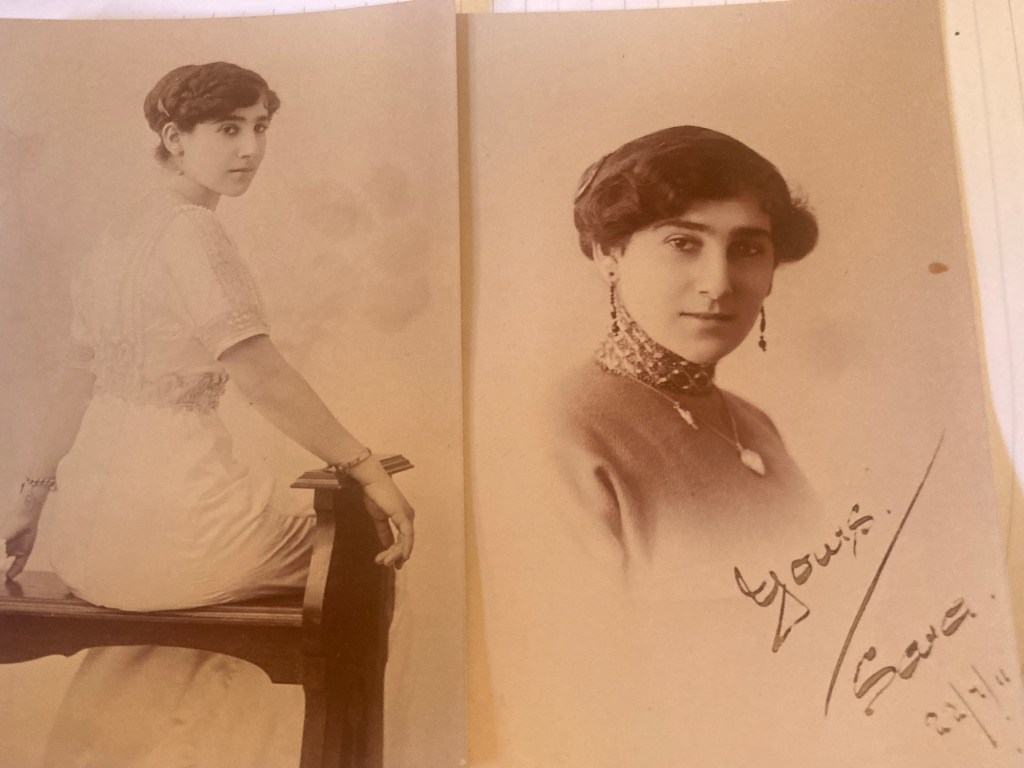
Uncle Bert wasn’t actually my uncle. He wasn’t a blood relative to my Mum or Aunty Doreen,* or to any of their succeeding generations. The family had bestowed the uncle title upon Bert on account of his being married to Aunty Sara. And Aunty Sara wasn’t really anyone’s aunt.


Mum and Aunty Dor cherished Sara, the sole surviving friend of their parents, who died while the sisters were young girls. Dor and Mum loved Sara and honoured her, and tended to her until she died, deaf and blind and loved, at ninety-seven. Uncle Bert died in his eighties, when Sara was still a vital lady of about seventy.


I knew Uncle Bert. He was quiet and gentle. He wore a suit of black material. I recall a black waistcoat. I have a mind picture of a pocket watch and a chain. I don’t remember what work he did. That’s not much to know of an entire living person. 


Uncle Bert and Aunty Sara had but one child, a boy, whom they named Basil. I met Basil once. Basil died in his early forties of an overdose of pethidine, an opiate in clinical use at the time. Mum reported Uncle Bert’s reaction. He said simply, My son is dead. Otherwise, Bert took the death in his quiet way, without demonstration. About ten years later, Bert too, died.


All of this came back to me recently while I was decluttering my study. Among odds and ends of my late elder brother Dennis, I found some papers relating to Sara and Bert, and tumbling free from them, a returned soldier’s medal. 


Uncle Bert a serviceman! I had no idea. The medal signified facts undreamed. The quiet man in elegant Sara’s shadow had served overseas in the First World War. Had he been in the trenches in France?

Had he, by chance, been gassed?

I never heard the quiet quasi-uncle speak of such.
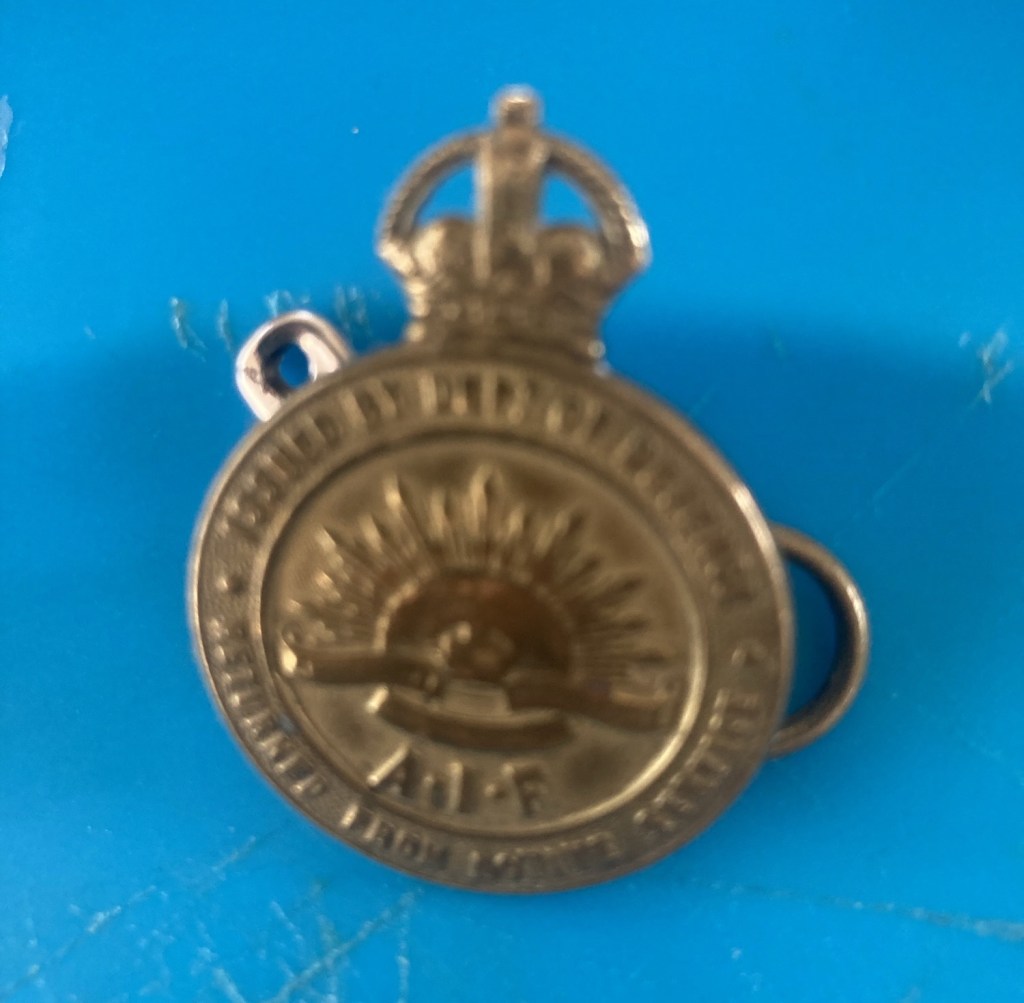
 

The little medallion weighed on me. It was not mine to keep. It signified a young nation’s acknowledgement of a man’s service. The medal knew more than I did, and I was one of a very few people still alive who knew Bert Harper. And Bert left no posterity. Time passed, and every day that passed brought me closer to the end of my own life. I worried that the medal, and what it signified, might die with me.  


***


A couple of months pass before family matters bring me to Canberra. I pack the medal and I hike my way to the Australian War Museum. As I drive I realise I can’t confidently name my former serviceman. Was Uncle Bert just Bert? Probably not. He might have been Herbert. Or Bertram or Osbert, maybe even Egbert…or Albert; probably not Umberto…


I ask the courteous guard, Where can I research a relative’s war record?

Climb those stairs, Sir, and there, to the left of the café, you’ll find Research.


In Research a young woman sitting behind a large screen smiles a welcome:

How can I help you?

I have a medal left by a relative. I want to find out about his war service.

We can help. Follow me please.

We take a couple of chairs before a second large screen. My companion and guide looks about twenty-five. She has fair hair and a friendly way about her. It transpires that we two will spend a good while together. After about ten minutes I introduce myself. She gives her name – we’ll call her Miranda – and she shakes my hand firmly.


By this stage we have dealt with the question of Uncle Bert’s first name. I gave Miranda my list of suggestions to which Miranda said, If he really was Egbert Harper it will make my day.

Howard: It would make mine if he was Sherbert.


We have already dealt with the medal. It signifies more than the fact of Bert’s service in the AIF. It certifies he had served overseas, had returned to Australia, and had returned alive.There’s a number on the medal’s reverse side. Miranda explains, This number isn’t a serviceman’s AIF number. It just signifies where this particular medal exists in a series of such medals. 


Quite a few Herbert Harpers served in the Australian Infantry Forces in the First World War. All are documented. We troll through all the Herbert Harpers.   


One Herbert Harper returned with a lengthy and eloquent citation. This Herbert had behaved with conspicuous gallantry, had been decorated repeatedly, and had been killed. My Uncle Bert had not died.


Miranda looks over to my covered head: What was his religion?

Jewish.

None of these Herbert Harpers put Jewish as their religion. Many Jewish recruits did not admit Jewishness. Usually they’d write C of E for convenience. What was his date of birth? Where was he born?

I thought he was born in Perth. His date of birth? I do not know. 

I call my eldest cousin. He knew the Harpers before I did. He should know more. Eldest Cousin knows less than I. He says, I remember Uncle Bert, but I never knew he went to war. I don’t remember much about him Doff. I’m afraid I’m useless.


Miranda asks where Bert was born. Mum told me the Harpers and her parents had all been friends in Perth. I assume that’s where Uncle Bert comes from. Miranda finds a Herbert Harper in the National Archives who enlisted in the AIF in Perth, in 1916. This Bert was five foot, seven inches tall, which Miranda informs me was close to the median height for a male serviceman in WWI. His full name was Herbert John Harper, his stated religion is Church of England. Miranda adds, All personal details are self-reported, their truthfulness self-attested. My grandfather, for example, gave his age as twenty when he signed up, but he was only seventeen.

I happen to know a few solid facts about Uncle Bert. He married in the Perth Synagogue, an Orthodox congregation. I know this from his ketubah, one of the documents that I stumbled upon when I found the medal. An Orthodox rabbi will not marry you unless you can prove you are Jewish. Customarily, you do this by producing your parents’ ketubah. 

This a Jewish marriage certificate, written in an ancient Aramaic formula.

Uncle Bert and Aunty Sara were definitely Jewish, not C. of E.
 

As I muse on Herbert John Harper of Perth, my phone rings: It’s the Eldest Cousin. Doff, I’ve googled Bert. He was born in 1885. He wasn’t from Perth, the family lived in Malvern, in Alice Street – where my nephew lives today!


I deliver this intelligence to Miranda, who checks the First World War Embarkation Roll of all Herbert John Harpers. Here she finds a Herbert John Harper who enlisted in the 44th Australian Infantry Battalion on December 30, 1915. He is listed as single, a commercial traveller, aged thirty years. His home address is 123 Raglan Road, North Perth. Herbert’s next of kin is his father, who lives in Alice Street, Malvern.


This Herbert is our family’s Uncle Bert. He is indeed, prosaic Herbert, not Egbert, not Sherbert. Before enlisting, he works as a commercial traveller, that is, an itinerant salesman, the humble line of work of many Jews at the time, (and in my own family, up to the 1960’s).

Sydney Myer was one such. Myer Emporia are his legacy.


So it’s at the end of 1915, when Uncle Bert is well beyond his callow days, that he joins up. Uncle Bert didn’t join the great romantic adventure of the War at its outset. Why join just now? I learn the War is going very badly for Britain and her Allies at the end of 1915. Britain has just withdrawn from Gallipoli, is retreating in Salonika, and has withdrawn from Macedonia. The British Commander in Chief in Flanders and France has resigned and been replaced. On December 30, the armoured cruiser, HMS Natal explodes, with 400 lost; and Herbert John Harper, commercial traveller resident in Perth, joins up. His Service Number in the 44th AIF Battalion is 804. Miranda informs this number will stay with Private Harper wherever he serves, and in all records. He might be seconded to a different unit, but he’ll remain Number 804.


Miranda directs me to the First World War Nominal Roll where we find an Embarkation Date of February 7, 2016, and a date of return to Australia twenty-two months later, in December 2017. She tracks his movements between those dates to Great Britain and subsequently to France.


Now, there’s normally no discharge so long as hostilities continue. Exceptions occur in the case of Dishonourable Discharge and in the cases of illness and injury. Why does Herbert Harper, 804, come back early?


Miranda finds Bert’s disciplinary record. He has misbehaved, being Absent Without Leave. This is pretty grim reading. Miranda finds the details: “CRIME: Absent from Reveille.” “Punishment: Admonishment.” By way of context, Miranda gives the story of her grandfather when he was AWOL. He nicked off somewhere for 4 or 5 hours. Grandfather’s punishment was docking of eight days pay! Our Private Harper, 804, has no pay withheld.


So this delinquency would not explain Bert’s early return. Was he injured or otherwise unfit? We turn to Bert’s Medical Record. We read his Certificate of Medical Examination upon enlistment: He does not present any of the following conditions, viz. : –

Scrofula; phthisis; syphilis; impaired constitution; defective intelligence; haemorrhoids; varicose veins, beyond a limited extent; marked varicocele with unusually pendant testicle; inveterate cutaneous disease; chronic ulcers; traces of corporal punishment; or evidence of having been marked with the letters D. or B.C.; contracted or deformed chest; abnormal curvature of the spine; or any other physical defect calculated to unfit him for the duties of a soldier.


Bert’s later records state he is discharged medically with Hyphasis. This is not a diagnostic term I learned at Monash Medical School between 1963 and 1969. I have not heard of it since. Neither has my colleague, Dr Google. The copperplate writing is very clear: the word written is clearly HYPHASIS. Does the recording officer misspell KYPHOSIS? This condition is not rare and used to be called hunchback. I don’t recall Uncle Bert having any spinal deformity. What is more, in his examination upon enlistment, Private Harper, 804, showed no abnormal curvature of the spine. His spine was straight and his “testicle not unusually pendant.”


Miranda moves on and shows me Herbert Harper’s request, in 1917, for a War Pension. Quite promptly he is awarded a pension of forty-five shillings per fortnight. Is this handsome or meagre? Quick enquiry suggests the equivalent in Australian currency is $270.00. By way of comparison, today’s Australian Disability Pension pays $1149.00 per fortnight.


These discoveries explain the somewhat unusual fact of Aunty Sara conducting her own business. Sara Harper owned and ran a women’s clothing shop in elegant Ackland Street. That precinct was known as The Village Belle. Aunty Sara’s was not a thrift store. It sems likely Aunty Sara worked because Uncle Bert could not.


Miranda has been musing: Herbert Harper is found fit to fight in December 2015. He remains fit for embarkation two months later. He is shipped to Britain and onward to France. After twenty-two months, he enters hospital in Australia, is soon discharged, and after only a few months, is awarded a pension. He must have been injured or otherwise medically unfit.


I wrack my medical brain. A formerly straight spine will collapse into a ventral hunch if one or more vertebrae collapses. Commonly this occurs in postmenopausal females who have osteoporosis. Cancer in a vertebra can also cause this, as can tuberculosis of the spine. Gunshot injuries might also destroy vertebrae, leading to collapse into kyphotic deformity.


We find no record of spinal injury or disease in Private Herbert Harper, just the enigmatic word, Hyphasis. 


So, here is Herbert Harper, unmarried on enlistment, a bachelor still. The War continues and he takes a wife, Sara. The couple are blessed with a son, who grows, becomes addicted and dies. Uncle Bert dies, and much later, Aunty Sara follows. Their line comes to an end. I recall my Mum corresponding with a woman in Perth who was connected to Sara. I think she was a niece on the non-Harper side. I don’t know her name. She was older than I, and eligible therefore, for extinction.


By the end of 2026, I estimate there might be twenty people at most who are alive today and who knew Uncle Bert. Most of that number are themselves aged. When all of our cohort departs this life, there will remain of Uncle Bert no memorial but the medal. And perchance, this record.


This troubles me. A quiet man, a patriot, who put his life at hazard and lost his health; who knew the joys of marriage and fatherhood; who lost his only son. Insignificant to me in my childhood, he matters to me now. He signifies.


A realisation dawns. Uncle Bert had a father, William Harper of Alice Street, Malvern. Did William father additional children? Did he have siblings? Who knows? – flocks of Harpers probably exist, unaware of their connection to Herbert John Harper, AIF, 804. Unaware too, of the medal that is rightfully theirs.


This little memoir is posted here in the hope it will find its way to a descendant or relative of William Harper, who lived in Alice street, Malvern, Victoria, in the early 20th Century.


(*Aunty Doreen, on the other hand, was sister to my Mum, authentic and authenticised.)


Last Prayer

I might die tonight

I don’t expect to

But I might…

I’m old.

I have my diseases.

I could go tonight, 

I’m eligible;

It’s not terrible.

We all must leave,

But before I leave

Just in case it’s tonight

Here’s my last prayer.

Hear me, I pray:

Hear me say

shema yisrael

Thanks for today

And yesterday:

Thanks for the mother,

the father in our Tabernacle

of love

And the sister,

The brothers

In that Tabernacle

Of love

Thanks for Annette, 

my love, my wife,

for her lovingkindness.

Netti, you are in my mind tonight.

My children so dear, 

Do you feel, do you hear

The pulse of my love

Tonight, 

As every night?

To the children of my children

You will not know until

Your own children

Have children

How you’ve sweetened 

This, the evening of my life.

If I’m to depart tonight

Let me today spare

For one in need

A kind face,

A kind deed.

Let me leave to my world

A smile, a laugh

As an epitaph.

Catching Up


I’m gaining on my parents. Dad died at ninety-two years and nine months, Mum died one week short of her ninety-second birthday. It occurred to me when I turned seventy-eight recently that I’m catching up with them.

It would be nice to catch up with them in the contemporary sense of a catch-up. But in reality, such a catch-up wouldn’t be face to face, but bone to bone. I’m not ready for that, not structurally nor emotionally.

I do catch up with my parents from time to time. One of the two will appear in my visual field when my eyes are closed in sleep. They don’t speak, but we know each other and we understand each other. They smile. I expect I smile in turn. I know I feel smilish, a feeling of being loved and deeply known, a feeling of loving back.

The feelings are sweet, sweet. 

It’s when I’m awake that I muse on the narrowing gap between us. Somehow the musing carries no pain, no fear, no sorrow. This contrasts with the fear I had as a child, of the annihilation of death. Death has no sting now: Dad did it, Mum did it. Their time had come and they went. We wept, we remember and the loving feeling is unquenched. They died, the love loves on. 

It was the love of my parents that formed me and sustained me. They taught me how to live. Now they are helping me as I approach the exit. If, as is written, the task of a lifetime is to come to terms with life’s finity, then my parents have taught me one final time.

My Ever Fertile Meadows

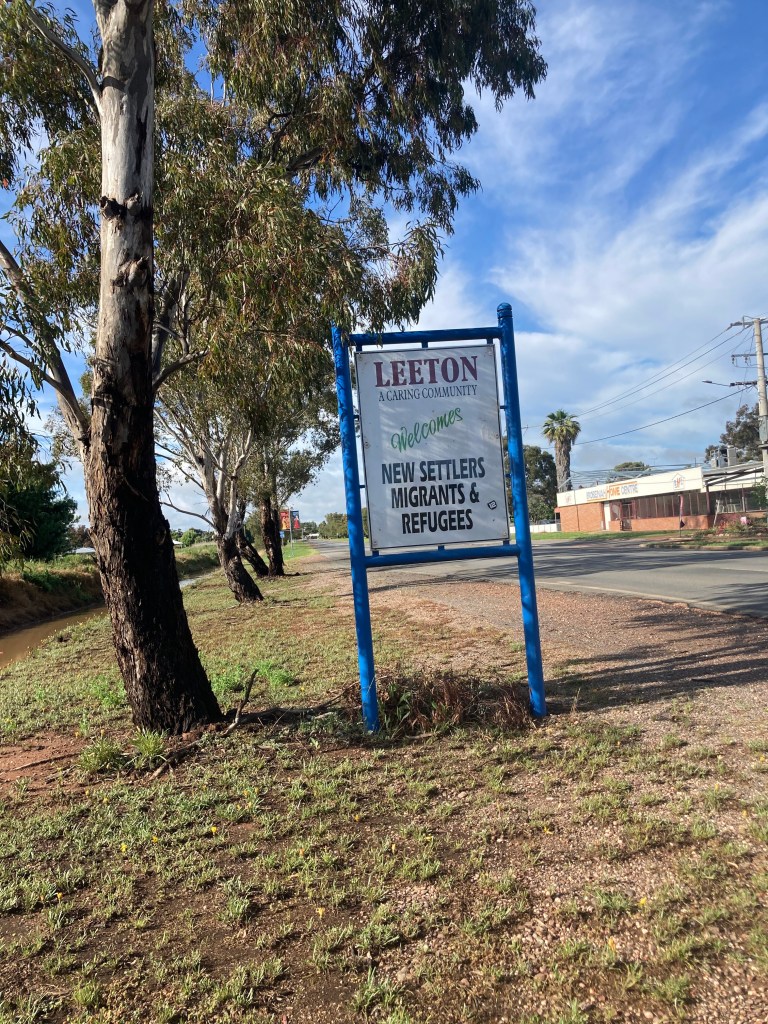
In the early years of my life I dwelled in a paradise called Leeton. Leeton is a small country town in south-west New South Wales, designed by Walter Burley Griffin. Irrigation and imagination provided the infrastructure for small boys to live a life of freedom and adventure. However, quite abruptly, at the age of nine-and-a-half years, I was kidnapped by my parents and transported to a city where I have lived in captivity ever since. 


It never occurred to me until recently that this abruption might be a trauma. But ever since I have contrived to escape the city for short intervals, to breathe cleaner air, to look at horizons, to listen to the silence. It is during such an escape that I am writing this. This escape is different from the many which have preceded it; my beloved is here with me. 


Together my beloved and I have journeyed around the sun almost fifty-three times, but it is only today that we will visit my hometown together. It was here, in this small town that I spent my seed time. Here the seeds germinated; it is from this soil and this sun that the shoots of my whole life spring. The roots persist and grow and they sprout, ever green. This town, those times haunt me. They haunt my loved ones too, to their puzzlement.


Today, perhaps, my beloved will feel her own enchantment. And perhaps she will not. A small town in the country is, after all, a commonplace thing. You can walk the wide streets and find them empty of sound or movement, unremarkable and untouched by charm. Perhaps the charm lies solelyin memories which I have watered and cherished and improved over a lifetime of years.

What will I show her, my beloved? How to water her imagination?


Of course, we’ll visit the old house. The new owner gave us permission to explore alone, trusting us with his own new love. She’ll see the bathroomwhere, behind a locked door, we played Murder in the Chookhouse. I’ll show her the hallway where my younger brother was circumcised. She’ll see the space where we sat in the Succah and celebrated Tabernacles. On the front doorpost we might find the scars of Dad’s mezuzah. I’ll show her the odd, circular window high in the wall of Dad’s old consulting room. That’s how the light got in.

But the obvious landmarks in town, such as the school, the kindergarten, the hospital, the olive oil factory that Dad built, do not call to me as loudly as certain unexpected sites. Will we visit the railway bridge under which we chose to play, drawn by the special allure of the forbidden?  Here we’d come into the domain of the locomotive, hot and blackand noisy, the very embodiment of implacable power. On one occasion we were playing under the bridge as the train entered, with its noise and its smoke. Too thrilled even for terror, we spent perhaps thirty unforgettable seconds in intimate relation to the monster, amazed dumb. I’ve never spoken of this escapade. My beloved will learn of it before you who read this.


Before we sight Leeton, we’ll pass Wamoon, where I’ll stop and we’ll walk across the bridge over the fatal canal. What will she see, what will she feel, this person who knows me so deeply and so long?

I’ll take her into the great park across the street from the old house. I’ll show her where the man lounging on a picnic rug with his girlfriend and a bottle of beer accepted my challenge to wrestle, one slow Shabbat afternoon. Here he pulled down my shorts. I’ll show her the Police Station just around the corner, where, a few days later, I went to report that strange event. Sergeant Stewart walked me to the spot and bid me look around. He asked, ‘Can you see the man you wrestled with?’ I could not, but to oblige the sergeant I pointed to a man at random. Sergeant Stewart observed: ‘Making a false accusation is a serious matter, Howard.’ The officer enlarged my vocabulary.

I’d like the two of us to climb the high boundary wall of Number Two Jarrah Street and peer over into the odd, kite-shaped backyard of my first friend’s home. That home was as much a refuge and a place of love for me as my own home, twenty yards distant. Through one rare day of soaking rain, that friend and I played in a room filled with enormous cardboard cartons, large enough to walk in. When, years later, that house was stolen and became a pizza shop I knew the meaning of sacrilege.


On the morning of our departure in 1955, my friend’s mother stood on her front step and took me and my elder brother into her arms and embracedus. She held us there and she delivered her benediction: You two boys have the duty to become the finest Jewish gentlemen ever – because of what your parents are giving up for you.


My parents? Did they suffer their own trauma? Did this commandment from our gentile friend shape my life?


Perhaps such memories are too strong for others to feel or know. Perhaps, in time, they can become malignant. Perhaps, on the other hand, I need to share them, to lay them bare to new eyes, to exorcise a haunting from the life I share with my beloved.


Afterword:

My beloved came, admired, and fell, quite charmed.

I Don’t Belong Anymore

My medical defence insurer wants to protect me from myself. The insurer invites me to attend a webinar titled, Keeping Professional Boundaries. I entered medical practice as I entered life: I wanted to break down the barriers that kept people apart. “Only connect” was the motto of the great E M Forster. It was my motto too.

In recent years, AHPRA has been writing to me, warning me to maintain necessary distance from patients. I should avoid initiating any physical touch of a patient, other than when clinically necessary. I must not treat friends, I must not treat family members, I should not meet a patient for coffee or a drink or a date, nor for a dalliance nor for a sexual relationship. Realising that the world has changed I register for the webinar.  

The webinar began with a playacted scenario of a young male doctor’s consultation with a youngish woman. The doctor is a good-looking male, personable and competent. His patient is an attractive young woman, perhaps slightly older than the doctor. At the conclusion of their consultation the patient asks, “Do you have any more victims today?”

The doctor hesitates and the patient clarifies: “Am I your last patient today?”

“Yes, as it happens.”

“Would you like to go somewhere and have a coffee together?”

At this point the youtube stops and the watcher is presented with three possible responses the doctor might make. One only is deemed correct.

1. The doctor assents. It’s innocent enough. Sharing a single cup of coffee is not improper.

2. The doctor informs the patient politely that he cannot accept. Further, he states the professional relationship has broken down and he must not see her again as her doctor, but must arrange for her future medical care with another doctor.

3. The doctor informs the patient politely that he cannot accept. He states, ‘We have professional guidelines which we must follow.’

To me the answer seemed simple. But the scenario made me think over the past 52 years of being alone with people of all genders and trusted by them. Form more than half a century I’ve tried to remove barriers. None of my patients, however, invited me for coffee, so I had no practical experience of the scenario.

I recalled an event that occurred perhaps a dozen years ago. I received a phone call from a previous patient whom I first met when she was one week old. She remained my patient through childhood to adulthood. I treated her father for his rare disease, which eventually killed him.

The young woman studied Medicine and when she graduated, she invited me to attend her graduation ceremony, I supposed, in loco parentis. She became engaged and she invited my wife and me to attend her wedding. She trained as a GP and started practice in the country. I didn’t see her for some years. Now she rang me, asking if she could consult me professionally. She was unsure how to approach a possible problem affecting her little boy.

I offered her the first appointment of the next convenient day. The young woman accepted. Then I said, ‘If you can come half an hour earlier, we can meet for a cuppa beforehand.’ My patient accepted enthusiastically. At the café, delighted to see each other again, we embraced, sat down, drank coffee, talked about our work and our widowed mothers then crossed the road for our consultation.

The same day I opened a letter from AHPRA which arrived in the mail. The letter warned against socialising with patients, specifying the dangers and the power imbalance that prevailed even in meeting for coffee. The same letter emphasised the need to avoid non-clinical touch. I thought about the hug with which my patient and I had greeted each other that morning.

This brought to mind another occasion in which I had transgressed. A religiously devout young woman whom I treated through childhood and adolescence moved interstate to train for the ministry. Her parents had been my patients before her. Her father was the first patient I referred for total knee joint replacement. The operation was a success but he developed an infection and died a week later, of septicaemia. His daughter was then a teenager.  

The young woman studied theology, married and served a flock in a distant city and I did not see her for quite some years. She returned once to Melbourne to seek my help with infertility. She was married happily to her first boyfriend, himself a minister in the same community. I asked some questions then placed some calls and referred her to my favourite genius. Years after that she turned up again at my country practice on the outskirts of Melbourne. I was delighted to see her. We sat down and I asked her about her life. The couple had been blessed with two small children.

The conversation turned to her health. She said, “I found a lump in my breast.” I examined her and felt the lump readily. It was hard, a bad sign; it was not mobile, another bad sign; the overlying skin was puckered, a further sinister sign.

After she had dressed, we talked. I answered her questions: Yes, it was worrying. Yes, it was probably cancer. We talked about treatment, about biopsy and tests, about choice of specialists. She asked me about the prognosis. I answered as well as I could. I asked her about the age of her children.

I placed some phone calls and wrote a referral letter. We spent well over an hour together, the visit spilling falling at the end of my morning’s work.

I felt shattered.

The young woman stood to leave. I took her in my arms and held her a moment then released her. But she held me for some time, her head resting against my shoulder, her body heaving with sobs. At length she wiped her eyes and said, “That’s what I crossed the country for.”

Looking back at that encounter I realise that this was the first time I had initiated such conduct. I had acted on an impulse, in response to which my patient had told me how much it meant to her.

I have socialised with patients, I have drunk coffee with them (and in one case, eaten pancakes with an ex-patient’s at her invitation). I have treated close friends and, apprehensively, I continue to do so. I have walked the primrose path toward the eternal bonfire.

In recent decades lawyers, teachers, nurses, ministers of religion, therapists and doctors have all been guilty of extremely harmful acts. In response to those wrongs all professionals have been warned to protect those who are vulnerable. Power resides with the professional. Power corrupts some. As a result, society is wary of abuse. And all of us in professions have been trained to mistrust ourselves.

I think about my Dad in his years practising as a GP in a country town. His patients were his friends. His friends were his patients. After we moved from the country to the city some of those friends drove hundreds of miles to consult him. I think of the many doctors living and working today in small communities. The AHPRA rules (or ”guidelines”) would, if followed, socially strangle a doctor and in preventing great harms to patients, do much harm to practice.

My insuror’s webinar gave clear and absolute guidance to members. We would be obliged to decline the coffee, and we must bring an end to the relationship forthwith.

I am guilty of great error: I still trust myself.

I no longer belong in a role which has long been my home.

This Marathon May Be My Last


“This marathon might be my last, darling.”

“We’ve heard that before, Dad.”

“I’m serious, Raph. I see it as a moral test. If I fail it, I’ll realise it’s over: I’ll know I lack the moral strength.”

“What are you talking about, Dad?”

“Simply this. I’m confident my legs are strong enough. It’s my spirit that’s in question: do I have the drive or the staying power or…the spiritual reserve? My fear is I’ll tire and decide to walk, and if do I weaken and walk, I’ll know my marathon ambitions to be vain. Finished.”

“Walking a marathon is nothing to be ashamed of, Dad. Especially at your age.”

”Well, shame might be an over-reaction. But willpower has been my private point of pride. I wouldn’t feel proud if I walked, simply for a failure of will.”

Like every Australian boy I always wanted to shine at sport but, being timid and lacking drive, I didn’t. I absorbed sporting ideals, however. Inspired by Pheidipides I honoured endeavour; with de Coubertain, I decided the important thing was not to win but to try my best. Translated to distance running, this meant not to give up. If I could persist I would win self-honour. Through fifty-five previous marathons I’d gained sufficient self-honour to try a fifty-sixth, on this occasion in Traralgon. But an aged man is a paltry thing and I’m an alert witness to my own decay. This Sunday’s marathon could take me as long as six hours.

(My doubts in mid-2021 arise following twenty months of lying fallow. Covid cancelled all four of the marathons I’d planned to run in 2020. I’m out of practice, trained presently to run no further than 20 kilometres.)

Over the following days the conversation with Raph plays again and again in my mind. Today, in Traralgon, my legs ask their question of will. My Rwandan yoga teacher, Philbert Kayumba, happens to be tall, slim, fit, a gifted distance runner. Phil accompanies me to Traralgon as my support person. Traralgon, I tell him, was the site of my catastrophic first marathon,as well as my fastest marathon.

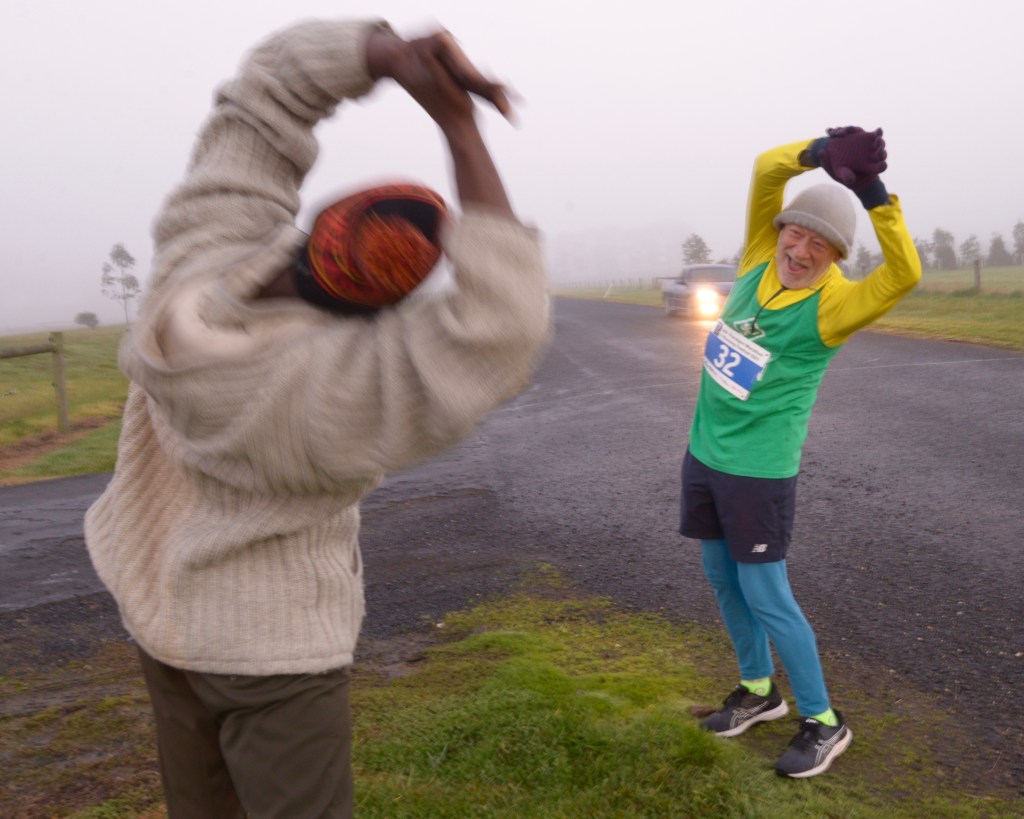
Today events conspire to help me. The good people who organise the event provide a special Early Start for the elderly and the unlikely. The weather forecast is for 1 degree Celsius. The Bureau adds, it will feel like minus1. In the event, the temperature starts at 8.7, rising to a windless 14 degrees at the finish. Gloved and cosy inside my six layers of shirting, I dance up and down skittishly at the Early Start. Phil instructs me to stretch, a religious ritual among runners that has always found me a disrespectful agnostic. Obedient today I do stretch. Colin, a friend of almost lunatic devotion, who has driven three hours through fog to photograph me at this early start, falls about laughing at the sight. He snaps his old marathon comrade actually stretching.

Photo by Colin Hockley

A short young man of rotund build joins me at the line. Luke, meet Pheidipides! Luke’s fist bumps my gloved hand. Good to meet you, Fylopidees! I regard my new comrade. At five foot tall and three feet deep, Luke looks like a serious rival for last place. He tells me his target time is six hours.  

The Early Starter arrives late. Ready Gents? Go! The Starter clicks his phone and we go.

Four hours and 46 minutes later, I stop. This is the Finish but it will not be the end. The daunting corollary of gaining self honour today is the prospect of doing it all again in the future.

In the course of those hours and in the passage of those forty-two thousand and 188 steps, Phil drives to meeting points and provides me with drinks, carbohydrates and caffeine, all in calibrated quantities. He keeps up a relentless commentary upon my strength, my greatness. Bystanders cheer and Phil declares, He’s a machine.

During long intervals of running alone I enjoy the feel of the benign surface of this new route. The organisers have improved the long-famed event by routing runners along the Gippsland Rail Trail. The surface of soil topped lightly with gravel is ideal. The earth yields briefly beneath my foot before releasing it with a spring. Or that’s how it feels. Viewing Phil’s video of my old man’s shuffle alters all notion of springing.

Whatever the truth of my running form, Traralgon has provided the kindest surface I’ve encountered in fifty-six marathons, a runner’s benison.

On this foggy morning, Traralgon blesses the route with a shifting curtain, visible but impalpable, of filmy white mist; by turns the mist conceals then reveals the deep green of foliage and the bright green of pastures on either side. I run through a dim tunnel of quiet and peacefulness, faintly mysterious, with intermittent patches of brilliance ahead wheresunshine breaks through. The sights bring to mind the dark tunnels towards bright light described by people who think they have died and who ‘come back.’ 

Here memories of the lost arise to meet me. I think of Manny Karageorgiou, my friend, officially declared Legend of the Melbourne Marathon, one of only eight to have run every one of the first 41 Melbournes. I ran the fortieth of these at Manny’s side, knowing he was achieving the wildly improbable, Manny having literally emerged from his hospital bed to run. That was a day of glory. I shared the run with my friend, rejoicing at  intervalswhen he’d be surrounded by his adoring family, all of them aware that their cherished Manny was doomed. Later that day I joined Manny’s circle of old friends and extended family at his home, where we ate and drank outside and rejoiced.

The agony of their love stays with me.

When Manny set out to run his forty-second Melbourne, he fell early. His nephew and I gathered him, bloodied, to his feet and he shuffled on. Minutes later, when his wife Dmitra sighted him, she gasped, took his arm and led him from the road. 

When Manny died the Melbourne Marathon died for me. I never ran Melbourne again.

Phil’s video shows my starting form to be ponderous and stiff, with my neck bent absurdly forward, and my marionette body engaged in endless chase of that pendant head. Yet I know myself to running hard. So ‘fast’ am I, I realise I’m running with calculated imprudence. I’m following my plan to attack the first half of the marathon, to run at a rate I can’t sustain.As I haven’t run further than twenty kilometres in training, there is no pace I will sustain. So I set out at my recently improved training rate of six-and-a half minutes per kilometer. 

For the initial ten kilometres I run alone with my thoughts. Phil appears before me on the track, radiating: I’m amazing, I’m looking strong, my form is impressive. In addition to these loving lies, Phil plies me with iced coffee and Black Forest chocolate. To drink without choking I must stop running. As soon as I put my drink down, Phil commands me: Keep moving, Howard. Don’t let your hips seize up. The respite is delicious, the resumption tolerable. Farewell, Phil, see you around 21ks.

Fast footfalls follow me, overtaking me swiftly. A tall male figure floats past, his strides smooth and strong. He’s the leading runner and he looks like a winner. A minute later runners Two and Three overtake me. They too look good. Admiration overtakes envy; such speed, such power and grace! Over the next quarter of the race, I have the opportunity to admire fifty or more runners faster than I. With every passing, runners exchange greetings, acknowledgement and encouragement. None of this is perfunctory. The respect is authentic. A runner knows the truth embodied in every passing comrade.

Keeping up this speed is getting harder. I negotiate with my legs, I put the hard wordon them: No excuses. I know you can do this. My legs plug resentfully on. Happily, every encounter interrupts such conversation. Volunteers cry out my praises. You can do this, they cry, as if they’d overheard my inward address to tiring legs.

Ahead on the track a tall figure waves to me. It’s Phil, meeting me somewhat before we arranged, around 18 kilometers. We’ll run together to the turn at 24 km and then back some distance. By then we’ll have reached 28 kms. Once there, with two-thirds of the distance behind me I’ll feel confident of finishing. It is at this stage that Phil tricks me. He leads me to the half-way and well past it without my realising. Never knowing I’ve reached that landmark, I forget to slow, and, thus deceived, I float on Phil’s oceanof goodwill without self-pity or ruminative arithmetic. 

More chocolate, a draught of Coke, a peeled mandarine and Phil is off, leaving me in the company of a tall young woman whom I’ll call Louisa, who’s running her second marathon. Louisa shares my mandarine and keeps my mind distracted,telling me of her mother, who fights her recurrent breast cancer and her rheumatoid arthritis. We’ve gone plant-based and we’ve chucked away all the auto-inflammatories. Mum did a seven-day water retreat and now you wouldn’t know her for the woman she was. No pain, no drugs. Happy.

Louisa appears to be Mum’s sole support. Mum appears to be Louisa’s project. Dad’s back on the farm in Horsham, Louisa’s the carer child. I hear about the five failed IVF cycles. I gave up teachingand became a personal trainer. Did the study and got the qualification. All my work happens in early morning and in the evening. In between I have time for Mum. And this marathon stuff, that’s my outlet. No, there’s no partner. One day, when the stars align, we’ll find each other…I guess.

Arriving at the final drinks station I seize a cup of water and the opportunity for a breather. A voice announces, This is Pheidipides Goldenberg, everyone! Hello Pheidipides. It’s me, Barry Higgins! Huge grins, flesh shakes flesh. You’re going to write about this aren’t you? I nod. I always write my marathon and in Traralgon I send the Traralgon Harriers, who organise the event, a copy for their newsletter. Barry Higgins is the soul of this marathon, having run it more times than any other and having written a fine history of its first fifty years.

A bunch of marginally faster runners overtakes Louisa and me and edges ahead, stealing Louisa away. Left now to my own thoughts, I encounter Temptation. You’re feeling pretty weary, aren’t you?Wouldn’t those legs of yours enjoy a break? A little walk couldn’t hurt, could it?

The voices make sense. But this whole enterprise defies sense. A marathon runner is a grownup child at play. It makes no sense to run where you might walk. But watch the child at play, see how she gambols like the lamb in spring, like a newborn foal. We grownup runners defy sense, defy the years. Our legs remember the joy, the delight, of speed, and our brains, registering effort, imagine the body to be speeding. 

My legs have posed their question. Will now responds in the negative. Dreadfully tired, I know I’ll not yield. I run on, tearful now, and joyous. I’ve passed my test. The sun shines, the mist has risen. I’ve removed layers of clothing as I’ve warmed, handing the sodden garments, one by one, to Phil, who bears them away. He reappears now, a beacon. He’ll run me home.

I run, awash with feelings of love and thankfulness for strength, for friendship, for the volunteers, for liberty, for this window in the pandemic, and for health. Especially for health. During the past week a message comes to me from Leni, Manny Karageorgiou’s daughter, telling me of the little boy born to her, whom she named Manoli in remembrance of Manny. Manoli is now aged three. He has been diagnosed with neuroblastoma, a rare and wicked malignancy of childhood. Manoli’scancer is Stage IV. In footage of Manoli, I see him gamboling for the simple joy of movement. His head is smooth, innocent of hair. When I report all this to my wife, my voice fails me. How is it I am so blessed while others must suffer?

The world smiles upon me as the distance to the Finish shrinks beneath my feet. Phil at my side, in my ear, sings his song of faith. You’re nearly there. Only two kilometres now. You’ve done a mighty thing. You’ve inspired me. I’ll run it myself next year. Keep going, Howard, keep it up. You’re running so strongly. We reach the final turn from the rail trail to the bitumen. Minutes later we come upon vehicles parked at the roadside. The Finish is just a few hundred metres ahead, at the top of a little hill. A hill! Read hell, not hill. Phil’s voice whispers a final blessing: I’ll leave you here, Howard. Only thirty metres, now. The crowd loves you.Go!

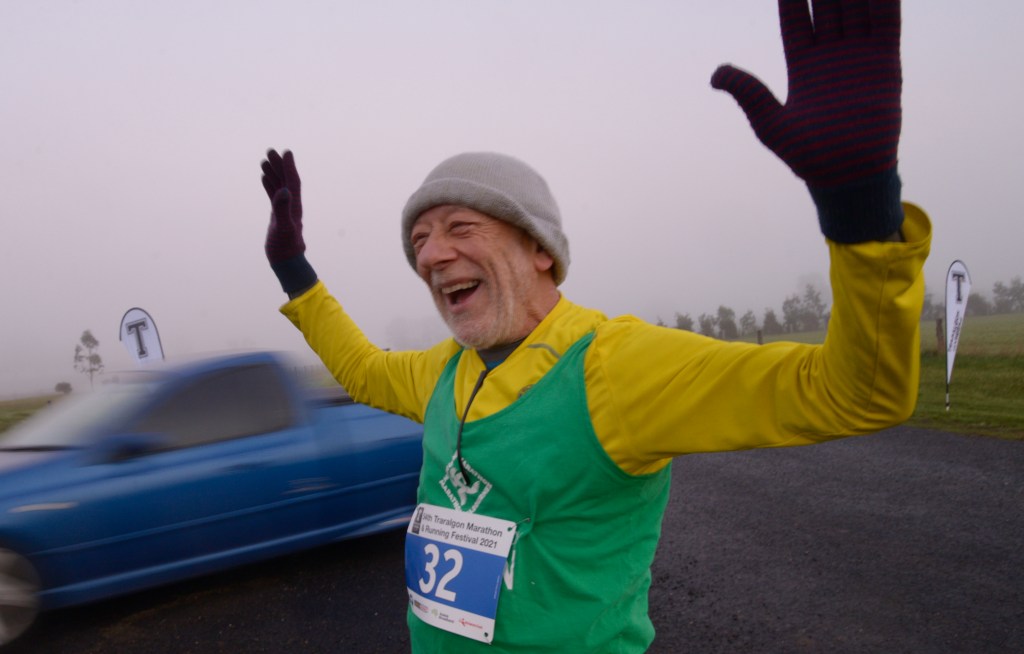
I go. The crowd does indeed care. They cheer as if I, Pheidipides Goldenberg, were their own. These people – runners long-finished, wearing their medallions, runners’ support persons, volunteers, organisers – these people have one voice that cries, together with Pheidipides of old, ‘Rejoice my brethren, ours is the victory!’

Photo by Colin Hockley

Footnotes: 1.Watch Phil’s video. I watched it and learned to respect my own absurdity.

2. Please watch Manoli Plueckhahn on The Project. https://m.facebook.com/TheProjectTV/videos/823036118338701/?refsrc=deprecated&_rdr

You might be moved as I was, to donate funds for his drug trial abroad.

What does it all mean? Part 1

We’ve rushed here today, to the Operating Theatre. During this Rotation we are to follow the surgeons wherever their work takes them.
A couple of weeks ago the young surgeon whispered: Don’t rush home this evening, Howard. Something’s going to happen,
something historic. I didn’t rush home and history did happen – Australia’s first heart transplantation. A few of us stood outside Theatre and waited. Somehow it didn’t feel anticlimactic to miss the experience, to stand adjacent as history happened. We sensed the meaning.

This afternoon the call came: Emergency surgery in Theatre. Come now!
The boy on the table was riding his bike home from school when he was hit. He wasn’t too bad at first but then his blood pressure fell,
and his heart started to race. His skin colour turned to parchment and his belly began to swell. His trolley bursts into Theatre and the Surgeon’s Apprentice begins to cut into the distended belly without waiting for anaesthesia: the boy had been deeply unconscious since he arrived in the ambulance. The Chief arrives, flings on gown and gloves, no time to wash, takes over the operation. A mild man of about sixty, wise, he’s not reflective now as he slashes the belly widely open and a tide of blood pours over both surgeons, onto the floor.
Suction!
Artery forceps!
Artery forceps!
Artery forceps!
Frantic action above the table, quick mopping at the feet of the surgeons, lest they slip and fall.
The tide of blood does not abate.
No speech, nothing heard apart from fast movement of limbs as they grope and suck and search slippery viscera for the bleeder.
Artery forceps grab suspect bleeding sources but the flood does not slow.
The blood they are transfusing is insufficient.
More blood!
A second transfusion starts.
The anaesthetist’s voice says, we’ve lost the heartbeat. There’s no blood pressure.
The surgeon works by feel beneath the surface, groping, hoping, grasping at straws for the unseen splenic pedicle.
The anaesthetist injects adrenaline, massages the heart.
He looks at the boy’s pupils. They’ve dilated. He shines a light to see if the pupils will shrink by reflex. He’s searching for vitality of a brain that’s had no supply of blood – for how long?
Too long. The reflex is absent. He leans over the boy’s pale face to his colleague and taps him on the arm: He’s gone. We’ve lost him.

All this took place in 1967. I don’t remember feeling stricken. Was I numb perhaps, with horror? With self-terror? I caught the event but I missed the meaning.
The boy was twelve years old. His hair was fair and he was lightly freckled. Today he’d be old enough for the pension. I feel stricken now. Riding my bike – yes, a bike: the connection passes me by – riding to the shops this morning, I feel the enormity and my feet fail on the pedals.

(This is the first in a series in which this old doctor recalls and reflects and wonders.)

Drawn Toward the Portals

I’m seventy-five. Seventy-five, a thankful number, and a thinkful one. Anyone who reaches this stage knows – with me – that we are closer here to the exit than the entry. Anyone who follows my writing will note how my mind drifts toward death, dying and the dead; toward memory and memorial.

A friend observed thirty years ago, ‘You know Howard, all this writing you are doing is a just means of coming to terms with your mortality.’

I hadn’t a clue what he was talking about. 

I smiled the kindly smile you give to the clueless friend who means well.

I know now my friend was right, dead right.

When I was a child the fact of death frightened me. To be annihilated – unthinkable! Literally, I was unable to think what the world could be like without Howard Jonathan Goldenberg. In my adult life I’ve experienced a similar disability of thinking: I find myself simply unable to think of an afterlife. I don’t deny the possibility, I just can’t relate to the concept.

So I live this life as if it’s my only one. I think now that death is a good idea. I don’t feel frightened anymore of annihilation. It’s my loved ones who fear my death, especially the grandchildren. The more I love them, the more they love me, the more vulnerable I make them. That’s a dilemma for me. I have felt at times, almost irresponsible, for becoming close and precious to children whose frailty I know so well. For myself, I can reflect how this planet, our species, did alright before Howard Jonathan Goldenberg arrived; once he’s gone, there’ll be one polluter fewer.

But just as the exit has always exercised my mind, the opposite portal called me irresistibly. As my own life ebbs, at the opposite portal an opposite tide of new life always rises. That portal has admitted nine grandchildren into life, into my life. The nine have broadened and deepened my late years. Those years feel more intense, more vivid, more life-stained than the years before.

I used to work at the portal that admits newcomers to life. I delivered babies. I was the intimate outsider, the guest who was invited to attend the birth of a family. Looking back, gazing over my shoulder towards that portal, that screaming gateway, I see blood and shit and tears, I see babies who gasped and roared, I see other babies who had to be coaxed into breath, I see some who would never breathe. I see women shaken, transfigured by the sudden knowledge of their enormous power. I see placentas stuck, I see the lifeblood ebbing, I feel once again the terror…

Two portals long have drawn me, twin doorways of universal truth.

My day starts with prayer, followed by some tablets to lower my blood pressure washed down with strong coffee to raise it. I plug in my hearing aids, I put on my specs, I stretch my shrinking spine and try to stand straight. These small acts, the adjustments of a seventy-five year old, as he moves ever backward, ever closer to the portal marked Exit.

I remember a book my wife’s father gifted me, an anthology of sorts, with odd bits of writing. One story ran something like this: 

A man went for a walk in the high mountains. Entranced by the grandeur that he saw all around, he jumped when he heard a loud roar from behind him. Looking back, he saw a snow tiger. The giant creature would very soon overtake him. The man ran, and as the tiger sprang the man reached the summit and leaped. 

The man looked down at the valley floor far below. Turning in mid-air, he reached and just managed to grab an overhanging branch of the small sapling that grew at the edge of the fall. The man swung from the bough, his fall broken. Looking up he saw the slavering tiger regarding him. Looking down he saw the unbroken fall. The man heard a groaning sound. Looking behind, he saw the sapling slowly coming away from the peak. Swinging, he looked at the cliff face, and saw, just beneath the sapling, some strawberries growing there. The man’s free hand plucked some strawberries and he ate them. How good the strawberries tasted.

Suspended between the portals of truth, a seventy-five year old enjoys the taste of strawberries.