From ‘Jerusalem Notes, 1967’. 

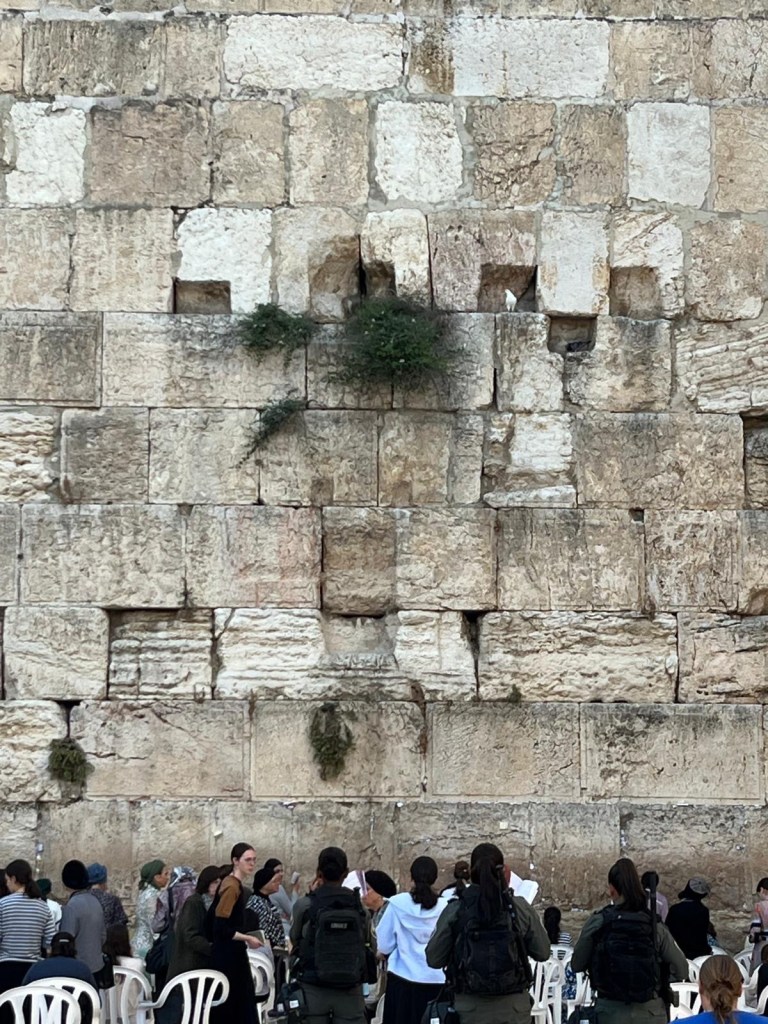
I was born in 1946. The State of Israel was born in 1948. I cannot remember a time in my own life when we did not have the Jewish state. Mine was one of many religiously observant families at the time whose experience of Zion was one of a longing that defined us. Jerusalem was our dreaming. Our emotions had not caught up with history. In 1967, I visited Israel for the first time. I went to pray at the Wall. It was a Thursday, market day in ancient Judea, a weekday when the Torah is read, both in ancient times and today. As a descendant of the priestly line of Aaron, although a visitor, I exercised a prerogative and gave the priestly blessing. Soon after it was time to read from the Torah. The layman conducting the service called: Let the Cohen come forward. Arise, Z’vi Yehonatan ben reb Melech hacohen. 

He was calling me first, using my patronymic, linking me with my preceding generation, choosing me – for my caste – to witness the reading of the Torah. It occurred to me that here I was, the first in my family in 1900 years to serve as a Cohen at the site of the Temple. It was a moment of déjà vu: I had been there before. I felt I was part of history and history was part of me. A light feeling and a deep one. 

The next afternoon, I returned to the Old City. I followed its narrow winding ways and realized after a while I was lost. I accosted a young man coming out of a house and asked, in Hebrew, directions to the Wall. He was about my age. He wore a dark suit and carried a cheap attaché case. He asked me in English: ‘From which country do you come?’ ‘

Australia.’ 

‘Australia! So far! Will you honour my house by coming inside for refreshment?’ 

I came inside and the young man introduced himself: ‘Yousef.’ I told him that was the name of my grandfather, who was born in Petakh Tikvah. ‘He never came here to Jerusalem. It was not possible for a Jew. Now I am here for him.’ 

Yousef ushered me to a narrow stairway. It was dark. I followed the stairs to a sunny balcony, where he sat me down and excused himself. I could see the Wall now, its stones creamy in the sunshine. Behind the Wall and looking down on it, was the Dome of the Rock. Beguiled, I sat in the sunshine 

and forgot who I was and who Yousef was. And who each of us was not. 

Footsteps behind me brought me back. Yousef carried coffee that he poured into a little cup. It had a muddy look, but it smelled good and tasted sweet. ‘What is that aroma, Yousef?’ ‘Cardamom. You do not like?’ 

‘I do, very much. Thank you.’ Next Yousef bought a large bowl brimming with baby mandarins.‘Clementinas. Please take, eat, drink. Please forgive me that I do not partake: it is Ramadan.’ 

Yousef told me he was a school teacher, but he was not teaching today on account of the Fast. Throughout my afternoon tea, Yousef was smiling. I must have smiled too. He wore a cheap suit and he carried a cheap valise, but he knew himself rich, living in Jerusalem and extending to a cousin the hospitality of Abraham who is Ibrahim, our father. Eventually, I left, my head swimming with Yousef’s directions to the Wall. As we parted, Yousef asked me to visit again next time I was in the Old City. I said I would. On numerous return visits, over the late months of 1967, and over decades since, my eyes would roam about the Old City, looking for a house with a balcony and a parapet, and a man of my years, with suit and valise, smiling. Yousef and I never found each other again. 

*** 

After taking my leave of Yousef, I set off for the Wall, striding after the setting sun. I soon got lost in an alleyway. I climbed an outer wall, and recited the Mincha prayer alone, in the late sunshine. I was reciting the Amida, the silent prayer, when a clattering disturbed me; stones were landing on a roof, around me and just next to my feet. I realized that someone was throwing these stones: someone did not welcome me here.
Remembering at the Wall

Jerusalem in high summer. We awaken at 4.30, depart the apartment at 5.00 and already the sky is blue, cobalt blue.

Jerusalem is quiet. The roads are quiet. Quiet is rare in this city that teems with the pious, the fervent, the urgent.

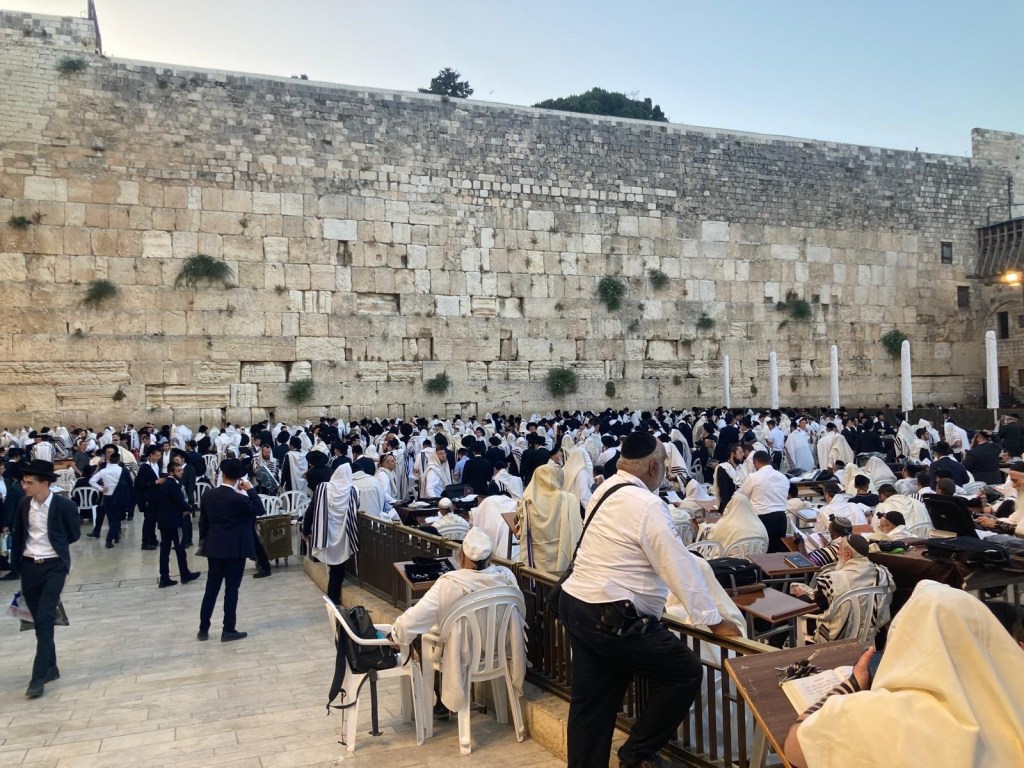
Wondering whether we’ll find people enough at the Wall for a minyan (quorum), we walk with fast steps along twisting ways. We need a quorum in order to recite Kaddish, the mourner’s prayer. Erupting from an alley into the broad square we sight the Wall. Before it, in their many hundreds, the devout, already at prayer.

We three are not in mourning, we are here to remember. We are our mother’s surviving children. An indispensable fourth is her son-in-law John, devoted to Mum now as in life. The remembering starts with the first sighting of the Old City’s perimeter wall. How ancient, these creamy stones, mutely dramatic, forever contended. So many conquerors, so many defeats, such passions, stones soaked in blood.


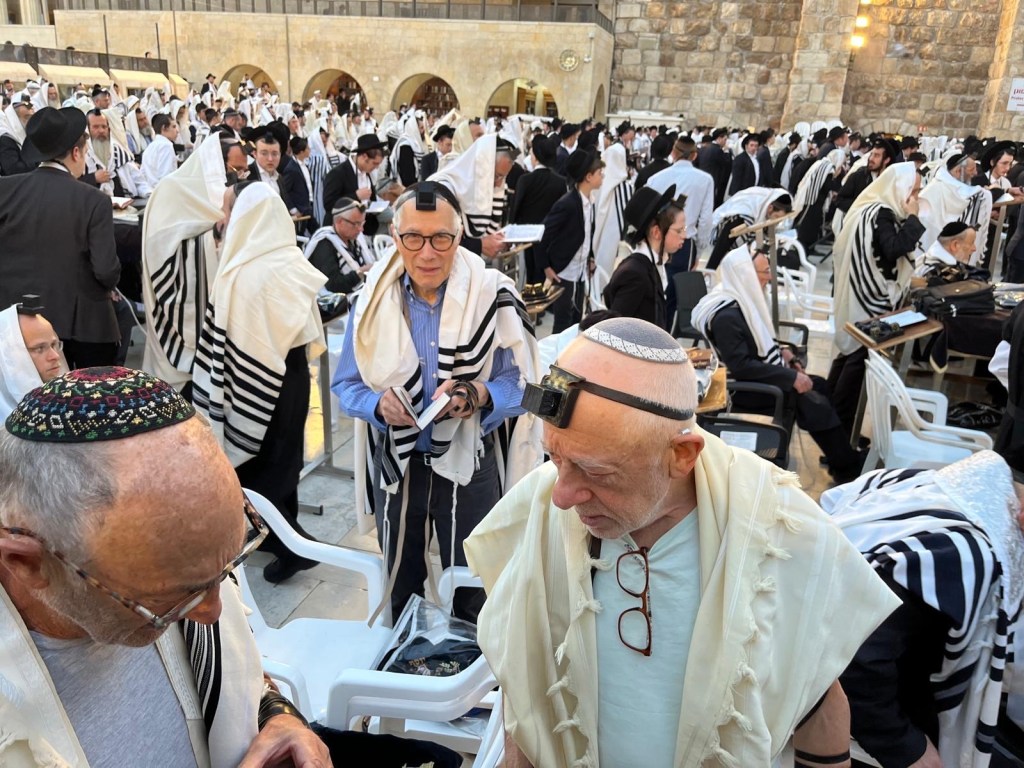
From the plaza, we sight many minyans of minyans, male bodies cloaked in tallithot (prayer shawls). Some wave and sway, others shake metronomically, all moving to intensify intention. One youth in front of me flings his arms to the heavens, his hands clench and unclench in his entreating to God. May his prayers be answered for the good.

Past the beggars, past worshippers of all stripes, past Haredim Caucasian, and Haredim North African, past modern orthodox, past the odd Ethiope, past a pair of the pious deeply asleep, my brother and I wind and wend to the far side where, separated by less than one metre, our sister will hear us recite kaddish.

A memory of my first visit. November 1967. It’s afternoon in early winter, the air crystalline, the skies blue. An impromptu service is in progress. I attach myself to a congregation that is the chance aggregation of the moment. Those elect who are of the line of Aharon the High Priest offer their hands for a Levite to wash, prior to giving the priestly blessing. I raise my washed hands and intone: May the Lord bless you and keep you…

An afterthought lands: here I am, delivering this blessing at the Temple. This my forebears did for centuries until the Temple was destroyed, almost precisely nineteen hundred years ago. My people went into exile. At some stage in the 1800’s my grandfather’s grandparents returned to the land, settling in Petakh Tikvah, the Gateway of Hope, far to the north of here.

Is it possible that I am now, in 1967, the first lineal priest in my family to officiate here since the year 70 C.E.? 

Today, together with my brother I will offer that same blessing. The blessing concludes: May the Lord lift up His face unto you, and give you peace.

Peace!

Our mother was a serene soul. She lived a long life of love, somehow happy through all of life’s losses and afflictions. Today, I remember her and honour her, without sorrow or pain. Late in her life, Mum said to me, You know I never did anything remarkable or distinguished. I never was famous or exceptional. But I did give birth to four children and I raised them and they all love me. So I suppose I was successful.

Mum, you don’t know the half of it: so well did you love us four, that every single one of us felt sure that we were your favourite.

Mum lived her life of peace. I can imagine her in no other state than peace. She went with heart at ease. My tears today are not for Mum. I shed a few sweet tears for this son who misses her. But many are my tears for my people, detested today, deserted by fair weather friends, threatened today, abroad and at home. There is tension in the air, fear too, appalled pain and grief. And mighty resolve.

But here, at this hour of pure air and quiet, Jerusalem is at peace. Have I ever attended prayers so quiet, so ruly? We hundreds recite the words, a soft hum rises from many lips. Until the Amidah (the silent devotion). Quietnessnow, perfect and complete. Torsi swing, sway and shake, hands clench and unclench. 

Prayers completed, kaddish recited, Mum honoured, I make my way to my sister Margot. We fall into a fierce hug that does not quickly end. My body heaves with sobs. I’m a good sobber. There’s much to shed tears about. Tears for the present pain, tears of hope for the future good.

White dove high in the cleft of the Wall