Sometimes the Sun

June 4, the sun shines on Traralgon and it shines on me. At 6.30m when I head out, the temperature is 4 degrees C (“feels like 2 degrees C”). A heavy fog lies upon the earth.

A mystic silence reigns as I set out on the 42.195 kilometres of the Traralgon Marathon. Although I’m starting my run one hour before the remaining 61 runners, I am not alone; my eldest grandchild drives his electric skateboard at my side.

The sun comes up at 7.30, warming my body and my spirit. The track, a rail trail, gleams as we move along towards that rising sun. Cobwebs, suspended from grasses and bushes, each of them a so-delicate necklace, that sparkles with sunkissed dew.Cows graze nearby, leaving generous splats for us to dodge. (I succeed, my grandson not quite.)

On his back the grandson wears a pack, ferrying supplies to replenish my body: planets*, reptiles** and salt tablets, and a flagon of water, as urged by Emily, the endurance sports dietitian and triathlete. My own project looks modest in comparison to Emily’s. As the weeks before Traralgon shrank to days, I rationalised: It’s not that far. I’ll run as far as I can, perhaps halfway, and when I can’t run anymore, I’ll walk… I’ll discover whether my legs remain capable of 42,000 steps.

As often as I daydreamed thus in hope, came that voice of dull prudence, Don’t be silly. You’ve never been so undertrained,you’ve never been so old…

Where lies wisdom? Where hubris, where cowardice? Thoughts alternate. Yes I am old, yes, I’ve had a stroke and, yes, the end approaches. I could sit and wait, retire from life and all risk and hope; and wait gracefully to die. An aged man is but a paltry thing/A tattered coat upon a stick/Unless…Unless soul clap its hands and sing. A decision makes itself. I’ll run!

This lovely marathon course winds and bends its ways between tall trees and low bushes and no trees at all. In nearby fields of pasture, tall grey gumtrees stand, gaunt, without foliage. What killed these survivors of fire and flood? They stand, each alone, each a memorial statue of its own demise.

At 8.00 o’clock, we pause for salts and serpents*, of which Emily commanded me to consume three every hour. This pause refreshes legs and lungs. Plenished now, those organs respond eagerly to the delights and sights on all sides. We cross little bridges over small waters and large, each bridge individual, this one of wood, this of metal, this one grassed, the next gravelled, the next paved of wood.

This being a rail trail, we reach the former rail station at Glengarry. Here, Jesse the skateboarding grandson, helps me to flout fairness in sport. He procures my performance enhancing substance, astrong latte, please Jesse, with sugar! This encourages lungs and legs already high on endorphin.

Everything smiles as we plod without pain towards Toongabbie Siding, where we sight a dark figure that moves ahead of us across the landscape. We close on this shifting shape and recognise Nick, close friend and ever-generous chauffeur. He and Jesse leave now, for their return to commitments in Melbourne.

I come to the turn, which is the half-way mark, all smiles. Ah, happy runner, happy, happy foolish, self-fooled runner, strong in the legs but too weak in the head to read a map properly. Utterly unaware that this out-and-back marathon course is not symmetrical, I discover the Toongabbie Loop, which now adds five kilometres of running. Why do I smile? What cheers me in my benighted state? It is my own laughable absurdity that cheers me so.

Forty minutes pass in happy solitude. More cows of course, more trees, more sun, and, the occasional fast marathoner, who now overtakes me, overcoming my one-hour start. Back at Toongabbie siding I’m overtaken by Kirsty, my marathon friend from Boston and the South Australian bush. Where is Sally, the third of our Boston threesome? She follows, in better time than mine. We swap stories of our morning so far, we sip salted drinks, then ahead sweepsKirsty, a real runner, on her way to finish in four- and a-half hours.

Alone again in the sunshine, recalling my first Traralgon Marathon, the first of fifty-seven. Another sunny day in winter.

Traralgon is Victoria’s Country Marathon Championship and Victoria’s first. All in all a pretty lustrous affair. Running under his nomme de jamb of Pheidipides, Howard Goldenberg completed his maiden marathon at Traralgon thirty-nine years ago. That year 181 runners started and 141 finished. I still have the official printout of the results. At the foot of the second of two roneoed sheets of paper (this report antedated the internet), you’d read: In 141st place, PheidipidesGoldenberg; time: 4 hours, 31 minutes, 31 seconds.

Every time I run a marathon I write one. That simple passage through time and space, so simple, so elemental, you mightn’t credit it worthy of remark. But every running feels remarkable to the runner. In the marathon the runner encounters his sole self, discovering some things about herself she’d prefer not to know and others that make him feel a little proud. In a marathon, as Zatopek remarked, we all die a little. The event is charged with significance for this runner because an often-solitary passage through time and space always involves encounters with others. It is the comradeship, the fellow feeling, the respect that elevate our experience. In that sense the marathon is a metaphor for our lives.

A watcher of the Barcelona Olympic Marathon might have caught images of the leading bunch of five as they passed their drink stop with seven kilometres to go. They had, running in intense humidity and heat, slowly outpaced a score of household names from Kenya and Tanzania and Korea and Japan and Australia. These five were the bravest of the brave on that particular day. One of these five, one only, would go on to become immortal. Four of the five grabbed their special drinks at the 35 KM mark. The fifth grabbed and missed. And ran on. Turning back was out of the question. The four drank and ran and drank again. One of the four passed his unfinished drink to the fifth. I do not recall whether the drink-giver won the event – I fancy he did not – but in that moment he joined the Immortals. Such small moments are the glory of the marathon.

All this reads a bit portentously. Most running – and all of mine – is more comedic or shambolic than deep. In the field of my third Traralgon I sighted at the Start the famed and cherished Cliff Young, Australia’s most famous potato farmer, a previous winner of the Westfield Sydney to Melbourne Ultramarathon. Cliffy used to train in his hobnail work boots. If he needed a haircut he’d trot the thirty kilometres from his farm to Colac, then run back home again. That day in Traralgon I wondered if I’d get close to him. Around the three Kilometre mark my legs became over-excited and accelerated and I hauled him in. Running a couple of paces behind Cliff I admired the light lacework of his tracksuit material. I drew closer. The lacework was in fact the work of a legion of hungry moths. Through the moth holes I could see and admire the pale skin of those spindly old legs…

A cry in the wilderness brings me back to now. Another cry, shrill and repeated. A flash of impossibly curly fair hair, and a form on the track ahead. The hair and the form,and now the face, I recognise as belonging to Rachel, my firstborn. A long embrace and on we race, one full kilometre, after which Rachel gasps, I’ve just done a full marathon, and retires to her car to drive to Glengarry for a stop, a planet or two and more coffee.

Phil Kayumba, Rachel’s partner, now materialises, tall, lean, young, the swift spirit of hope. Phil sings but one song:

Howard goldenberg/looking good/running well

Howard goldenberg/looking good/running strong…

and today he’ll sing it often as he pumps me full of sunshine, breathing it into my ear as he spirits me to the Finish.

A long pause at Glengarry, more coffee, more chocolate planets, more gummy serpents. After a12-minute pause, we are off and ‘running’, really just plodding. Somehow nothing hurts. The sun smiles on me, Traralgon Harriers smile on me as thy run past. They cry, Go, Mister Goldberg!

Keep going Mister Goldberg!

Who are these strangers? Whomever they be, they are in league with the elements, with my kin, with my friends, with the volunteers who bless my path.

Phil is in my ear: Only 13 kilometres to go, you can do this Howie.

No Phil, it’s eighteen.

No Howie, just thirteen.

Phil is correct. In my masterful map-reading failure, I’ve undercounted the kilometres run. Phil’s news comes as a gift. Phil’s simple song sings itself to the rhythm of our falling feet:

Howard goldenberg/looking good/running well 

Howard goldenberg/looking good/running strong…

One foot strikes the grassy path, the opposite foot follows. A stranger to volition, to strain, to suffering, I float above, with love at my side, love all around, love and joy awaiting and greeting me as I puff and plod absurdly the final thirty, hilly metres to the Finish. Cheers, a medal, drinks for the hero.

In all my scores of years’ ruminating about the meaning of a marathon, time and again recurs this deep and bright truth: my life is like the marathon, an effortful passage through space and time, made rich by love and companionship. Meaning congeals within me. As Malamud wrote, I am a man, which is not very much. But it is a great deal more than nothing.
*The planets that sustained me were Mars.

**The serpents were jelly snakes.
Running with the Cows

One foot in front of the other. That’s how you do it, this running business. It’s not complicated, it’s not even hard, so long as you don’t do it too quickly or too many times. In the marathon I need to do it 42,185 times. My car finds that distance tiring and so do I. But Traralgon is where I ran my first marathon and – on a later occasion – where I ran my quickest. I try to run Traralgon every year. One of the many things I like about the event is the small field, which allows me to boast, ‘O, Traralgon, yeah, I finished in the first one hundred’.


In 2017 injury saw me miss the fiftieth running of the Traralgon Marathon. I was sorry my legs would miss out on history. The event is Australia’s oldest and it’s also The Victorian Country Marathon Championship. In 2018 I trained, I paid my registration and I injured my knee again.  Once again I missed out. But last Sunday saw me fit, I was new again, keen, and running faster than I have for five years. I had lost weight, I’d trained hard and consistently, I felt invincible.


The marathon taught me something I should have known: I am vincible.


I brought my own support team along. Philbert Kayumba from Rwanda is a natural runner. Being on the run from genocide brought him to Australia as a refugee, and Australia grabbed him, and my family grabbed him. Toby Wundheiler is my skinny grandson. He loves running almost as much as he loves his Saba, Pheidipides Goldenberg. The two believed in me, I believed in me, what could go wrong?


The lady at Registration peered at her spreadsheet and answered my enquiry: there are 105 starters in the full Marathon, she said. This was the first augury: I would have to beat five, or they’d have to get lost, or pull out or expire, if I were to finish in the first one hundred finishers. I looked around me at the start and I did not sight anyone who looked slow enough for me to beat.  


At the start I heard a couple of blokes speaking in refined accents, their English correct, grammatical. Must be foreigners, I deduced, and indeed they were. They were veterans of many Comrades Marathons. The Comrades is an event run over an appalling ninety (90!) hilly kilometres in South Africa. Respect! These boys looked stronger than their estimated fifty-odd years. We fell into conversation and the kilometres flew beneath my feet. A sparrow flying with eagles, I ran surprisingly fast, fatally fast. By the time I reached the 11-kilometre mark, the Comrades were well ahead, still in sight, if out of earshot, my breathing was hard and my legs felt tired. Only a quarter of the distance run and I had shot my bolt and I was not Usain.


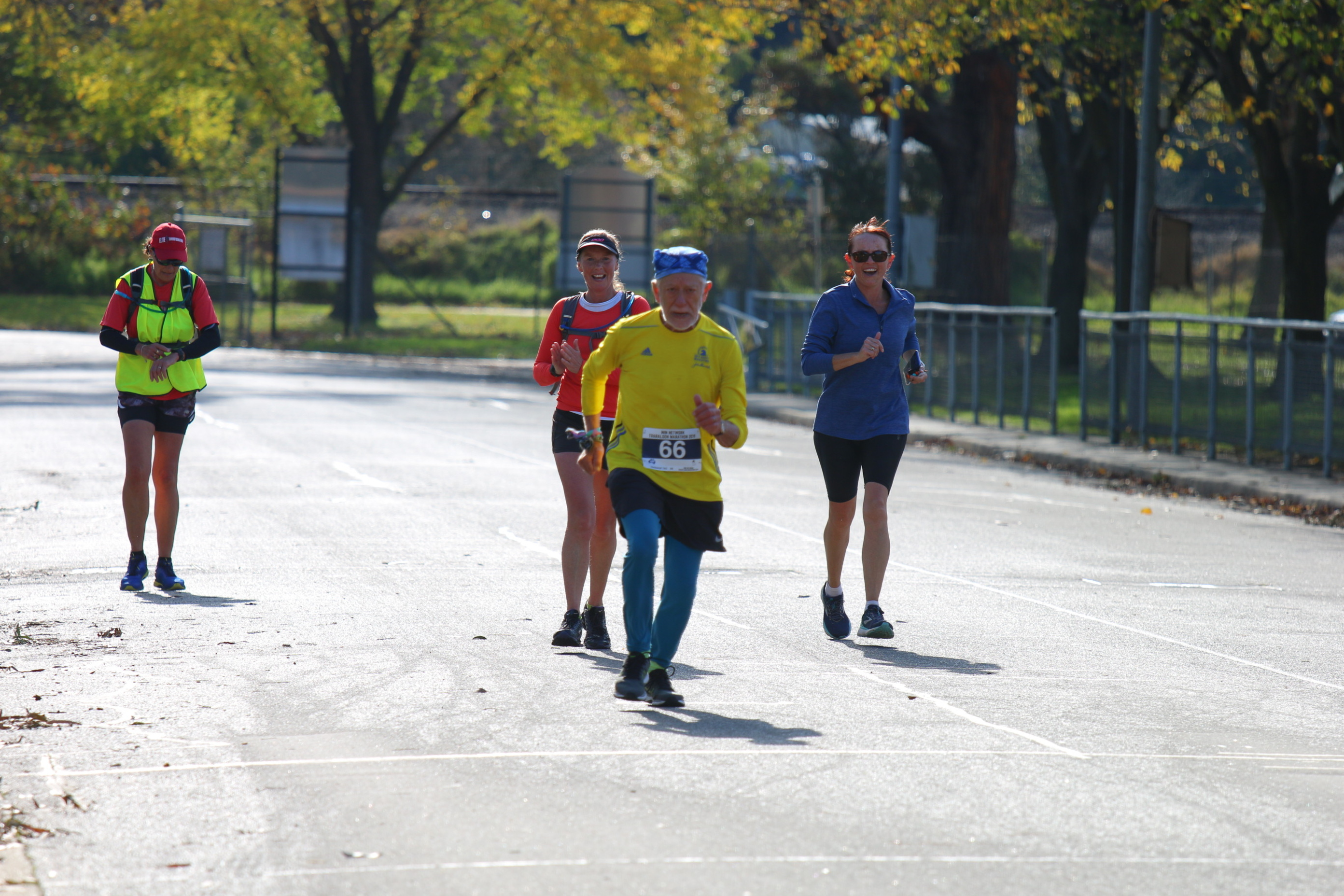
Afraid I’d ruined my marathon, I took stock and nourishment. My nourishers on this occasion brought Coca Cola and belief. The nourishing duo were Toby and Philbert. I blessed them and heaved my frame into motion. Now the marathon looked better and felt better, as the route left the paved roadways grey and followed the rail trail. The trail is paved with gravel that springs the tired leg and cushions the sore foot. It runs through the native bushland that fringes the pastures. Amiable cows watch and munch and splatter as the runners pass.  A lone human now, I spent some time running steadily in bovine company; the cows and I established a comfortable fellowship, no words needed.


An apparition in red, a young woman, announced herself: ‘Hello, I’m your sweeper.’ The voice was sweet, the smile friendly, but I knew dread. The sweeper is the official who sweeps clean the Marathon Course of runners, once their allowed time has expired. Her arrival meant I was running in last place. She would keep me company until the fatal hour. I’d need to reach the Finish before 1.00 pm or I’d be swept. Sweep Lady introduced herself: I’m Vera. I told Vera I was Pheidipides. Vera looked at me jogging along. You’re running well, she said. Would it be rude if she asked me my age? I told her my age. You’re amazing, she said. In my turn I questioned Vera. She’d run Traralgon a number of times, finishing around three-and-a half hours. Today she’d volunteered, giving away her own swifter marathon in favour of the slowest.  


Vera spoke proudly of her daughters, aged 17, 14 and her boy, 11. All were mad about sports, the elder two being elite junior netballers. Vera drove the eldest to training in Melbourne two days a week. She didn’t mind spending four hours on the road. She was happy to keep doing it, until the day she says, ‘I don’t want to do this anymore’. Then we’ll stop, no pressure.   


A second red blur appeared in my lateral field. The blur rode a bicycle. She introduced herself: I’m Lucy.  Lucy too had given up her marathon to share the sweeping duties. Had Lucy run Traralgon before? Sure have. I won it seven times.  My interrogation of Lucy revealed she held her Age Group World Record for a 200 kilometre race. A few of my records have been beaten, but I still hold the two hundred. Like Vera, Lucy taught at a local school. The two chatted about mutual friends. Maxine was doing better now her daughter was recovering. Therapy had made all the difference. Madeline was running today, the 10 K, not the marathon. She’d given that up to referee the hockey. Young Robert had been stood down by his school. Despite warnings, he was out. You couldn’t push a classmate into the urinal, you couldn’t pull his pants up while he was taking a pee. No respect. It didn’t make it better that the urinating victim was African. You need to have respect.


Kilometres passed pleasantly. So and so had a new job, closer to town. Such and such was working night shift at the hospital which allowed her to help the littlies at school with their reading. A third friend ran the Fire Brigade Coffee Truck. He gets up early Saturdays and Sundays and drives the truck to the local footy – both sexes, to the local soccer – girls and boys – to the netball, the basketball, then the AFL in the afternoons. The profits from the coffee truck go to buy musical instruments form the town Junior Band. The cows and I listened and learned.  


Even tired old legs retain some pride. My legs were tiring, certainly they were old, but here were Lucy and Vera, a pair of runners who’d dedicated their day to the slowest of all. Fleet-footed and vital, these two would recognise my flaccid morals if I stopped. I kept going, sustained by pride, bemused by gossip that spoke only good of their fellows.


A noise up ahead, a flash of black flesh, cries of Saba! Saba! You’re awesome, Saba! And Saba was me and the noises were Toby’s and the flash was Philbert. More Coke, more embraces, more sunshine pumped up my bum, and here we were at the turn, at the halfway point.


Phil and Toby saw me around the turn, where the Marshall cried, Pheidipides!  Pheidipides Goldenberg! I recognised Barry Higgins, this marathon’s historian. His splendid book, ‘In the Long Run’, records the history of this event and its fifty famous years. 


Toby loped and leaped at one side, Philbert glided at the other. I knew no pain. The halfway mark signals good tidings to the runner; the mind realises every step now leads shortens the road to the Finish; the legs know they can do it. The reality of twenty-one kilometres remaining somehow weighs less simply for having turned for home.


Toby announced: I’m going to run with you to the three-quarter mark, Saba. It’s only ten kilometres. He darted ahead. Vera observed, you’ve got a lovely grandson there, Howard. Lucy remarked, not quite beneath her breath, and your son Philbert’s hot!  ‘Yes, they are’, I agreed.  Hot Philbert left the gravel to retrieve the car. Lovely Toby ran on until, one kilometre later, he sighted the car and decided he’d keep Philbert company.


More of the same. Step followed step, perhaps a little slower. The sun shone palely, I discarded gloves, then a shirt, then a singlet. The legs found a rhythm they could tolerate, my brain separated itself from pain; I was spending time in pleasant company, passing though the wintry green. At some stage I must have fallen silent.


I heard a question. Someone was asking, are you retired, Howard?  I answered Lucy, who then asked, so you know all about the heart, then?

No.

Lucy pressed on: Have you heard of arrhythmia?

I had.

We had a long chat about arrhythmias, how a runner’s heart muscle might be strong enough to run two hundred kilometres in record time one day, but beat so irregularly the next that running was impossible. But arrhythmias could be treated.


Vera spoke of her youngest, a boy born dangerously premature. They’d prayed for the little mite. He was too sick for the local hospital and ambo’s speeded him to the Monash Children’s Hospital where he pulled through. Ever since, the little fellow had lived his lively life in a body small and frail; it never occurs to him he has a disability. Never mind he has to spend periods at home, never mind that he too is prey to a parlous heart irregularity – all the other kids played sport, so would he. The reality of a brave boy, running the marathon that is his life, made my own marathon a small affair. I was a child, running was my play; Vera’s child on the other hand, runs to the ‘Wall’ every day.


I listened to Vera and to Lucy and thoughts of fatigue never broke through. What was tiredness? Some petty experience, not admissible, lacking substance. Assuredly I was slowing all the time, but the sweepers assured me I remained a legend, I was certainly awesome, thoroughly amazing. You’ll easily arrive before they close the course. You’re way ahead, said Vera. I looked at my watch, but by this stage I was incapable of computation.


A small black car peeped between the bushes, and here, in a flurry and a roaring were Toby and Philbert bearing love and belief and Coke and a Mars bar. We’d reach the three-quarter mark. Numb in the brain, sugared into foolish cheerfulness, I picked up my feet and plodded on. At every road crossing and at every aid station, we found volunteers. I’d salute them and the sweepers would dismiss them: You’ve done your job. Thank you, thank you all. This man here is the last runner. I might have wept for thankfulness.


Off the gravel now and onto those pavements grey, as Yeats called them. Up a hillock, down another, head down, a dour business. Abruptly a pretty lady in blue burst into my threesome. She flung herself into the arms of my companions. Boadicea! How did you go, Bo?

Personal Worst.

You’re kidding! Boadicea, meet Philopities! Or Howard. He’s a legend. Ask him how many marathons he’s done.

The young lady in blue asked me how many.

Fifty two. This will be fifty three.

Boadicea affirmed I was a legend. I knew she had that back to front. I concentrated on not falling over and I said nothing.


We ran on. Four kilometres to go, four nasty, mean kilometres, each one of them longer than the one before. 

When a man’s afraid

A beautiful maid’s

A cheering sight to see. 

The lines from The Mikado bypassed my brain and came to my lips and I heard myself singing in the empty back streets of Traralgon. The ladies looked at each other. Charitable souls all, they said nothing.


Thus inspired I ran on. I knew I’d find Toby and Philbert in the final kilometre. We twisted and turned in empty back streets that quite befuddled me. Sandwiched between my colourful escorts, I followed wherever they led. I was a dumb machine, a mechanism of bone and gristle and muscle, an automaton untroubled by thought or pain. One limb faithfully followed its fellow, mine was a body as free of volition as if I were falling. I might easily have been asleep.


But here was familiar territory. Parkland, a creek, Traralgon’s sporting precinct must be somewhere near. A skinny stick figure in black tights and top materialised, a great grin flashed, a boy mad with love and joy flung his arms about me, imperilling my dodgy balance. The boy ran at my side, in front of me, across me, then sprinted away into the distance, shouting: See you at the Finish, Saba! Vera said, Toby’s gone the wrong way.

Philbert, smooth, quiet calming, ran at my side. He looked emotional. Next time I want to run this with you – the whole distance.


A minute later the sports ground loomed. We turned a weary corner and there, two hundred metres ahead, was the Finish. Go, Howard, said Phil’s quiet voice.

Go Howard, cried Vera and Lucy.

Go Philopities, screamed Boadicea.

So I went. I went fast. EmpIoying bundles of fast-twitch muscle fibres that I hadn’t used in the 42 slow-twitch kilometres that lay behind, I sprinted.

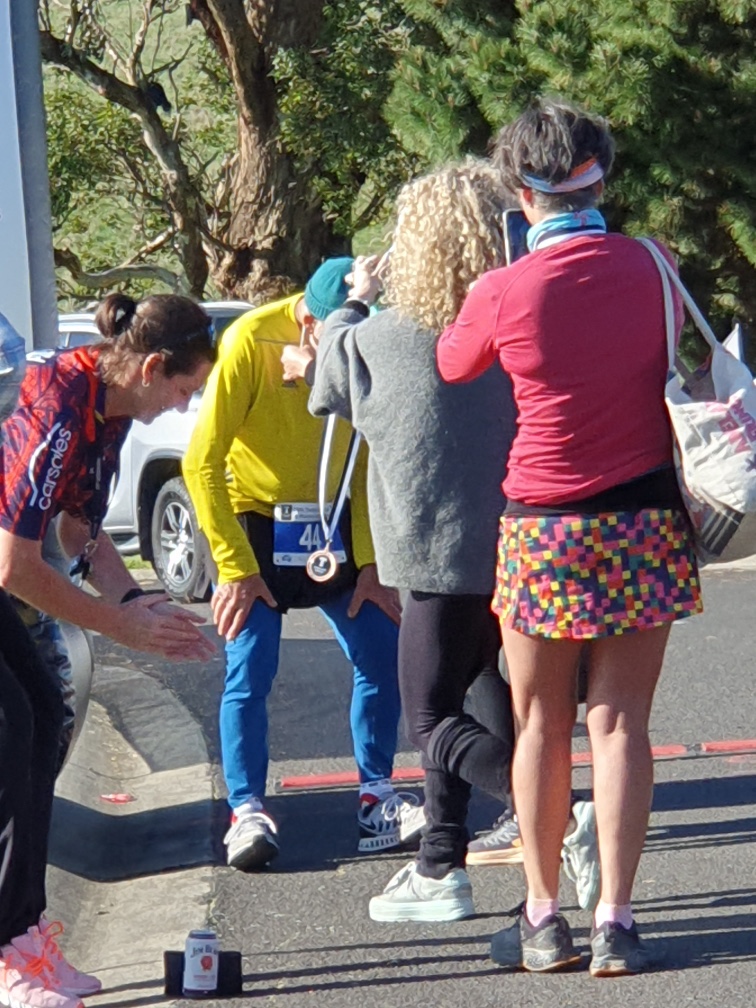
I felt fast. I felt liberty, release, the knowledge of an ending. I pumped my arms, I waved them, I flew and I crossed the Line and I fell into Toby’s arms. The clock read, 5 hours and 52 seconds. Two women in red and another in blue told me I was a legend, I was amazing, I was awesome, as they clapped my back and kissed my face.


Later Philbert sent me footage of the final sixty metres or so. I looked and I laughed. The video camera catches me in profile. Had I not known otherwise, I’d have taken the spavined biped in the picture as some strange clockwork creature in green tights. I invite the reader to view the footage and share my mirth.


On the way home Philbert drove and I stretched out and ate and drank. Philbert said, that will be my event. I’ll run Traralgon next year with you, Howard. I’ll run it every year. Toby said, You’re my inspiration, Saba. I’ll run it too. I’ll bring Mancha, I’ll bring Mami and Papi, I’ll bring Nana. Savta will come, my bothers too. We’ll all run.


Footnotes:


1.   Five hours and 52 seconds is not a fast time. It is, however, 30 minutes faster than my previous five or six marathons. By way of comparison, my first Traralgon (in which I ran last) took four hours, thirty-one minutes and thirty-one seconds. My best Traralgon took three hours and fifteen minutes. Today I finished last but I was the first runner over 73 years to cross the line. I am happy to claim the title, Victorian Marathon Champion (male), (over 73). And I have duly added that title to my CV.


2. Mancha is a Border Collie.


3. Savta is my wife, a walker, not a runner. Nana is her 92 year old mother, a Yogi, not a runner.


Not Running with the Devil

The longest night in the southern calendar, June 21, gave birth to a splendid and frigid morning in Traralgon. By the time we started running the temperature was four degrees celsius, a good deal cooler than Boston where, a couple of months earlier, self-pity and hypothermia had congealed within me. Wiser this time, I enclosed myself in layers. A Michelin Man, I set off, discarding layers as I warmed. The layers were, I realised, like geological striae, those stripes in a rockface that are time’s memorial. First to go at twenty five metres in was the remarkably ugly tangerine rain jacket (discarded in Boston by another runner who decided wetness and cold were preferable to Adidas’ ugliest.) Next to go were the elegant little white gloves that cocooned my fingers during winters in the eighties when we’d run the alps of the Diamond Valley. (Ahh, my friends, my friends…) At the twenty kilometre mark I left my stripy thermal top (Kathmandu, 2014) and the Stepping Strong top that honours Gillian Reny, the young dancer whose legs were shattered by a Tsarnaev bomb (Boston, 2013). At 35 kilometres I divested the Miles for Michael shirt (Boston 2013). This left a salted wreck whose overheated genitals must abide within undies (Leigh Creek supermarket, c. 1999), olive green tights (Kathmandu, 2000) and New Balance running shorts, veterans of seventeen marathons (Leigh Creek, 2008). 

In the dawn no wind blew. Silent and shapely, six plumes rose pink against the indigo sky. Delicate and pretty the smoke of Loy Yang poisoned my world. 


I ran the first half hard with legs confident from last weekend’s fast training run from Babinda to the Boulders and back, a distance of fifteen kilometres, longer than one third of a marathon. My wristwatch read 74 minutes. This absurdly quick time suggested I’d regained some speed. I reckoned in Traralgon I’d take a full hour off the Personal Worst that was Boston. I ran first with Leanne, a shrivelled fifty-year old, light of step, a lean machine. I kept up with her, keeping myself honest. Leaving her behind I chased a rounder matron who took a bit of catching. She said, I just want to finish. We swapped names; the matron’s name was Marlene. Keeping pace with Marlene did me good – in the moral sense. I had to reach deep for Nobility and Courage. After Marlene left me behind with benediction, I ran alone for a while, this time on a stony dirt track. Mother earth beneath my feet, hard but fair, took me back to childhood in the country. My reverie – have I been dreaming, have I slowed? – was interrupted by busy footfalls pattering behind. Light of foot my pursuer spurred my own feet and I worked to stay ahead. Three kilometres later the pattering feet drew alongside and they belonged, not as I expected, to a female but to a bloke named Duc. We exchanged the lead a few times before I sent Duc on ahead with my blessings.


Next came Sam. Short like me, bearded like me, his fleshy face a crop of smiling peaches, Sam didn’t look like he was made for distance running, his well-fed body the antithesis of the ascetic distance runner’s. But Sam too left me behind. I would see him again as I approached the turn and once again, much later, as I staggered past the 41 kilometre mark; Sam, smiling still, had finished a full hour earlier.


At the halfway mark I met the Devil. In fact he’d run with me all the way, quietly waiting his moment. (In Judaism the Devil is not personified much; if anything he is The Adversary. He lives, not in hell but within us as desire, ‘the evil inclination’, which is ordinary, domestic, human weakness. As such the Devil doesn’t really earn his capital letter.) The devil was up and about early in Traralgon.


With my friend Nick and his febrile son Darcy waiting for me with love and drinks at the Half, I paused. The sun shone in a windless sky as the devil murmured in my ear, congratulating me on my time, which, while not the blinding brevity of Babinda, was quickish, respectable even. The devil suggested I needn’t knock myself about so much. He counselled me, drink slowly, recharge your energies. It might be wise, he insinuated, to hold something in reserve. He whispered something to my bones, to my thighs, something I didn’t catch. He reminded me the turn wasn’t really halfway; the second half doesn’t start until 32 kilometres, when you’ve got ten more to go. The sun was soft now on my face. It felt good. And so I jogged. 


Jogging isn’t running. When you run you leave the devil behind. Jogging along past kilometre marks that came and went agreeably, time did not count. I looked at the sky and followed the flight of ducks. I looked long at the smoke stacks of Loy Yang, pondering my own complicity. I smelled the cows. Runners passed me and we’d exchange congratulation and encouragement. A large vehicle came up behind, slowed and swerved close. Two female faces shone with enthusiasm and screamed you are awesome! Never mind these words have been bled white of meaning in a million million facebook ‘likes’, these girls transfused the words back to life. I felt wonderful. Just ahead the girls called the same to a much speedier runner who just grunted. Wonderful girls, aren’t they, I said. He grunted again, his face a mask.


I jogged on. When I turned into Black But Road the devil slouched over to me with some advice: the stones underfoot here on this unmade track can hurt your feet. Best to walk here. A little walk can’t hurt… Over the remaining fourteen kilometres I enjoyed a number of little walks. They didn’t hurt at all.


I turned back onto the Traralgon-Maffra Road where busy cars sped past at their full entitlement of one hundred kilometres per hour. I crossed the Latrobe River, where, in all twelve of my previous Traralgon Marathons, my skyscanning eyes have sighted a sailing pelican, my white bird of hope. Always, gazing across to the chimneys, I’ve thought of the Ancient Mariner:


Nor dim nor red, like God’s own head,

The glorious Sun uprist:

Then all averred, I had killed the bird

That brought the fog and mist.

‘Twas right, said they, such birds to slay,

That bring the fog and mist.


Today, for the first time, I saw no white bird.


At thirty five kilometres I sighted the white car of Good Friend Nick. He accepted my sweat-laden shirts in exchange for my drink of Coca-Cola-and-orange-juice. This dysenteric-looking concoction contains sugar, potassium salt, sodium chloride and caffeine. And water. Ever since the turn my dry lips had been telling me I forgot to load up with water before the race. Now I loaded up with every molecule known to aid a depleted body.

Darcy, no longer feverish, looking at me, wanted to know, is it hard? His Dad looked at me and laughed. I said, yes Darcy it is. That’s why we do it.

Running slowly ahead of me, his aged body skew-wiff, his pace dogged, we sighted a Spartan as he pressed steadily onward. Over the next seven kilometres of straight road I saw his singlet of emerald green, a flag of courage that reminded me of my own lack of that quality.


Nick drove off to hide my final bottle of dysenteric elixir for me at the 40 km mark before hurrying back to Melbourne to watch his elder son play footy .


Now walking, now shuffling, now jogging, I pressed on. I knew a full-bodied run would hurt intolerably. I knew this because the devil told me so. Runners continued to pass me, every one of them urging on this bent wreck. Voices said, looking good. And, great effort. Not long now…


A small parcel of sinew and strings drew alongside. I recognised the woman’s face, full of years and resolve. I recognised the voice that hectored me for ten kilometres in 2013, before its owner hurried away to assist others with her wisdom. Now the voice said, I know you. I ran with you here once before. Today she didn’t not linger to advise, or assist, or direct or instruct me. Perhaps it was something I said.


I felt the caress of fingers dancing lightly on my left shoulder. I looked up to see an able body, young, upright, light of foot. I saw a face buried in a forest of auburn beard. In the depths of the forest I saw a smile and from them a voice blessing me, extolling me, praising my effort. The dancing fingers left a sensation that abides still, twenty-four hours later.


Here and there the Traralgon-Maffra Road undulates. From the 38 kilometre mark to 39 kms in a flat marathon course the road rises steadily. As I sailed downhill early in the outward half I marked this well, resolving I would not stop, nor even slow, during my return. Brave promises those, the promises of legs that feel fresh, of resolve not yet tested. Walking now I saw the road rise ahead of me. I stopped and took a deep breath and cranked my limbs into a shuffle. And then a slow run. Putting the devil behind me I ploughed uphill. I reached the top and turned and started the downhill run home. Now my legs started cramping. Earlier, when they’d have excused me from trying to run at all, I’d have welcomed these cramps, but not now. I decided to ignore them.

I ran studiously down the hill attempting a judicious balance between speed and cramp. Footsteps behind me, soft voices, closing on my left shoulder. The runners drew alongside, a bloke in his fifties, and a much younger female. Her face had the puppy fat of childhood. They saluted me and passed. I saw the child wore a pair of floral shorts. The freshness of her being, the stream of approval and encouragement flowing from her father, the sweet amity and unity of the two, these lifted my spirits and distracted me from pathetic thoughts and tremors.


Approaching the 40km mark I decided I wouldn’t stop for my drink. Here I was, maintaining a precarious run; if I stopped I mightn’t start again. So it was with mild puzzlement but no regret that I sighted no bottle at the 40 km marker. Ahead a marshall smiled and directed me to the second last turn, calling, you’re doing well, Howie. “Howie”. How did she know me? Now her little boy approached me, near to blocking my path. His outstretched hand held a small bottle of brown fluid.

Small kindnesses, these, potent with grace. I recalled other moments, over my previous forty five marathons. Crossing the Line at the finish of the New York Marathon in 1988 I heard a sweet voice singing. It came from a fellow runner, a student of opera at the famed Julliard School. He asked my name: Pheidipides.

Ah, Pheidipides. Reverting now to Greek he recited that runner’s dying words: ‘Rejoice my brothers, ours is the victory’.


On Patriots Day in Boston, Athens of the New World, a river of grace flows during its Marathon. Of three million Boston citizens fully one million come out – and stay out – to cheer on the runners, both the fleet of foot and the unfleet. They cheer us, they feed us – everything from bananas, to segments of orange, to candies to barbecued sausages dripping fat – they love us. When two explosions destroyed the ceremony of innocence that is a marathon, overwrought Bostonians overflowed with tender concern for their thwarted guests.


Together with every runner in the world I watched the telecast of the Olympic Marathon in Barcelona. In the final brutal kilometres as the runners raced up the slope of Monjuic, one of the lead bunch of five missed his drink at the drink stop. With a medal in sight and no time to be lost, he ran on without it. A rival passed his bottle and the two shared it.


I was one of a generation inspired by John Landy’s act in the 1956 National 1500 Metres Championship. A young Ron Clark fell at Landy’s feet. The champion stopped to assist him than ran on and won.


I ran my first marathon in Traralgon. On that occasion achilles tendonitis and unremitting cramps forced me to walk from the 30km mark to 40kms. I contrived a pathetic run for the last stanza, hobbling into view of the football club where all the other 140 finishers were enjoying refreshments. One caught sight of Pheidipides approaching in the gloom. To a man, my fellow runners abandoned their scones and passionfruit sponge cakes and sausage rolls to applaud the runner who ran on an hour after they’d finished.


After my mother-in-law-in-law survived Auschwitz she dedicated her life to fighting racism. A tiny woman of immense will, she was never scared to take me to task. She challenged me once with the folly of the ‘disordered’ (her term) pursuit of marathon running. Shortly afterwards I ran the New York Marathon and found my answer: my life is a marathon, an undistinguished passage through time and space; it is a passage made rich and significant by the people who run their race at my side.


Postscript: Yesterday in Traralgon I set a new PW of five hours nineteen minutes. My time of 5.13, Boston was a sprint in comparison.


Where Else But Alice?

Where else but Alice Springs can you run through Honeymoon Gap (part of the Macdonell Ranges, not part of the body) and see the world ablaze as the sun rises, greeting a file of self-selected marathoners with silent fanfare?
Where else than Alice can such a mediocre runner place fifteenth in a marathon? (There were only seventeen starters that year).
Where else than Alice do the volunteers – endlessly cheering us, feeding us, hydrating us – outnumber the runners?
Where else in the running world can you run through air as pure as crystal and finish your marathon in the mild golden glow of mid-morning?

Alice has the best kept secret in the world of marathon running. I’ve done Boston (four times), New York (thrice), Traralgon (ten times), Melbourne (15 times) – and Alice just as often. I come back for every third Sunday in August. My wife is suspicious: she should be: Alice Marathon is my secret love.