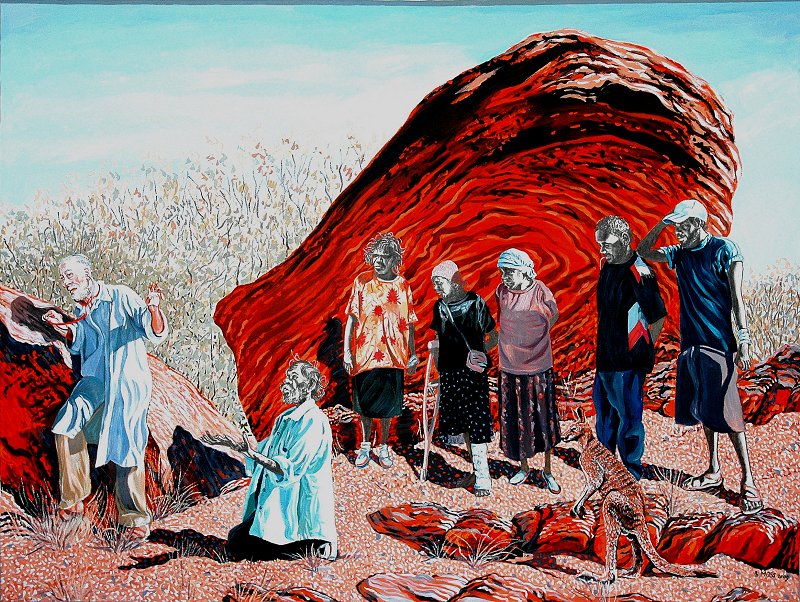
From ‘Jerusalem Notes, 1967’. 

I was born in 1946. The State of Israel was born in 1948. I cannot remember a time in my own life when we did not have the Jewish state. Mine was one of many religiously observant families at the time whose experience of Zion was one of a longing that defined us. Jerusalem was our dreaming. Our emotions had not caught up with history. In 1967, I visited Israel for the first time. I went to pray at the Wall. It was a Thursday, market day in ancient Judea, a weekday when the Torah is read, both in ancient times and today. As a descendant of the priestly line of Aaron, although a visitor, I exercised a prerogative and gave the priestly blessing. Soon after it was time to read from the Torah. The layman conducting the service called: Let the Cohen come forward. Arise, Z’vi Yehonatan ben reb Melech hacohen. 

He was calling me first, using my patronymic, linking me with my preceding generation, choosing me – for my caste – to witness the reading of the Torah. It occurred to me that here I was, the first in my family in 1900 years to serve as a Cohen at the site of the Temple. It was a moment of déjà vu: I had been there before. I felt I was part of history and history was part of me. A light feeling and a deep one. 

The next afternoon, I returned to the Old City. I followed its narrow winding ways and realized after a while I was lost. I accosted a young man coming out of a house and asked, in Hebrew, directions to the Wall. He was about my age. He wore a dark suit and carried a cheap attaché case. He asked me in English: ‘From which country do you come?’ ‘

Australia.’ 

‘Australia! So far! Will you honour my house by coming inside for refreshment?’ 

I came inside and the young man introduced himself: ‘Yousef.’ I told him that was the name of my grandfather, who was born in Petakh Tikvah. ‘He never came here to Jerusalem. It was not possible for a Jew. Now I am here for him.’ 

Yousef ushered me to a narrow stairway. It was dark. I followed the stairs to a sunny balcony, where he sat me down and excused himself. I could see the Wall now, its stones creamy in the sunshine. Behind the Wall and looking down on it, was the Dome of the Rock. Beguiled, I sat in the sunshine 

and forgot who I was and who Yousef was. And who each of us was not. 

Footsteps behind me brought me back. Yousef carried coffee that he poured into a little cup. It had a muddy look, but it smelled good and tasted sweet. ‘What is that aroma, Yousef?’ ‘Cardamom. You do not like?’ 

‘I do, very much. Thank you.’ Next Yousef bought a large bowl brimming with baby mandarins.‘Clementinas. Please take, eat, drink. Please forgive me that I do not partake: it is Ramadan.’ 

Yousef told me he was a school teacher, but he was not teaching today on account of the Fast. Throughout my afternoon tea, Yousef was smiling. I must have smiled too. He wore a cheap suit and he carried a cheap valise, but he knew himself rich, living in Jerusalem and extending to a cousin the hospitality of Abraham who is Ibrahim, our father. Eventually, I left, my head swimming with Yousef’s directions to the Wall. As we parted, Yousef asked me to visit again next time I was in the Old City. I said I would. On numerous return visits, over the late months of 1967, and over decades since, my eyes would roam about the Old City, looking for a house with a balcony and a parapet, and a man of my years, with suit and valise, smiling. Yousef and I never found each other again. 

*** 

After taking my leave of Yousef, I set off for the Wall, striding after the setting sun. I soon got lost in an alleyway. I climbed an outer wall, and recited the Mincha prayer alone, in the late sunshine. I was reciting the Amida, the silent prayer, when a clattering disturbed me; stones were landing on a roof, around me and just next to my feet. I realized that someone was throwing these stones: someone did not welcome me here.

Character


I heard Michael was a goatherd. I heard he was an ostrich farmer before that. Ostriches are tough, durable creatures, goats are the same. Michael’s country on the border between New South Wales and Queensland is hard and dry. Michael was tough and leathery and just as stubborn as his animals. I heard he’d visit a city with reluctance. Quickly restless in urban places, he’d be quick to flee. He spent half a day in Melbourne then bolted. Michael, I understood, was a character.


I learned the goat business wasn’t complicated: you’d drive a few hundred kilometres to relieve someone of their feral flock; you’d drive a good distance in another direction to buy another herd and you’d bring all the creatures back to his farm near the small town of Texas. Later you’d drive many more kilometres and sell the consolidated mob to someone who wanted to export them to Muslim countries to the north. So long as the selling price sufficiently exceeded the price of purchase that was a sound business. And, goats being droughtproof, Michael would survive through the long dry.


Doubtless there were goat traders somewhere in the city who used computers and create spreadsheets. Michael would scribble figures onto the back of an envelope; the back pocket of his work pants served as his filing system. It worked.


When I met Michael it was at his house in Texas, on a grassless property at the end of a dirt track that led from a narrow road that twisted and turned just inside New South Wales. He was a large man, older than I. When we first met, a smile as large as Texas wrapped itself around his face as his large hand wrapped itself around mine. He shook my hand gently as he looked down from his long and rangy frame. I don’t know what Michael saw but I suspect he’d made up his mind already: he was going to like me on account of my being a friend of his daughter. Twice  a week that daughter’s landline would ring. One person only called on the landline, and that was her father. The voice would speak, always somehow astonished, always  joyful; Hello beautiful! How are you going? It wasn’t hard to like Michael; everybody liked him. Or just about everybody. He carried himself with utter authenticity. He had no time for formality, no time for insect authority in the noisy flapping of its wings.


After a long epoch of rooflessness, Michael’s high house had only recently been reroofed. After the storm that tore off roof, the insurer was in no hurry. So Michael and his wife Lisa lived there for a year without a roof, waiting for the insurer to come good on the policy. I looked at the high house; you entered it at the top of a high staircase. I took a breath and climbed the stairs. Afterwards I reflected that climb demanded fluid joints and I misgave for Michael. I reckoned Michael’s old skeleton couldn’t possibly last in that house much longer. Likewise driving truck across the breadth of Queensland and New South Wales was surely beyond him. Better and safer to accept reality and stop driving altogether. But that would be the thinking of retirement inside the township, the thinking of a life spent indoors, life in a nice unit somewhere on a nice street that was paved, with new neighbours close. That was the thinking of a life that would be death, and Michael turned his back on it and kept on driving and buying and selling and climbing those stairs.


Years later I visited again. The stairs were just as high but Michael was not defeated. I met Elisa, a small woman from the Philippines whose will and durability were a match for Michael’s. Elisa and Michael managed to cater kosher for their new Jewish friend and Halal for the local doctor, a Muslim. I met their sons, a pair of pocket Hercules. The young men are body builders. Powerful bodies are all the go in Michael’s tribe.


Michael came down to Melbourne to watch his sons compete in a bodybuilding championship. I saw Michael breakfast at an outdoor table with his family around him and an old mate at his side. The mate was a rough scrubber, jovial withal. The men shared an enduring love for the bushman each saw in the other. They laughed over wild old times, wild days, wild nights. I looked at Michael and I saw Falstaff:

We have heard the chimes at midnight, master Shallow.

That we have, that we have, in faith John, we have… the days we have seen.


Bits of Michael’s body stopped working, important bits like his heart and his lungs and his kidneys. The local doctor, himself an individual tenacious in his faith, could recognise and respect another tenacious believer. He must have misgiven mightily as the goatherd kept on, regarding his body as he might regard his old truck: roadworthy or not, Michael would keep it on the road and keep on driving it. Late last year Michael bent to hitch a heavy steel trailer to his vehicle and something snapped in his spine. Unable to move, in agony, he took to his bed and endured. No, he would not go to hospital, certainly not in the capital, hundreds of kilometres distant. Bloody Brisbane? Be buggered!


Soon Michael was delirious with pain. In and out of consciousness he came to in a modern city hospital where every mode of doctor and specialist and every modality of imaging and investigation was brought to bear. All the king’s horses and all the king’s men… His descendants descended upon his sickbed from all parts and wept and prayed and wept, and looked to ever more doctors and ever-clever technology to – to do what? – to keep Michael alive? Amongst those closest to Michael the wiser ones saw what he would see. Love torments the lover; the lover must long for a recovery that she knows to fear.


Michael’s mind hovered, wavering between calm lucid periods and the opposite. In clear moments he’d hear a loved one reminisce upon a life lived on its own terms, a life hard and long. These were precious moments of calm understanding. After a time his mind stopped rebelling against his body and he inhabited a limbo, while all the time his family kept vigil. Days and nights, nights and days passed. All held their breath. At last Michael stopped breathing.


Almost a year has passed. A year in which my friend’s landline has not rung. In Texas – desolation; in all the places of their dispersion, among his loved ones, the silence weighs upon an emptiness. Michael was a big man.


I met Michael but a handful of times. I’d draw up and he’d smile hugely. Knowing him fleetingly, I experienced how deeply his character left its mark upon another. I saw his son-in-law, his grandsons, I saw how Michael’s being seized them, how they loved him, how character tells. How deeply they respect him still.