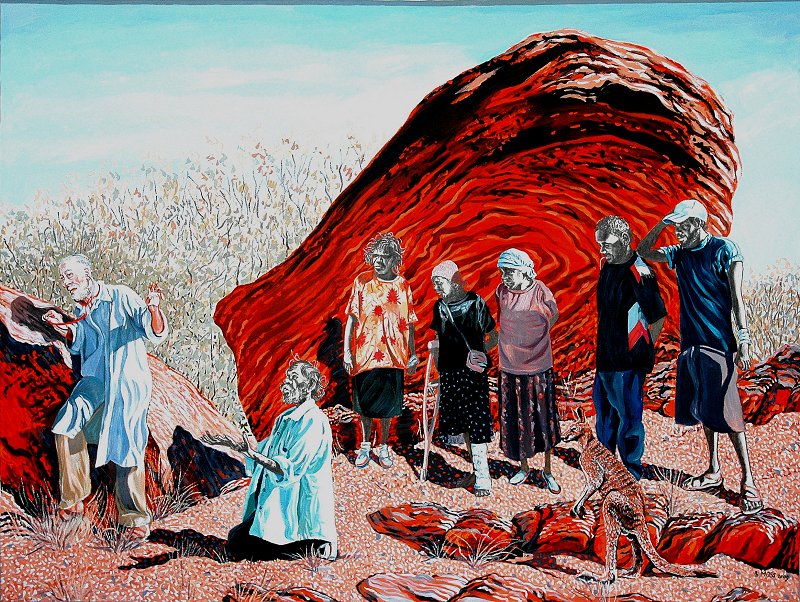
My family used to be employed in Jerusalem. Unfortunately our family business was disrupted for a time by conflict and conflagration. In what appeared to be arson, on the ninth day of the month of Av in the year 70 of the Current Era, our office was burned down.
The office I refer to was the Holy Temple where my forebears would officiate in rituals of sacrifice, in mediating and arbitrating disputes, in quarantining suspected carriers of contagious disease and in blessing the people. As the reader will realise we worked as lawyers and doctors and priests. After the burning my family was unable to go to our office for nineteen centuries. Then in 1967 we returned. The other day I went back to the office where I resumed working in the family business.
It happened like this.
My two eldest grandchildren, both aged thirteen, accompanied my wife and me on our current visit to Israel.
The boy, a pretty secular fellow whom we’ll call Jesse, walked down to the Wall with me. He understood the antiquity of the Wall and something of its sanctity. Praying is not his specialty. ‘What will I do, Saba?’
‘I pray there, Jesse. Some people write their prayer on a slip of paper and insert it into a crack between stones.‘
‘What should I pray for, Saba?’
‘Think of the thing that you most want in the world, Jesse. Ask for that. It could be some deep and secret thing, something you wish for yourself or for someone else.’
Jesse has seen suffering. Earlier he saw a man begging. Well made, about the age of Jesse’s father, the man requested small change, blessing anyone who donated. The man walked on a distance from Jesse, turned away and covered his face with his hands. His shoulders shook.
At the Wall, Jesse pressed his lips against the glowing stone. He leaned his forehead against the Wall for some time, his lips moving. Then he posted his slip of paper into a tiny eye socket in the stone.
As we walked away backwards, Jesse stopped me and threw his arms around me. He said, ‘That was a really important experience, Saba. Thank you for taking me here…I love you, Saba.’
We rejoined my wife and Jesse’s cousin, whom we’ll call Ellie. They too had prayed at the Wall. Ellie’s fair features glowed: ‘Saba and Savta, that was wonderful.’ My hands twitched, a spasm in unemployed muscles. I recalled I was a Cohen, a lineal priest: I was in the blessing trade. I rested my palms on Ellie’s head. My fingers splayed and I searched for some voice. The voice shook as I recited the ancient words: ‘May God bless you and keep you…’ Here I was back at the old workplace, here was Ellie, flesh of my flesh.
I had waited 2000 years to get back to work. I annointed her fair head with my salt tears.
Tag Archives: grandchildren
Scavengers at Woolworths in a Remote Mining Town
By the time we disembark in the town we have travelled most of the day. The streets are a desert in the empty way of a Sunday afternoon in the country. We need to buy food supplies but all is quiet. Nothing moves. The air tastes hot. Breathing becomes an effort.
Up and down slow wide streets we prowl, looking for a supermarket. Hello! This is Woolworths. A cluster of cars baking in the carpark. Signs of life. Or recent life.
We tumble out, one grizzled grandfather, two ratty ten-year-old twins. Woolies is open! In the course of the following twenty minutes I load a trolley with fruit, vegetables, cheese, pasta, milk, yoghurt, confectionary bribes, cans of tuna, smoked salmon for the sybaritic grandsons.
The boys have disappeared. All other customers have disappeared. Someone turns off a lot of lights. I wrestle the trolley to the check-out where the twins lie face down, arms outstretched, fingers groping in the narrow cracks beneath the checkout counters, Their long curly hair wears a diadem of dust. Their once-clean shirts from long ago – this morning – are grimy. Their faces are coated in dirt. They wear expressions of intense concentration. When I call their names they do not respond. They pay no heed. Business as usual.
I pay a distracted-looking checkout person who asks me whether the boys are mine.
Technically they are not. But I admit to the connection.
Checkout person says: ‘That money doesn’t belong to them.’
‘What money, I wonder?’
I call the boys and advise them I am about to leave, the store is about to close, and I will collect them at opening time tomorrow. If I remember.
The boys surface, faces aglow with dirt and triumph, their hands full of coins. ‘Look Saba! We found all this money under the checkouts.’
‘That money doesn’t belong to you’ – checkout person again.
‘It doesn’t belong to you either’, says one cheeky voice.
‘Who does it belong to?’ – challenges another.
‘Woolworths!’
‘No it doesn’t.’ – two voices in chorus.
‘It can’t belong to the shop, Saba. The people paid the shop. The people dropped the coins. It’s not the shop’s money.’
‘Whose is it, do you think?’ – asks the grizzled grandfather, who isn’t really too clear on the legalities or the morals here.
The boys have an answer: they’ve spied a tin chained to the checkout counter. The tin has a slot for coins in its top.
The boys are busily feeding the coins into the tin, counting as they go. ‘Twenty two dollars and thirty-three cents, Saba! All for charity.’
The boys were unerring in their reading of the moral landscape: the label on the tin reads: HELP DISADVANTAGED CHILDREN.
Gap Years
The friendly young man in the bookshop approves of my reading choice*: ‘Good book, I really enjoyed it. It was prescribed in my literature course last year.’He looks young, too young to be a uni graduate: ‘What was your course?’
‘School. I finished last year.’
‘What are you doing this year?’
‘Working here. Saving. I’m going to travel; I’m taking a gap year.’
Everyone takes a gap year nowadays. I never thought of it. No-one did back in 1963. I was keen to get on with becoming a doctor. I couldn’t see a gap and I would not have walked through it if I found one. Tempus was fugit, vita was brevis, gluteus was maximus, so I sat myself down and flogged my humanities brain over the sciences that were the stepping stones to doctoring. I never gave thought to my already clear history of stumbling through the sciences. I entered medical school, I studied the sciences and I stumbled on. If in later years I referred to my undistinguished undergraduate days, patients refused to believe it. They’d look at their trusted doctor and smile, knowing he must be joking; their peace of mind required he have no gaps.
I became a husband, I became a father, once, twice, thrice. I had four new people in my life to love, four more to work for. And I did work. A joyful and fulfilling part of my work was caring for women in pregnancy and childbirth. I became the intimate stranger, the guest at the birth of families. I’d be called to the hospital in the middle of the night, during dinner, at the kids’ bedtime, at quiet times alone with my wife. I’d leave home early in the mornings to visit the mother and her newborn in hospital. I’d leave before the children were awake. I left lacunae in our family, gaps where the dad was elsewhere when a daughter was sick, when our son had asthma, when our youngest cried at bedtime because a classmate at kinder teased her about the warts on her fingers. After twenty years I bade farewell, a long farewell to obstetrics, and hoped I’d mend the gaps.
The children grew, graduated, went to work, married, became parents. Became busy. Their time cramps them, crowds them in. The gaps that open in our children’s lives allow my wife and me in and enrich us.
The friendly young bookseller-bookreader will head off into his gap. He’ll travel towards his Ithaka and become rich with all he learns.
The truth is, life is full of gaps. As Leonard Cohen teaches us, that’s how the light gets in.
*Brenda Walker’s ‘Reading by Moonlight’. A gift for a friend with a couple of cancers.
On Turning Seventy
At some time on January 8, 1946, at St Andrews Hospital in East Melbourne, Yvonne Mayer Goldenberg (nee Coleman) gave birth to her second child, a son. The precise hour of the child’s birth is no longer known. St Andrews Hospital no longer exists and, sadly for this son, neither does Yvonne. Since the moment (unspecified) of his birth, that child has enjoyed an ambivalent relationship with Time.

The temporal relationship was subjected to distorting stress even before the child was born. Although Myer Goldenberg delivered hundreds of other people’s babies every year in the Leeton District Hospital he determined his own children would be delivered by obstetric specialists in Melbourne. Two weeks before the second babe was due Myer drove Yvonne to Melbourne, dropped her at his parents’ house and returned to his patients in Leeton. Once Nature had taken its course he would return to meet the baby. Yvonne came into labour at night. Her father-in-law, Joseph Hyman Goldenberg, an excitable man and an erratic driver, bundled Yvonne into the car and raced towards East Melbourne. Joseph Hyman had no obstetric ambitions of his own: emphatically he did not wish to get down and bloody with Yvonne. He drove anxiously. In those days doctors erected a red light outside their medical premises to inform the passing trade. At every red light Joseph Hyman slowed to ask Yvonne, Should we stop here? Are you sure the baby is not coming? The pair passed from East St Kilda to Fitzroy Street, where red lights abounded: doctors were not the only practitioners with red lights. In this manner, slowing and accelerating by turns, the two proceeded to St Andrews where the child was born.
The parents named the child Adrian*.
The baby was blessed with two distinct exemplars in the matter of Time. Myer Goldenberg was a stickler for punctuality. He tried to stickle his wife, but Mum wasn’t sticklish. So unpunctual was Mum, so indifferent to Time’s pursuit, Dad claimed: Yvonne can’t tell the time. Mum’s riposte became famous: I can tell the time, I just don’t approve of it.
I took after Mum.
When I was nine years old I decided to become wealthy. Mum offered to pay me to shine shoes at one penny a shoe. Dad had about four pairs, Mum twice that number. I polished and I banked the proceeds. After shining two thousand, four hundred shoes I had accumulated ten pounds in my Commonwealth Bank account. I withdrew that sum and I bought a wristwatch. With that purchase I won my chance for mastery over Time.
I won it and I blew it.
School and life offered challenges, adult tasks, endless opportunity for a dysnumerate adolescent to strain his brain with numbers. Tomorrow always appealed. Later was better than now. Soon, Dad, soon.
After taking up middle distance running in my ‘teens I became interested in my pulse rate. I discovered my heart beat precisely sixty times a minute. I spent many lessons with my right index finger pulp resting over my left radial artery, counting the wrist minutes to the end of class.
My father had the impressive ability to awaken from sleep at a designated hour. He’d pack the boat at nine in the evening, we’d all climb into our bunks, and we’d sleep until the roar and throb of the marine engine told us Dad had awakened, as he’d planned, with the turn of the tide. Such a skill seemed to me mystical. I know it now to be physiological, supported by a time-swollen prostate, the older man’s alarm clock.
Dad was always awake. I’d awaken and wonder why I had; or, more precisely, why now? And go back to sleep. I came to realise I could estimate the passing of time with remarkable accuracy. Let us say I heard the News on the ABC at seven AM and then went about my business through the day until mid-afternoon. I found I could stand still, rehearse the movements and actions of the intervening time, and calculate the hour. I’d say, I reckon it must be about four, or maybe a bit after. We’d hail someone wearing a watch who’d confirm it was five minutes after Four.
Curiously Time stalked me. I never chased it; it wasn’t particularly interesting to me. Now, at threescore years and ten I have discovered a new skill, equally unexpected: ask me when someone died, when someone else married or divorced or when she published her second-last book, I’ll declare, five or six years ago. Or, the Easter before last – and I’ll be right. Time has slipped through my hands. I never gripped it firmly but I have felt its mass, I can weigh it in my mind and give you the quantum of time that has passed.
Of course my time with Time is limited. The psalm I recite every shabbat reminds me: the days of our years are threescore and ten…I’ve had my threescore and ten. I’ve spent them and enjoyed them. I have seen much, I have loved many. Many are the books I have read, many the teachers who showed me their light. But what of my books unread, my books unwritten? What of the cracks in my world I was going to fix? What of the love I owe and never paid? Happily my psalm offers an extension: but with heroic effort, eighty years…
At medical school I came across a novel and striking notion: senescence proceeds from birth, hand in hand with growth. The processes continue. Like a plucked fruit I ripen and I decay. In the house at night you can hear me snoring. In a coffee shop the other day I sipped my cappuccino while peeking at the attractive barrista. My thigh felt suddenly hot. I turned from the young woman and saw my cup held on its side, coffee streaming onto my flesh. I realised I have come to a stage where I can no longer perve and drink coffee at the same time. On the anniversary of my birth the grandchildren celebrated me. One wrote: Saba, I love you more than mangoes. Another, We will put you in a Home.
In Time there will be time ample for sleep. For now I sleep less, as if to waste no moment of the light. I hear less but I appear to miss little. Deafness is my censor, filtering out much noise, admitting much signal. I taste Time and it remains fresh and sweet. It passes, slipping away, slipping, like a breath. New times will follow and, like all times, they will pass into memory, after that into a memory of memory, and finally into forgetting.
I can feel Time passing by weightlessly. Time as quantum wields no heft, bears no moment: somewhere I have a wristwatch, capable of measuring time. I have set it aside: I just don’t approve of it.
*The parents named their new baby Adrian. Years later my mother showed me the notice she and my father placed in ‘The Murrumbidgee Irrigator’: Myer and Yvonne Goldenberg are pleased to announce the birth in Melbourne of their second son, Adrian.
Over the following ten days of her confinement, Yvonne received a stream of visitors, all of whom asked the name of the newborn, and all of whom vomited. Presently their friends Ben and Ethel visited, bringing with them their son, Howard. After the vomiting my father looked at my mother, my mother looked at my father, they both turned to Ben and Ethel, asked did they mind, and Adrian became Howard. Baby Adrian was not consulted.
Do You Have Children?
She was the first patient in my day.
She was sent to this city in North Queensland by the foreign mining giant that employs her.
I had never met her before. We introduced ourselves.
She said: ‘I was woken by awful pain in my bladder. It’s an infection, I’ve had them before. I couldn’t sleep for the pain. It was four in the morning, but I got up and went out and walked the streets until I found a 7- eleven. I bought some Nurofen tablets for the pain.’
‘Did they help?’
‘A little.’
Her urinalysis was positive.
‘I think you’ll need an antibiotic. Antibiotics famously render the oral contraceptive pill inoperative. Maybe. So during this cycle you shouldn’t trust the pill… unless you want a baby.’
A smile and a shake of the head. The smile is not that smile that says, ‘Tread with care.’ She is a mature woman at peace with herself. Excepting for her hostile bladder. The smile licensed me:
‘Do you have children?’
‘No.’
Another smile as she sat and formulated a response to my silence.
‘I never thought I would. Now I realise I really have to decide – this month in fact. You see I’ll turn thirty-nine next month. I wouldn’t want to have a baby after forty.’
‘Why the late uncertainty?’
‘It hit me I might come to regret never experiencing that.’
She talked about childbearing and childraising, describing the contrasting experiences of her sisters. I agreed it was a momentous question. We talked about bladders and we parted.
At home I asked myself how I’d describe my own experiences. I’d be unable to resist describing – at clear risk of malicious misinterpretation – the intense pleasures of bathing or changing soft bodies, the satiny skin, the small weightiness in arms or lap.
I thought about my feelings and the word that came was ‘intensity.’ Had she asked I might have said, ‘Becoming a parent deepened me. I believed I was tender towards children, but my firstborn taught me how I had tiptoed through mere shallows.’
I recalled an early piece of Martin Flanagan in the Melbourne ‘Age’. He described nursing his small daughter through a night of torrid fevers. From memory, I recall him writing, ‘I know I will never feel closer to this child than I have this night.’
I might have quoted an early patient who became an enduring friend. Her asthmatic sons struggled night after night for breath. She told me how she’d walked the floors, holding them, counting breaths, weighing ambulance against a dash in her own car.
Inevitably I was visited by verse.
I have walked and prayed for this young child an hour
And heard the sea-wind scream upon the tower,
And under the arches of the bridge, and scream
In the elms above the flooded stream….
(W B Yeats, ‘A Prayer for My Daughter’)
I might have described the common and uncommon thrill of feeling a newborn curling her fingers – by reflex – around the finger that I rest on her palm. I might have said, ‘The unearned trust of my child makes me know – as I have never known before – I am significant.
I might have said, ‘My children gave me a clarity that was visceral: I knew through them my task, the meaning of my being alive. I knew I would give my labour without question or measure or thought of recompense.
I could never have dreamed the reward that would follow – grandchildren. And of course, with grandchildren comes the renewal of mission, of labour, of redemption of my aging. Feeling anew that deep significance I stride towards my latter end with head high.’
Had she asked, that’s what I might have said. But of course we will not see each other again.
Postscript: But we did see each other again – the next morning. With her consent I read aloud the words you just read. I looked up. Her face was suffused, on her lips the widest smile, from her eyes a flow of tears.
She thanked me and in answer to my question she said, ‘Sure, you can publish that.’
An Outbreak of Bibliophilia
Children, like humans, thirst endlessly for stories. My own seven grandchildren, who range in age from twelve-year old Jesse to two-year old Ruby, love stories. They thirst for story as we elders hunger to give story.
‘My son,’ remarked Rabbi Joshua to Rabbi Samuel (Babylonian Talmud, Tractate Sanhedrin), ‘More than the calf yearns to suck the cow longs to give suck.’ How do I know this maxim? That story dates back to the commencement of the academic year in March, 1965, when I purchased the latest edition of Samson Wright’s textbook of physiology. I opened the great tome and found at the foot of an otherwise blank second page the above quotation. The sole yarmulke wearer in the class, I was the only one of 120 students likely to have knowledge of the Talmud. But the passage was new to me. And I was astonished to read the quotation and its attribution in this secular text.
What have the lactation urges of the cow to do with human physiology? Everything, it happens: that interrelation of forces, that feedback loop, that mutual energising is the very stuff of homeostasis, which operates also in markets, in the climate and in the biological relationships between humans. The sage Rabbi Joshua nailed a great truth. But I fear I wander.
The entire purpose of children is to satisfy the need of humans to regale them with stories. The reason children don’t run away is their reciprocal story hunger. The reason we don’t chuck teenagers out is the promise they’ll one day employ their disturbing sexual organs to create grandchildren for us so we can resume storytelling. And that’s what happened: my adult children used their sexual organs for the pleasure of their parents, creating seven grandkids.
All seven served their grandparents well, occupying yearning arms and longing laps, snuggling in and subsiding to the song of the story. Then they learned to walk. Two of seven, both of them boys, took to their heels and never stopped running. In time, although those two learned to read, they never took it to heart; it is in motion that they find themselves, one in organised sports, the other in disorganised sport. (Readers of this blog will recall this boy and the rescue of his fingers when trapped in a bathplug.)
Their bookish grandfather gazes upon the boys and sighs. He calls them to the couch for a story but the call of their balls is louder. Off they run, to soccer, to cricket, to mayhem.
What will become of them? What will become of grandfather?
Later the ball-players have returned home. Grandfather wanders to the toilet. Before him, on the floor, lies a cornucopia of books; the disorganised sportsman comes to a stop in this place. And in this sanctum he reads.
Tearful in New York City
My red rimmed eyes smart. Tears fall. A victim of homeland security in the United States, I cannot blame the state of my eyes solely on the State of Siege. My blephs were reddened and my tears prone to fall before leaving Australia.
What is blepharitis?
In general I know –itis. -itis is my stock in trade – be it stomatitis, be it balanitis*, be it appendicitis – if it’s inflamed, it’s an –itis. My own inflammation is blepharitis. Blepharitis is the inflammation of an organ that has no known name: search as we might in medical dictionaries and in general lexicons we will find no blephs. But blepharitis, which is the inflammation of that part of your eyelid which is neither external skin, nor internal membrane, but the terminal edge of the lid, hurts in a niggling and mildly miserable manner. The seat of the problem is a scaly deposit, a scurf, somewhat like dandruff, that forms on the edge of the lid. With every blink that scaly stuff scratches the surface of the eye. The eye responds with perpetual tearing.
There is no cure for blepharitis.
My grandson Toby – known in this blog for his flirtations with danger and for his love of this grandfather – witnesses my tears as they swell to a fullness and fall. His insect features tighten with concern. He approaches, leans forward, pulling me down towards him,
studying my face anxiously. His rodent digits grab at my arms to arrest me: ‘Are you sad, Saba?’
His love makes me laugh for joy. My mirth augments the tearing. A full waterfall of affection and my blepharitis is somehow sweetened.
My son-in-law Dov, a rising genius in ophthalmology, advises me: ‘There’s no cure, but there is treatment; you need to dip a cotton bud in diluted baby shampoo then scratch away at the scaly stuff at the edge of your eyelids. I invite my readers to try this: most enjoy the practice quite as much as vaginal douching performed with sandpaper.
On the eve of my trip abroad, I decant some baby shampoo into a urine-less urine specimen jar. I seal the jar and pack it carefully in a nest of socks in my suitcase. On arrival in the United States I open my suitcase and read the enclosed:
NOTICE OF BAGGAGE INSPECTION.
To protect you and your fellow passengers, the Transportation Security Administration is required by law to inspect all checked baggage. As part of this process some bags are opened and yours was selected for physical inspection.
My suitcase has been selected! I feel honoured. Glad to protect my fellow passengers in this manner, I rummage for a pair of socks. My fingers report something unexpected, the tactile sensation of something cold and viscous and gooey, not unlike cooled semen. Sticky soggy socks everywhere swim in baby shampoo manufactured by Johnson and Johnson. The urine jar itself is fragmented, shards of plastic dripping yellow.
The shampoo treatment suspended, my blephs scale, my eyes smart and redden and weep. Without Toby’s loving concern blepharitis is no fun at all.
The Prayer of the Traveller
Many of us are on our travels as I write this. Today I will resume mine – one hundred and fifteen kilometers by road before a flight of forty minutes (in the air we register time not space), then a break before resuming for the next seventy minutes of flight. Finally thirty kilometers of suburban roads. Then home. Home – that word for an idea that houses our love; for the island we build to grow a couple into a family. After two stationery days I’ll skip from the continent of my birth to the land of the free – three flights, ten security checks (eight of these in the US) – eighteen hours in the air.
Long before the Malaysian airliner disappeared I had my misgivings. The loss of a civilian passenger aircraft over Donetsk did nothing to comfort me. And now the AirAsia tragedy. Travel is dangerous. Out here in the Outback, the roads are full of kangaroo, wandering stock, feral donkey and camel, species which share with the shahidi a zest for homicidal suicide. Air travel, far, far safer, remains hazardous.
Travel has always been thus.
If you are a wuss (I am) and if you have a prayerful bent (I am severely bent in that way) you might pray for a safe arrival – and if you are needy or greedy (I am both), you’d slip in a word for your safe return home.
The following comes from the ancient Traveller’s Prayer recited by Jews. The text catalogues a surprisingly contemporary list of hazards:
May it be Your will to direct our steps to peace, to allow us to reach our desired destination in life, in joy and in peace.
Rescue us from any enemy, ambush and danger on the way and from all afflictions that trouble the world.
Let us find grace, kindness and compassion from all who see us.
You can fill in your own particular concerns. (Afflictions that trouble the world are plentiful. I think of Ebola. I think too of violence of all kinds – both abroad and within our domestic walls.)
An anxious Jewish traveller (Jewish people are past masters at anxiety), having completed the lines above, might feel the need for elaboration or emphasis. Such persons follow on with Psalm 91. I do. I love this one: I loved this one and I quoted it to my shell-shocked teenage daughters after two hilarious hoons chucked rotten eggs through the girls’ car window, breaking on and altering the grooming of their lovely long locks.
Five years ago, grandson Toby, famous in these pages for his flirtations with danger, drew a picture in vivid primary colours. The picture, three inches by one and a half, was intricate, pulsing with the vibrancy of his four-year-old being. Toby presented it to me: ‘This is for you, Saba.’ Since that day it has sat between the leaves of my travel prayer book. It guards the place of Psalm 91.
One who lives in the shelter of the Most High abides in the shade of the Almighty. He will save you from the trap of the hunter and the deadly pestilence. You need not fear the terror by night, nor the arrow that flies by day; nor the pestilence that stalks in darkness, nor the plague that ravages at noon. Though a thousand may fall at your side, even ten thousand at your right hand, yet unto you it shall not come nigh.
I am not simple – or faithful – enough to believe that simply reciting these words will guarantee my safety. Saying the words is not the equivalent of completing the enrollment forms in supernatural travel insurance. I am not insured. But it is in the beauty of the poetics; in the relief of putting fears into words then filing them away; in the unspoken reminder that in matters in which I am powerless there is no point fretting – in these I find comfort, acceptance.
I am not insured, just assured.
I wish us all safe travels.
A Visit to the Dentist
You could say it’s all my mother’s fault. It was Mum who made me go to the dentist. It was Mum who made me wash. Like many mothers Mum had a religious belief in soap and water.
When I was a small child Mum took me to the dentist, Mister Mc Auliffe. In those days dentists were Mister and doctors were Doctor. Mum tried to make it sound like a treat: ‘Afterwards we’ll go across the street to Mr Iano’s shop and I’ll buy you the biggest apple he’s got.’ I had better reasons, anti-dental reasons, for going to Iano’s. As well as being the fruit shop it was the milk bar: you could buy lollies there. Mum said, ‘Afterwards we’ll get the biggest and brightest and greenest apple in the whole shop.’ Afterwards! I heard a rat. What would happen in-betweenwards?
In between the honeyed talk and the greenest apple was the climb up to Mr Mc Auliffe’s second-floor surgery. From there I had an excellent view of Iano’s lolly shop. Inside that narrow chamber I smelt smells, I heard sounds, I felt vibrations, all novel, all taking place within my mouth. The drill moved with all the speed and softness of a peak-hour cable tram. My teeth were the rails. I felt smoke but could not cry ‘Fire!’
Afterwards, as promised, there was the apple.
Five years later, attending my expensive new school in Melbourne, I stood on the top step of the slide. A pushing-in kid, hostile to this newcomer, tried to push in. I stood my ground. Push came to shove in the back, I fell face-first onto the steel side rail of the slide, arresting my fall with my right front upper incisor. I left part of that upper front tooth in the Mount Scopus playground in St Kilda Road. My parents decided I looked odd and sent me to a dentist. A Melbourne dentist, I discovered, had modern methods of preventing pain by causing pain. The dentist – still mister – squirted local anaesthetic into the nerve nearest the front upper tooth. He said, ‘This will stop you feeling pain.’ Perhaps it did do that, but the injection hurt in a way that was new to me. Mister dentist asked me, ‘Do you want a gold filling?’ I didn’t want anything more this man might do to me. But I didn’t say no so I left those premises unaware of the new vertical glint of gold in my smile. It was a long time before I smiled, longer still before I saw myself in a mirror.
Many decades later grandchildren arrived. They learned to speak. They looked at me, they looked at other humans, and they asked, ‘Saba, how come you got a gold tooth?’
I told them the truth of course. I told them how I fought a gold toothed dragon that no-one else would fight, how I’d killed it and kept one tooth as a trophy.
Every time they saw me, the grandboys would ask, ‘Tell us how you got that golden tooth, Saba.’ I told them how I’d swum into the deepest ocean and fought barehanded the Giant Shark, fought tooth to tooth, how I’d bitten out his black heart, how his blood-red tooth had bitten my gum, had lodged there and rusted and turned gold.’
And again, ‘Saba how did you get that gold tooth?’ I told them about the dinosaurs that caused so much wreckage in my childhood days. ‘You know how Tyrannosaurus wrecks, don’t you, kids?’ I was forced to tell them of my desperate struggle in the dark jungles of Paris, how I saved the Parisees, how Tyrannosaurus died, his black blood turning the dirt streets of Paris black, his last tooth taken as a souvenir – a French word I borrowed from the Parisees – how I had that tooth implanted in my own brave gums. ‘And, kids, today you never see any dinosaurs any more, not even in the dark jungles of Paris. And the streets of Paris are all black.’
All went well for some time. The gold tooth stories nourished hungry young minds, filling them with useful knowledge of geography, of history and of pre-history. The gold tooth gleamed modestly from behind my bulbous lip, a stamp of my enormous, self-effacing courage.
Then my Mum stepped in. Not physically, but in habit ingrained and indoctrinated, Mum’s habit of soap and water, a habit I am embarrassed to admit survives her, years after her death: I showered. And while showering I ran my idle tongue along the inside of my upper teeth, where that slippery pink rasp felt something that was not there: my tooth, my gold tooth, had gone!
That’s life, I said to myself. Sixty years a gold-toothed person, now ungolden. I grinned at myself in the mirror. I looked like a failed terrorist. Something gleamed from the floor of the shower recess. I picked it up and placed it in a urine jar.
I asked the nurses, ‘Is there a dentist in this small town?’ There was, there is. And the dentist’s receptionist had more bad news, ‘You can see him today.’
So I went. The dentist is Doctor now. But he was not the real, dinkum, authentic dentist of my childhood. He covered my eyes to protect me from my own germs. He showed me a horror show on the screen above me: the images were those of my own teeth, my receding gums, my doomed dentition. He did things inside my mouth, asking me questions I never heard in childhood: ‘Does that hurt? Please tell me if I hurt you.’ He used a drill and he didn’t hurt. I think he doesn’t know how. He glued back my bit of gold. I lost my terrorist’s grin.
Nowadays a dentist has lost those old skills, those old black arts; now that a dentist is a Doctor it’s only your wallet that hurts. So a dentist who is a Doctor employs a failed dentist and calls her a hygienist. And she knows how to hurt.
Another Toby Emergency
A scream from the back of the boat, the scream of amazed pain. Now follow loud cries as Toby’s face rises above the transom. Tears stream down his face, uncharacteristically pale. At the point of his chin a gleaming carbuncle of deepest red rises to a meniscus, then overflows. Brilliant red drops appear on the white deck, tracking Toby’s path to adult rescue.
I apply my nearly clean handkerchief to the wound. Toby darling, press this hard against the cut. Very hard.
I’m sorry, Saba. I’m sorry.
No need to be sorry, Toby – just press.
I’m sorry. I’m very sorry…
My bottle-green hanky is turning red. A quick peek underneath shows a deep and gaping gash. The wound is irregular; it will need meticulous suturing to minimize the inevitable scarring.
Before we arrived in Metung I commanded the kids: NO RUNNING ON THE BOAT, NO JUMPING ON THE BOAT.
I’m sorry, Saba, I won’t do it again.
Pablo scoops his son into his arms and we run to the car. The patient, cocooned in his father, is stowed in the back. We drive into the little town to look for the doctor’s premises: the Village Store, a hardware and fishing tackle shop, the pub, a real estate office, a few coffee shops – these account for one half of the Central Business District; a u-turn brings us to the post office, a laundromat and a petite pharmacy. The pharmacist, a lady of my years, petite like her shop, is sympathetic. She advises, Yes, there is a doctor in town… every Tuesday morning.
Hmmm. Do you have surgical glue?
I don’t think so. I’ll look…
The search doesn’t take long. No glue. We settle for some stout Steri-strips, a gross of sterile gauze squares and a gallon of Savlon.
Across the road the door to Hardware and Fishhooks is locked. It’s only four PM, Friday. The sign reads, Open 9.00-5.00, M-Thurs. Fri 9.00-1.00.
The Village Store stocks food, suncream, the dailies, the Metung Meteor. Unless it’s a condom or a painkiller I seek, no pharmaceuticals. Do you have Super-glue? (Super-Glue is identical to Surgical glue; it’s packaged in crushable phials for single use, to discourage germs.) The helpful young cashier leads me to her hardware shelf. No Super-glue but we do have Araldite.
Araldite. I’ve never glued human tissues with this product. Will I try it on my grandson? I call the Emergency Physician in Alice Springs, where ED is full of my workmates. Yeah, Araldite will hold it, same as Super-glue. But it’s thermogenic. In an emergency, better than nothing, better than Steri-strips alone. Translated, ‘Thermogenic’ means the glue will heat the skin.
Back to the car. No doctor in Metung: we’ll have to go to Lakes Entrance. Toby lies quietly, eyes widening as I approach his wound. A wince, a gasp as I peel away my hanky of dark green and dark red, exposing a valley of flesh. Briefly bloodless, the wound fills quickly. Clean white gauze is applied. Toby darling, press again, hard. Here.
The child’s eyes follow me anxiously as he anticipates the uppance that surely will come: I’m sorry, Saba. I won’t do it again.
Driving back through town I wonder about the boatyard. They repair boats there, they must glue things. The Boatwright is helpful: Sure, Howard, we should have Super-glue somewhere.
The tube is not new. They have no other but needs must…
Pablo and I remove the patient and lie him on a picnic table, Pablo cradling the child’s head. Darling, we are going to put some glue on your cut to close it up. First I’ll wash the cut with this yellow stuff. It will be quite quick.
A splash, a yelp, a bit of quick mopping and a flow of fresh blood. It is quite quick – and quite hurty.
Now I’m going to squirt some glue onto your cut, Toby. It will be quite quick.
Pablo, pinch the skin edges closed… like this.
Pablo pinches – which hurts – as I peel away the gauze – which hurts. Toby’s eyes widen in fresh surprise, he releases a single gasp, half rises, then subsides. He takes deep breaths, slow breaths, as I squirt the glue – which hurts – and Toby breathes on. Through the following three minutes, Pablo pinches the skin edges – which hurts – and Toby, calm in his self-mastery, gazes trustingly into our close faces.
A few Steristrips bridge the narrow ridge of pink that was a cleft moments before. The wound is closed, and dry, more or less regular, messy in its scatterings of dried blood. It will heal and eventually scar.
Toby kisses his torturers and thanks us: You’re the best father, Papi. I love you, Sabi…I am sorry.
Postscript that might have been a Prescript: readers of this blog might recall an earlier, very lengthy post, titled ‘Toby’s Fingers in the Bath Hole’. A year after the Fingers in the Bathplug Story, we had the Batteries in the Ears story. Toby spent an afternoon in hospital for removal of hearing aid batteries trapped in his ear canals. Once in-situ, batteries create an enveloping oedema of the canal walls, a watery swelling of the flesh that neatly encloses the little discs. Toby is not deaf (not yet) and has no need of hearing aids or their batteries. But the batteries he found were just the right size, so…
Additional Postscript: Toby’s cousin Noah described the accident: Toby tried to get from the back of the boat onto the pier but his life vest caught on this wire and he fell when he jumped.
“When he jumped”: that must have been what Toby’s “sorries” were for. Not a forbidden jump at all, this was a jump from the boat, not on it.

<a
 howardgoldenberg