Striped Socks

In late 1969 the new doctor emerges half-baked from his progressive medical school. After graduation he spends three years in residence in major hospitals. He emerges from that great womb and enters family practice, feeling underdone still. But he blazes into his new work in a rural general with a few guiding verities. He will not create distance from his patients. He will not wear a white coat. He will wear bright socks, a signal to the young that he too is – was – is young. He will not hold himself aloof. He will not frighten children.


He starts his work and his feet are rainbows. When he treats children he sits next to them on the floor. Instinct rather than ideology guides the new doctor: he needs to be close; he wants to do away with barriers.


On his very first day, the ninth of April, 1972, the new doctor delivers a baby, a little girl. He becomes a long-term friend of the new mother. Every April ninth he remembers and often contacts the ‘baby’ – long after she grows, graduates, becomes a musicologist, a linguist, a creator of Aboriginal dictionaries.


He keeps changing his colourful socks but he does not change his ways. So long as his patients are, for the most part, young, the thin membrane that separates doctor from patient suffices for safety; the blurring of the professional and the human nurtures both the doctor and the doctored.


A young mother passes terrifying nights seated by her firstborn, watching him, willing his breathing as he gasps his inbreaths and wheezes his outbreaths. She brings the child to the new doctor. His concern comforts her. In time the boy’s asthma improves. The doctor meets and treats all three of that young woman’s children. He is drawn to the three, the thin boys gangling, the coal-eyed little girl, a faun. The children do not fear him. These too he befriends.


A few years pass and the young parents bring Grandfather to the doctor. The young family have taken the old man and Grandmother in to their home, thoroughly alarmed by the pneumonia he narrowly survived during the previous winter. Sixty years previously that man survived gassing in the trenches. His lungs are ruined, he might not get through another winter. Would the young doctor resume his care? He does, and further friendships grow.


Grandfather survives a dozen more winters in cheerful semi-invalidism, dying eventually in his late eighties. Grandmother, born in December 1899, lives to see three centuries and two millennia, living beyond all arithmetic probability, dying eventually, aged 104.


The father of the asthmatic boy likes to run. He’s a graduate in Architecture, a landscape artist who turns to teaching maths. He teaches at a school fifteen kilometres distant. Sometimes he runs those fifteen kms, up and down hills, across a couple of creeks to the school in the valley. The teacher shows his doctor friend the secrets and joys of running sandy country tracks. Up hills they run, sharing vistas of white, off-white, pale grey, deep grey, their breath white in the frosty mornings. Summer sees the two up and running before the heat strikes. Sweat-born raptures bind them in close friendship. The doctor showers and dresses for work in the en-suite bathroom of the aged matriarch. He tiptoes past the old lady lying asleep in her bedroom, greeting her after she has awakened. 


Years pass. Decades pass. All are older now. The Medical Board sends letter after letter to doctors, warning them to keep proper distance from patients. The Medical Board has never had the pleasure of being a country doctor. The doctor wears his garish socks still, unconsciously. He knows by now the byways of health, the pathways along which he and patients alike, stumble; ways that lead slowly or rapidly towards the universal destination. He knows his own vulnerability to the pain of others, the sorrows that seep through a thin membrane; and the power of hope to seep osmotically back. He knows too the cases where hopes of cure are cruel illusion. He seeks in these cases to be a guide, to keep company with his patient his friend. That a friend not pass, lost or alone, into finality.  


The running friend becomes unexpectedly breathless. Time passes and he cannot catch his breath. Tests show a shadow on a lung. Other tests reveal a tumour in the bowel. The years of torment begin. Surgery, chemotherapy, surgery again, scans and biopsies that show a third disorder, a serious chronic lung inflammation, nemesis now of three male generations. The teacher painter architect runner friend – what word can encapsulate a human person? – must take strong steroid medicines to stay alive, to breathe.


The breathing man works on a new painting. He paints a square-rigged ship negotiating a strait. He paints the ship then repaints it. His work reaches no finality. He shows the work to his doctor friend, who comes – as he used to in the running days – for breakfast. That’s a sound in New Zealand, a fiord really. It’s called ‘Doubtful Sound.’ Captain Cook came to the entrance, felt uncertain whether he’d get ‘The Endeavour’ out if he were to enter. He felt doubtful and he named the place for his doubt.


The painting shows a tall ship heeling before a strong wind. Its bow points bravely into the wind. The wind bears it towards the reef that guards the mouth of the sound. The rocks are a maw, open, baleful. The sails are close rigged. This is a ship under strain. Relieving that strain is a smaller boat whose heaving oarsmen pull the larger one towards safety. The doctor looks at the picture doubtfully. He was raised on boats. He’s negotiated dangerous narrows, but he had a motor to see him through.


That small boat, that’s a whaler. I used to row boats like that as a boy, on the Thames. In earlier times the master of a square rigger would launch the whaler to sound depths, but also, to help the mother vessel in places where the going was tight. When he felt doubt that he’d make it through.


The cortisone voice crackles, phrases punctuated by breathing pauses. The creator looks at his unfinishing work. Artful brushstrokes of blue, of greys, of white, create waves, wake, bow-wave. The ship holds its own. In all the stresses and forces it has not reached finality.

Twelve at a Dinner Table

The year was 1938. In November a coordinated series of pogroms across Germany and Austria saw the burning of synagogues and the shops of Jewish people, and the beatings and murders of Jews on a huge scale. The Night of Broken Glass, Kristallnacht, broke more than glass. It saw the destruction of hope among those German Jews who remained hopeful that this madness would soon pass. In its place a realization, completely new, at odds with the eagerness of the Jew for acceptance: They want to kill us all. If we stay they’ll kill us.   


Far away in Australia twelve friends enjoyed a convivial dinner. Long after they’d finished eating the friends sat and talked. A relaxed group,intimate and trusted. One pulled from his pocket a sheet of paper. This arrived in the post today. The stamp reads, ‘Osterreich’ – I think that’s German for Austria. The letter seems to be in German; no-one at work can speak or read German. We don’t know what to make of it. It is addressed to us apparently. That is, we think so. The first line uses our company name. The same on the envelope…


A hand reached across the table. A second voice spoke: Pass it here. I’ll have ago. I did German at school.

A brow furrowed. A quietness fell, the quiet of satiety and comfort among friends. Hey! This is horrible. Terrible – if it’s true. The German scholar translated. The quiet now took on an earnestness, an intensity, as twelve ordinary Australians grappled with facts that would unseat innocence. The reader’s voice slowed as she rendered the closing lines: Honoured Uncle Borer, Unless we can leave Austria, we will die. They will kill us. Unless you sponsor our admission to your country.


This story was told at my family dinner table towards the end of a recent Festival meal. At the table sat three generations of Jews, all but one of us born after WWII. We too had sat, sated, content, comfortable. It was the voice of my wife’s sister, Robyn telling the story. She continued: ‘This was a family that was desperate. Jews could still get out – if they had a visa. Australia would accept a certain number of Jews if they had a relative here who would sponsor them – that is if the family would guarantee their upkeep.


That terrified family in Austria recalled an obscure uncle somewhere in Australia. The only detail they recalled was the name the family had known him by, ‘Uncle Borer.’ Was Borer a first name or a family name? They were uncertain even of that. Where in Australia did Uncle settle? Was he still there? Was he alive? Would he help them?


Armed only with the ardent desire to live, the family somehow procured Australian telephone directories. They searched for the name Borer. Few were the families in Australia that answered to that name. But the family wrote to every Borer they found, explaining their situation and pleading for Uncle to save them. They never heard from Uncle Borer. But the Manager of a small Australian enterprise listed in the telephone directory under ‘White Ant and Borer Exterminating Company’ received a letter written in the German language, which he brought with him that evening to a dinner party in 1938.


No-one at that dinner table had relatives in Germany or Austria. None of them had friends there. The twelve absorbed the content of the letter. They contemplated its closing lines, they will kill us…and they heard the words that had reached them like a letter in a drifting bottle – unless you sponsor us.’


Robyn paused. Eleven of us, all Australian by birth, Jewish by heritage, reflected on our families’ stories of arrival. We knew by name those who sponsored us, we knew the dozens of families that our families had sponsored. The twelfth person among us, mother of Robyn and my wife Annette, was born ninety years ago in Danzig. She too arrived in1938. The matriarch at our table, Nana, our treasure, a brand plucked from the fire, was sponsored, saved. Nineteen Australian citizens, Nana’s descendants, are alive today. (A twentieth is expected).


Robyn resumed: ‘The manager of the borer company sponsored the family. We know that family, they are friends, but I never heard their story until now. And there’s one more thing – everyone at that dinner table sponsored Jews who needed to escape. Apparently forty people – or was it forty families – were saved by the borers and their ordinary Australian friends. Incidentally one of those twelve was a man named Harold Holt.’


Harold Holt! I remembered the prime minister from my student days. I remembered him as the conservative who sucked up to the USA in Vietnam. ‘All the way with LBJ’, was his catchcry. Harold Holt giving succour to asylum seekers was not how I imagined him. How old was he, I wondered, when he heard that letter to someone’s Uncle Borer? 


At our table that night I looked around, mentally counting: twelve, yes we too were twelve. Would we, I wondered – would I – sponsor a family of foreigners as that twelve did? But as matters stand, we twelve Australian adults are all impotent under our present laws to sponsor anyone, not even those who have escaped to Manus or to Nauru.

POSTSCRIPT:

So I looked him up in Wikipedia: “Harold Edward Holt, 5 August 1908 – 17 December 1967), was an Australian politician and the 17th Prime Minister of Australia from 1966 to 1967. He was born in Stanmore, New South Wales and won a scholarship to study law at the University of Melbourne. Holt went into business as a solicitor, during which time he joined the United Australia Party (UAP). In 1935, aged just 27, he was elected for Fawkner. Holt spent 32 years in Parliament, including many years as a senior Cabinet Minister, but was Prime Minister for only 22 months before he disappeared in December 1967 while swimming at Cheviot Beach near Portsea, Victoria, and was presumed drowned.
As Minister for Immigration (1949–1956), Holt was responsible for the relaxation of the White Australia policy.”
So here is one ordinary Aussie, aged thirty, a junior politician who acts and does a private good. Eleven years later, in his public capacity as minister for immigration, he recognizes the humanity of those humans whose skin is not white, transforming for the better a largely monochrome country.

Empty, Empty and Desolate the Sea

I can’t see Manny anywhere. I stand and fret in St Kilda Road. The spring gale blows a clatter of discarded plastic drink cups along the great boulevard. The cups fly and land and take flight again, baffling the redshirted volunteers who try to arrest them. In all the great sweep of road it is only the volunteers who run, no others: the marathon field has swept past me as I keep my watch and ward, as I wait and wait for Manny.
 

It is eight thirty-five. The marathon runners have passed, the half-marathoners too. Where is Manny? We’d arranged to meet at seven thirty. When we saw each other a week ago Manny told me he could run only two hundred metres without breathlessness. I was treating him for the respiratory infection that he’s prone to: whether it’s his cancer therapy or the cancer itself or a recurrence of pneumonia, he’s been unable to train. ‘Until the other day’, he says hopefully, ‘I did 10K on the treadmill.’ Then he concedes, ‘I had to walk and jog.’


Last night Manny sent a message: I’m hoping miracles do happen. This will be my thirty-ninth Melbourne Marathon. I am determined to start. I don’t want to embarrass myself. I hope I make it to the five kilometre mark. I’ll meet you there around seven-thirty I hope.


I have been watching since seven-fifteen, searching faces, peering into the throngs for sight of Manny’s familiar features, his labouring body. The road has been full, but empty, empty and desolate. So Manny has been defeated at last. After running thirty-eight successive Melbourne marathons, one of only eight people who have started and completed every one, Manny has admitted defeat. And it is not the event that has defeated him, but his illness. The wind howls in my ears, dust flails my face. I am almost relieved that Manny does not have to run into the gale.


I turn for home then look back over my shoulder. At the extreme of sight two figures are dimly seen. Their bodies are shapes, undefined. They seem to move: are they moving towards me or away? I wait. Yes, two figures, moving slowly, making slow progress in my direction down St Kilda Road. Can this be Manny and another, a support person? I wait my turn to become the next in Manny’s chain of supportive escorts. The figures approach, they gain definition. They move comfortably, they laugh and wave. They are young, female, they are not Manny.


Sombrely I jog back, keeping pace now with some lagging half-marathoners. Sloggers, these, a sub-sub-sub elite, united in dour resolution. These runners have the Manny spirit, the spirit that brought him through and home in the last two full Melbourne Marathons.


Back home I try to call Manny. No luck. I call his devoted son – all his relatives love and cherish him: no answer. I leave an anxious message. Restless, I await news. Day ends without word. I send an email.

Finally the following arrives: With help from my wonderful family I did the impossible and finished the thirty-ninth Melbourne Marathon.

I did the Cliffy Young shuffle and someone was with me all the way to help me along. I’m feeling very sore and tired.

I’m sorry I missed you. Hopefully we can run together next year.

‘Next year’. Two years ago Manny’s cancer doctor warned him against running: You fractured a cancerous rib just by coughing. You might have cancer in any of your bones. You can’t afford to run. But Manny did run. In 2016 with the same warning echoing, he asked his GP what he thought; this GP said, I’ll run at your side. And that was our plan again this year. But I missed him.
I missed him but Manny ran. He shuffled through the spring gales and he completed the full forty-two kilometres, plus the final terrible two hundred metres. And I missed witnessing one of the great athletic feats, one of the triumphs of the spirit over the flesh.


Next year, Manny, next year.


THE MCG STANDS EMPTY, THE SOLE RUNNER, LIKE PHEIDIPIDES OF OLD, ENTERS ALONE

The Mufti at the Synagogue 

Rachid Imam lives in Diamond Creek, where I used to live. We both raised our families there. In a country town of white faces there were a very few Maltese, the odd Italian and the Chinese wife of my medical partner. I was the Jew on the Main Road and Rachid was the Muslim on the hill. For many years we ran together. As we ran we’d speak of our families. Rachid told me he was the second of three brothers, the black sheep.

He spoke tenderly of his Mum, born into a Christian family, who fell in love with Fehmi El Imam, formerly of Lebanon, since 1951 a resident of Melbourne.
Rachid told me how his Mum left Melbourne, travelling to London where she applied herself to the study of Islam. There she converted to that faith, returning to Melbourne with that as her surprise gift for Fehmi. They married and eventually brought their black sheep into this world – a sheep pale enough to do the pilgrimage to Mecca with his Dad and his daughters. I greeted him with, ‘Salaam, Hajji Rachid!’
Rachid and I had been friends for years before he said with quiet pride: ‘Fehmi came here as a young scholar. The community needed a teacher. Now he’s Mufti of Australia.’
After nearly thirty years the time came for me to leave Diamond Creek. The local Methodists lent their hall for a communal afternoon tea. Rachid made a speech. He mentioned my offer to circumcise his child (how was I to know she was a girl?), he mentioned my tendency to arrive for a run before six on a Sunday morning, waking him and his sleeping girls. After he finished reminiscing he called me up on to the stage and he kissed me – twice – once on each cheek. Then he took the microphone and declared, ‘I’ll run with you anytime, anywhere, my Jewish brother.’
Some years before I met the Sheikh my elder daughter married. At her wedding I watched with delight the son of Australia’s Mufti dancing a hora with the President of the Zionist Federation of Australia.
Yesterday Rachid’s father died. 
I knew Sheikh Fehmi’s health was failing. I’d heard of his stroke, I knew his wife had died years earlier. Today Rachid and his brothers and his sister will observe the rituals of burial and receive condolences from their thronging community, from high dignitaries to the Muslim in the street. All those familiar old rituals, all those echoes of the mourning I observed with my brothers and my sister after our father died.
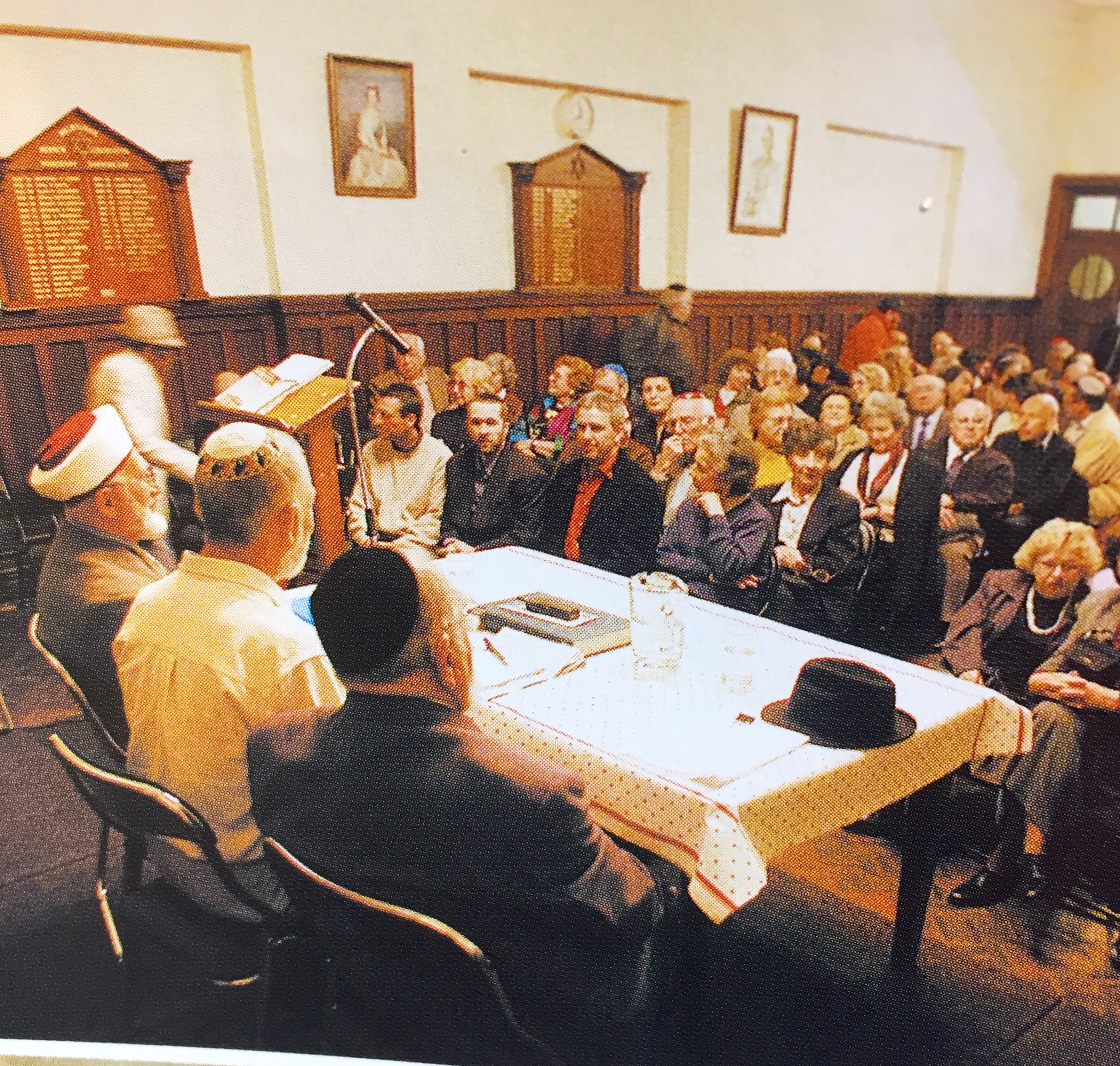
I met the Sheikh but once. It came about like this: my family has belonged to the Melbourne Hebrew Congregation since 1853. Like most members of that grand synagogue, I seldom attend its services, but I remain a member. Every so seldom the Congregation runs a communal cultural program. Around the year 2000 my brother asked me if I’d ask Rachid if he’d ask his Dad to join a Rabbi one evening and each would address the members on the question, ‘Do we Need to be Afraid of Islam?’

photos courtesy Destiny Magazine Melbourne Hebrew Congregation


I agreed, Rachid agreed and Sheikh Fehmi agreed. Were we foolhardy? I imagine we all heard the same challenge, unspoken, inescapable: if not us, then who? On the appointed night Rachid met me on the footpath and introduced me to his father and to his brothers. The brothers stood either side of their father. It was clear they were there to support him – and if need be – to protect him. The Sheikh wore a traditional head covering. One son wore a kaftan.
The clergy were to speak in the Social Hall. I offered to show the Sheikh the synagogue’s interior. He was interested. I found some light switches, we entered and I saw the place – a little emptier than usual – with new eyes. I took in its splendor and I sensed from the Sheikh’s reactions the Mosque in Preston was a more modest affair.
We went upstairs. The clergy were introduced to each other and to the audience. The hall was full, people were standing in the aisles, the atmosphere was intense. I saw faces I knew, some of them of people I knew to be mistrustful of Muslims. I was to be the moderator. I welcomed the reverend gentlemen and I reminded all present that the Rabbi and the Sheikh were our guests and I would insist we conduct ourselves on our shared principles of Abrahamic hospitality.
The rabbi spoke uncontroversially on the history of Jews and Muslims. The Sheikh spoke diplomatically on the principles of his faith. He explained the precept of Jihad: ‘Every Muslim must practise Jihad. Jihad, simply, is struggle. It is not warfare. It is, fundamentally, the struggle within to live a godly life.’ The voice that spoke these words was unemphatic, mild, genuine – a teacher’s voice rather than a preacher’s.


Questions followed. Mistrust found its voice. Fehmi never raised his voice. He spoke with quiet dignity. Abraham took a bruising that night at the synagogue, but his hospitality was not broken. Sheikh Fehmi’s bodyguards did not need to rise to his defense.
After our evening at the synagogue I never met Fehmi El Imam again. Later I askedWaleed Aly how the Sheikh was regarded in his community. ‘He’s a very gentle soul, widely respected, he wants a convivial relationship between the faiths in this country.’ I wondered how the Mufti avoided the sectarian conflicts of his diverse community: ‘Fehmi has been around as an Imam for some fifty years, he has an Order of Australia, he is very widely respected and highly regarded. He’s untouchable,‘ said Waleed.


Yesterday Rachid’s family lost a patriarch. His grandchildren lost their Jidoo. The Australian community lost a peacemaker. An asset increasingly scarce has passed. He leaves, within the breast of this infidel at least, an abiding resolve, a personal ‘jihad’ for peace and harmony. The Islamic Council of Victoria said: ‘Former Mufti of Australia, Sheikh Fehmi Naji El-Imam moved to the mercy of God this morning.’

Jim is Dead

December 18, 1969. A large moon rises before me in the geriatric wing of the Royal Hobart Hospital. This is unexpected as we are indoors and it is noon. The moon shines across the room in my direction. Beneath the bright disc sits a white clerical collar. Just below the disc’s equator a set of white teeth smiles widely. The smile advances, a pink fleshy hand extends and a voice says, ‘Hello. I’m Father Jim. I’m a chaplain here. Call me Jim.’ The hand is warm and kind. I am a new doctor. Today is my first day in my first job. All around me old people drool and gibber in a manner to overwhelm a new doctor.

The moonfaced Friar Tuck is delighted to meet Howard Goldenberg. He says, ‘You’re new here Howard? Welcome to the Royal. I hope you’ll be very happy here.’

Fifty metres distant stands the weatherboard shack which houses the new doctor and his new wife. The new doctor says, ‘Jim, will you join my wife and me for lunch? We’re going to eat soon. Fish…it’s an Indonesian recipe.’ Jim would love to. Thirty minutes later Jim and his new friends Annette and Howard are seated in the shack eating a luncheon of fish bones and curry. Jim fossicks for flesh among the fine bones, eats up and does not complain. And Annette and I have made the first new friend of our married lives.

April 6, 2016. My Facebook-facing daughter forwards the following:

Dear Howard, I am sorry to have to post a message like this via Facebook but I am sad to say that your good friend Jim Smith has died this week, here in London. My name is John and I am his partner, Jim & I met you in North London when you were visiting your family, I think in 2014. Jim had a stroke last year and I was caring for him at home, he had to go into hospital with a pulmonary embolus and then had complications which led to his death on Sunday. I know he always enjoyed his conversations with you, if you have any special memories you would like to send me I can include them in a JimMemory book I intend to put together. I will let you know when the funeral is, if you would like to light a candle and say a prayer for him.

PS RIP Jim! He was quite comfortable and free of pain (he had some back trouble) at the last. John

Jim is dead. Faster than tears an image flashes before me. I see a black and white photo in a family album of a moon-faced man seated outside our rustic house in a village outside Melbourne. The large face is crowned with a white handkerchief knotted at its corners. Upon the lap of the large man sits a small child, our angel Raphael, aged not many months. A perfectly ordinary image: no collar, no ecclesiasticals, no pretence; just a man nurturing a child. The image says enough. A man, a child. Poignant as a Pieta the image drives me from my screen to Annette. My voice disintegrates as I tell her the news. I ring my daughter who is tearful too.

Father Jim Smith married hundreds of heathen nurses to hundreds of pagan doctors in his days at the Royal. All those unbelievers flocked to this man who seemed to personify something missing from the lives of those science-infested people. But around 1990 Jim quit marrying. He said, ‘I marry them, they make vows, then they divorce.’ He felt the losses, each by each, personally. ‘It’s as if their marriage meant more to me than to them’, he said.

Father Jim introduced us to his partner in goodness, Jim Turley. Now we had two Father Jim friends. The two – together with a non-priest – created what might have been Australia’s first refuge. They called it St Michael’s Priory and to it flocked beaten wives, beaten children, lonely people, people mad and broken. All were taken in, housed and fed, and where possible, repaired.

The Priory rested upon the slender incomes of the three and upon donations from parishioners, who brought laying hens, a milch cow, produce – and a pair of Nubian goats. The Jims took us down to shed and showed us two sleekly beautiful creatures. Their coats of Nugget Dark Tan shone on the backs of their aristocratic bodies. Shy, their slender faces darting, their small ears rising and turning to sound, they looked like deer. ‘Meet the Goldenbergs’, said Jim Smith. He was addressing Annette and me, not the goats: ‘This one is Ruth and this is Naomi. They’re pedigreed. We were told we should register them. You could register them by name, so we chose from the Bible. Then Jim and I said, “Ruth and Naomi are Jewish names. Let’s give them Jewish surnames”. So we called them Goldenberg, after our Jewish friends.’

Years later Annette and I gave our third child a Biblical name. She became Naomi Goldenberg, named after a relative at St Michael’s Priory in Hobart.

The Jims used to come to our shack in Gore Street, for Shabbat dinner on Friday nights. They’d stand silently in their yarmulkes while I’d recite Kiddush. Afterwards they’d make a fair fist of translating odd phrases from the Hebrew, to which they’d been introduced during their studies in Divinity. One Shabbat eve one of the Jims – I don’t remember who – challenged the second: ‘Jim, I don’t sense you are making any effort at all to convert the Goldenbergs.’ The other Jim confessed: ‘That’s true.’ And the second Jim nodded and admitted he too was remiss. And one said: ‘I don’t feel any call to change the Goldenbergs.’ That moment love shimmered before us at our Shabbat table: two men of God had each found grace sufficient to deny abstract vocation in favour of human feeling.

Eventually Jim Smith left the Royal, left Hobart, said goodbye to the Priory and to his celibate brethren. It might, for all we knew, have felt like dereliction. Today I picture it as burnout, as an escape from accumulating vicarious trauma.

Jim took a job in Melbourne as chaplain at Pentridge. There his parishioners were prisoners and warders. He sat and he listened to their confessions and to their unconfessions, their lies and their rationalisations. One godless murderer habitually visited Jim on the pretext of spiritual need where he simply craved intelligent conversation. That man had forced his way into a hairdressing salon where he splashed lighter fluid over his rejecting girlfriend before igniting it. The woman survived her horrible burns. Her hairdresser did not.

An equally godless, notoriously brutal warder used to seek Jim out in the Officers’ Mess. He’d ask Jim, ‘Do you mind if I join you?’ Jim decidedly did mind but avowed the reverse. The man, loathsome and unctuous, habitually chose Jim as his companion. Jim couldn’t say which of the two – the murderer or the officer – he liked less.

On one occasion the murderer made a singular confession: boastfully he declared, ‘When we want to punish a warder, we do. We have our ways.’ Jim, genuinely curious, asked –‘How?’ He regretted the question instantly. The prisoner said, ‘We piss in their tea.’

Some time later Jim went to the Officers’ Mess for lunch, took his seat at an isolated table and said, ‘Yes, of course’ when the warder asked to join him. Shortly a prisoner arrived to take their meal orders. Jim ordered his lunch, the warder ordered, the prisoner noted their requests, then asked, ‘Beverages, gentlemen?’ Jim requested tea, the warder said, ‘Same for me.’

Jim sat and enjoyed the warder’s conversation until a second prisoner arrived bearing their food and drink. This prisoner was none other than the murderer. He handed Jim his food, passed the officer his, then said, ‘Here’s your tea, Father.’ He walked around the table and, standing a little to the side and behind the warder, passed him a second mug. Winking hugely at Jim he said, ‘And this is yours, sir.’ Jim sat and watched and kept his peace.

Once again Jim and we were living in the same city. Often he’d would join us at our Shabbat table and at Passover Seder and he’d report on what he called, ‘my time in gaol.’

Later, with his usual genius for vocation among the desperate, among those who were losing and those who were lost, Jim became chaplain to Intensive Care at a major Melbourne hospital. In ICU something like one patient dies of every four who enter. The rates of loss are higher than in a theatre of war.

Eventually Jim retired. Amazing us all, since he’d been resolutely republican and a pronounced proletarian, Jim settled in Britain. Here he found love, a partner in John, and diabetes – the lot of many Friar Tucks.

Every Passover and every Jewish New Year a letter would arrive addressed and written in the child’s block lettering that was the Jim Smith calligraphy. The letters told us of the Jewish roots of Jim’s belief. They’d include clippings from the newspaper columns of ‘my favourite religious writer, Rabbi Jonathan Sacks’, soon to become Chief Rabbi of the British Commonwealth. In his long London epoch Jim read widely and deepened his sense of following a Jewish Jesus. His pleasure in our friendship grew deeper and eventually he crossed the world to attend our eldest daughter’s wedding in Melbourne.

Jim lived with John, sharing travel with him as well as musical theatre, which he loved. A man great in his levity, Jim radiated a softness that healed, attaching him to old friend and to new. When I visited my daughter Naomi (the goat’s child) and her husband and children during their domicile in London, Jim, frailer now, crossed the great city with John for a visit. It was Shabbat and space and time had shrunk. Here was Jim, here were his old friends, here were our tender little ones. Jim was still Jim. The spark of joy still shone. But I wondered if we’d meet again. The moments passed.

And now Jim is dead.


Happy Concatenation

Mr Menzies, as he was then, used to report to Parliament upon his return from
The Prime Ministers’ Conference in London. He’d introduce his report with, ’By a happy concatenation of circumstance I happened to find myself in London for the Conference at precisely the time of the Cricket Test Match at Lords…’
I read this in the ‘Age’ newspaper and looked up ’concatenation’. I have kept the word close, generally unused, for the half century since.
 
By a singular concatenation of circumstance, today Jewish people around the world observe Shushan Purim on precisely the date of Good Friday. Yesterday we had the concurrence of Purim with Shrove Thursday; and the previous day the Jewish Fast of Esther coincided with the fast of Ash Wednesday. That’s how calendars concatenate.
 
By a happy concatenation of circumstance, while riding home through the park yesterday I overtook another cyclist, emerging into Commercial Road just as she did. From a long way back I saw first the yellow jacket. Gaining, I noted her tall, erect carriage in the saddle, her fair pony tail, her fair skin. Emerging from the park, with eyes only for the vehicular traffic ahead I had no time to sight her face.
I crossed the road and halted, waiting for the red light to turn. A voice emerged from a blur of yellow: ‘Howard? It is Howard, isn’t it?’ I had time now to take in that fair face, to recognise the features and that voice. A voice of a singular quality, a soft voice, with a sweet self-echo, as of a bell. I knew that voice.
‘Hello, Camilla.’ My voice would have carried surprise and delight.
‘Where are you heading, Howard?’
I indicated.
‘Me too,‘ she said, ‘I’m headed to St Lucy’s to pick up Joe.’
Our ways were the same and we rode together and caught up on the events of ten years: the growth of her son Joe (one of my babies), the decline and deaths of her parents and mine; and the premature loss of a brother, in each case only a little older than ourselves.
 
 
I told Camilla about Dennis. I mentioned the regret, my uncompleted mission, that marked my time with Dennis and that surfaces years after his dying, in my dreams. When I spoke of my brother’s dying Camilla’s face fell. Her voice a deeper bell.
 
‘I lost a brother too. I loved him.’ Camilla’s voice thrilled and her face shone as she spoke of her brother. ‘His name was Tom. He was a twin. He lived to forty-nine then he died. I don’t know what of. He was disabled. I loved him. We spoke on the phone every day. Every single day.’
‘What was his disability, Camilla?’
A smile, a half shrug: ‘Do you know, I can’t say exactly what he had and I don’t know what he died of. I suppose now you’d call it cerebral palsy. He was born with it. He was just my brother and we loved each other. We were together every day as children, back in the Mallee. Then I left and studied and moved interstate, but it was still the same. We spoke every day. I loved him. Often we’d speak a few times in the one day.
‘Tom was the second twin, you know. Second twins are often sicker…but you’d know all about that.’
I wondered about Tom’s disability: ’Was it physical or intellectual, or both?’
‘It was both. Do you know, I’m buying the old family home. In the Mallee. It’s a sentimental thing, a bit silly really.’ Camilla laughed: I’m buying out the other twin. I want the house. Tom and I lived in it, Tom lived there all his life.’
 
We arrived at St Lucy’s. Children thronged in the grounds, ignoring the scores of parents who waited outside. They played and shouted and pushed and grabbed each other in the high spirits of the coming holiday, while Lucy’s eyes searched for Joe and my mind played on brothers loved and lost. On a brother who called me every day, often two, three times a day.
 
Shouting goodbyes children drifted from the gates to their parents. A tall child, erect and fair, came into view. He greeted Camilla in a sweet voice, soft, with a sort of self echo.


[I wish readers variously a joyous Shushan Purim, a holy Easter, and always, always – happy concatenation.]

The Delinquent Chromosome and the Marathon Runner 

Most of us have no intercourse with our forty-six chromosomes. They perform their work honourably in intracellular obscurity and we leave them alone. Not so for my friend Manny Karageorgiou: his Chromosomes Numbers 13 and 14 have conspired to mutate. This mutiny came to light late in 2013 when he broke a rib without trying. He simply breathed or coughed or heaved a carton and the rib quietly cracked.
 

What Manny has tried to do – what he has managed to do every year for 37 years – is to run the 42.195 kilometres of the Melbourne Marathon. Manny is one of a tiny and diminishing band of brothers to achieve this feat. This, their 38th year, they number only eight.


When Manny’s rib cracked he consulted his doctor. In their shared innocence, patient and doctor initially believed they were dealing with a painful area in Manny’s chest, a mere nuisance, an impediment to running: and Manny had a marathon to run. The Marathon would call him. Come October Manny would obey the call and run. Always the Melbourne Marathon, always and only Melbourne. Athens too, has called Manny. Deep in his Greek heart’s core he hears that call. He feels aeonic tremors, he hears echoes across time of Pheidipides at Marathon field. Manny feels, he hears and he yearns to join the runners in Athens; but year after year that marathon clashes with Melbourne’s.


Manny could not run both. Melbourne held him: captive of his love for the Melbourne, of his obligation to its history, of his loyalty to his old comrades, Manny stopped his ears to Athens in October, he turned his back on the Aegean and, busted rib and all, he ran Melbourne. That was last year. For a period of time between the fracturing of the rib and that Sunday in October, my colleagues filled Manny’s body with poisons – thalidomide, dexamethasone, bortezomib – in their attempts to put down the chromosomal mutiny. The short term for that poisoning is high-dose chemotherapy. 


When I wrote of Manny’s marathon in 2014, runners from around the world responded in awed respect of the man who’d run thirty-seven Melbournes, and who’d prepared and run it this time with a diseased rib and a poisoned body.


All that was in 2014. Since then Manny has undergone autologous haemopoietic stem-cell transplantation. The chemical savagery of this procedure – doctors have to poison every blood-producing cell in his body – can cure or kill. It did not kill Manny. But the mutiny grumbles on, bones everywhere are eroded, they await their moment of innocent impact or small tumble. One crack and a marathon runner will have run his last.


Manny’s haemato-oncologist, a compassionate and scholarly man, forbids running. He knows too well Manny’s disease. My guess is he has never run a marathon, is innocent of the joy, has never known the intensity of that blood-filled, tear-filled passage through space and time to self-realisation. For his part, Manny knows little about his proliferating mast cells, rogue daughters of his body’s revolution; he knows less of the osteoclasts punching holes in his bones; and nothing of the dysregulation of an oncogene translocated to his perfidious chromosome 14. But Manny knows enough. He understands the doctors do not speak of cure, he accepts the unending medication, he understands the risks of running. But he takes the occasional light run.


I haven’t asked Manny, ‘Do you run to live?’ I sense that the occasional light run is the answer that Manny’s mind or body drives him to. When Manny asks this family doctor, ‘Do you think I can run the marathon again this year?’ – the question I hear is: ‘Am I permitted to live before I die?’ And who am I – captive of my own marathon dreaming – to deny Manny? I decide I will run Melbourne at Manny’s side.


***


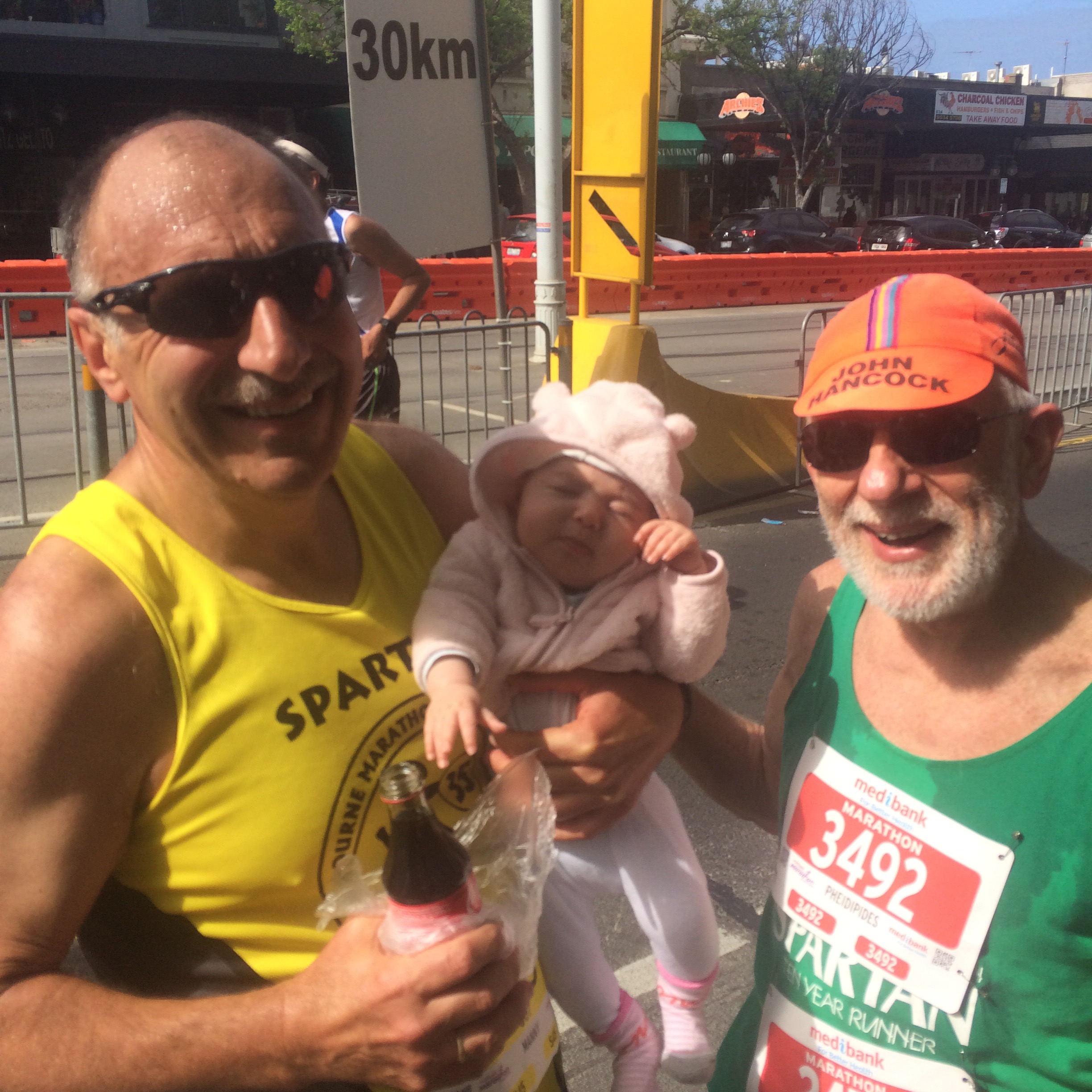
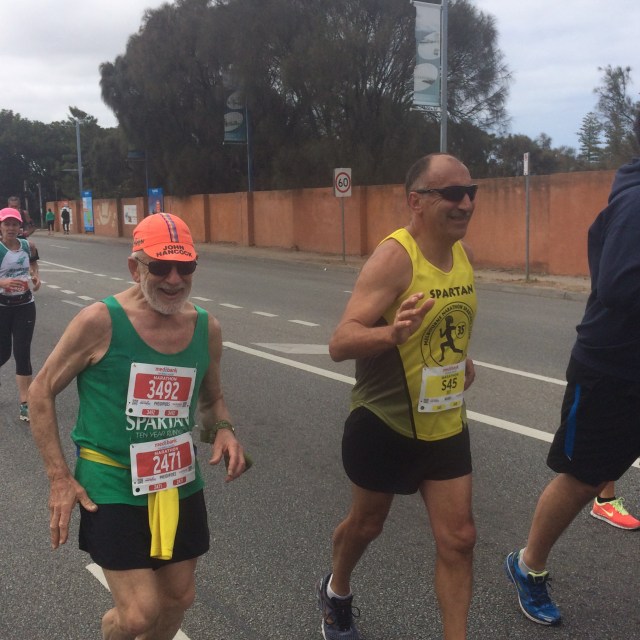
Lining up at the rear of the field of seven thousand dreamers before the Start, Manny implores me for the seven thousandth time: ‘Promise you’ll leave me behind once I’m too slow for you, Howard. I don’t want you to sacrifice your time for me.’ Manny never dreams he’s honouring me. But even before the gun sounds, runners reading the rear of Manny’s shirt salute him: ‘Legend!’ – they cry – ’Thirty-five Melbourne Marathons! Amazing!’ They clap him on the back, not realising Manny’s shirt sells him short by two marathons. Manny does not correct them. The same people spill glory and goodwill onto me in my Spartan’s shirt: ‘Go Spartan!’


A beautiful morning for running. Beneath low cloud a light breeze cheers and cools us as we snake along boulevards and run spirals through Melbourne’s parklands. Manny’s prudent pace suits me. I search for bodily pains to fret about. Nothing: silence from the supposed stress fracture in my left foot, nothing from the torn right calf muscle that I have rested from four weeks. The opposite calf sends alarms, but these are false. Pheidipides Goldenberg has no complaints.


Running half a pace behind Manny I take him in, not as the indoor person I have known, but Manny as runner. His build is not classic Kenyan: Manny is constructed of old materials, a series of chunks assembled one on top of the second. Impressive that he has lugged this unpromising torso through thirty-seven marathons. Projecting below that torso are the legs which are Manny’s secret. Beautifully muscled, elegantly defined beneath skin shining with vitality and sweat, Manny’s legs look decades younger than he as they pump smoothly, rising, descending, devouring distance.


Approaching the thirteen kilometre mark, Manny grinds on steadily, shouting out greetings to figures who come into view and earshot, his comrades, these, fellow members of the hallowed eight. To a man they look old. And calm. The marathon is their familiar foe. It holds no terrors, no surprises for them. Not for the first time, I recall Tennyson’s Ulysses as he looks upon his comrades:


Souls that have toil’d, and wrought, and thought with me –

That ever with a frolic welcome took

The thunder and the sunshine…

You and I are old;

Old age hath yet his honour and his toil;

Death closes all; but something ere the end,

Some work of noble note, may yet be done…   


With a cry of a different temper, Manny swerves, his voice joyous. He mounts the kerb, sweeps a good-looking woman into his arms, kisses her face, her hair. She pushes him away a little, looks at him searchingly. Satisfied, she smiles: ‘You look good, darling, you look wonderful. You’re running smoothly.’ The good-looking woman is Manny’s wife Demetra. She plenishes us both with cola and kisses, promising to find us again ten kilometres down the route. Manny releases his wife, takes a step, turns back, grabs Demetra again, crying into her hair, ‘I love you, darling’, and sets off again. I look down and try to deal with a lump that has risen in my throat.


Heading out toward the beach now we are bathed by sun and cooled by the breeze. Aaah, blessed day. The first Kenyan, having turned and now heading homeward, glides past us on air. Shouts of wonder rise from all throats as runners and spectators alike react to this shock of the beautiful. 


‘That’s my street there, Howard, Number 141. Please join me and my family at any time from 3.00. Bring your wife. Please.’ I want to join Manny and his family. If I finish in time I’ll certainly be there. Until now, Manny has spoken little while I have spoken more. A quieter person, he places one foot before another, repeatedly, steadily, and runs inwardly. I ask from time to time, ‘How are you going, Manny?’ ‘Not great. Not as good as last year.’ Not feeling great but not complaining either. As we swing out along the beach road and past Café Racer, a bunch of bystanders suddenly flows onto the road in our path and Manny’s face relaxes and falls into a wide smile. Hugs, handshakes, claps on Manny’s back, kisses on Manny’s face from two toothsome young women, and Manny keeps smiling and keeps on running. The interlopers pump sunshine up Manny’s arse and run alongside him. For the best part of an hour we run with the posse and through all that time Manny is smiling.
We come to the turn and the posse whoops and cheers as Manny turns for home. Manny is brother to one, uncle to a couple, second cousin to a few more, godfather to another. The kissing females are godson’s girlfriend and her girlfriend. The brother is shorter than Manny, genial, younger, rounder and pretty fit. He stays the distance for the full hour as do godson and one of the kissers. Others, out of shape or out of condition, fade away and re-join us later. Finally, with farewells, more clasps and shakes and blessings the mob falls away. ‘See you at my place, darling!’ ‘See you after three, Manny!’ The mob loves Manny and he them. Afterwards he tells me, ‘They’re here to meet me every year. Every year at the same spot. They never fail.’ A little later Manny says, ‘Dem and I are taking the whole family to Athens next year…it won’t be at marathon time of course.’

Increasingly I relish Manny’s invitation to join him and the family. These people run to the beat of a familiar drum.

  Back on the road, unescorted by Manny’s family, I have a question: ‘Manny, are you Manuel or Emmanuel?’

‘Manuel. They call me Manny. Also Manoli.’ 

Manny, Manoli – these affectionate diminutives are the aural furnishings of a life. Cushioned at every mention of his name, the man lives his life in relation, in connection, not alone, never – so long as these names are heard – alone. Back on the road, the solid road, returning from my abstractions, back with Manny-the-person I notice him struggling wordlessly. What silent erosion within his skeleton, what deposition of para-proteins in his kidneys, what mischief in his marrow, hampers this champion? Conversely (and most striking), how remarkable the redemptive effect of the loving presence of Manny’s family!


Around the corner and into Fitzroy Street where the crowds thicken and the cheering is a roaring without end, we allow ourselves a fifty-metre walk up the ugly little hillock placed here for the torment of the tiring runner. I reckon we’ve run better than two thirds of our 42.195 kilometres. Manny bursts into joyous shouting: ‘My baby! My baby!’ Emerging from the midst of the thronging cheerers is the adoring Demetra, bearing encouragement and affection and more Coke. And a baby! – their first grandchild. Manny cradles the pink bundle, adores her like a Magus. To me Demetra passes chocolate! I’m dubious about this; I’ve never eaten chocolate in the middle of a run. Will I like it? Will it like me? Too late – it’s melting in my sweaty paw. Now it’s inside me, followed by a bottle of Coke. Supercharged with caffeine and sugar and fluid I am invincible. In Demetra’s arms, holding his pink grandbaby, Manny looks the same, but once around the corner and out of sight, he looks and feels utterly vincible.


Around the corner now and into St Kilda Road, the broad thoroughfare closed to traffic in honour of us marathoners. The sun shines, the day has warmed, everyone who is not running enjoys the balm. Runners enjoy the painful raising of knees, the heavy hurt in the thighs, the weight of weary, weary bodies that started running almost four hours ago. The 32 – kilometre sign tells us there are only ten kilometres to go. Only ten kilometres to go feels to a runner as welcome as only ten more years might sound to a prisoner serving life. The experienced runner knows the second half of a marathon starts at 32K.


We plod in the sunshine. The field has thinned as faster runners leave us behind and others – the broken, the breaking, the bleeding, those limping – fall behind us. Here to one side of us, runs Eeyore, a young woman from England. She runs smoothly ahead then stops, bends forward in apparent pain, and breaks into a slow walk, and soon she is at our side again. Eeyore replies to my clinical enquiries morosely. I encourage her, I pump sunbeams, I tell her she should be proud. I should shut up and allow her to enjoy her misery. Eeyore and Manny and Pheidipides keep company intermittently until the final few hundred metres. Just ahead and to our left runs an aged, arcuate Japanese runner. His age might be anywhere from fifty to seventy. He clings to a line, a crack visible in the road’s surface where one layer of tarmac meets its neighbour. Dourly, silently, mute to my greetings, his spine twisted into a boomerang convex to the left, Japan runs the lines. His speed is no better than ours but I bet he could run all the way to Hokkaido without stopping.


A soft sound issues from the female who runs half a pace ahead on our right. The slight sound recurs – the grunt of a person in pain? – pulls me close. No not a grunt, it’s a moaning, the woman’s lament for her suffering self, her threnody sung for self-comfort. She’s about forty, shapeless, pale, a moving emblem of tortured humanity. The moment brings me back to the Olympic Marathon (I think it was at Barcelona) where a Swiss or French runner, whose name I seem to recall was Dominique Something approached the Finish. No-one who witnessed the sight of this tall, thin woman, faltering and staggering in her final lap of the stadium will forget her in her extremity. The brutally hot day, the merciless steeps of Monjuic in the approach to the stadium, the criminal timing of the event in such heat had all but undone her. She lumbered into view, slowed, stooped, seemed to recover herself and advanced. Time and again she seemed at the point of falling. Officials were seen to move toward her, then to retreat. Appalled viewers on screen and in flesh begged wordlessly for it to end, but Dominique stumbled on. Twenty, thirty metres from the Finish she fell. Officials came to her aid and in so doing ended her chance of completing the Olympic Marathon. It is Dominique whom I hear now as this woman moans.


It is no disrespect to acknowledge that we belong to the dregs of the marathon world: among the select who run marathons, possibly the most resolute and vigorous of people, our sub-group group is the most enfeebled. And all the more honour to us who persist. On we go, pausing for drink every three kilometres, enjoying the excuse to walk twenty, thirty metres. Then up again with weary legs, up and back into the slow steady tread that our heartbeats allow us, that is all our breaths and our body salts and our fluid reserves and our moral reserves can support. We walk, we pause to walk thirty guilt-free walking paces, then on again we run, and on. Manny and I negotiate small contracts: we’ll run without stop to the top of this short rise, then we can coast down the farther side; we’ll run and not stop until we reach the next drink stop, then we’ll reward ourselves with cool fluids and a splash of water; we’ll run now and will not stop until we reach the MCG, and then…


We enter the great stadium side by side. The huge grandstands tower about and above. We insects crawl the margins below. At my left Manny says, ‘It’s magnificent, isn’t it?’ It is, it is indeed. We swing our arms, pumping our reluctant thighs into action, we raise our heads, then hoist ourselves onto our toes for the final 150 metres. Two aging men, one with an intact skeleton, the second much ravaged, swing around the bend. We pass the bent man from Japan: his face, transmogrified, is a rising sun; and Manny and I are sprinting, and sprinting we fall across the Line.
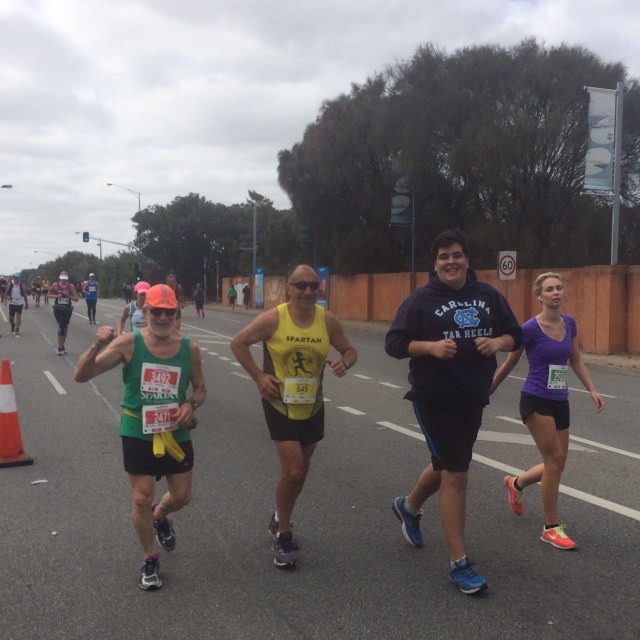


POSTSCRIPT: I have written elsewhere of my inadvertent double entry (and double payment) in this year’s Melbourne Marathon. I duly wore two bibs – each with its distinct number – and with them, both electronic timing chips. I had speculated that Pheidipides Goldenberg might record a finish in both last and second-last places. If you google Melbourne Marathon Results 2015 you will see how closely I anticipated the result. And you’ll find, ahead of me by one second, Manny, Manuel, Manoli Karageorgiou. 


I Tried to Drown

I tried to drown my enemy last night. I thought he and I might become friends. He seduced me, and I fell. I told myself he was the apple of my eye. I knew what I was doing, I saw behind that gleaming façade the black tunnel and the signs that warned me, give up hope all ye who enter here.
I dressed him in candy pink, the better to declare to him and to all who beheld us together, this is unnatural, this is absurd, we do not belong together…I made him look ridiculous the better to ridicule myself.

Early in our – what was it? – a friendship? – an affair? – he showed himself in all his treachery. Yet I could not put him to one side.

I had, I knew, sold my soul. I had no recourse to a Divinity, no-One to pray to.

I spoke to my friend, saying:

Wert thou my enemy, O thou my friend,

How wouldst thou worse, I wonder, than thou dost

Defeat, thwart me?

Lying in the bath last night, pleasuring my marathon-weary muscles, my friend called me. I reached for him with hands all slippery. My friend was in my fallible grasp, at my mercy. I dropped him into the waters, to his fate.

Some time later (I cannot say how much time had passed) in an act of mistaken morality, I hoisted him from the depths. I shook him a little, dried him perfunctorily, turned my back on him and plunged my face beneath the waters to remove the soap. I had done with my bath and I had done with my friend.

I emerged and I dried myself. Just then my i-phone rang and I knew I had failed to drown my enemy.


I No Longer Know my Country

I Left Home a Few Days ago and When I Returned it wasn’t there

Australia is my home; it has been since adventurous forebears from England and France arrived in the 1840’s and 1850’s, and desperate forebears came in the 1890’s. Nowadays we might call these people economic migrants and queue jumpers.
I flew from my home country last Thursday and returned yesterday morning. I read the paper and I knew I was no longer at home. My home had gone. I might never get it back. What had changed?

Border Force to have up to 6000 armed officers

Border Force in Australia sbs.com.au

Border Force in Australia sbs.com.au

I read the headline. I didn’t understand it. This Border Force would be deployed not on the border but inside my home. Most of its officers would be armed, many already are ‘trained for use-of-force operations.’ I sat and I wondered: what ‘operations’ inside our borders do they contemplate? Against whom are they armed? Who is the enemy within?

In the home where I used to live people trusted each other. We were different and we were OK. Some of us were very different indeed: in the small country town of my boyhood a sole Jewish family lived, trusted and trusting. That family was my own. Trust was rewarded, we were neighbours, we became friends, we knew each other and we were citizens together.

In the home where I became a father I met a man who was extremely different. He was the son of a Muslim cleric who went on to become Mufti of Australia. The father worked for amity and respect between communities and became a Member of the Order of Australia. The son, a ratbag or scallywag or black sheep or white sheep, became my friend and danced at my daughter’s wedding with the then President of the Zionist Council of Australia.

All that took place in Australia, which used to be my home.

On September 11, 2001 the world changed. Three days later the Melbourne ‘Age’ reprinted an article by respected Israeli journalist and novelist, David Grossman. Grossman had witnessed the effects of terror within his own community. He wrote that terror’s greatest victim is trust between citizens. When you believe your neighbour might wish to hurt you, you cease to trust her; you cannot afford to trust. Grossman predicted in 2001 we would see that erosion of communal trust, that injury to community.

Grossman’s prophecy has well and truly come to pass. Ironically, in Australia’s case, the principal destroyers of trust have been politicians who promote fear recklessly. We have a government led by a man who acts like a boy who swoons at the sight of a uniform.
Little by little, day by day, our masters in government – as well as the odd mistress – attack trust. The headline in the paper on the day of my return to my homeland appears below another: Transfield to remain at Nauru;
and alongside a third headline: Yongah Hill detainee hurt after incident of self-harm

All of this is relegated to Page 8. In this country that used to so welcome the stranger it is no longer big news that a private corporation be rewarded (at a daily cost of $1500 per head) for its systematic unkindness to inmates. This is not news. This is policy. As is ‘turn back the boats’, the policy that hath made my name to stink upon the earth.
In this place that used to be a home a man who cut his throat in detention is hospitalised, then returned to that place of detention where he ‘is receiving appropriate medical and mental health support and care.’ In that place his doctors and mental health carers risk two years of gaol if they report on that ‘appropriate’ medical care. I know detention. I sewed my lips, I accepted overpayment and I worked as a doctor in detention.

But in the place that used to be a home nothing like this is news.