A Gift from a Dead Lady

Ruby came into my life three years after my mother died. Mum would have loved this newest baby, not just because of her unruly, abundant hair; not only for her full moon abundance; nor for her kookaburra laugh alone; but because Ruby is of a rare species, a female.

Most of Mum’s kids were boys. And she loved us even though we were boys.

My brother Dennis was Mum’s firstborn, a peach-faced baby with golden hair. Adored, but a boy.

I was next, a truly lovely child, I often said as much. And Mum agreed. But still, a boy.

On Friday evening May 13, 1949, Mum came into labour a third time. The rains came, the river broke its banks and in the next town of Narranderra, Mum’s doctor was stuck in his shrinking island in this Riverina sea.

Mum laboured on. The Sabbath came. Dad lit the Shabbat candles and went to the hospital where he delivered Mum’s third baby.

The next morning Dad read in the paper that a resident of our small town had won the lottery.

Full of the news, he hurried to Mum in hospital: ”Yvonne, a Leeton man has won the Sydney Opera House Lottery.”

“That’s nothing. I’ve got a girl!”

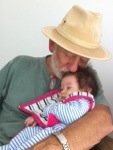
Last December our thirdborn gave birth in a hospital in Bristol. My wife was present but I was not. Thirty-six years previously I had delivered that thirdborn, a girl. Now she had borne a girl, Ruby. One of Ruby’s Hebrew names memorializes my Mum.

I met Ruby about six weeks ago and spent three weeks loving and learning her. Since I parted from her, Ruby has learned to laugh and to suck her thumb. She is the smartest kid of the present century. Mum would have loved her.

(If you look at this little movie you’ll fall in love too.)

My Mum would have burst with love for Ruby.

But Mum died. She left little pieces of beauty, bits of jewellery she gathered here and there during a long and travelling life. These lovely things have found their way to her female descendants as keepsakes.

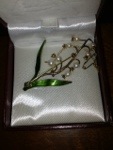
One item, a small brooch of enamel and pearls, wanted a claimant. I saw Ruby, I came home and found the brooch. Then I remembered Mum and how she was about little girls.

If, one day, a score of years from now, you happen to bump into a plum-cheeked young lady with disobedient hair and this brooch (see link) in her lapel, you’ll know: this is Ruby; her great-grandmother would have loved her.

Copyright Howard Goldenberg, 28 April, 2013.
20130428-163421.jpg

Ruby My Love

Crossing the world to meet Ruby, to feel her feel, to smell her smell, to catch her smiles, to hear her voice – her voices actually; meeting this newest granddaughter after she and I have waited for each other for three months; holding her close in her crying moments, in her moments of calm, watching her slow smiles of pleasure as she fills a nappy; hefting her little body, laid prone along my forearm; bathing with her slippery-smooth pink body on my lap; whispering, crooning, humming, singing silly sweet nothings to a bundle whose gaze meets mine only fleetingly.
With her barely four kilograms, this small potentate holds me hostage: she reduces me with a cry, with a smile she plenishes my wrinkled life with freshness.
All this, in the Festival of Spring in the holy land, where Ruby and we, her suitors, estivate.

20130326-060328.jpg

In the Poo and Out of it

Dennis and I are playing in the park in Wade Avenue. The trees are
bare and the air is cold. Mum has dressed me in a pair of overalls in
a heavy woollen fabric to keep me warm. The pants chafe my legs
pleasantly. The overalls have a chequered pattern in reds and greens.
We run across the park to its middle where the playground equipment
awaits. Our breath comes out in clouds.
We run to the see-saw, play for a while, then to the swings, then to
the roundabout. This is a heavy timber affair, a circular platform set
on some invisible centre so as to rotate with children aboard. There
are metal handrails that you hold on to while the roundabout goes in
circles that never end, so long as someone is pushing. When Dad pushes
you spin very fast and you need to hold the rail or you’ll fall off
onto the sand.
Today Dennis and I and Christopher Payne and his older sister are
riding the roundabout. There are no grownups so we have to push as we
ride. You hold the rail with both hands and you run in circles in the
deepening groove dug by pushers’ feet. My hot breath clouds are coming
faster, the roundabout is whirling, my head is spinning, the big kids
are too fast, the rail is almost yanking me off my feet as I leap
aboard at the last minute and taste the dizzy drug of motion.
Then, as we slow, it is off again and push, run and push, my breathing
a hard burning in my chest, racing, keeping up with the big ones, then
once aboard again, giddy, floating, trees and faces and shapes
blurring as they whiz around me.
The afternoon is darkening. Hot and happy to be accepted by the big
ones, I pay no mind.
Something is hot inside my overalls. Something is different: I can’t
feel the chafing. Instead there is a sensation that I half remember. I
understand what has happened but I don’t want to know it. I wait a
wordless moment, then get off and walk carefully away in the direction
of our home in Wade Avenue.
My walking is slow. Although I want to be away from here, away from
the other children, away from everyone, I do not hurry because I
cannot. I have to walk that slow, peculiar, wide-legged walk as my hot
legs send their messages of disgrace to my amazed mind.
The big children are calling out, calling my name, but I don’t turn
around. I hear Christopher’s voice and his sister’s. Loud questions.
Dennis says something in reply. Their voices say things that I cannot
make out as I keep walking. I hope, helplessly, that no-one follows. I
won’t be able to run away from them.
Here is Wade Avenue. The street lamps come on but they do not yet
penetrate the darkening. I am glad of the dark.

Mum comes to the door, the house bright behind her. I don’t know what
to do. I know what to say but I don’t want Mum or me or anyone to hear
the words. I stand and Mum is cuddling me gladly, now cuddling me
differently as she realizes, now helping me to the bathroom. Only when
we are inside that small room and the door is closed does she remove
her enveloping arms as she turns and runs a bath.

Somehow Mum has got me out of those loathsome overalls. They lie on
the floor, red and green and unbearable. After today I will never see
them again.
Mum lifts me into the bath, stands me with my back towards the tap as
she paddles warm water against my skin. Her hands are firm as she
applies soap and warm water to my bottom and my thighs. The hands go
everywhere they need to and I look out and not down. I look out,
across the narrow room, away from the overalls and succeed in seeing
nothing.
Now Mum is sitting me down in the bath and I allow myself to see. The
bathwater is clean, I am clean, the soap smells nice, Mum’s hands are
on me, soft and present.

Has Mum spoken? Nothing has been said about my disgrace, nothing about
the check pants. Nothing spoken, all is known and understood. I am in
clean pyjamas, redeemed.

***

Do my hands remember? Does my skin recall the touch, the knowing care,
the rescue?

***

Forty years later, following stroke after stroke of havoc inside the
vessels of Mum’s brain, she and I are once again in the bathroom.
Stronger hands help to lower and to raise a weaker body. Skin to skin,
they clean here, dry there, restore Mum to order and presentability.
From time to time over seventeen years this joy comes my way. It is a
job that calls for concentration but I never have to worry about
dignity. Mum has her dignity. It is inseparable from her.

Copyright howard goldenberg, 24 june 2009.

Twenty Swear Words

I celebrated my 67th birthday recently. By the age of 67 my vocabulary should be just about complete: now that I’ve reached the age of forgetting, I’m not likely to remember new words.

But my eldest grandson believes otherwise. His present to me was a list of words that Shakespeare coined. He thought I’d appreciate them. He tells me they are swear words.

I drove that 10-year old and his seven-year old twin brothers to school today. In a chorus of loving name calling that began with the familiar “Captain Big Nose” they quickly turned literary.

“You Huge Hill of Flesh!” was something to contemplate.

“You Huge Bombard of Sack!” had me looking down to my lap.

“You Swollen Parcel of Dropsies!” was pleasingly clinical and accurate. My calcium channel blocker does in fact cause me some fluid retention.

“You Prince of Wales!” puzzled me. Surely no insult, unless we are supposed to hear Prince of Whales – the prince being the Sperm Whale – and the ejaculation some sort of perverse tribute. As I frowned in contemplation of the words of the Bard, the three kids were helpless with hilarity. This epithet somehow became me. The more they chanted “Prince of Wales” the funnier it became and the more we all four enjoyed it.

Eventually the ten-year old Shakespeare scholar moved on to “You Bull’s Pizzle!” He realized from my facial expression that this was a winner. Once they learned that the pizzle was the phallus of a farmyard animal (famous as the projectile with which Jude woos Arabella in the Hardy novel) they wouldn’t let it go.

I was a Bull’s Pizzle all the way to school.

As they dismounted from the car in high good spirits, they added “You Foot-Licker!”

I farewelled each with a kiss and “You Vile Standing Tuck!” – the last word from Captain Big Nose.

20130214-215901.jpg

Ruby

There you are on my screen, your face round and red and glowing.
I can see your fleshy cheeks, your extra chin.
Now you settle into your mother’s breast. I see your profile, your
pink ear, your welcome mat of thick black hair.
You are quiet, quiet, seen on my screen, seldom heard.

You arrived magically on the far side of the world in a land of short
dim days, days of rain and chill. In Australia, your grandfather –
this stranger grandfather – sweated and read dread warnings of
bushfire risk.

You are in the right place: your mother is your address. I sit in this
far country that will be your country, and I am not myself, not my
proper grandfathering self. My fingers have not touched your skin. My
eyes have not followed the rise and fall of your breathing. I haven’t
smelled you, haven’t heard you burp, seen you cry. I haven’t run a
soapy palm across your tummy.
Although I am a skilled and fearless nappy changer, I’ve never changed
you, made you fresh and clean and dry.
I should do these small intimate acts, then give you to your mum. She
will hold you and I will put my arm around her birth-swollen body;
I’ll rest my old cheek against her and I’ll feel again the newness of
flesh of my flesh of my flesh.

I am a pretender, Ruby. I await my time, our time.
I am not real.
When I see you I will run my finger beneath your chins and feel the
warmth of that soft cushion of flesh. I’ll rest you across my rocking
forearm, I’ll sing you my silly soft songs, I’ll feel your mass and
your space.
And you will make me real.

Wedding Rings

A voice says will you marry me?

Annette looks up in surprise – I am a bit surprised myself: where did that voice come from?

Annette says are you joking?

The voice says no, Annette says yes, and a week or so later we are buying a ring to make the meaning of our voices concrete.

A few months later, our voices exchange promises before witnesses, and we exchange rings to cement the promises.

I have never worn a ring before. In my family, real men never wore rings – were we too modest, or simply too poor? – I don’t know. There was certainly a feeling of disdain for ostentatious jewellery. The ring that Annette gives me is a narrow band of white gold, quite weighty for its modest size. It is a discreet, silvery statement of love and commitment. It feels fine and it sends a message to all from Annette that she claims me. The inner surface of the ring is engraved with my name and the date, 3.12.69. This is the date that marks my movement from my family home and ways into a new way.

But surgical asepsis allows no concessions to love and marriage. I am newly wed also to medicine, so the ring comes off for every surgical scrub in the operating theatre and for the delivery of every baby in labour ward.

And I slip the ring off my finger every morning for the ceremonies of worship: I wash my naked fingers before prayer, then wind the leather strap of tefilin around my left fourth finger while reciting the threefold declaration of betrothal to the Creator.

After these rituals the finger is ready to resume its conjugal connection to Annette. I slip that silvery band back onto the finger with a feeling of conscious pleasure.

On the seventh morning of the month of December in 1976, I take that ring off for the last time. I place it on the shelf in our bedroom, wash and say my prayers. Hurrying away to work, I leave the ring on the shelf. I never see it again.

When I return to my destroyed house a few hours later, the exploding hot water service which sat for years in dutiful silence beneath our home has torn, enraged, through the floor, through the ceiling and through the fabric of our lives. The bedroom is unrecognizable: there are no horizontal surfaces, no shelves, no ring.

Annette and our children are intact, we are all intact, the three goldfish – Shimmy, Pizza and Coco-Pops are all intact. This is no time to grieve for a ring.

Twenty years pass, the children are adults and the goldfish have gone the way of all flesh, fowl and fin.

My finger itches again for the trappings of marriage, so I buy a slim band of white gold and wear it. The world at large makes no comment but Annette marks my wearing of the ring, and understands.

A few years later, the second ring falls while I am praying, onto the floor. My search for it is anxious then rapidly frantic. I find to my surprise that I am sobbing as I bend and scrabble on the floor for a small piece of absence surrounded by an annulus of gold.

That little circular symbol of the big fact of my life is never found. In its place is rediscovery of the intense nature of my commitment.

Some fingers never learn. After 32 years of marriage, the fourth finger on my left hand demands a third wedding ring. My friend Colin is on his third ring and his third wife: he has three mothers-in-law and he has earned his jewellery.

In my case, I still have Annette and I wish to show that fact to the world. So I buy a new ring.

This ring is heavier and tighter – harder to lose, but also harder to pull off and to put back on. This is no simple sensual pleasure, no slip off – slip on, but a struggle in which three fingers from the right wrestle with the left fourth. Before every scrub, before every morning wash and prayer, I shed some skin on the altar of marriage, a small sacrifice of my flesh. After twelve months of the third ring, my finger is scarred. There is a cicatrice, a ring of flesh which is permanent. This is a ring which no-one can remove and I can never lose.

It looks like I am married. For good.