Running with the Cows

One foot in front of the other. That’s how you do it, this running business. It’s not complicated, it’s not even hard, so long as you don’t do it too quickly or too many times. In the marathon I need to do it 42,185 times. My car finds that distance tiring and so do I. But Traralgon is where I ran my first marathon and – on a later occasion – where I ran my quickest. I try to run Traralgon every year. One of the many things I like about the event is the small field, which allows me to boast, ‘O, Traralgon, yeah, I finished in the first one hundred’.


In 2017 injury saw me miss the fiftieth running of the Traralgon Marathon. I was sorry my legs would miss out on history. The event is Australia’s oldest and it’s also The Victorian Country Marathon Championship. In 2018 I trained, I paid my registration and I injured my knee again.  Once again I missed out. But last Sunday saw me fit, I was new again, keen, and running faster than I have for five years. I had lost weight, I’d trained hard and consistently, I felt invincible.


The marathon taught me something I should have known: I am vincible.


I brought my own support team along. Philbert Kayumba from Rwanda is a natural runner. Being on the run from genocide brought him to Australia as a refugee, and Australia grabbed him, and my family grabbed him. Toby Wundheiler is my skinny grandson. He loves running almost as much as he loves his Saba, Pheidipides Goldenberg. The two believed in me, I believed in me, what could go wrong?


The lady at Registration peered at her spreadsheet and answered my enquiry: there are 105 starters in the full Marathon, she said. This was the first augury: I would have to beat five, or they’d have to get lost, or pull out or expire, if I were to finish in the first one hundred finishers. I looked around me at the start and I did not sight anyone who looked slow enough for me to beat.  


At the start I heard a couple of blokes speaking in refined accents, their English correct, grammatical. Must be foreigners, I deduced, and indeed they were. They were veterans of many Comrades Marathons. The Comrades is an event run over an appalling ninety (90!) hilly kilometres in South Africa. Respect! These boys looked stronger than their estimated fifty-odd years. We fell into conversation and the kilometres flew beneath my feet. A sparrow flying with eagles, I ran surprisingly fast, fatally fast. By the time I reached the 11-kilometre mark, the Comrades were well ahead, still in sight, if out of earshot, my breathing was hard and my legs felt tired. Only a quarter of the distance run and I had shot my bolt and I was not Usain.


Afraid I’d ruined my marathon, I took stock and nourishment. My nourishers on this occasion brought Coca Cola and belief. The nourishing duo were Toby and Philbert. I blessed them and heaved my frame into motion. Now the marathon looked better and felt better, as the route left the paved roadways grey and followed the rail trail. The trail is paved with gravel that springs the tired leg and cushions the sore foot. It runs through the native bushland that fringes the pastures. Amiable cows watch and munch and splatter as the runners pass.  A lone human now, I spent some time running steadily in bovine company; the cows and I established a comfortable fellowship, no words needed.


An apparition in red, a young woman, announced herself: ‘Hello, I’m your sweeper.’ The voice was sweet, the smile friendly, but I knew dread. The sweeper is the official who sweeps clean the Marathon Course of runners, once their allowed time has expired. Her arrival meant I was running in last place. She would keep me company until the fatal hour. I’d need to reach the Finish before 1.00 pm or I’d be swept. Sweep Lady introduced herself: I’m Vera. I told Vera I was Pheidipides. Vera looked at me jogging along. You’re running well, she said. Would it be rude if she asked me my age? I told her my age. You’re amazing, she said. In my turn I questioned Vera. She’d run Traralgon a number of times, finishing around three-and-a half hours. Today she’d volunteered, giving away her own swifter marathon in favour of the slowest.  


Vera spoke proudly of her daughters, aged 17, 14 and her boy, 11. All were mad about sports, the elder two being elite junior netballers. Vera drove the eldest to training in Melbourne two days a week. She didn’t mind spending four hours on the road. She was happy to keep doing it, until the day she says, ‘I don’t want to do this anymore’. Then we’ll stop, no pressure.   


A second red blur appeared in my lateral field. The blur rode a bicycle. She introduced herself: I’m Lucy.  Lucy too had given up her marathon to share the sweeping duties. Had Lucy run Traralgon before? Sure have. I won it seven times.  My interrogation of Lucy revealed she held her Age Group World Record for a 200 kilometre race. A few of my records have been beaten, but I still hold the two hundred. Like Vera, Lucy taught at a local school. The two chatted about mutual friends. Maxine was doing better now her daughter was recovering. Therapy had made all the difference. Madeline was running today, the 10 K, not the marathon. She’d given that up to referee the hockey. Young Robert had been stood down by his school. Despite warnings, he was out. You couldn’t push a classmate into the urinal, you couldn’t pull his pants up while he was taking a pee. No respect. It didn’t make it better that the urinating victim was African. You need to have respect.


Kilometres passed pleasantly. So and so had a new job, closer to town. Such and such was working night shift at the hospital which allowed her to help the littlies at school with their reading. A third friend ran the Fire Brigade Coffee Truck. He gets up early Saturdays and Sundays and drives the truck to the local footy – both sexes, to the local soccer – girls and boys – to the netball, the basketball, then the AFL in the afternoons. The profits from the coffee truck go to buy musical instruments form the town Junior Band. The cows and I listened and learned.  


Even tired old legs retain some pride. My legs were tiring, certainly they were old, but here were Lucy and Vera, a pair of runners who’d dedicated their day to the slowest of all. Fleet-footed and vital, these two would recognise my flaccid morals if I stopped. I kept going, sustained by pride, bemused by gossip that spoke only good of their fellows.


A noise up ahead, a flash of black flesh, cries of Saba! Saba! You’re awesome, Saba! And Saba was me and the noises were Toby’s and the flash was Philbert. More Coke, more embraces, more sunshine pumped up my bum, and here we were at the turn, at the halfway point.
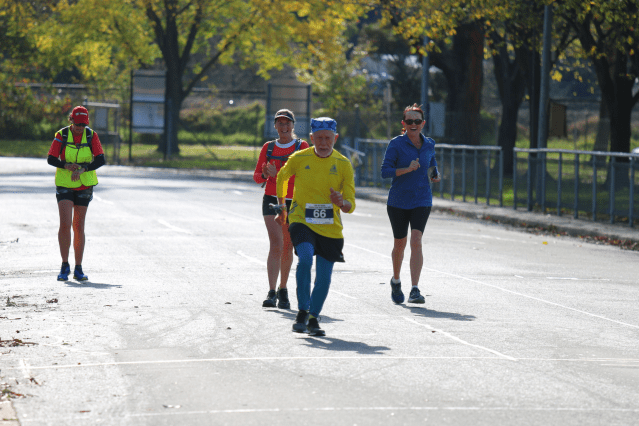


Phil and Toby saw me around the turn, where the Marshall cried, Pheidipides!  Pheidipides Goldenberg! I recognised Barry Higgins, this marathon’s historian. His splendid book, ‘In the Long Run’, records the history of this event and its fifty famous years. 


Toby loped and leaped at one side, Philbert glided at the other. I knew no pain. The halfway mark signals good tidings to the runner; the mind realises every step now leads shortens the road to the Finish; the legs know they can do it. The reality of twenty-one kilometres remaining somehow weighs less simply for having turned for home.


Toby announced: I’m going to run with you to the three-quarter mark, Saba. It’s only ten kilometres. He darted ahead. Vera observed, you’ve got a lovely grandson there, Howard. Lucy remarked, not quite beneath her breath, and your son Philbert’s hot!  ‘Yes, they are’, I agreed.  Hot Philbert left the gravel to retrieve the car. Lovely Toby ran on until, one kilometre later, he sighted the car and decided he’d keep Philbert company.


More of the same. Step followed step, perhaps a little slower. The sun shone palely, I discarded gloves, then a shirt, then a singlet. The legs found a rhythm they could tolerate, my brain separated itself from pain; I was spending time in pleasant company, passing though the wintry green. At some stage I must have fallen silent.


I heard a question. Someone was asking, are you retired, Howard?  I answered Lucy, who then asked, so you know all about the heart, then?

No.

Lucy pressed on: Have you heard of arrhythmia?

I had.

We had a long chat about arrhythmias, how a runner’s heart muscle might be strong enough to run two hundred kilometres in record time one day, but beat so irregularly the next that running was impossible. But arrhythmias could be treated.


Vera spoke of her youngest, a boy born dangerously premature. They’d prayed for the little mite. He was too sick for the local hospital and ambo’s speeded him to the Monash Children’s Hospital where he pulled through. Ever since, the little fellow had lived his lively life in a body small and frail; it never occurs to him he has a disability. Never mind he has to spend periods at home, never mind that he too is prey to a parlous heart irregularity – all the other kids played sport, so would he. The reality of a brave boy, running the marathon that is his life, made my own marathon a small affair. I was a child, running was my play; Vera’s child on the other hand, runs to the ‘Wall’ every day.


I listened to Vera and to Lucy and thoughts of fatigue never broke through. What was tiredness? Some petty experience, not admissible, lacking substance. Assuredly I was slowing all the time, but the sweepers assured me I remained a legend, I was certainly awesome, thoroughly amazing. You’ll easily arrive before they close the course. You’re way ahead, said Vera. I looked at my watch, but by this stage I was incapable of computation.


A small black car peeped between the bushes, and here, in a flurry and a roaring were Toby and Philbert bearing love and belief and Coke and a Mars bar. We’d reach the three-quarter mark. Numb in the brain, sugared into foolish cheerfulness, I picked up my feet and plodded on. At every road crossing and at every aid station, we found volunteers. I’d salute them and the sweepers would dismiss them: You’ve done your job. Thank you, thank you all. This man here is the last runner. I might have wept for thankfulness.


Off the gravel now and onto those pavements grey, as Yeats called them. Up a hillock, down another, head down, a dour business. Abruptly a pretty lady in blue burst into my threesome. She flung herself into the arms of my companions. Boadicea! How did you go, Bo?

Personal Worst.

You’re kidding! Boadicea, meet Philopities! Or Howard. He’s a legend. Ask him how many marathons he’s done.

The young lady in blue asked me how many.

Fifty two. This will be fifty three.

Boadicea affirmed I was a legend. I knew she had that back to front. I concentrated on not falling over and I said nothing.


We ran on. Four kilometres to go, four nasty, mean kilometres, each one of them longer than the one before. 

When a man’s afraid

A beautiful maid’s

A cheering sight to see. 

The lines from The Mikado bypassed my brain and came to my lips and I heard myself singing in the empty back streets of Traralgon. The ladies looked at each other. Charitable souls all, they said nothing.


Thus inspired I ran on. I knew I’d find Toby and Philbert in the final kilometre. We twisted and turned in empty back streets that quite befuddled me. Sandwiched between my colourful escorts, I followed wherever they led. I was a dumb machine, a mechanism of bone and gristle and muscle, an automaton untroubled by thought or pain. One limb faithfully followed its fellow, mine was a body as free of volition as if I were falling. I might easily have been asleep.


But here was familiar territory. Parkland, a creek, Traralgon’s sporting precinct must be somewhere near. A skinny stick figure in black tights and top materialised, a great grin flashed, a boy mad with love and joy flung his arms about me, imperilling my dodgy balance. The boy ran at my side, in front of me, across me, then sprinted away into the distance, shouting: See you at the Finish, Saba! Vera said, Toby’s gone the wrong way.

Philbert, smooth, quiet calming, ran at my side. He looked emotional. Next time I want to run this with you – the whole distance.


A minute later the sports ground loomed. We turned a weary corner and there, two hundred metres ahead, was the Finish. Go, Howard, said Phil’s quiet voice.

Go Howard, cried Vera and Lucy.

Go Philopities, screamed Boadicea.

So I went. I went fast. EmpIoying bundles of fast-twitch muscle fibres that I hadn’t used in the 42 slow-twitch kilometres that lay behind, I sprinted.

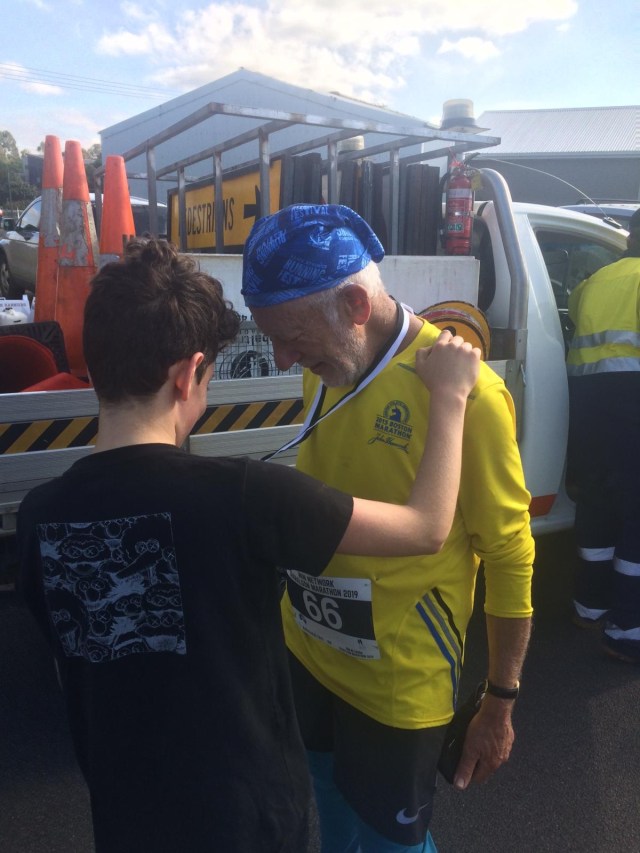
I felt fast. I felt liberty, release, the knowledge of an ending. I pumped my arms, I waved them, I flew and I crossed the Line and I fell into Toby’s arms. The clock read, 5 hours and 52 seconds. Two women in red and another in blue told me I was a legend, I was amazing, I was awesome, as they clapped my back and kissed my face.


Later Philbert sent me footage of the final sixty metres or so. I looked and I laughed. The video camera catches me in profile. Had I not known otherwise, I’d have taken the spavined biped in the picture as some strange clockwork creature in green tights. I invite the reader to view the footage and share my mirth.


On the way home Philbert drove and I stretched out and ate and drank. Philbert said, that will be my event. I’ll run Traralgon next year with you, Howard. I’ll run it every year. Toby said, You’re my inspiration, Saba. I’ll run it too. I’ll bring Mancha, I’ll bring Mami and Papi, I’ll bring Nana. Savta will come, my bothers too. We’ll all run.


Footnotes:


1.   Five hours and 52 seconds is not a fast time. It is, however, 30 minutes faster than my previous five or six marathons. By way of comparison, my first Traralgon (in which I ran last) took four hours, thirty-one minutes and thirty-one seconds. My best Traralgon took three hours and fifteen minutes. Today I finished last but I was the first runner over 73 years to cross the line. I am happy to claim the title, Victorian Marathon Champion (male), (over 73). And I have duly added that title to my CV.


2. Mancha is a Border Collie.


3. Savta is my wife, a walker, not a runner. Nana is her 92 year old mother, a Yogi, not a runner.


While in Israel

As my fingers hit the keys to write this, I imagine a reader shifting in her seat, adjusting, resuming a familiar position. If you squirmed a little on reading the title of this post, I guess the reason to be the word, the noun, the divisive name, Israel. When it comes to Israel everyone has a position. The position has been preformed, (too often prepackaged, bought cheaply off one shelf or another, marked respectively, ‘’Approve of Everything” and “Disapprove”.) ‘Israel’, the word itself, is derived from ‘struggle.’ The geography of the place, situated at the very crossroads of the ancient world, determines contest. The land sits plonked in a Valley that has seen every kind of Rift.

In my own way, I’m with you, squirmer; I too have opinions and sentiments. What follows is a list of happenings, little events. The reader can weave with these threads, as I do, the pattern of her choosing. I expect I might affront readers of every stripe.

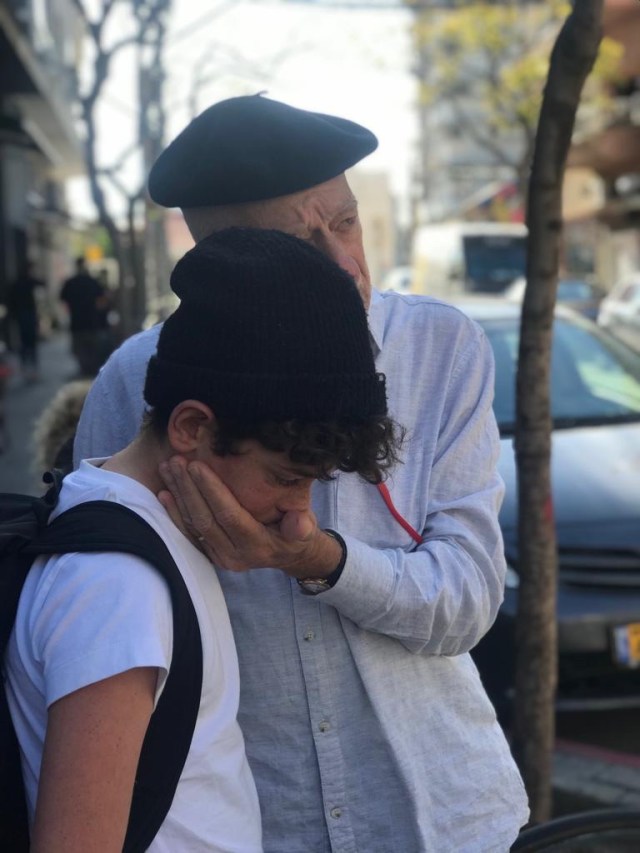
While in Israel, travelling in the family caravanserai, a thirteen-year old grandson visited Yad Va’shem, the Holocaust Memorial in Jerusalem, an emotionally hazardous experience for anyone. This is especially true for a child equipped with limitless empathy and less resilience. At the exit the child noticed a black book into which a visitor might register a reaction to the experience: Saba, wait! I want to write something. ‘Writing something’ took some time. A head of dark curls bent over the page, the pencil moved slowly, words were crossed out and replaced as a person of action and quick movement, slowed, stilled and searched within. At last he was done. Saba, you can read it now, he said. I read the following:

On December 15 last year I celebrated my barmitzvah. But here, today, I became a man.

I dedicate this to the person who prepared me for my Barmitzvah.

While in Israel we ate at a beachfront meat restaurant. In Israel ‘Meat’ and ‘beachfront’ both signal ‘expensive’. I decided to choose something affordable; on the menu, Turkey Testicles caught my eye. Do turkeys actually have testes? – I wondered.

No reason why not, I realised. They’d be very small, surely, if all were to be in proportion. More likely than true gonads, the ‘testicles’ would be some oblate spheroid of other flesh, colourfully named. I ordered them.

The family chose the safe and familiar, all the time speculating colourfully on my choice. Grilled meats arrived at table, chicken portions, sausages, kebabs. No surprises, nothing scrotal. Finally, five spheroids of dun flesh arrived on a plate. These would be mine. Breaths were held as I raised my fork, cameras sought, found and aimed as I impaled the first and smallest. It tasted meaty, turkeyish. My teeth struggled for purchase as the nimble little nugget slipped to one side or another. Finally trapped between a couple of molars, the testis yielded and collapsed, releasing a thin fluid (ejaculate, perhaps?) which was not entirely repulsive. The texture? I couldn’t decide. So I ventured a second of the near-spheres. This was unambiguously unpleasant – not the taste but the texture, which was of offal and quite awful. My mouth grappled for gristle, or fibre, for something chewable, but tongue, teeth and gums found only a slippery Gollum of near-solid goop. I cannot really commend turkey testicle. But don’t let me put you off.

While in Israel we went down to the Dead Sea. (Here some exposition of terminology is helpful: from abroad, one goes up to the Holy Land; within the land one goes up to Jerusalem. A spiritual ascent is intended.) But from anywhere on the surface of the planet you go down; the Dead Sea is the lowest point on Earth. We went down.

Nature too goes down to this sea. The Jordan flows from the snows of Lebanon (the name means ‘whiteness’) southward, ever downward, passing through Earth’s many trauma sites – Sodom, Gomorrah, the Cities of the Plain, where fire fell and brimstone rained – down, down to a sunlit sea. The sea is mineral-rich, life-poor. It kills all. All excepting the credulous, who bring their diseases to its waters for the Cure.

With the Negev Desert hulking above you on the right, you follow a road that winds down and down: you have entered and you now descend that storied Rift Valley. Arid Geography from schooldays comes alive in the dramatic silence of that descent. Huge tumbled sandstone cliff-faces on your right fling the gazing eye ever upward. Rugged, broken, appearing ever ready to break open afresh, to swallow you up like the biblical Korach, those Negev steeps keep their menacing silence. In colour the stones of the Negev resemble turkey testes (vide supra), while in sound they resemble nothing at all, so annihilating their silence.

And all the time we whizz and plunge car-bound, so many frantic ants, as if retreating from some dull terror that has no name. All about, on every side, the heat presses down, time pushes down, the brief moment of human history is swamped utterly.

And then the Dead Sea appears below you on your left, its silvery waters silent too, but this the silence of the ineffable serene. You look and you sigh. There on the far side loom the hills of Jordan. Before you on the water, an image of those hills lies reflected. All is still. You, the watcher, feel yourself stilled, your being subsides, the world of cares recedes, quiet rapture consumes you.

Later, as the day begins to die, the waters begin to colour. Pale blue opal appears, giving way slowly, slowly to deepening pinks as the unrippling waters darken and turn metallic. Night falls and your sated soul fills with contentment. Now the moon rises, near-full, and the sea shimmers once more.

Up betimes while the hotel slept, I wandered down to the beach, seeking more glimmer and shimmer. But cloud had settled upon the Rift overnight. I sought sight of the sun that should have been rising above Jordan. The merest glow in the grey was all I saw. The world lay beneath a muted light, lovely beyond words. I wished for a camera and the skill to capture a captured sun. I wished for words I would never find for this moment of deep peace. Alone on the beach I recited the dawn prayers and gave thanks for peace and for beauty.

Had I prayed for a camera and a photographer to operate it I might have found what then materialised, a man and a woman, Nordic blond upon the sand. They too had drunk deep of peacefulness. We greeted each other. I said the sea and the sky and the quiet were beyond capture by word or camera. The man, Johann, produced a telephone and captured these images. Johann and his wife, Gro (pronounced ‘Grew’, Norwegian for ‘Grow!’) were old enough to know we three had stumbled into unwonted moments of gift. The gift bound us in a web of memory. Weeks later, with few words shed, I feel those enduring bonds. The man had photographed shanti.

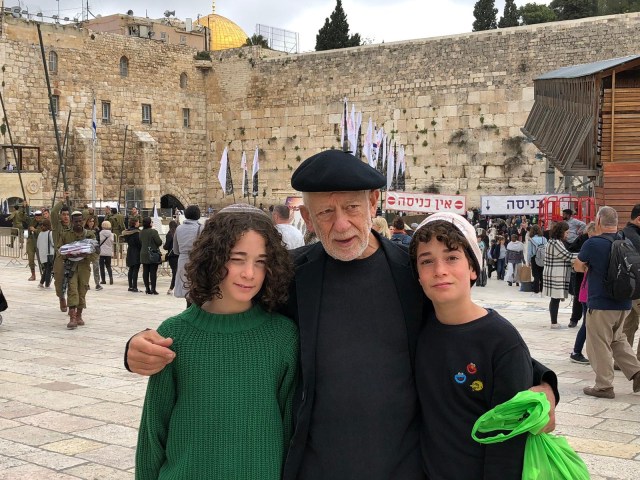
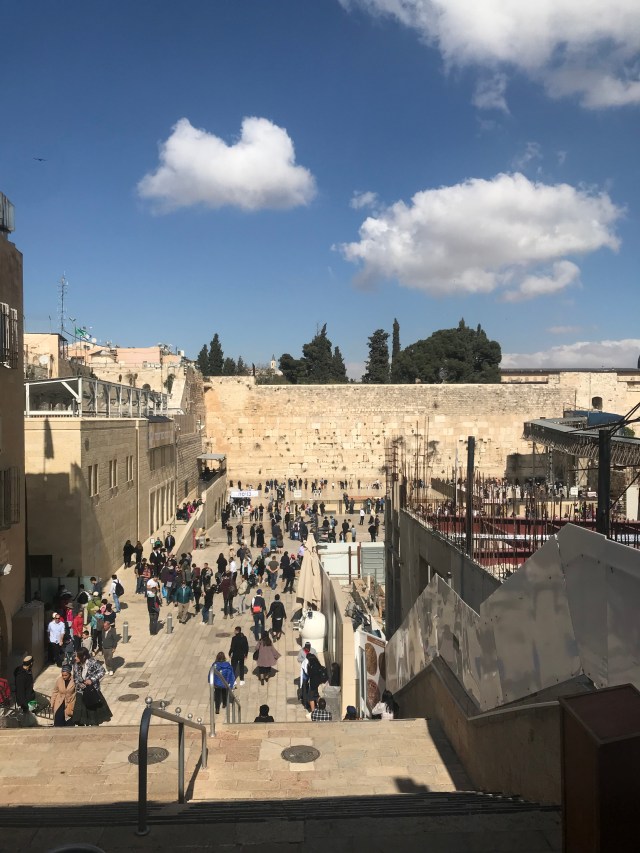
While in Israel we visited the Western Wall of the ancient Temple in Jerusalem. The Kotel, as it is known, is Jewry’s holiest site. You go up to the Kotel. Going up with me were our two recent barmitzvah graduates, a pair of happy philistines who seldom have troubled their Creator with prayer. (They don’t like to impose.) But on visiting this location the sense of occasion, of significance, falls upon all. Would the boys feel lost? I made a suggestion: There’s no fixed prayer. There’s nothing you have to say. Some say the she’ma, which is the first prayer you boys learned. Or you could think of your dearest, secret wish or feeling. You could say that at the Kotel.

We stood before the Wall, its huge stones creamy in the morning sun. There was room to stand a nose-length from the stones. Antiquity, the weather, and a million kisses have all opened small cracks between the stones. Here worshippers have written down personal prayers and squeezed them in, little letters to God. My eyes closed and I whispered to God what He must already know. The boys were not heard, not sensed. At length I opened my eyes. One boy stood close, bending, posting something in a minute gap. The other was nowhere.

In due course we came together and we blessed each other, the three of us. Later I found written in my notebook, the following fragment, prepared for posting in a crack:

Hey God.

Please try to manage hate, discrimination and sad…

‘Try to manage’ – a modest enough way to couch a heartfelt plea – but my heart lurched to think of ‘hate, discrimination and sad’ hurting one of my tender ones. Did he find a crack?

There is a crack/a crack in everything/that’s how the light gets in.

While in Israel, we visited the pavilion that honours the Anzacs at the charge of Beersheba. Here, British, Australian and New Zealand soldiers defeated the Turkish defenders of the strategic wells dug by my biblical ancestors the Patriarchs. The respective allied forces took distinct roles in the battle; it fell to Australian horsemen to attack Turkish gun emplacements on horseback in what is described as the last cavalry charge in history.

At the pavilion we bumped into an ocker individual called Colin, a volunteer guide to the place. Colin grew up in Melbourne and came up to Israel forty-five years ago. He’s older than I, taller than Goliath, rounder than Falstaff, utterly devoted to the place and its Australian heroes. He’s also rigorously honest and quite unwilling to gild any historic lilies in his narrative. He doesn’t need to. If you are Jewish or Australian, or if you’ve ever thrilled to the power of horseflesh at the gallop, I defy you to hear Colin’s account of the charge and to watch footage of the re-enactment and to emerge with dry eyes.

While in Israel my thirteen-year old twin grandsons and I accomplished in 45 minutes at Masada what took besieging Roman armies three years: we reached the top of this mesa on foot. The Snake Path takes its name from its serpentine coiling route up the rugged steeps from Dead Sea level. Only Ancient Romans and boys at puberty choose to make the climb on foot in that blazing desert. Others take the cable car.

While in Israel we visited a cousin whose incurable medical condition is so extremely rare most doctors have never heard of it. (I hadn’t.) Of the details of my cousin’s plight I have nothing to say here. Rather, it is of a community that so elevates the care of its disabled that I feel moved to write. I witnessed among Israelis a broad embrace. No-one is hidden away. In the synagogue, in the streets, at tourist sites, in all manner of public places, the ill-formed, the mentally ill, the amputee, the palsied, the intellectually deficient, alongside those extremely aged, ride their electric conveyances and live among their people. Tough Israelis, old and young, include their disabled with tenderness. I saw it on all sides and always I felt thankful and oddly humbled.

While in Israel, at the precise moment of our landing at Ben Gurion airport, the people learned of the results of their elections to the national parliament. We lugged and sweated our way through Immigration and emerged into the dazzle of Israel light. Our cab driver had no words for us; he was listening to the election news.

Mi nitzach (who won)? – I asked.

Bibi.

Our driver discharged himself of those two syllables – that were to comprise his entire conversation – without emphasis or feeling. It was a fact.

In Tel Aviv, on the beaches, in the streets and cafes, on the buses, neither excitement, nor surprise, nor exultation. I sensed a numbness, a resignation: Bibi had gained victory, but respect? Irrelevant question, it appeared.

(An aside, a quiz:

1. Who won five of the last six elections in Israel?

2. Who won five of the last six free, clean elections in the Middle East ?

Answers to 1 and 2: the same person)

While in Israel the New York Times cartoon appeared: Trump in a black yarmulke, led by dachshund–Netanyahu, wearing a Star of David. Oops, sorry, a mistake, said ‘The Times.’ Some readers were surprised, some shocked. I was one who felt both, personally, and deeply disturbed. A violence had occurred in my immediate vicinity; a newspaper like the ‘The Times’ is that territory of thought occupied by people of moderation, of contemplation, of liberal values.

The cartoonist pleads the absolute, inviolable sanctity of free speech. A week or so after ‘The Times’ published the cartoon, someone decided to attack a Jewish house of prayer and study in Poway, California. Only one fatality.

Barely seventy years have passed since the unspeakable. Few remember, fewer know. Memory does not prevent repetition. Where today does the Jew feel secure? As I write this news arrives of four hundred rockets fired from Gaza onto civilian targets in Israel. Illogically, in precisely that place where most attacks occur, a Jew feels safest. Ultimately there exists but one land where the Jew is not the stranger, not dispensible.

On an isolated beach south of Haifa I went running with a friend and colleague, an Israeli Paediatric Emergency Physician. Picking out a ragged path between clumps of ground cover I kept a sharp eye out for snakes. ‘Do you treat much snakebite in Israel? – I asked. ‘Not so much in the cities, but down south, around Beersheba, plenty.’

‘What species?’

‘Viper.’

‘What about scorpion bite?’

‘Plenty.’

I thought about our countries’ respective biters. Scorpion bite in the Australian outback is not common. I’ve not heard of any fatalities.

An old story came to mind; my friend had never heard it, so I told him: A frog was swimming in the Nile when a scorpion called to him from the bank.

Suddenly, last Friday

A latecomer entered a mosque in Christchurch and he saw, among the larger human forms, a child.

The NZ Herald reported:

Mucad Ibrahim.


At just three years old, Mucad Ibrahim is thought to have been the youngest victim of the massacre.

The toddler had gone to the al Noor mosque with his father and older brother Abdi when the family were caught up in the deadly attack. Mucad was lost in the melee when the firing started, as Abdi fled for his life and his father pretended to be dead after being shot. The family searched in vain for the toddler at Christchurch Hospital and later posted a photograph of Mucad, smiling with Abdi, along with the caption: “Verily we belong to God and to Him we shall return”.


Rachid was the one I thought of first. I sent him a note.


Stunned with grief, Rachid, we reach out to you and to your family with love.

In the synagogue today, a great and heavy solemnity.

Someone offered a public prayer for “our cousins” in NZ. 

It came to me as I stood and mourned I was glad my father was not alive to hear and know this.

How much more so, your father, the peace-loving Mufti .

Asalaam aleikum

Shalom


Rachid wrote back:

Thank you Goldy.

How true about how our fathers would have felt about this.

What a beautiful gesture from inside your synagogue.


Rachid.


I wondered whether Farooq’s parents knew of the attack.

Yes, my parents heard about it back in Iraq. They were upset.

I wondered, Aren’t they used to that sort of thing? Fifty killed – that wouldn’t be so rare, would it?

No. No, it’s not. Sometimes many more. Once six hundred died; a truck loaded with bombs drove into the Mall.

Three storeys collapsed. Six hundred – burned. But this, last Friday, we all feel upset.

I said quietly, I’m sorry. Everyone I know is sorry. We feel sad.

Farooq said, It helps.


The bloke on the phone, quoting on my car insurance, said: The premium would be sex hundred and sexty-two dollars…

I said, I’m sorry about the events in Christchurch. Everyone I talk to is staggered. In grief. We’re a nation shaking our heads.

The phone fell silent. A throat cleared, a voice followed, now hoarse: Excuse me. You caught me off guard. Hasn’t been easy being the chirpy salesperson these last few days… You know, we’re a close team here, we’re all nations, all creeds, one of us a Moslem.

He can’t work at present. We sent him home.


I sent a text to Waleed: I have nothing I can write, nothing adequate for the need. Nothing equal or useful or valuable

in any way beyond the human need to share the wound. To express my grief. I need my cousins to know I am with them.

Waleed replied: Thanks for sending it. The human need to share the wound is among the most important, most civilised needs we have. So that act of civility means an unbelievable amount. Thanks, cousin.


Speaking on TV, Waleed said: I know what the worshippers were doing in the moments before the attack. I know because I go to the mosque on a Friday. I know the prayers, the quiet, how far they were from this world, in the meditation, in the perfect quiet, in the peace inside the Mosque.


A mosque called Al Noor – ‘the candle, the light.’ So close to the Hebrew of my prayers. I thought of bodies bowed, of backs turned to an intruder, of those moments of innocence when the worshipper turns away from the world, turning inward in faith. As I entered my synagogue from the rear I saw anew how, in those sublime moments, we all are children, all undefended. In churches too, the faithful face forward, turning trusting backs to any entering latecomer.


***

Suddenly we all were Kiwis. Suddenly a change; we gasped, we shook our heads, we wept. We saw Al Noor, a light. Suddenly the Moslem was not the stranger. 


What will follow?


Phone, Lost

My i-phone and I became separated today.

Using my wife’s phone I tried calling mine. The call went to Voicemail. A voice invited me to leave a short 10-second message for Howard. On the spur of the moment I couldn’t think of any short ten-second message I needed to send myself. I couldn’t think of a long ten-second message either.

I searched my memory. Where had I been?

I’d driven to the  movies. 

I searched the car.

I sat in the car and called myself. 

I remembered then I’d switched the phone to ‘vibrate’. I heard no ring tone. I left no message.

I called the cinema. 

The menu invited me to press 2 to speak to a human. The human was a young man who asked me to describe my phone.

I think it’s an i-phone.

You think it is an i-phone, sir?

I think so… it’s small… portable. You can make calls… there’s internet…

You’re not sure it’s an i-phone?

Is there another sort? It’s small. You can fit it in your pock…

No one’s handed in an i-phone today sir.

I left my wife’s number.

Next stop the supermarket. 

The young man had acne. He was kind. He searched Lost Property. The phone wasn’t there.

I thanked the young man and prowled the aisles in which my wife and I had shopped. It wasn’t where we’d selected celery and leeks, it wasn’t amongst the lentils, not with the fat-free milk, not with eggs.

I returned to my friend with the zits: May I leave you my number?

Certainly sir. I’ll take it down.

I gave him my number. Later, in the sanctuary of my home, I realised how unhelpful it was to leave my number: the caller would receive the call intended for me.

That phone costs me money. I have a Plan, I have Bundling, I have Home Internet, a fax number (yes, by means of fax I receive documents from fellow antediluvians.) I pay for all of these. I am bewildered by the Plan, the Bundle, the two separate bills for Internet. I pay the bills.

Hours passed. During the Separation, time has passed peacefully. I called my friend at the Supermarket. 

No news, I’m afraid sir.

If you do find it, I’ll pay you to keep it. 

The young man carbuncular laughed: You’re not being serious, sir.

I wasn’t sure.

My wife sent a text message to my phone: This phone has been lost. If you see this text please respond. Thank you. 

My wife joined me in the garden, bearing her phone and a smile of satisfaction. 

It’s at the cinema.

As I drove to the cinema I remembered visiting the Gents’ toilets. My cubicle was a pool of urine. Using toilet paper I bent to the task of mopping and cleaning and drying. Whenever I bend in these slim fit trousers things fall from my pocket.

At the cinema the young lady asked: How are you going today? 

Thank you for asking: not much different to when you asked me how I was this morning.

She smiled. 

I enquired after my phone.

The young lady went to an office and returned with a small phone. 

Is this your i-phone, sir?

I recognised the photo of my granddaughter’s school sweater (she doesn’t want her likeness looked at without license from her, so we agreed I could show her tummy in school uniform.)

Yes, that’s it.

I thanked the young lady, who smiled again..

In the course of the Separation I’d missed some calls. Happily, Voicemail had rescued the following:

Hello Doctor Goldenberg. How are you today? I’m calling from Amex to invite you to give feedback…

Hello Howard. How are you today? This is Alex. I’m calling from Telstra with our Special Offer…

Hello Doctor. Long time no talk. This is Sal from American Express. How are you today?

To all my callers, I’m well thanks. And my i-phone is well and truly back.  

Mum Interviews God

Friday, eighteen minutes before sunset. Mum stands before the candelabra, strikes a match, holds it to the wick, pauses and watches until a flame rises, blue at the wick, yellow at the fringe.  She applies the same match to a second candle, which obliges with a sturdy flame just in time for Mum to drop the match-end that was about to burn her. She lights the third and last candle. Again she watches briefly, now drops the match and holds her hands – cupped palms upward – above the dancing flames. Now starts the ballet I have witnessed and loved since earliest childhood, as Mum’s hands move up, then down, up again and down, then a third rise and fall, as she caresses air and brings up the light of Shabbat.

Mum’s hands move to her face and shield it from sight. I won’t see Mum’s face again until she completes her interview with God. She whispers a blessing. Then silence. What is she doing? Unlike us boys Mum does’t wear her religion on her sleeve, nor, for that matter, on her head. Mum’s discourse is free of theology. She is not one for external display. But this moment – these moments – she dedicates to One who is outside and above that world in which she cooks and reads and dreams and loves. 

I wait. We all wait. All of us, her four children, our father, smelling the smells of the sabbath meal, all suddenly ravenous. We’ve recited our prayers, we’re ready. But we must wait while Mum talks to God. Mum lowers her hands, turns to us, “Good shabbos, darlings.” Her eyes shine behind tears.

Eighteen minutes before sunset on a Friday, sixty-five years on. Mum stands before the candelabra, takes a match and strikes a flame. This is no longer a simple act: to do this, to light the candles one by one, to judge when to hold the burning fragment and when to drop it, Mum must release her grip on the kitchen bench. Since the haemorrhage that tore through the back of her brain, none of Mum’s motor functions is simple: to stand, to remain standing, to direct the fingers to strike a match, to light a candle, to articulate words, every act a challenge to be met and overcome. The three candles rise, yellowblue, to Mum’s wavering matchstick. She drops the match and now her hands caress air. Once, twice, three times, those slender hands, those long fingers still graceful, rise and fall. Now the hands rise to Mum’s face and hide it, and we hear her whisper the words. No sound now as we watch and wait.

After one of these lengthening quiets, I ask Mum what it is that demands so much of the Creator’s time. “What are you saying, Mum?” 

“I’m asking God to care for you all, darling.”

Mum has four children. She had a husband but he died a few years ago. She has grandchildren who have become adults, she has a rising score of great-grandchildren, she’s accumulated children-in-law, grandchildren-in-law. Every one is precious, each has individual needs, each must be singled out and presented to God for blessing. Blessings must be tailored: Heal this one, strengthen that one, protect that third, comfort him, calm her, bring them peace.  

We wait and we wait. Mum and God have much to discuss, as God’s old friend comes to Him again with her weekly agenda of love.  

Family, Therapy

I’ve been seeing a doctor who is a family therapist. It all started around 1982 when my family and I were going through an epoch of change; it made sense to me to consult a family therapist. In the 1980’s family therapy was enjoying a vigorous infancy and Brian was one of its champions and very well-known in his field. I suspect Brian’s aura of celebrity was an attraction for me.


I saw Brian again today, as I have done at intervals ever since 1982. I continued seeing Brian long after I learned celebrity is illusory. You could say I see my doctor now for his aura of ordinariness.


The family events of the 1982 epoch were decidedly ordinary, but to me they felt momentous: a loving father and his doting daughter found themselves in conflict at bedtimes. Every single night! Tears overflowed from a deep well of love. Leapfrogging shouting matches, feelings wounded on both sides. Bewildering. The child’s parents brought her to Brian with whom she had a private consultation that lasted thirty minutes. The parents were then invited to join therapist and naughty daughter. From that day the loving father has loved and the naughty daughter has doted and they’ve never fought like that again.


I kept seeing Brian. He diagnosed an overdose of compliance. He suggested I cared too much for the expectations of others. He prescribed delinquency. It must have worked because my father remarked: Howard, you’ve changed. I felt troubled and liberated. At the age of thirty-six I’d entered adolescence.


In 1983 my father in law was diagnosed with advanced cancer. He was not old and he wasn’t ready. None of us was ready. We went, four of us, to see Brian. Brian helped us – a family foundering, a frightened cancer sufferer who would not see his grandsons’ barmitzvahs, a shocked wife, a daughter trying all she knew: how to support a father, to comfort her mother, to mother her own distressed children? And a son in law out of his depth.


How did Brian help? What did he do? What did he say? I cannot say. But he helped: through the fear, through the dying, through the disfiguring grief in all its forms. Somehow I didn’t cry. I loved my father in law, called him Dad. But when he died my eyes stayed dry. I felt myself shallow. A year later the family was doing well. I watched a TV mother spreading margarine onto white bread. I saw her TV family eating, children dancing around  the mum. The voiceover said, You ought to be congratulat-ed.  And I started to cry. So I went to see Brian.


Perhaps it was Brian who cured my sadness. Perhaps he helped me to know my sadness and to make room for it in my life. For a time we stopped seeing each other. I left his consulting room taking with me the gift of tears, accessible again now after a drought of three decades.


But before too long I was back. I was doctoring as well as I could, I was fathering and brothering, I was a son. And I was doing my best at all of these. I was husbanding too, an amateur at the job. All these jobs, so important! To fail at any of them? Unbearable thought! I needed some help for a problem I couldn’t define. In my sessions with Brian I must have received help without quite being able to name it. I heard myself say once, I measure my life in coffee spoons. It was busy-ness I was suffering from, jamming too many important things into too few frail minutes. For sixty minutes every month or two I’d breathe out. I’d hear Brian ask a question and I’d pause and think and answer slowly. Brian would hear me. I’d hear myself.


And so it went on. Family kept happening: this one married, that one became unwell, another distressed. Parents aged, their bodies failed, their willpower arrayed in fierce battle against any help. Grandbabies were born, astonishing joys, swamping strains, grandparents stretched to thinness. A parent died, a brother died, finally the remaining parent. Family, the furnace and theatre of my life, kept happening; so, naturally did my therapy with Brian. By now Brian knew this family, in its longitude and its latitude, in its occasional depths, in its many heights, as few outsiders could.


Brian never seemed to say much. He’d sit and think and nod. Silences would stretch open and I’d feel comfortable within them. When Brian spoke I’d hear an affirmation – my feelings, Brian’s words – and something more, some new molecule of extension or understanding. It was never portentous but it would sink into me and I’d leave lighter.


As the years became decades I began to recognise distinctive elements in my visits to Brian. Prompted by the remark of another who works in mental health, this seems more like a friendship than therapy, I conceded that partial truth. I heard too unspoken echoes of purists: what sort of family therapy is it when only one family member participates? Fair enough, but not far enough; these thoughts never outweighed the heft, the lift, of one person meeting with another, of a person encountering himself through narrative and counter-narrative; of knowing himself respected, accepted, safe to extend himself and to develop. I could see this as it had become, a friendship. I could sense the fear and the sneer of Authorities that decree that a doctor who is also a friend must be less of both. That absurdity is the zeitgeist, the fruit of the self-distrust which has become normative in all professions. Deeply I know it to be untrue of my friendship with my doctor.


At some stage, perhaps twenty years ago there entered a new element, love. It happened like this: Brian closed his professional rooms and began to see patients in his home.

That home is a Victorian building with a central corridor leading to private rooms. One room serves as waiting area; you enter and find it littered with books and magazines. Comfortable chairs invite a guest to sit and browse. Nothing you pick up is familiar, everything is novel or intriguing. Too soon, the appointed hour arrives and the guest who-is-the-patient enters Brian’s consulting room. Here bookshelves extend from floor to lofty ceiling. Brian appears, offers coffee, I decline, he disappears to prepare his own cuppa and leaves me to the books. I know no library to match this cornucopia. Books of poetry, books of biography, of history, of ideas, of beauty and cultures. Every author I know or have heard praised is in that room. There’s not a book here that I own or would not wish to own. I browse until Brian returns with coffee and spoils it all. I put down the book, passing some remark. Brian says, borrow it if you like, Howard. And I do.


A book lover meets a second book lover in a book bower every couple of months. I meet Rilke and, never understanding a word, I fall into a trance. Brian recommends fellow physician, William Carlos Williams, whom he calls a satyr.


A dawning realisation: I wish never stop this “therapy.” I must never cease visiting these books. What’s more I need to continue. Divorce, a stranger to my family story, breaks down walls that were built of my children’s love and faith and hope. The bricks and the timbers fall hard and heavily onto my little ones. The floor buckles beneath them. They are thrown about hard. Will they be broken? Unlike that epoch of my wife’s father’s death, now I know  my pain, I shed my tears, I ache as one aches for the pain in the heart of one’s tenderest. I act strong; I become bricks, timber, floor. How durable am I? Bricks, timbers, floors do not complain. But Brian hears all of this, he nods, he murmurs. He understands. Perhaps he says something that shifts the picture; some light gets in. At the end of the hour I get up and I leave that old room of books, thanking the therapist and riding fast to work. The puffing and the sweating help. I arrive at work feeling encouraged, a bit lighter. 


In the calms between the storms we speak of work, mine and Brian’s. What does it mean to labour where we must always fail? What is the call? How to answer the call? I speak of legacy. What have I received? What does it call me to do, to be, to become? What do I pass on? And how? We speak too of a shared passion. Brian and I know the one eternal truth of any great love: love means loss means grief. It is the love of the Collingwood Football Club in whose depths we know this truth.


I write and I publish books, articles, opinion pieces. I share many of these with Brian. I present him with a copy of each of my books, inscribing each one in thankfulness. Thankfulness for what? I think I’m giving thanks, in the final analysis, for Brian knowing me. My inscription boils down to, Thank you Brian; I feel known. Brian never congratulates me, never approves the writing. For once I’m not looking for praise or admiration or congratulation, those junk foods of a ravenous ego. It is enough that Brian knows that I write and I am serious.


In years past a patient would say to me, I’ll make an appointment to see you first thing next Tuesday morning.

Well, no you won’t. First thing next Tuesday I’ll be seeing my own doctor…

Why so coy? Where’s the shame in saying I’m seeing my psychiatrist?  So I start to say that and it alarms people. They search my face, hoping for a joke. So I explain. By and large people prove equal to learning that every human needs help from time to time. I’m one of those humans who gets help.


I reach the age of seventy years and Brian and I speak of retirement. It’s an idea that remains an idea, an abstraction. It sits over there on a shelf, within my view, but dimly, while my work burns brightly, and I continue. So, after his fashion, does Brian. For years now he’s taken no new patients, continuing with a rump of which I must be one. He won’t abandon us. Eventually he expects it must end; he’s ready but are we?


Three more years pass. Family keeps happening. Visits to the family therapist continue. Late in 2018 Brian and I appoint to meet again in February 2019. February arrives. Brian asks of my outback experiences and I tell him of the familiar joys, the familiar frustrations, the shocks against which time cannot shield. I speak of family, how once again I’ve been feeling the urge to dash to the rescue of this loved one or that other. We speak of that impulse which is a reflex which has become a habit. I know in my being that habits ossify. What used to work will not work forever. I used to jump to catch my little ones as they fell. Is this what I must do in this late phase, when my little ones are grown and stronger than I know? A habit becomes a pathology, I know. Brian listens, ponders, offers no directive. I’m not looking for instruction. I receive what I need, what always I’ve received from Brian, an attentive listening. I hear my voice, Brian hears it, a quietness settles around us. A seed of thought falls, to germinate and take root and grow.  We’ll talk of it at our next session, or at some session later.


It’s nearly time to finish. I speak of Collingwood, of how we came so near to glory, of defeat in those last moments. Brian mourns: remember it ever; speak of it never. A Brian pause, then: we reach a point when we look back and see where we’ve been… how far we’ve come… how far short we’ve fallen. What have we done, what remains to be done? What can we still do?


My ears, attuned still to the Collingwood near-triumph, detect an alteration in tone, a new note. It is of valediction that Brian speaks, a farewell, a long farewell to all this richness. He goes on: it is not ours to finish the work, nor are we free to desist from it. I murmur, Hillel, The Ethics of the Fathers.


We rise. I pull out my diary to appoint the next visit. “No, Howard. This was our final session.” So it was! I had managed to forget.  Brian escorts me to the door and waves a goodbye. He’s still standing by the doorpost as I jump on my bike. I ride to work, not hurrying, not sweating, just thinking, thinking and feeling. I’m seventy-three years of age. Brian has been my doctor for thirty-six-and-a-half of those years.


My Friend the Policeman

Working here in this large regional hospital in the Kimberley not a day passes without a call to the care of drunken patients.

More often than not the patient arrives in the company of a pair of police officers. More often than not the patient is abusive. Frequently she swears at her captors, often roaring at the them. The custodians stand calmly, quietly watchful, gentle, as I do my work and the patient does her worst. The police officer is here as a guardian, my guardian, the hospital’s, the patient’s. I wonder at this patience.


***


When I was very small my parents brought me to the city for the High Holydays.

Mum took me to Collins Street, a river different from those I knew in our small riverine town.

Collins Street flowed, a fast human current that would sweep up a small boy, sweep him away, never again to see his loving kin. I looked up and about, legs everywhere, legs striding fast, eddies, rips, king tides. 

I gripped Mum’s hand tighter. “Mum said, don’t be afraid, Howard. The Police will look after you. If you ever get lost find a policeman. The Police are your friends.”


Back in my hometown I knew this to be true. A man pulled my pants down in the park. A couple of days later I told my parents about the man’s strange behaviour. Mum looked at Dad and Dad looked at Mum and a few hours later Sergeant Stewart arrived at our house. 

We walked together into the park. I led him to the place and answered his questions. “Look around the park, Howard. Can you see the man?”

I couldn’t but I didn’t want to disappoint the officer. I pointed out a man dozing on his picnic rug: “That’s him”, I said. Sergeant Stewart said, ‘It’s a very serious thing to make false accusations, Howard.” I learned a new word that day. 


Another time I found a ten shilling banknote in the street. Briefly I was rich. Mum said, “‘It’s lost property, darling.”

“No it’s not Mum. It’s found.”

“You report lost property to the Police and they look for the owner.”

I walked to the top of Wade Avenue, past the courthouse and around the corner to the Police Station. Sergeant Stewart opened a book dipped a pen into an inkwell and asked, “What’s your name Howard?”

“Howard.”

“Do you have any other names, Howard?”

“Jonathan. Goldenberg”

Sergeant Stewart’s thirsty nib drank again and again at the inkwell as he recorded my address and my parents’ telephone number. “Leeton two eight, isn’t it, Howard?”

Six months passed, an age. Our telephone rang and Constable Bulley said something to Mum. Mum thanked him and hanged up. “Go to the Police Station, Howard. No-one has claimed the ten shillings.”

I went and said I’d come for the money. I signed the policemen’s book and I left, a rich man.


On one occasion I tested Police probity. Leeton sat in the Murrumbidgee Irrigation Area, fruit bowl for the nation. Fruitfly was the feared enemy that could wipe out the industry, it might destroy livelihoods and the local economy. You weren’t allowed to bring exotic fruits into the MIA. If you wanted bananas or pineapples you had leave the Irrigation Area and drive to Narranderra, nineteen miles distant. One Sunday we did just that and gorged on those tropical fruits. To my surprise, my law-abiding parents embarked on a criminal career and brought the surplus home.

After lunch the next day I was loitering outside our house in Wade Avenue when Sergeant Stewart strolled past. The Sergeant is my friend; I should offer him the pleasure of conversation:” Hello Sergeant.

“Hello Howard.”

“We’ve got bananas at home.”

The officer smiled.

“And a pineapple.”

“Good afternoon, Howard.”


***


Ten years ago I met Detective Inspector John Bailey (retired) in Albury. He spoke of his father, the police officer who, unarmed, braved an armed murderer, who shot him. Bleeding from his wounds Bailey Senior grappled with his assailant, pinning him beneath him. Bailey died, the only police officer known to have arrested his own murderer. Bailey – the son – showed me the George Cross, awarded posthumously to his father. I hefted the weighty silver medal in my palm, while the old officer looked down at me between ptotic eyelids: “It’s a great thing, a George Cross, but it’s not a substitute for a father.” The orphaned son followed his father into the force, entering in his teens, retiring a much-decorated and admired servant of the community.


***


Every night in the Kimberley police officers bring in their freight of broken and bleeding humanity. Their charges reel with the effects of alcohol, their heads, faces, limbs bloodied. Many are handcuffed. Invariably the officers tower over the injured prisoner. Sometimes the prisoner-who-is-patient shouts in a crazed manner, offering abuse to nurses and coppers alike. The officers remain calm, their manner respectful, even, I should say, kindly. Gently they lead the injured miscreant to care. I see this, time and again. I see it and I marvel.


***


I never became separated from Mum in Collins Street River. I never needed police succour until the day came when an arsonist set fire to my motor cars parked in the street outside my home. The policeman, Commander Kim West said, “When someone sets fire to your car they’re saying they can burn your house. They’re saying they can burn you.” The Commander asked me about my children. He gave me a significant look. He wrote some digits on the back of his card and handed it to me: “That number will get me night or day, Howard.” 


Twenty years have passed since the Commander gave me his card. A few months ago Kim returned from Europe where he’d visited with his wife. He buttonholed me: “We went to Auschwitz.” A shake of the massive West head: “Shocking. Shocking. When I tell people that, they say,Who’d want to go to Auschwitz?  I tell them, Everyone should go to Auschwitz!  Soon after our chat, Kim became unwell. Tests showed cancer, advanced and widespread. Very quickly he died. At the close of his funeral the minister said to the congregation: “The last prayer Kim recited was at the former concentration camp at Auschwitz. There he and his wife read the Jewish Prayer for the Dead. Rise please and read this with me: Yitgadal ve’yitkadash shmei rabah…” 


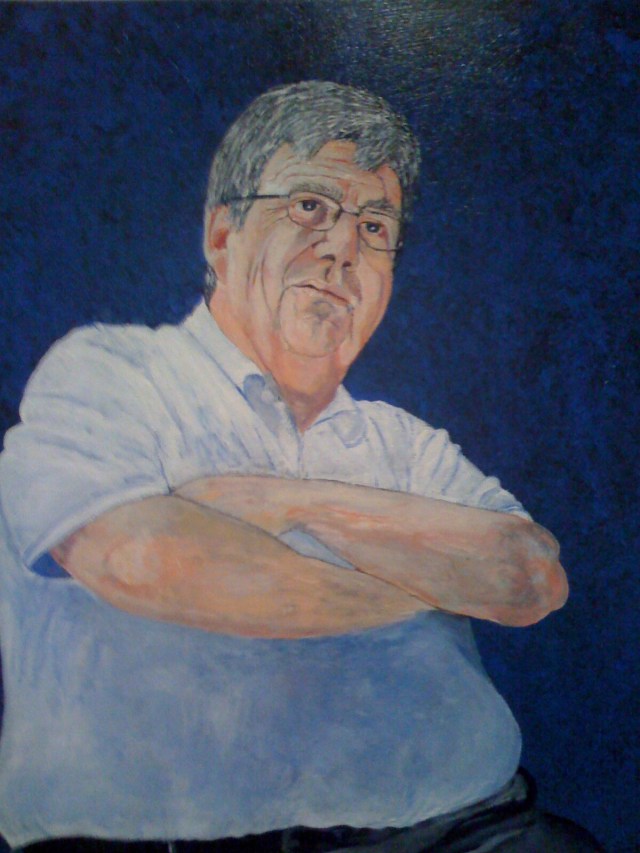
Portrait of Kim West by Dr Harry Unglik for the Archibald Prize

Summer Stories: Big Fat Tree

I think they’re properly called baobab trees. That’s the shape of word I seem to recall from Exupery’s The Little Prince, but out here they’ve been cut back. Here they are boabs. They don’t look at home here in the Kimberley. Like all us pink people, like all the Indians here and the Philippinos, like the Chinese, the Koepangers, the Japanese, like all their hybrid descendants, the boabs are newcomers. Baobab trees came here from their homes in Africa, and like so many immigrants they changed their name upon arrival. How did they come? We don’t know and the bird that carried the seed across the seas isn’t telling.


They have an odd look, these strange fat-arsed trees, with bark elephant-fawn, leviathan thick, they are exotics. But the land, the generous land took them in. Traditional owners hold the boab ancient, original. Venerated in creation myth, the boab has insinuated itself into culture. Treacherously the Prison Tree outside Derby that impounded slaves blackbirded for the pearl diving is a boab. But for all that Aboriginal people love the boab. 


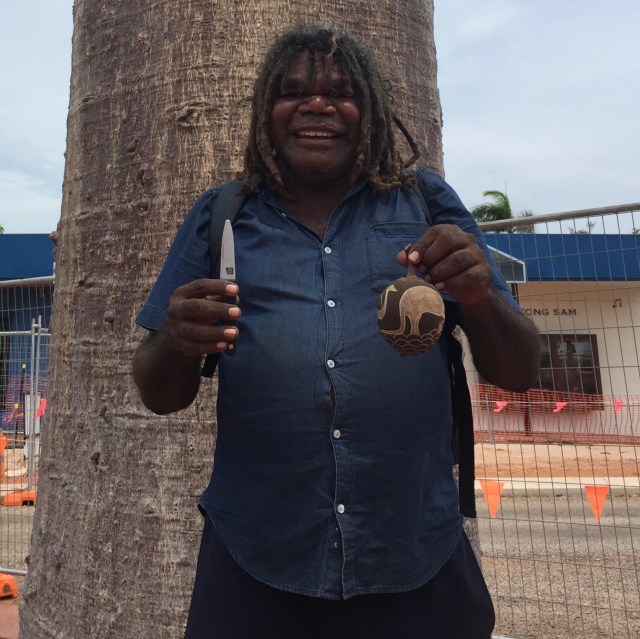
I met a boab lover today in the main street of Broome.  Hello he said, his face round and fleshy his spherical head crowned with abundant waves of hair. 

Hello, I’m Wayne. 

Hello Wayne, I’m Howard.

Howard.

A large smile emerged from the face of flesh. A soft hand extended itself towards me. I took it my smaller hand, which sank within its cushions. Soft and dry, Wayne’s hand held mine. Wayne did not shake. My hand briefly enveloped, at home in the palm of the countryman.

Howard, I’ll sell you this. Forty dollars.

Wayne held a boab gourd, intricately worked with boab, boab ferns, kangaroo (joey not seen but marsupium visibly bulging), emu and emu chick. A spheroid worked in pointillism by Wayne’s fine kitchen knife.

I don’t have forty, Wayne. Will fifty be alright.

Yeah. Fifty alright.


Wayne and I posed for my self-photography. The boab and Wayne posed for my photography. Howard with camera is no match for the artist that is Wayne with kitchen knife.


The Erratic Reader – II


Bloody newspapers! Having settled into my summer of crime I had little patience for newspapers or the news. The Weekend ‘Australian’ felled a forest in my palm. I looked sourly at the ‘paper’s unrelenting jaundice, directed uniformly in denunciation of the new mob who will steal government from the present mob. In this mood the ‘Australian’ deplores democracy. Deploring busily myself, I turned to the non-news. This is to be found in ‘Review’, the newspaper’s excellent weekly look at books and pictures and movies and dance and music and television shows.  In short, the arts.


Looking cursorily I leafed through the pages. As I did so I felt cursory; the accursed ‘Review’ was full of attractive material. I came to poems. Poems are hard, like algebra. Unlike algebra the trick is not to try to solve a poem, first listen to the music. Here (‘Review’, page 22) was Barry Hill, himself guilty of poetry, reviewing a book by another poet, Paul Kane. No, I hadn’t heard of him either. Kane’s book, ‘A Passing Bell: Ghazals for Tina’, is a lament for the poet’s wife, Tina, who died a few years ago. Barry Hill likes the book; I loved Hill’s review. I want to give you a taste of Hill on Kane on Tina, but what to choose? Better, what to omit? Not a word is dispensible. Here, at random:


It comes in the form of ghazals, the ancient lyric common to the Sufi poets writing in classic Persian (or Arabic, Turkish or Urdu), whose lines fell down the page in couplets that came to rest with a fresh mention of the beloved or the Beloved (sometimes called Master).

In any case, the Sufi exalted the visible as a song to the invisible.


Hill’s language is pregnant, heavy with knowledge and understandings, gravid with a scholarship I can only envy. Hill chooses the following lines by Kane:


“He never meant to write this, it simply took shape and wouldn’t let him go until it was over. But it will never be over for him, his heart inscribed with the name of the beloved, Tina”


and:


“At night I lie awake and call to you,

but you don’t reply, except in silence.

The night bird is not silent but sings

A simple single note. His mate does not sing back.

I do not understand this silence, as if God

Has departed and taken you with Him.

I have no words to form a prayer

That could reach you or Him.

Two wine glasses sit on the counter top –

One is full then only half full.

Without emptiness the glass could not exist.

If you should speak, Tina, the glass would shatter.


And back to Hill:


…Meanwhile, the ghazals, their pace and suspension, create a sense of time stretched to some mysterious limit, or of language floating on the waters of emptiness. “What words are these that well up like tears not shed?”


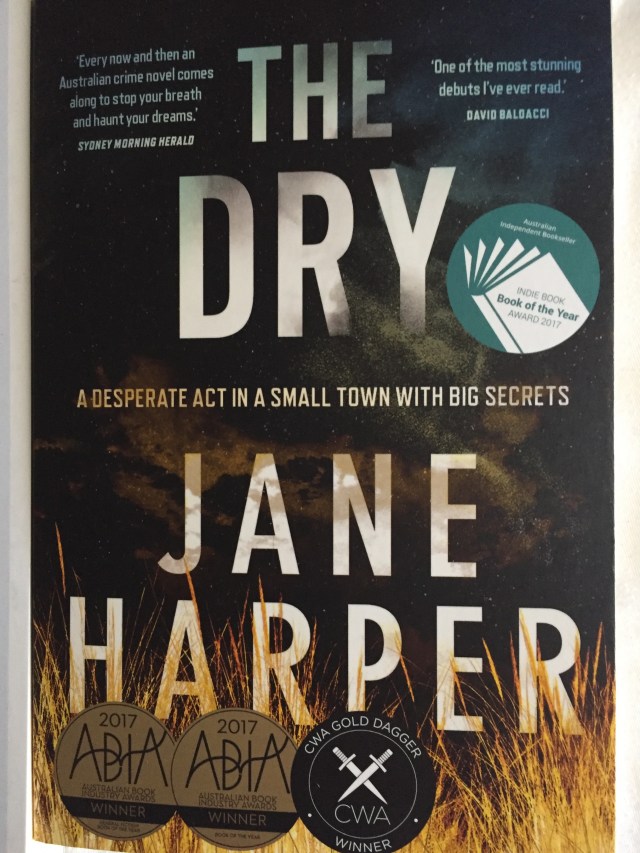
It took me quite some time before I could go back to Peter Temple’s ‘Dead Point”, my first Jack Irish novel. My first, definitely not my last. And now I’m on to Jane Harper’s ‘The Dry.’ Bloody crime writers writing literature. It’s enough to drive a man to Algebra.


Paul’s Passing

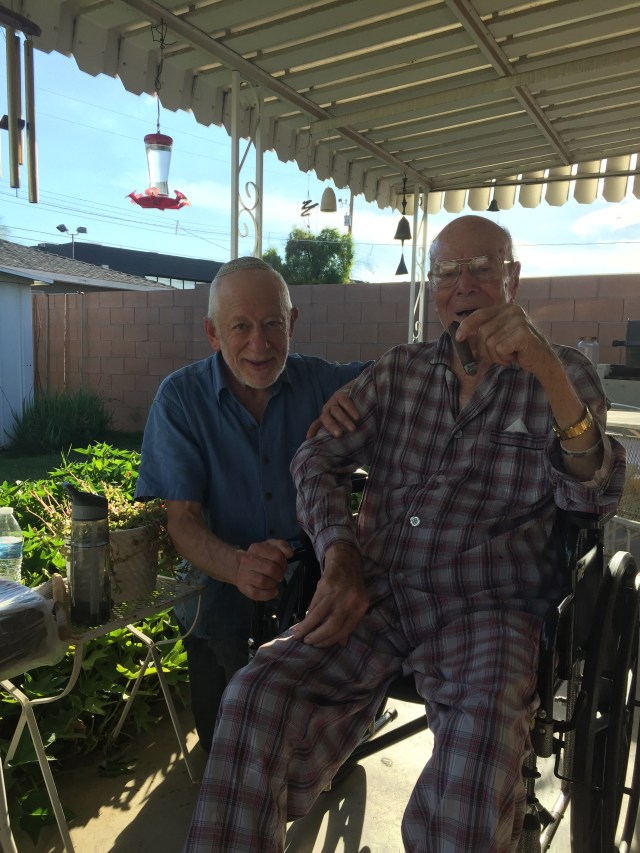
An attentive reader of this blog will recognise the name Paul Jarrett. Paul was my friend. He died last week aged ninety-nine years and eleven months. We had known each other by email for ten years. By the time we met in the flesh Paul was ninety-four. We were together in the flesh but thrice, and spent but five days in each other’s company. Yet his friendship enriched me. So long as my mind knows the truth Paul Jarrett will be with me.


Every day Paul sent out numerous emails to his friends and family, who numbered about eighty souls. I became one of those fourscore followers. By the time we became

e-friends Paul had retired from Surgery, he’d ceased piloting aircraft, he was living alone with his memories and his collection of ragged stray cats. The TV news fed his active mind, which would turn often to past world events. He’d recall those as well as people from his private life, teachers, relatives, colleagues, friends, and most keenly of all, his deceased wife Beverley. Paul would send emails, four or five or six in number. I read them all.


I came to know a man who believed in God, who attended his Methodist church every Sunday, who voted Republican, who supported gun ownership, who disliked Obama and who loathed Hilary Clinton and who loved cats. Paul described himself as a conservative. He said, I’m to the right of Barry Goldwater and he showed me a photograph of the two, taken around the time of Goldwater’s run for the Presidency. Goldwater was far to the right of any US president of my lifetime  (with the exception of the present incumbent, whose position can only be the fruit of daily conjecture and of analysis of the tea leaves of his Twitter account). Characteristically Paul never mentioned to me that Goldwater intended to appoint him to his Cabinet as national chief of Health.


I was none of those things that Paul was, yet a friendship grew. Paul and I both entertained a veneration of our late fathers and mothers that bordered on ancestor worship, we both loved Medicine, we cherished old friendships, we preferred the burnished past to the distasteful present, and we could smile at human error and laugh at ourselves. I’d read Paul’s emails and I’d enter a different world; I learned about earlier eras, I met remarkable people, I was challenged with novel viewpoints (frequently opposed to my own), I relearned Medicine I’d long forgotten. I knew I stood in Paul’s shadow but he saw me in my own light. I’m sure I felt flattered that such a man would treat me as his equal.


Paul and I shared a real friendship. I’d challenge him when his politics got up my nose and, unoffended, he’d defend his position. Paul’s penultimate year was spent grieving for the America he loved. He detested the Democrat candidate and felt offended by the Republican. He knew duty would call him to cast his vote. In his distress Paul’s agony was spiritual in its intensity. He would not shirk his duty. He must serve his country. Patriotism, that quality that cynics dismiss as the refuge of the scoundrel, burned brightly in my friend and he suffered for it. 


Let me share with you some of Paul’s very many letters. 


 August 2, 2015

My mind returns to the days when I would, by my mood and demeanor, sour a bowl of honey.

Beverley, who was acutely attuned to my moods would pinch my cheek, give me a pixyish

smile and say, “Be Happy”!

At first this would annoy me, then I realized that she never acted like I did, so there must be some choice in presenting a foul mood.

Some of us pull an ill disposition around us like a protective blanket.

Not Bev.  She was as careful about her demeanor as she was about her appearance.


August 11, 2015

I am not sure where the admonition to, “Feed My Sheep” ends and Backshish begins.

Never have I seen such a drive and competition for charitable funds nor such a constant demand for our attention so that we can be hit-up.  By phone, by mail, by door to door solicitation, through the Media and other advertising.  The sheer volume makes one suspicious that such an army of petitioners can not contain only those with charity in their hearts.

And all of this attention is not devoted toward appeal for charitable donations.  The phone just rang.  It was a canned message.  It said, “How are you?  Good.  Can you hear me all right?  Good.  (I had not said a word.)  Congratulations are in order, you have just won a vacation trip with two guests, all expenses paid, all you can eat—“  At this point I hung up.  That automatic dialer will call me back tomorrow.  Hopefully my automatic answering machine will converse with their automatic dialing machine and transcription.

Saturday I received 5 pieces of regular mail, 4 of which were appeals for money and one an advertisement for a Mexican Restaurant. 

I will admit that I could be a more cheerful giver, but in addition to wanting to hang on to my money, I am beginning to question whether or not I am getting my money’s worth?

We are living in times that can only be described as “Devious”.


“Now the Day is over, Night is drawing nigh.  Shadows of the Evening steal across the sky”.

And what a day it was.  The temperature hit 117 in the shade, and to add to the disasters brought in by August, Beverley’s Grandmother clock jammed the chain on the weight that powers the clock itself when it ran down.  My vision is not sufficient to fix it any more.  It has happened before and I have been able to get it going again, but my vision is no longer capable of accomplishing this.  Her clock was amazingly accurate, and I enjoyed hearing it chime the hours and quarter hours, during the day and through the night.

I have eaten a frozen dinner prepared for me by Ann, and am about to settle down in front of the television and nap before time to go to bed.  This is the daily routine.

A gracious good evening to all of you.

G’nite!


 August 16, 2015

It promises to hit 117 again this afternoon.

The poor cats do not have refrigeration, but they have cool spots under the shacks

and have thrived in this heat for many years. Sylvester as spokesman for the Etudiants,

scolds me for not permitting them to come inside where it is cool, but this falls on deaf ears when I consider the life of Riley they lead, and the amount of fur they leave behind.

I try and keep the bed outside the Breakfast Nook moist when it comes into the shade in the afternoon, which is the only air conditioning they are going to get.

When you stop and think about it, it takes some temerity to lecture me about the weather, and Sylvester may be spending some time in attitude modification in the near future.  He has lost a lower right canine tooth (if cats can have canine teeth), but I have observed no loss of appetite.  They are eating me out of house and home.

I worry about them though when I am called to my reward (whatever that may be).


 August 29, 2015

I was thinking about some unusual surgical cases I found myself involved with without adequate training or experience.  A surprise after opening the patient.

Having no other source of help in the urgency of the moment I prayed urgently and silently.

That ordinary people can accomplish extraordinary things with God’s help, I can affirm.


October 11, 2015

I received a call from Bob and Dianne at the Cabin with Nikki this week-end.

Bob has the knowledge and ability to provide Satellite telephone service up there, and it works well.

They have had a lot of rain, the Pack Rat problem appears to be under control and the weather is nice with Fall in the offing.  Bob reports that the road up to the Cabin is in need of repair from rain damage, and he will be able to do that with his new tractor.  I think they return tomorrow.  There are some apples that are ripening and they will bring some for me.

Those Western Delicious yellow apples from Stark’s Nurseries are the best I have ever tasted, although late freezes make them available about once in ten years.

It is warm here, although comfortable.  We have what my Mother would call a “Buttermilk Sky”.  Little sun, a slight breeze and a great day to sit on the Patio and smoke a cigar.

It looks as if I may be around another Christmas, and I am making plans to prepare envelopes for my Family to insure their delivery.

The cats have made me a present of the head of a Roof Rat which they laid out on the Patio door mat.  I discarded it because I have no recipe for Roof Rat heads, although I appreciate the gesture.


Paul Jarrett has died. America has lost one of its big men, a patriot, a man of substance and integrity. Medicine has seen the passing of the last of his kind. A congregation has lost a faithful worshipper. We who were Paul’s friends have lost a wise man, a sort of prophet. Phoenix has lost an ornament. But whatever his greatness in the wide world, it was in the little corners of life where I saw Paul Jarrett’s meaning writ clear. It might be seen in his solicitude for the unpromising cats he succoured, in the empathy and in the respect he extended to those battered living things. Born into an era where males were born to rule, Paul esteemed women higher. 


Paul was the son who honoured his father and his mother; of two brothers Paul treasured and measured the greatness of the one, and cherished the second in his deformity. Paul was the husband who never ceased to love and to sing the praise of the wife he outlived for so many lonely years. Paul was the father proud of those stalwart sons, adoring of that dandled daughter; Paul was the grandfather who inspired grandson Benjamin to follow him into the guild and bond of medicine; Paul was the Methodist whose whole heart could celebrate his great-grandson’s bris. The measure of the man, Paul Jarrett, was the honour he paid to those he loved.  


More than once Paul wrote, “Great was the celebration in Heaven when Beverley arrived.” Such was the simplicity of Paul’s faith. Mine differs. But it gives me pleasure to imagine how great might be the celebration for that good and faithful man.