In June 2024, I flew to Israel to support my loved ones in the continuing emergency. The anniversary of my mother’s death fell during my visit, and together with my sister and brother, I went up to Jerusalem to offer prayers at the Wall in memory of our Mum.
Afterwards we meandered through the Old City on foot. Passing one of the Arab-owned shops, my eye fell on a bright red kippah. I needed to replenish my supply of such items, on account of the holy thieves – mainly my grandchildren – who borrow mine and never return them. I had a rough idea what such a kippah might cost, around AUD$15-25. I did the conversion: about 35-60 Israeli Shekels.
I picked up the kippah and tried it on. About the right size and weight, nice and lairy. I decided to buy.
How much for this one?
For you, my friend, ninety shekel.
I did the conversion. Forty bucks? Tell him he’s dreamin.
I understand the rules. We are supposed to bargain. We’re scripted to do so. The vendor is a professional at this, I a poor amateur. Further, I’m constitutionally disposed to drive a soft bargain. The vendor will surrender to my best offer and I will end up overpaying. Afterwards the vendor will celebrate discreetly, chuckling at my innocence.
I make my counter offer: I can’t pay ninety. I’ll pay forty.
No, no, my friend. This one costs me more than forty.
We look at each other, hiding our amusement. He’s sizing me up.
Tell me mister, you speak Hebrew with accent. You are maybe British?
No, not British.
The vendor’s eyes brighten. Maybe American?
Americans are richer.
No, I’m Australian.
Ahh? Tell me Mister Austria, how much you pay? Not forty…
Forty-five.
This one is very fine knit. Look at the knit, how good.
I look at the knit. Indeed it is fine. And brilliant in its contrasting red and green.
Try it on. I show you in the mirror.
Once again I try it on. I admire myself. I shake my head, remove the kippah and make to walk away.
The vendor calls, In Austria, Mister, you don’t find such a one.
Actually, I’m from Aust-ralia.
Australia? So far! …
My friend, for you, I accept forty-five.
I smile. The vendor manages to appear wounded, grieved. Money changes hands and two happy men exchange farewells and part. I realise who here is the victor. I realise my opposite number will laugh about Mister Australia.
In due course my bright kippah and I fly home.
Some months pass. I am to attend a book launch. I dress to kill, choosing my new kippah.
A friend observes: I like your Palestine Kippah.
What do you mean?
The watermelon design. It’s an emblem for Palestine.
Is it?

Later, google enlightens me. In 2007, a Palestinian artist named Khaled Kourani created a painting which he called The Story of the Watermelon. The design became a symbol of popular resistance. Further googling shows a Dutch Jew wearing the watermelon kippah together with the Palestinian keffiya. The text explains that such apparel betokens Jewish support for Palestine. In specific relation to Hamas the text is coy.
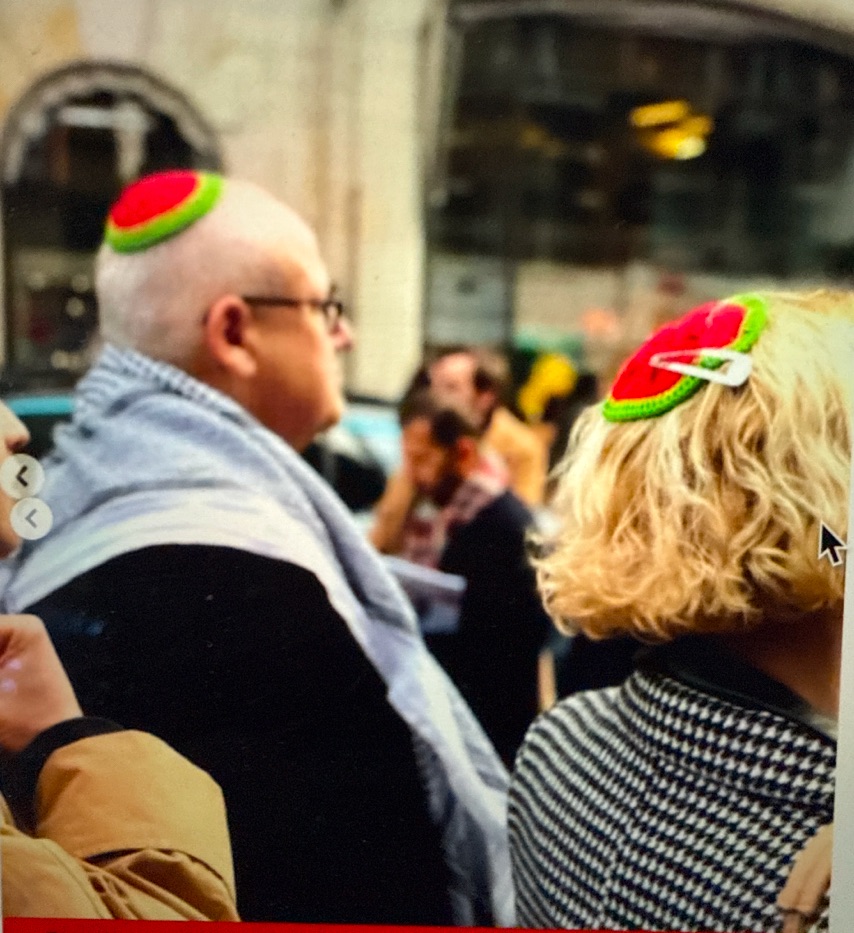
My mind returns to the shop in the Old City, where I see my vendor as he regales friends with the hilarious story of the orthodox Jew from Australia who bought the narrative of Palestinian resistance.
Nowadays I look at that kippah with discomfort. Out of respect for the wounds of my people, I cannot wear it. Perhaps in a far distant future, after longhealing, I might wear it again, to express myself as I am: a Jew, an observant Jew, one who hopes for a better future for Palestinian people.
 howardgoldenberg
Dear Howard,
The humanity and humour are priceless, and beyond creed. May the world find a happier place with more stories about the more uplifting sides of the human condition.
Warmest thoughts,
Lee Meakin, one of your former medical students. xxx
LikeLiked by 1 person
Hi Howard
I love this story. I imagined the whole process as you purchased it. What I also loved is the innocence you had when buying it, and at such a time in the world, I reflected on this innocence which is lost in people.
Itâs interesting how we put so much emphasis on symbols and their meaning to us. What we tell ourselves it all means.
I suppose when we strip all of that away and stay in the present moment and our awareness of that moment, all the stories and narrative disappear.
I love the photo of you in that Kippah, maybe you can wear it within the walls of your home and know exactly what it means to you. Xxx
On another note, Iâve connected with Rachel over the waves of Instagram, and see that sheâs living with an injury which is certainly changed her life for now.
Itâs funny how her and I connected just before Mum passed. We have such similar interests, we are similar in many ways.
I hope youâre all doing well. It would be nice to see you some time x
Kind regards Tracy
I acknowledge the Australian Aboriginal and Torres Strait Islander peoples as the first inhabitants
of the nation and the traditional custodians of the lands where we live, learn and work.
LikeLike
Well-told, poignant story, Howard. I imagine the vendor would have enjoyed telling it from his perspective! Are there any winners
LikeLike
I love the way you look at the world Howard. Please never lose your humour ,even in these dark times. Thinking of you and the family x
LikeLike