A Myrtle in the Middle East

The righteous are called myrtles, likened to a good tree with a pleasant smell…

Rabbi Shmuel Eliezer Edels, the Maharsha

On my way to Hadassah Hospital, I mused on its name. Hadassah is the alternative name of the biblical Queen Esther. As a humble, common noun it means myrtle, a modest shrub with a pleasant scent. To the Persians, Arabs and Jews, myrtle was a symbol of paradise, of purification and rebirth.

A tall thin bloke called Nir and a wider tall man called David, met me at the entrance of the Gandel Rehabilitation Centre of the hospital. We entered by the car park. It looked like any car park. The men opened a great door nearly a metre thick and led me deeper into concrete catacombs. They turned on some lights. I found myself facing underground wards of hospital beds, each equipped with all the fittings of an intensive care department. The great door, the hundreds of beds, Nir told me, have been very recently prepared in frantic haste against the fearful prospect of bombardment by Iran or Hizbullah.

The Gandel Rehab Centre isn’t finished. It wasn’t supposed to be operational yet. Suddenly there was war, instant improvisation followed and this underground place of grim realism was the fruit. 

We ascended.

We emerged into a place of brightness. Here was a functioning rehabilitation ward in full swing. Room after room for Occupational Therapy, Physical Therapy, Speech Therapy, Psychological Therapy. Wide gyms equipped with exercise machines adapted to the limbless and the weakened; to those ravaged by plain civilian disease as well as those torn apart by the machines of war. The equipment, its conceptual ingenuity, the human imaginativeness are marvels. But these were not what I marvelled at. Marvellous is the spirit abroad in these wards of happiness and hope.

I looked around and I saw old people, young people, wounded or weakened by illness, with their clinical attendants, all smiling as they chatted and worked. I’ve never seen such a happy hospital. The hospitals I know reduce their patients to subjects. They erode agency. As patients, we all regress, we’re infantilised. Here at Hadassah I had entered a level community. Hierarchy of authority must surely exist, but I could not detect it. Everywhere I looked, I saw worker greeting worker greeting doctor greeting therapist greeting mother, father, spouse of the afflicted. And the afflicted showed no bearing of affliction. Here was a team and the patient was a member of the team, looking forward.

The palpable harmony and camaraderie cross all lines. I saw Jewish Israelis and Arab Israelis working together, joking together, conferring earnestly about the care of patients. The patients themselves were Jewish and Arab, some whose dress identified them as strictly religious. When I looked I saw difference. The workers looked and they saw only people. David said, the Director of Emergency Medicine at Hadassah is an Israeli Arab. The Chief of Surgery is an Israeli Arab. Outside, a war is raging. People who work here love others who are being hurt or killed. Yet everyone turns up to work. Everyone works to repair people who are damaged.

I wondered how these people hold within themselves their personal pain or sorrow or rage. I marvelled at their tranquillity. Is it their work, their knowledge of purpose, that sustains them? Does the repair of others somehow repair them?

Emerging from the ward into a communal area where people played electronic games and drank coffee, I found myself on a high balcony overlooking semi-arid valleys and gullies and wadis. If I lifted my gaze I could see Jordan. I looked out from this place of repair and allowed myself to hope.
Remembering at the Wall

Jerusalem in high summer. We awaken at 4.30, depart the apartment at 5.00 and already the sky is blue, cobalt blue.

Jerusalem is quiet. The roads are quiet. Quiet is rare in this city that teems with the pious, the fervent, the urgent.

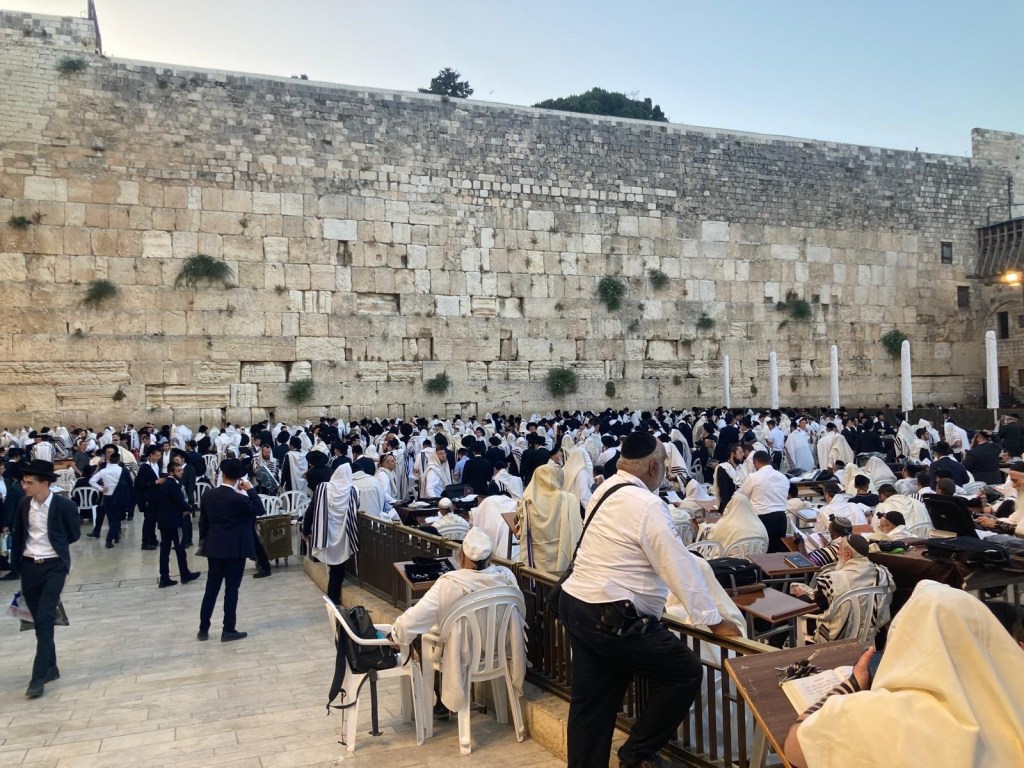
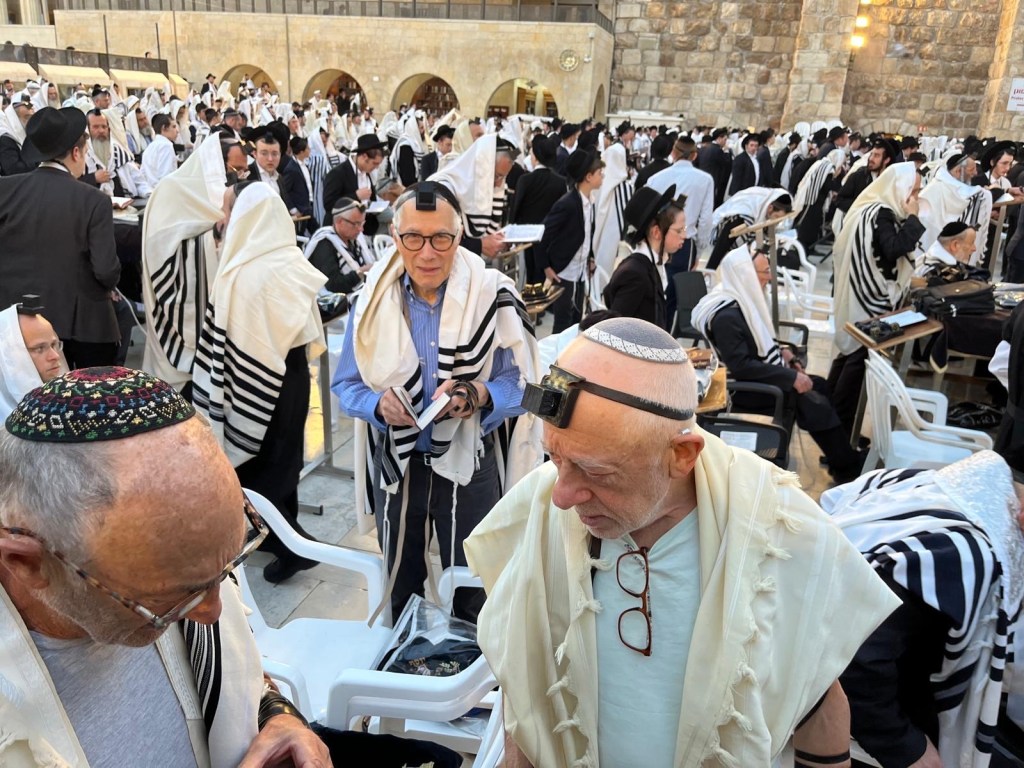
Wondering whether we’ll find people enough at the Wall for a minyan (quorum), we walk with fast steps along twisting ways. We need a quorum in order to recite Kaddish, the mourner’s prayer. Erupting from an alley into the broad square we sight the Wall. Before it, in their many hundreds, the devout, already at prayer.

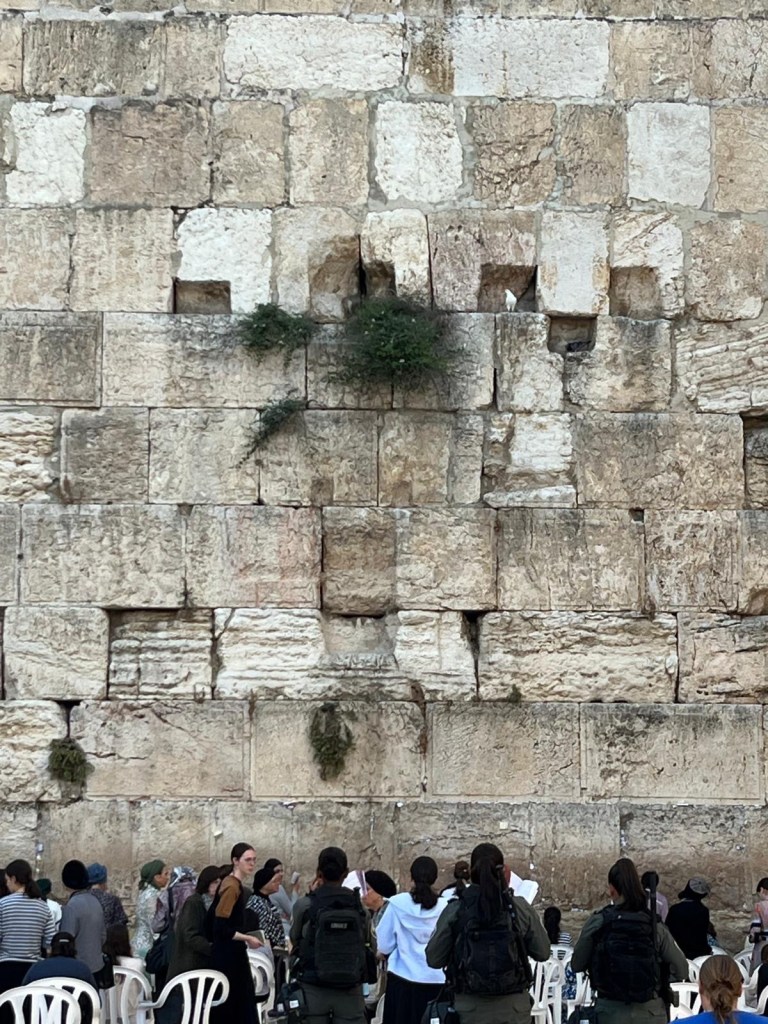
We three are not in mourning, we are here to remember. We are our mother’s surviving children. An indispensable fourth is her son-in-law John, devoted to Mum now as in life. The remembering starts with the first sighting of the Old City’s perimeter wall. How ancient, these creamy stones, mutely dramatic, forever contended. So many conquerors, so many defeats, such passions, stones soaked in blood.


From the plaza, we sight many minyans of minyans, male bodies cloaked in tallithot (prayer shawls). Some wave and sway, others shake metronomically, all moving to intensify intention. One youth in front of me flings his arms to the heavens, his hands clench and unclench in his entreating to God. May his prayers be answered for the good.

Past the beggars, past worshippers of all stripes, past Haredim Caucasian, and Haredim North African, past modern orthodox, past the odd Ethiope, past a pair of the pious deeply asleep, my brother and I wind and wend to the far side where, separated by less than one metre, our sister will hear us recite kaddish.

A memory of my first visit. November 1967. It’s afternoon in early winter, the air crystalline, the skies blue. An impromptu service is in progress. I attach myself to a congregation that is the chance aggregation of the moment. Those elect who are of the line of Aharon the High Priest offer their hands for a Levite to wash, prior to giving the priestly blessing. I raise my washed hands and intone: May the Lord bless you and keep you…

An afterthought lands: here I am, delivering this blessing at the Temple. This my forebears did for centuries until the Temple was destroyed, almost precisely nineteen hundred years ago. My people went into exile. At some stage in the 1800’s my grandfather’s grandparents returned to the land, settling in Petakh Tikvah, the Gateway of Hope, far to the north of here.

Is it possible that I am now, in 1967, the first lineal priest in my family to officiate here since the year 70 C.E.? 

Today, together with my brother I will offer that same blessing. The blessing concludes: May the Lord lift up His face unto you, and give you peace.

Peace!

Our mother was a serene soul. She lived a long life of love, somehow happy through all of life’s losses and afflictions. Today, I remember her and honour her, without sorrow or pain. Late in her life, Mum said to me, You know I never did anything remarkable or distinguished. I never was famous or exceptional. But I did give birth to four children and I raised them and they all love me. So I suppose I was successful.

Mum, you don’t know the half of it: so well did you love us four, that every single one of us felt sure that we were your favourite.

Mum lived her life of peace. I can imagine her in no other state than peace. She went with heart at ease. My tears today are not for Mum. I shed a few sweet tears for this son who misses her. But many are my tears for my people, detested today, deserted by fair weather friends, threatened today, abroad and at home. There is tension in the air, fear too, appalled pain and grief. And mighty resolve.

But here, at this hour of pure air and quiet, Jerusalem is at peace. Have I ever attended prayers so quiet, so ruly? We hundreds recite the words, a soft hum rises from many lips. Until the Amidah (the silent devotion). Quietnessnow, perfect and complete. Torsi swing, sway and shake, hands clench and unclench. 

Prayers completed, kaddish recited, Mum honoured, I make my way to my sister Margot. We fall into a fierce hug that does not quickly end. My body heaves with sobs. I’m a good sobber. There’s much to shed tears about. Tears for the present pain, tears of hope for the future good.

White dove high in the cleft of the Wall

The Mufti at the Synagogue 

Rachid Imam lives in Diamond Creek, where I used to live. We both raised our families there. In a country town of white faces there were a very few Maltese, the odd Italian and the Chinese wife of my medical partner. I was the Jew on the Main Road and Rachid was the Muslim on the hill. For many years we ran together. As we ran we’d speak of our families. Rachid told me he was the second of three brothers, the black sheep.

He spoke tenderly of his Mum, born into a Christian family, who fell in love with Fehmi El Imam, formerly of Lebanon, since 1951 a resident of Melbourne.
Rachid told me how his Mum left Melbourne, travelling to London where she applied herself to the study of Islam. There she converted to that faith, returning to Melbourne with that as her surprise gift for Fehmi. They married and eventually brought their black sheep into this world – a sheep pale enough to do the pilgrimage to Mecca with his Dad and his daughters. I greeted him with, ‘Salaam, Hajji Rachid!’
Rachid and I had been friends for years before he said with quiet pride: ‘Fehmi came here as a young scholar. The community needed a teacher. Now he’s Mufti of Australia.’
After nearly thirty years the time came for me to leave Diamond Creek. The local Methodists lent their hall for a communal afternoon tea. Rachid made a speech. He mentioned my offer to circumcise his child (how was I to know she was a girl?), he mentioned my tendency to arrive for a run before six on a Sunday morning, waking him and his sleeping girls. After he finished reminiscing he called me up on to the stage and he kissed me – twice – once on each cheek. Then he took the microphone and declared, ‘I’ll run with you anytime, anywhere, my Jewish brother.’
Some years before I met the Sheikh my elder daughter married. At her wedding I watched with delight the son of Australia’s Mufti dancing a hora with the President of the Zionist Federation of Australia.
Yesterday Rachid’s father died. 
I knew Sheikh Fehmi’s health was failing. I’d heard of his stroke, I knew his wife had died years earlier. Today Rachid and his brothers and his sister will observe the rituals of burial and receive condolences from their thronging community, from high dignitaries to the Muslim in the street. All those familiar old rituals, all those echoes of the mourning I observed with my brothers and my sister after our father died.
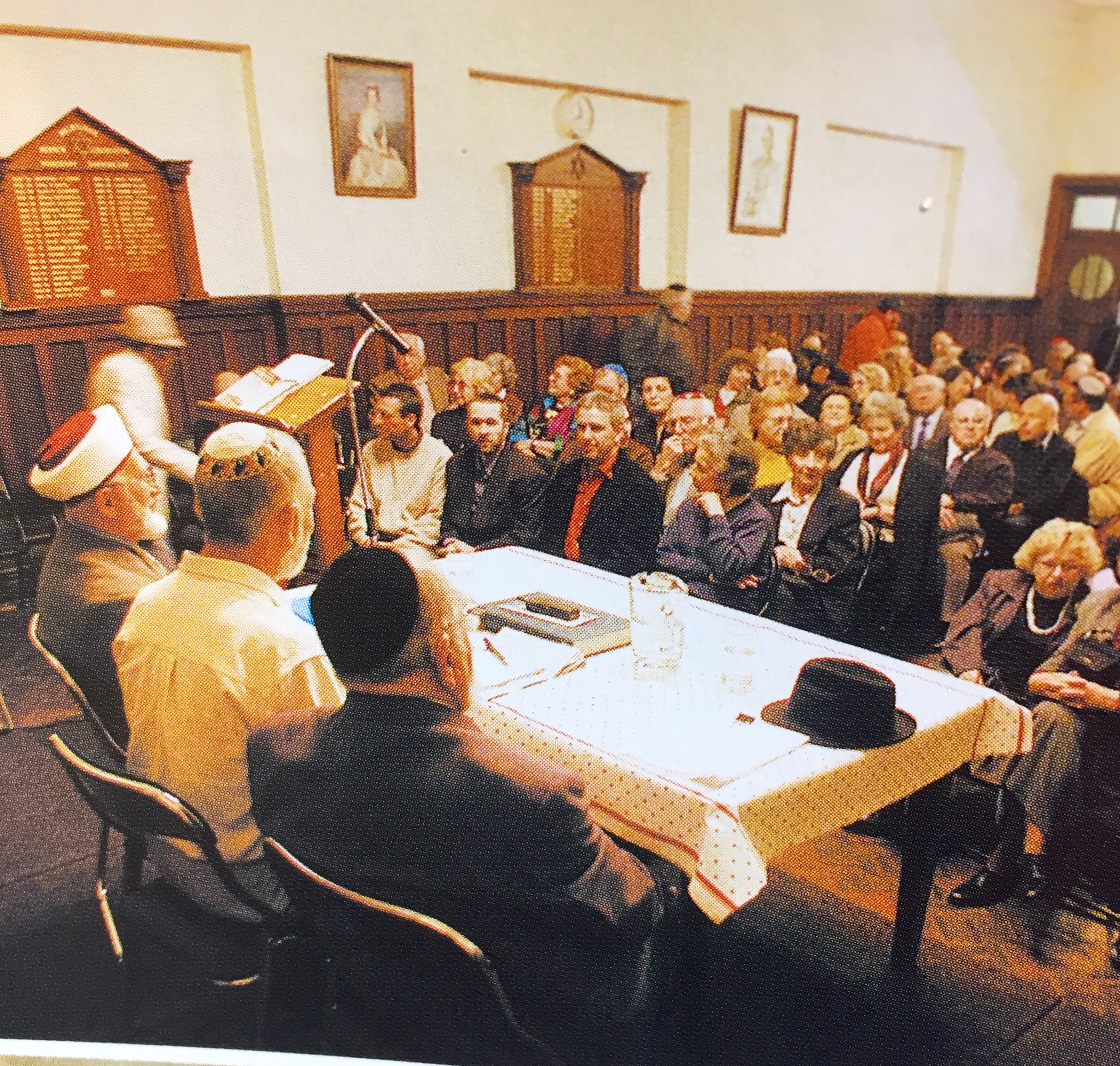
I met the Sheikh but once. It came about like this: my family has belonged to the Melbourne Hebrew Congregation since 1853. Like most members of that grand synagogue, I seldom attend its services, but I remain a member. Every so seldom the Congregation runs a communal cultural program. Around the year 2000 my brother asked me if I’d ask Rachid if he’d ask his Dad to join a Rabbi one evening and each would address the members on the question, ‘Do we Need to be Afraid of Islam?’

photos courtesy Destiny Magazine Melbourne Hebrew Congregation


I agreed, Rachid agreed and Sheikh Fehmi agreed. Were we foolhardy? I imagine we all heard the same challenge, unspoken, inescapable: if not us, then who? On the appointed night Rachid met me on the footpath and introduced me to his father and to his brothers. The brothers stood either side of their father. It was clear they were there to support him – and if need be – to protect him. The Sheikh wore a traditional head covering. One son wore a kaftan.
The clergy were to speak in the Social Hall. I offered to show the Sheikh the synagogue’s interior. He was interested. I found some light switches, we entered and I saw the place – a little emptier than usual – with new eyes. I took in its splendor and I sensed from the Sheikh’s reactions the Mosque in Preston was a more modest affair.
We went upstairs. The clergy were introduced to each other and to the audience. The hall was full, people were standing in the aisles, the atmosphere was intense. I saw faces I knew, some of them of people I knew to be mistrustful of Muslims. I was to be the moderator. I welcomed the reverend gentlemen and I reminded all present that the Rabbi and the Sheikh were our guests and I would insist we conduct ourselves on our shared principles of Abrahamic hospitality.
The rabbi spoke uncontroversially on the history of Jews and Muslims. The Sheikh spoke diplomatically on the principles of his faith. He explained the precept of Jihad: ‘Every Muslim must practise Jihad. Jihad, simply, is struggle. It is not warfare. It is, fundamentally, the struggle within to live a godly life.’ The voice that spoke these words was unemphatic, mild, genuine – a teacher’s voice rather than a preacher’s.


Questions followed. Mistrust found its voice. Fehmi never raised his voice. He spoke with quiet dignity. Abraham took a bruising that night at the synagogue, but his hospitality was not broken. Sheikh Fehmi’s bodyguards did not need to rise to his defense.
After our evening at the synagogue I never met Fehmi El Imam again. Later I askedWaleed Aly how the Sheikh was regarded in his community. ‘He’s a very gentle soul, widely respected, he wants a convivial relationship between the faiths in this country.’ I wondered how the Mufti avoided the sectarian conflicts of his diverse community: ‘Fehmi has been around as an Imam for some fifty years, he has an Order of Australia, he is very widely respected and highly regarded. He’s untouchable,‘ said Waleed.


Yesterday Rachid’s family lost a patriarch. His grandchildren lost their Jidoo. The Australian community lost a peacemaker. An asset increasingly scarce has passed. He leaves, within the breast of this infidel at least, an abiding resolve, a personal ‘jihad’ for peace and harmony. The Islamic Council of Victoria said: ‘Former Mufti of Australia, Sheikh Fehmi Naji El-Imam moved to the mercy of God this morning.’

Smoking the Peace in the Middle East

We stand on the Tiberias to Tel Aviv highway waiting or the early morning inter-city bus. As we anticipated the bus is crowded with soldiers and civilians returning to work after the Passover
holiday. My wife and the two grandchildren struggle into the bus, informing the driver that we have four suitcases that we’ll need to stow in the luggage compartment below. The driver activates a switch and a hatch opens. The luggage compartment is too full to fit a sandwich. I stand on the pavement with my four suitcases and a thoughtful expression. A soldier just old enough to grow a few whiskers has a backpack to stow. He leans deeply into the luggage compartment, bending his slim back, hefting, pulling, piling, jamming items of baggage together. He has created ample space for his backpack.

But he steps over his own luggage towards my array, grabs a suitcase in each hand and thrusts them into the space he has created. Again he leans, lifts and shoves. Somehow our cases are all aboard. I hoist the soldier’s backpack, find an interstice and widen it, shove the pack in and hope. The hatch closes and we two ascend, the last of the riders. I pay the modest fares for the 170 kilometre ride for four passengers. The driver apologises: regulations require him to charge the two thirteen-year olds full fare. He is sorry, what can he do? – he asks with a raised shoulder.
Inside the bus all seats are occupied. Three young soldiers lie in the aisle, one sleeps while the other two busy themselves with their screens. From the rear seat a figure in civilian red rises, beckons to me, indicates the seat he has vacated. I must sit.

Amused, grateful, mildly embarrassed, I tell him I’m alright mate.

No, he says, I must sit.

I shake my head.

‘Please sir, sit. Next stop, I descend.’

Three recumbent soldiers in the aisle rise with good grace and make way for the old man with his bulky backpack.

We emerge from the two-hour bus trip at Tel Aviv’s Central Bus Station. Passover has just come to an end and we are looking forward to eating leavened breads again. We emerge from Security and see before us a huge array of croissants, bagels, seeded rolls and pastries. I take the family’s orders and approach the squat woman behind the counter. ‘Two double espressos, one croissant, one chocolate turnover, one danish pastry, please.’ The woman maintains a studied silence. I stand for a moment, nonplussed. Has she not heard me? Is it perhaps, self-service? Is she perhaps deceased?

After a good time the woman passes me three paper bags. She manages to do this while turning her back to me. She has not spoken. Feeling like a semi-licensed thief I fill the three bags. Mrs Pastry now leans over her ranks of post-paschal breads in my direction, proffering coffee in a paper cup. A second follows. Still, no conversation. 

‘By what sum am I indebted to you?’ – I ask in my courtly, non-colloquial Hebrew.

The oracle now speaks: ‘Forty.’


Ellie looks up and laughs through her mouthful of chocolate yeast turnover: ‘Look Saba, Savta!’

We look towards the tee-shirt shop next to Mrs Pastry’s, where Ellie indicates a shirt in pink with the text:
DON’T WORRY

BEYONCE.
‘Ellie, would you like shirt like that?’

Ellie would like a shirt like that.
Ellie and I enter the tee-shirt emporium. Hundreds of tee-shirts of modest price and quality hang from cords suspended from the ceiling. All the shirts are suspended high, beyond human reach. Safe from theft they are also unpurchasable without human help. We look around us. Moving browsily beneath the display a handful of humans considers the merchandise. One sits, cross-legged on stool, like patience on a monument, entirely still. This person is slim, petite, elegantly presented.Her lips are the colour of venous blood. Her skin and hair are of midnight black. I approach her. She does not speak or move.

Hazarding a guess, I ask, ‘Do you work here?’

The merest of nods.

‘My granddaughter wants to buy the BEYONCE tee-shirt.’

Movement now as a slim arm emerges from behind the slight torso. Between two fingers of the hand at the end of the arm sits a cigarette.

The confessed employee inhales deeply and silently.

No verbal response. Perhaps we have visited her workplace during her sabbatical.

‘Can you help us?’

The Queen of Sheba points her cigarette over our heads. We turn and look up and backward for the shirt. We cannot sight it. 

We gather we have made our visit at a time when the spirit of enterprise is not active.

Ellie, richly amused, decides she can be happy without beyonce.

Instead, chuckling, she takes photos of the the tee-shirt in the display.  
At ‘Abulafia,’ the Palestinian bakery in the ancient port city of Yaffo, men in pious black yarmulkas queue to buy pastries from Palestinian men in tee-shirts.

In Hebrew and English the shopkeepers wear tee-shirts reading, ‘Jews and Arabs refuse to be enemies.’ Others wear shirts that read, ‘Headquarters of Israel-Palestine peace.’ As shopkeepers the peacemakers are indistinguishable from Jewish Israelis in their generous disdain towards customers. My wife, an attractive grandmother, speaks a clear and correct Hebrew. The bakery boys affect not to understand her menu enquiries. One shrugs and directs Annette to his colleague. He too affects non-comprehension. He winks at his colleague and turns away from Annette, his face closed.
When a second customer approaches, Annette’s two refuseniks compete to serve her. This newcomer is forty years Annette’s junior. 
Now I try my luck. ‘A toasted pita please, with salad filing.’ The man I address does not look in my direction. Like a magician, he flicks an unseen cigarette from nowhere into his mouth. Exhaling dragon-like he grunts something indistinguishable. I look around, find myself the sole customer and ask, ‘Pardon?’

‘Harif?’

Harif is the Hebrew term for shrewdly intelligent. In fast food places it means, ‘spicy.’

‘A little, please.’

This is the second time I have spoken the P-word. ‘Please’ gives me away as surely as it betrayed Annette. Despite our better than serviceable Hebrew, we have revealed ourselves as that least assertive of all tourist species, the Anglo-Saxon.

A second smoker materialises, slides my pita into a toasting oven, smoking all over my lunch in transit.  

Moments later, seated on ‘Abulafia’s’ dusty stone steps we enjoy our smoke-toasted borekhas, pitot, and pastries. Too hot to handle, ridiculously inexpensive, memorably good. 


Worst of Times, Best of Times

Ours is a world in agony. The holy is awash in profanation. Men hear the voice of a ravening god that sends them to cut off heads. Others kidnap children in the name of a god. Again the toxic cohabitation of religion with violence, the foul marriage that brought us the Crusades, the Spanish Inquisition and Bushido on the Burma Railroad.

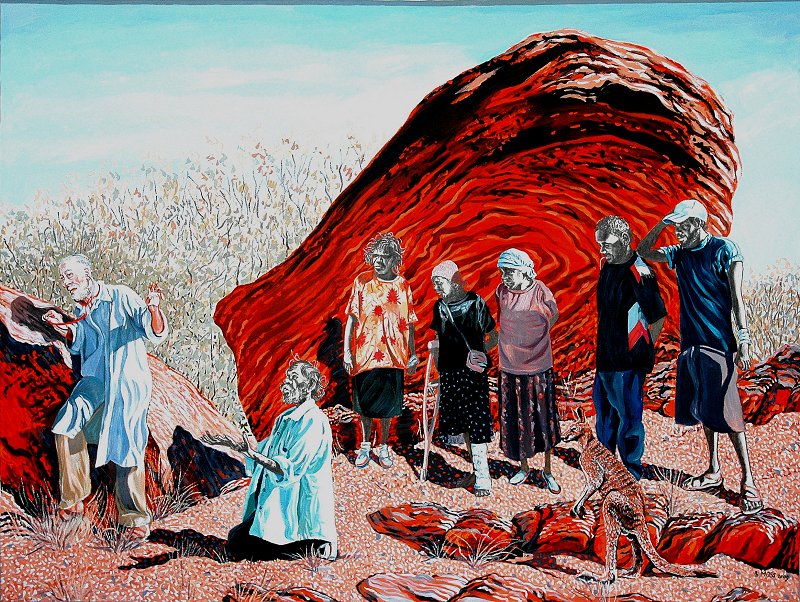
In the centre of our own country the Hayes clan lives at Whitegate, a ‘town camp’ in Alice Springs. The site is ancestral land going back to a time before the counting. Last week local government cut the water supply to Whitegate. The power died there some time ago. The cold desert nights are bitter.

How to breathe? Where to find hope? Why believe in our species at all? What light can we show our small children?

Last week the International Council of Christians and Jews honoured Debbie Weissman, a veteran worker across the tribes and creeds, building frail bridges of peace. Peace has broken out in Gaza-Israel. Rod Moss, artist and writer, chops wood and hauls water to Whitegate.

The peacemakers, the hewers of wood and drawers of water: these small signs. I clutch at such as these.

She Would Not Look at Me

Only three days following the fall of the twin towers the Israeli author and journalist David Grossman wrote a thoughtful piece that was reprinted in The Age. The first and always casualty of terror – he wrote – is trust. You do not trust your fellow citizen, you feel you cannot afford to. Your neighbour of yesterday might be your enemy of today. Community is the casualty.

In the happy isle in which I live and move and work, terror and war and conflict are seldom seen. Insulated as we have been we could afford still to trust – long after other communities had been rent apart into fractions and fractious factions. So it is that when I go to work at the hospital for sick children, one half of my children come from homes where the first language is not English. There is a bridge of trust between us, where we meet and work harmoniously. Fifty percent of the non-anglophone families are Muslim. The parent looks at me, sees an oldish man in a skullcap. That adult thinks whatever she thinks but receives and returns my asalaam aleikum courteously.
Sometimes cautiously, often gladsome, the adult moves towards me across our bridge of trust and we meet. Minutes later, the old man in the yarmulka is no longer an infidel, a foe: he is just a person who understands the child’s illness and who cares about that child and can help. My guest sees in the Jew a fellow human.

Now the children of Abraham are locked in cousin conflict again. My first Islamic parent identifies himself as Ibrahim. He smiles at his cousin’s greeting and returns it.
Later a tall dignified woman, taciturn, her head veiled, her face exposed, meets the doctor who will treat her child, with evident displeasure. She has no smile. Her daughter’s earache, which has been distressing, is easily diagnosed and will be readily relieved. I know I can help her and within minutes I have. The child is five years old. She does not speak,a mutism that can be explained by shyness, by a lack of English, by illness, or by family custom. But her mother, face tight throughout, spares few words and no smiles for the doctor. After I have explained the nature of the illness, its treatment and its happier future course, there is no thaw. I express the hope and the belief that the child will be soon well, insh’allah.
No smile.
There is a war.
The bridge is broken.

Whom* By Fire, Whom* by Knife and Fork

The High Holydays are almost upon us. Jewish people are reflecting on their ways, repenting, seeking forgiveness from those whom* we have wronged, resolving to do better in the coming year.

The seasonal liturgy lists an intimidating list of “who’s” – fire, water, hunger, thirst; who in his allotted span and who before his span; who will be at peace, who will wander; who will pass in quietude, who in agony.

It makes you think.

The liturgy does prescribe antidotes – prayer, sincerely remorseful penitence and charity.

On the eve of Rosh Hashanah Jewish families gather to overindulge. We will be fifteen at our table and we’ll consume one bottle of wine and three sheep, numerous hens and sundry kine. We eat too much and drink too little. Next day, following a synagogue service lasting about five hours we go home and gorge ourselves, thereby putting ourselves at risk of “whom by knife and fork.”

We eat apple dipped in honey and we take honey on our round loaves of challah (read brioche, the “ch” in challah being like the final throat-clearing sound in Bach; the ch in brioche the same as in douche). The honey suggests the wish for a year of blessing. In our case that sweetness resides in the grandchildren who will throng and riot around our table, ensuring our New Year commences not in quietude but in full throated life.

My wish for my reader/s is that you might find this blog rewarding in the year to come, that you might buy the books that I’ll flog to you (a novel – Carrots and Jaffas – in early 2014; and A Threefold Cord – a novel in 67 chapters for 8-10 year olds, also in 2014, if not before.)

More disinterestedly, I wish for peace in the Middle East, a Collingwood premiership – at the moment both appear equally likely – and a year of euglycaemic health for us all.

Expressed as Shana Tova u’metukah

Sincerely,

Howard Goldenberg

*I realize that Leonard Cohen sings “Who by fire”. Likewise “Who” appears in the English translation of the Hebrew prayerbooks. However, I am persuaded on grammatical grounds that it is not what you know in this life that matters but whom you know.

In Israel

Parable: A frog is swimming in the River Nile. A scorpion hails him from the bank: will you please give me a ride on 

on your back across the river?

The Frog replies: no, you’ll sting me and I’ll die.

Scorpion: no, I wouldn’t do that.

Frog: word of honour?

Scorpion: word of honour.

Frog, swimming over to the bank: alright, climb onto my back.

All is well until they are halfway across, when the scorpion suddenly stings the frog.

Frog, dying: why did you do that? Now I’ll die and you’ll drown.

Scorpion, drowning: this is the middle east – what did you expect?


I understand President Obama is visiting Israel at precisely the time as the visit of my family. I believe this to be a coincidence: neither party knew the other was coming.

However it seems their agenda might be the same.

At the play centre today, a bigger boy, perhaps 4 years old, pushed grandson Joel, aged one year and 358 days. Joel fell over. He arose and pushed the other child.

Joel’s mother said: Don’t push, darling. 

Another who mother had witnessed the exchange of shoves, interceded on Joel’s behalf: Really your boy was simply defending himself. The bigger boy started it.

Joel’s mother thought for a moment: Yes, but it doesn’t solve anything does it?

Joel’s defender, smiling: You can’t have lived here very long. Of course, you are right, it is not a solution. But tell me, tell us all – everyone here needs to know – what do you suggest?


Copyright, Howard Goldenberg, 19 March, 2013