The Sounds of Two Silences

Since its inception, this blog has proceeded on tiptoe. Ever since my own inception as a person conscious of myself, this blogger has walked on the tips of his toes. We have been moderate, fair, civil, politically correct. This blog and I don’t like stridency. Not for us the megaphone,but the voice of sweet reason. We’ve been progressive, we’ve been likeable, and we’ve been liked.

Until we ceased being likeable and started to appear tribal. Tribal is not so likeable. This blog has not been liked much since… well, since October 7 last year. Over that period we tiptoed less.

Allow me to explain what I mean by tiptoe, and why we do it. By ‘we’ I mean Jewish Australians. But I could just as easily refer to minority Australians of all stripes. We walk on tiptoe, careful, so careful not to tread on the toes of others. We walk on tiptoe as an act of self-humbling, as an act of apology really. We understand how a turban or a hijab or kippah marks us as different. We understand how difference piques discomfort. We don’t wish to offend or confront. We tiptoe so we’ll be excused for being not entirely the same. 

From very early in our lives as minority Australians we know we represent our tribe. As children starting school, we know that all of us Sikhs, all of us Moslems, all of us Jews, all of us Africans, Asians of every origin, all of us Indigenous people – we all must behave nicely in public, because we kids stand for all of us. If one of us misbehaves or offends or speaks our foreign language too loudly in public, we all will be judged. Our entire group will be judged by the worst of us. Speaking only for myself, this self-consciousness has weighed but lightly. It feels good to behave likeably because Australian people broadly reward us with affection.

There’s a very good reason for anyone – for everyone – in Australia to tiptoe. Once they see past the difference, once they see you’re just like them, Australians embrace you. You feel the love, you return the love. 

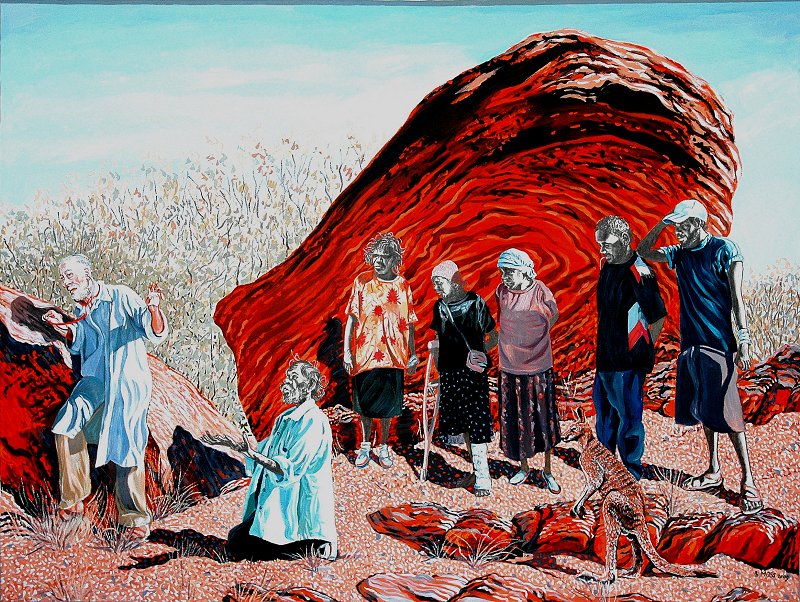
Over the decades that I have worked among AboriginaI people I have witnessed much conduct that seems placatory in nature: voices normally loud, lowered for the whitefella; rage directed at their own people rather than at the dispossessor; humble acceptance of the Gap that never closes. It’s at once excruciating and absurd that a First Owner might feel obliged to live a life of apology.

Tiptoeing can be detected, I think, in highly unexpected places. Have a look at photos of women in public life. Note how many face the camera with head held a little aslant. You don’t see this posture in the public male. When I see this, the woman’s face is invariably smiling. The posture and the smile win trust; they say, ‘Yes, I am successful, I am known, but don’t worry, I’m not a threat.’ In a country where a woman dies every week at the hands of a man, such tiptoe might be ingrained in childhood. I like the images of a woman facing the camera squarely, without the obligatory smile.

Until the turn of this century, my tiptoeing was unnecessary. If I tiptoed, I did so, not on account of outside hostility, but on account of my own native timorousness. Until about the year 2000, I had tiptoed beneath my public kippah. But tremors, intimations, opinions, voices, all drove my kippah into hiding. I walked the ways and byways of this beloved country with my kippah in hiding beneath a non-sectarian hat. Only within Aboriginal communities was my kippah nakedly seen. My mob was much honoured by their mob. 

Was I being over-sensitive in the mainstream? Possibly so. But come October 8 last year, when the mob outside the Opera House howled and burned flags and hunted Jews, there was no mistake. Look online where hatred of Jewish people has found its voice, where all shame has been shed, and know why I might walk on tiptoe. 

But I’ve stopped apologising for being Jewish. My kippah can be seen again wherever I go now. It asks Australia a question. And Australia answers with a nod or a smile or a pat on the back, as I guessed it would. But not so on this blog: I suspect I have confused my readers, whom I guess are mainly of progressive mind. Since October last year I have written as a Zionist – albeit as a supporter of Palestinian aspiration – and I sense progressive peoplefind this confronting. I think my readership feels nonplussed. Hence the likeable bogger is no longer ‘liked’. I imagine also that my gentle readers wish to protect my feelings by their reticence. 

Hence, silence.

But I’m not afraid of civil debate. We can agree to disagree. Most days I disagree with myself.

Awful conflict in the Middle East has polarised Australians. A hush has fallen. For many, feelings are too strong for calm utterance. I understand this, because my own feelings are so strong and so painfully conflicted. But that conflict on other shores need not silence us on racism on our own shores. I feel confident the silent majority of Australian people detests anti-semitism. The majority is nonplussed, often offended and irritated by this hatred and wishes us well. The great problem here is the very silence of the silent majority. Anyone who is offended by racism and who remains silent misses a precious opportunity to protect and repair harmony in our community.

A Myrtle in the Middle East

The righteous are called myrtles, likened to a good tree with a pleasant smell…

Rabbi Shmuel Eliezer Edels, the Maharsha

On my way to Hadassah Hospital, I mused on its name. Hadassah is the alternative name of the biblical Queen Esther. As a humble, common noun it means myrtle, a modest shrub with a pleasant scent. To the Persians, Arabs and Jews, myrtle was a symbol of paradise, of purification and rebirth.

A tall thin bloke called Nir and a wider tall man called David, met me at the entrance of the Gandel Rehabilitation Centre of the hospital. We entered by the car park. It looked like any car park. The men opened a great door nearly a metre thick and led me deeper into concrete catacombs. They turned on some lights. I found myself facing underground wards of hospital beds, each equipped with all the fittings of an intensive care department. The great door, the hundreds of beds, Nir told me, have been very recently prepared in frantic haste against the fearful prospect of bombardment by Iran or Hizbullah.

The Gandel Rehab Centre isn’t finished. It wasn’t supposed to be operational yet. Suddenly there was war, instant improvisation followed and this underground place of grim realism was the fruit. 

We ascended.

We emerged into a place of brightness. Here was a functioning rehabilitation ward in full swing. Room after room for Occupational Therapy, Physical Therapy, Speech Therapy, Psychological Therapy. Wide gyms equipped with exercise machines adapted to the limbless and the weakened; to those ravaged by plain civilian disease as well as those torn apart by the machines of war. The equipment, its conceptual ingenuity, the human imaginativeness are marvels. But these were not what I marvelled at. Marvellous is the spirit abroad in these wards of happiness and hope.

I looked around and I saw old people, young people, wounded or weakened by illness, with their clinical attendants, all smiling as they chatted and worked. I’ve never seen such a happy hospital. The hospitals I know reduce their patients to subjects. They erode agency. As patients, we all regress, we’re infantilised. Here at Hadassah I had entered a level community. Hierarchy of authority must surely exist, but I could not detect it. Everywhere I looked, I saw worker greeting worker greeting doctor greeting therapist greeting mother, father, spouse of the afflicted. And the afflicted showed no bearing of affliction. Here was a team and the patient was a member of the team, looking forward.

The palpable harmony and camaraderie cross all lines. I saw Jewish Israelis and Arab Israelis working together, joking together, conferring earnestly about the care of patients. The patients themselves were Jewish and Arab, some whose dress identified them as strictly religious. When I looked I saw difference. The workers looked and they saw only people. David said, the Director of Emergency Medicine at Hadassah is an Israeli Arab. The Chief of Surgery is an Israeli Arab. Outside, a war is raging. People who work here love others who are being hurt or killed. Yet everyone turns up to work. Everyone works to repair people who are damaged.

I wondered how these people hold within themselves their personal pain or sorrow or rage. I marvelled at their tranquillity. Is it their work, their knowledge of purpose, that sustains them? Does the repair of others somehow repair them?

Emerging from the ward into a communal area where people played electronic games and drank coffee, I found myself on a high balcony overlooking semi-arid valleys and gullies and wadis. If I lifted my gaze I could see Jordan. I looked out from this place of repair and allowed myself to hope.

She Would Not Look at Me

Only three days following the fall of the twin towers the Israeli author and journalist David Grossman wrote a thoughtful piece that was reprinted in The Age. The first and always casualty of terror – he wrote – is trust. You do not trust your fellow citizen, you feel you cannot afford to. Your neighbour of yesterday might be your enemy of today. Community is the casualty.

In the happy isle in which I live and move and work, terror and war and conflict are seldom seen. Insulated as we have been we could afford still to trust – long after other communities had been rent apart into fractions and fractious factions. So it is that when I go to work at the hospital for sick children, one half of my children come from homes where the first language is not English. There is a bridge of trust between us, where we meet and work harmoniously. Fifty percent of the non-anglophone families are Muslim. The parent looks at me, sees an oldish man in a skullcap. That adult thinks whatever she thinks but receives and returns my asalaam aleikum courteously.
Sometimes cautiously, often gladsome, the adult moves towards me across our bridge of trust and we meet. Minutes later, the old man in the yarmulka is no longer an infidel, a foe: he is just a person who understands the child’s illness and who cares about that child and can help. My guest sees in the Jew a fellow human.

Now the children of Abraham are locked in cousin conflict again. My first Islamic parent identifies himself as Ibrahim. He smiles at his cousin’s greeting and returns it.
Later a tall dignified woman, taciturn, her head veiled, her face exposed, meets the doctor who will treat her child, with evident displeasure. She has no smile. Her daughter’s earache, which has been distressing, is easily diagnosed and will be readily relieved. I know I can help her and within minutes I have. The child is five years old. She does not speak,a mutism that can be explained by shyness, by a lack of English, by illness, or by family custom. But her mother, face tight throughout, spares few words and no smiles for the doctor. After I have explained the nature of the illness, its treatment and its happier future course, there is no thaw. I express the hope and the belief that the child will be soon well, insh’allah.
No smile.
There is a war.
The bridge is broken.