Retrogressive

“Progressive” has become a label. People who identify with an underdog claim that title, people who care and work for a fairer world. That would be me.

Progressive people are derided by conservative people by the term, Woke. That would be me. The term Woke is meant to hurt and it hurts me.

Back in the times before it became a label, I used to be progressive. Of course the word progressive is an adjective, like big, or old or green. In the past I wouldn’t have called myself a Progressive, any more than I’d have called myself a Big (which I am not), or an Old (which I am), or a Green. Very many people identify as Greens. I’m green: I’m concerned for the environment and live accordingly. However in Australia, the Greens as a political party are an organised mass movement hostile to Jewish people. (The Greens will deny, hand on heart that they are anti-semitic. But I am a Jew who judges them by the harm they do, not by their ever-so-pure, who-me? intent.)

We Jews hear a Greens voice that allows our people no homeland. The Greens voice that Australians hear is not heard on Hamas terror. It’s a voice that cannot pronounce the word rape when committed by Hamas.

The Greens of course, would claim to be progressive.

So I’m not a Progressive, that proper noun that’s a self-label. In the days when I knew myself as progressive, rape was rape, and rape was always hideous, always condemned, always wrong. In the days when I was progressive, we who embraced the underdog were capable of civil agreement to disagree. In those times those who embraced Palestinian people as underdogs did not vilify those who supported Israel. They did not deny our humanity. That inhuman individual would be me, Zionist, former progressive. 

Progressive people knew once the dignity of difference. We might be Zionist or non-Zionist or anti-Zionist, and we could hear each other. We could see the human face of one with whom we disagreed. 

We had not learned to cancel.

Progressives have made progress. They’ve progressed to shouting where previously they’d debate; to shaming where they’d show respect; to cancelling and to doxing. Once upon a time Progressives used to be democrats. The Progressives have progressed far out of sight, so far they cannot be recognised. They have followed the logic of their self-contradiction to their present morass of moral confusion. Many Progressives – in my speculation most of them – mean well. Many are young and are uninformed and susceptible. Some become useful idiots manipulated by older persons, agitators for one cause or another or every cause de jour.

So I am one whose constituency has moved on. I am one left behind, marooned in a once-was world, a world of outmoded values like decency, like openness to the other, like mutual respect. I am stuck in a past where we could agree to disagree.

I guess I have to accept I am not progressive. I need a new noun. Call me a Retrogressive.

The Watermelon Kippah

In June 2024, I flew to Israel to support my loved ones in the continuing emergency. The anniversary of my mother’s death fell during my visit, and together with my sister and brother, I went up to Jerusalem to offer prayers at the Wall in memory of our Mum.

Afterwards we meandered through the Old City on foot. Passing one of the Arab-owned shops, my eye fell on a bright red kippah. I needed to replenish my supply of such items, on account of the holy thieves – mainly my grandchildren – who borrow mine and never return them. I had a rough idea what such a kippah might cost, around AUD$15-25. I did the conversion: about 35-60 Israeli Shekels.

I picked up the kippah and tried it on. About the right size and weight, nice and lairy. I decided to buy.

How much for this one?

For you, my friend, ninety shekel.

I did the conversion. Forty bucks? Tell him he’s dreamin.

I understand the rules. We are supposed to bargain. We’re scripted to do so. The  vendor is a professional at this, I a poor amateur. Further, I’m constitutionally disposed to drive a soft bargain. The vendor will surrender to my best offer and I will end up overpaying. Afterwards the vendor will celebrate discreetly, chuckling at my innocence.

I make my counter offer: I can’t pay ninety. I’ll pay forty.

No, no, my friend. This one costs me more than forty. 

We look at each other, hiding our amusement. He’s sizing me up.

Tell me mister, you speak Hebrew with accent. You are maybe British?

No, not British.

The vendor’s eyes brighten. Maybe American?

Americans are richer.

No, I’m Australian.

Ahh? Tell me Mister Austria, how much you pay? Not forty…

Forty-five.

This one is very fine knit. Look at the knit, how good.

I look at the knit. Indeed it is fine. And brilliant in its contrasting red and green.

Try it on. I show you in the mirror.

Once again I try it on. I admire myself. I shake my head, remove the kippah and make to walk away.

The vendor calls, In Austria, Mister, you don’t find such a one.

Actually, I’m from Aust-ralia.

Australia? So far! …

My friend, for you, I accept forty-five.

I smile. The vendor manages to appear wounded, grieved. Money changes hands and two happy men exchange farewells and part. I realise who here is the victor. I realise my opposite number will laugh about Mister Australia.

In due course my bright kippah and I fly home.

Some months pass. I am to attend a book launch. I dress to kill, choosing my new kippah.

A friend observes: I like your Palestine Kippah.

What do you mean?

The watermelon design. It’s an emblem for Palestine.

Is it?

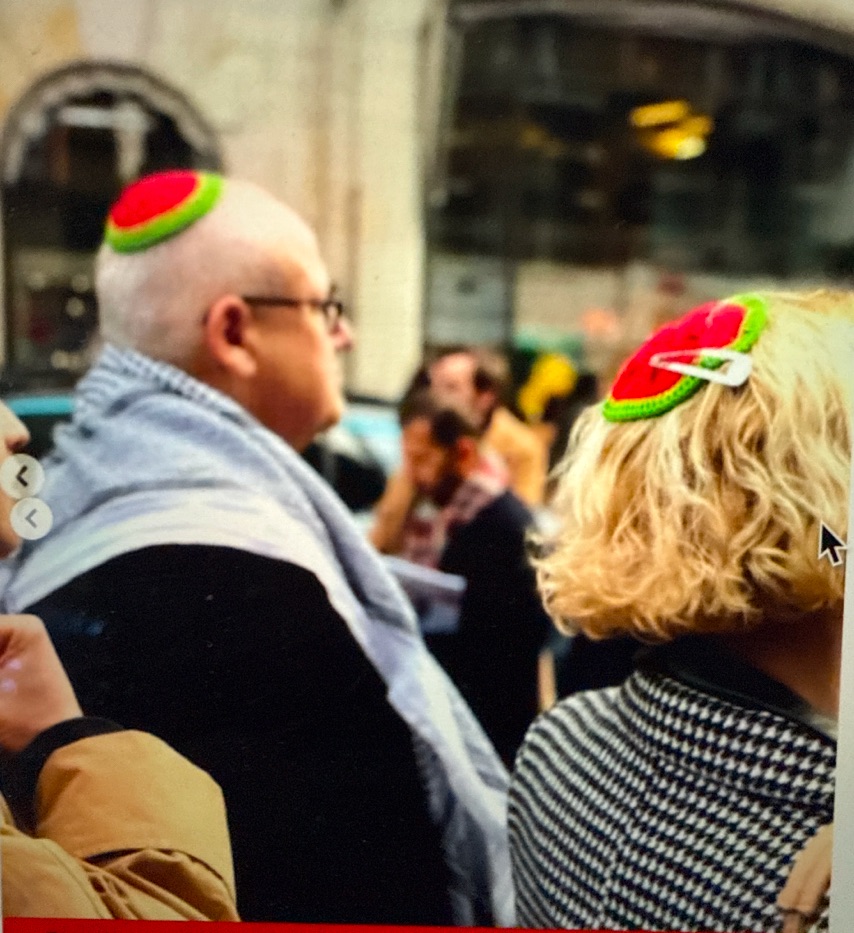
Later, google enlightens me. In 2007, a Palestinian artist named Khaled Kourani created a painting which he called The Story of the Watermelon. The design became a symbol of popular resistance. Further googling shows a Dutch Jew wearing the watermelon kippah together with the Palestinian keffiya. The text explains that such apparel betokens Jewish support for Palestine. In specific relation to Hamas the text is coy.

My mind returns to the shop in the Old City, where I see my vendor as he regales friends with the hilarious story of the orthodox Jew from Australia who bought the narrative of Palestinian resistance.

Nowadays I look at that kippah with discomfort. Out of respect for the wounds of my people, I cannot wear it. Perhaps in a far distant future, after longhealing, I might wear it again, to express myself as I am: a Jew, an observant Jew, one who hopes for a better future for Palestinian people.