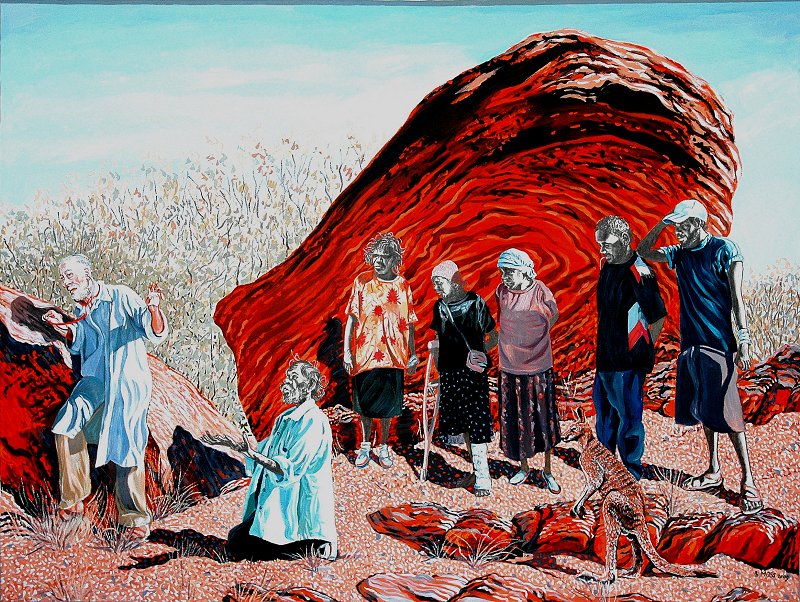
I recognised the name as soon as I saw it at the head of the medical chart: ‘Yami Lester’. The man who entered my consulting room looked anywhere between fifty and eighty, short and stocky, his eyes hidden behind black wraparound glasses. The white stick he carried was redundant at the moment of his entering as a younger man, also Aboriginal, piloted him on his arm. Yami’s hair was a shock of silver, his smile a bolt of white across the brown of his smooth round face.
“I want a prescription for Viagra, Doctor.”
The language was accurate, the delivery winning, a composite of confidence and charm. I felt myself swell into the moment; it was not that this was my first ever request for Viagra (at that time a new and prohibitively expensive drug); nor that this was Yami, man of legend: I think it was the smile.
Jose Feliciano smiled like that. So did Stevie Wonder. I recall the unsettling witticism of the day about the smiles of those blind men: Why does he smile like that?
Because he doesn’t know he is black.
***
Last week I wandered into Out of Print, a shop that sells old forgotten books. I left sixty dollars lighter and weighed down by a treasury – Rider Haggard and Edgar Rice Burroughs for my grandkids, poems by Drawoh Grebnedlog for me, some novels for Annette (wife of this blogger) – and Yami, the autobiography of Yami Lester.
Yami writes as he speaks. Truth rolls out of him unvarnished, unemphatic, undodgeable. No style, just substance. The writing of a man who does know he’s black, but knows something greater: he owns his land, the land owns him in return. Lester knows an owning that no whitefella Australian can know.
Here is Lester on the historic blinding at Maralinga after the British and Australian governments tested the atom bomb on Yami’s lands:
The ground shook and a black mist came up from the south…Later on I lost my sight and my life was changed forever. If I had my eyes I would probably still be a stockman. Because I haven’t I became a stirrer.
Here is Yami again, this time on Nelson Mandela:
For a long I’d wanted to meet that man, hear his voice in person, to touch him…I had tears in my eyes when I shook his hand. He’s been struggling in Africa with his people for a long time and even after twenty-seven years in gaol he’s still strong and alert. And when I listened to him I could see that what’s happening in Australia to Aboriginal people is the same as what’s happening to black people in South Africa in lots of ways.
And in his Epilogue Yami recalls beautifully the moment he became a father: I could hardly believe it. I don’t know how long I stood there…I had that smile on my face I get sometimes, and sang out, “It’s a boy, a bouncing baby boy. Another boundary rider, just like me.”
***
I warned Yami, “Viagra’s really expensive.”
That smile again: “Don’t worry about that, Doc. I’ve got this.”
He produced the Gold Card that Veteran’s Affairs issues to returned servicemen and their widows, the card that opens the vaults of government largesse to the selected, the card we gave Yami in return for his eyes.
Glad to be able to help, I asked: “How long have you had problems with erections,Yami?”
“Oh I don’t have any problem with that. Not me. No, it’s for my friend here.” And Yami pointed to his pilot.
 howardgoldenberg