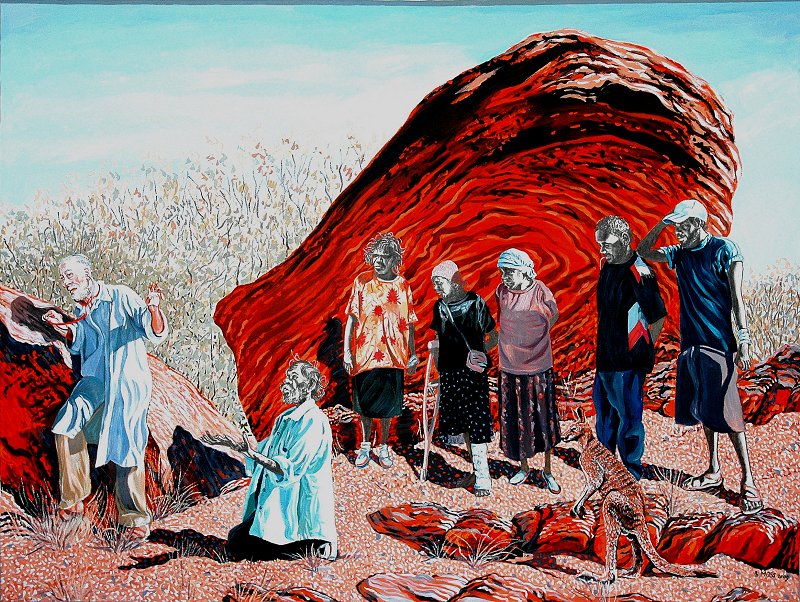
Suffer the Little Children

For forty years I have worked as a GP. I have seen and shared in all the dramas of the lives of my patients, both in outer suburban practice and in scores of remote Aboriginal communities. I thought I had passed beyond shock and reached a calmer shore.

1990. My maiden posting in an indigenous community. In the Emergency Department, the first patient is brought in with a burned leg. He lies, apparently insensible of pain. So drunk last night that he fell into the fire, so drunk he couldn’t roll out of it, so intoxicated – the word means poisoned – he slept on in the hot ashes. We remove his trousers and the charred meat that was his leg falls away in chunks.

Next patient: belted over the head with a nulla nulla while drunk – at 10.00am – he won’t wake up. Is he simply pissed, literally out of his mind, or is his brain bleeding?

Next patient is 30 years old. His heart muscle is flaccid, failing. He has alcoholic cardiomyopathy. He’ll die without a transplant.

In the comfortable mainstream such stories feed the mills of lazy generalization and undeclared prejudice. In the mainstream, we ‘know’ blackfellas can’t drink responsibly. Not like us whitefellas.

Let the self-congratulating mainstreamer join me on the Oaks Day train from Flemington back to the City; let us witness together in our crammed carriage, young women falling out of their gorgeous dresses, toppling from their high high heels, shouting to each other, in alcohol disinhibition, intimate details of their love lives, staggering, collapsing into the laps of seated passengers, whinnying with helpless laughter; and note that these people, not underprivileged, not indigenous, belong to our culture where going out equals partying equals drinking equals drunkenness.

Let the disdainful mainstreamer swallow this: the proportion of  blackfellers who drink is far lower than that of whitefellers.

There is nothing new in any of the above. We are a nation with a drinking problem. Alcohol is a colourless liquid. Its harms are scarlet and black.

***

1968. I am a medical student in residence at the psychiatric hospital. Here a patient, intellectually impaired, is eight months pregnant. She has been an inpatient for twelve months. No family visits her. The baby has been fathered in hospital.

1972. I start to work in the outer suburban practice where I will become a partner for nearly thirty years. Every Thursday I visit the local home for intellectually impaired boys. Mental illness is embarrassing, almost shameful, so we have hidden these children away in an institution, where the Brothers care for them.

I cannot gain my footing at the home: the Brothers are neither priests nor nurses; they do not provide satisfactory answers to my clinical questions. I cannot satisfy myself that the residents are well cared for. But I am new to the practice, new to medicine. Perhaps that is it.

2001. I leave the practice after 29 years, no wiser. The Brothers don’t seem holy or caring or competent; nor helpful with information. Again I doubt myself.

It takes a long time for my generation to comprehend the reality of endemic abuse. For too long we lack the questions.

In the year 1990, the question crystallizes for me: I put my question to the esteemed therapist to whom I have referred patients these last ten years: what proportion of our patients have been abused?. My referrals – for depression, anxiety, psychosomatic fixations, insomnia, anger, substance abuse, sexual problems – total some hundreds. The therapist reviews my cases, of ordinary problems of ordinary people. Her answer shocks me: Fifty percent were abused in childhood. Continue reading

Don’t Vote

Student demonstrators of the May 4th Movement ...

Tiananmen Square in May 1919. (Photo credit: Wikipedia)

Don’t Vote, It Only Encourages The Bastards

When I first saw that bumper sticker message I thought it was funny. Now it seems a fair comment on Australia’s elected politicians.

In Australia the law obliges me to vote; in most other places voting is optional. The alternative to voting is to take the chance that others will do so and they’ll elect the wrong bastard. If a relatively small number of passive non-electors had gone to the polls in Florida eight years ago, this planet might now, under outgoing President Gore, be on the road to salvation.

This coming week voters in the elections that really matter will or won’t encourage the bastards. An act of God, Hurricane Sandy, has done what a thousand PR people couldn’t do: it has made Obama look like a president. Looking like is the thing in western elections, is more influential than being president.

The elections in the USA are as important to the American people as Melbourne Cup Day is to Australians.  It is the day that stops a nation.

A huge proportion of voters will not get around to voting. These stay at homes will determine the flavor and much of the content of our lives in Australia in the coming decade or two.

Those Americans who do not vote, like those who do, are exercising choice. They are electing whether or  not to vote.

Two days after the presidential election in the USA, voting will take place in the People’s Republic of China for the leadership of that country. There are a lot of citizens in China but only 2,270 voters. These are the delegates, chosen in secret, to the Communist Party Congress, the first in ten years.

In Australia our elections are always held on a  Saturday, usually late in the year.  When I was a child my parents would wait for three stars to appear in the sky, signifying the conclusion of the Sabbath, then they’d rush off to the local primary school – my school – to vote. It seemed exciting. On their return I’d ask which party they voted for. Mum would never say. Instead she made one of her Declarations of Faith: in Australia we are fortunate; everyone is entitled to vote; no-one can force you to tell whom you chose. I remember how Mum seemed to glow with the pride of being a voter in Australia.

The Chinese Communist Congress will be held in the Great Hall of the People, next door to Tiananmen Square. The results of these elections have been known for months, ever since Bo Xilai, a man of ambition and powerful enemies, was expelled from the Politburo for serial adultery, corruption and implication in a murder case involving his wife.

Chinese would-be democrats won’t be thronging to learn the outcome, singing Are You Going to Tiananmen Square?  They’ve been there, done that, seen the tanks.

We in Australia will not have a vote, while masses of Americans and selected Chinese choose the bastards who will determine our future.


Doctor and Suer

I ate breakfast with a sixty-year old doctor who told me he’d retired from doctoring. He is a paediatrician, a member of that special tribe of doctors whose hallmark is kindness.

I congratulated him on his courage. It takes courage to walk away from a mistress as beautiful – or as possessive – as Medicine.

‘Oh no, I wasn’t brave; the opposite. I was sued.’

‘Really?’

Why was I surprised? Even in his quiet state of Tasmania we Aussies follow America in so much.

I wondered what he’d done.

‘Nothing. I wasn’t accused of doing anything wrong. That was the problem: rather I was accused of not doing something right; I didn’t detect a cancer that was diagnosed years later. By the time the cancer was found it had spread and could not be cured.’

My friend told me the story: how the woman consulted him for breastfeeding advice when her new baby was four days old for breast pain that went away over the following week. Two years later an aggressive breast cancer was discovered.

The woman visited my friend only once. By the time the case came to court the unfortunate patient had no memory of my friend.

America’s doyenne of breast feeding, a distinguished doctor, still acute in her nineties, travelled to testify what any doctor – or any mother – would know: breast pain is universal in the early days of lactation; that transient soreness of that sort is not caused by cancer but by engorgement; and when engorgement settles the pain disappeared. That is what happened in this case too; the eventual cancer was permanent but its supposed symptom was temporary.

This did not deter the counsel for the plaintiff from bullying my friend and decrying his knowledge and skill. In open court, on the public record.

The jury found for the doctor. He was exonerated. And, following two years of legal proceedings in which he lost sleep, lost weight and felt shame, he decided to stop seeing patients. ‘If I can be sued for practising properly, then I can never feel safe. I could be humiliated and publicly insulted in that way at any turn.’

A family with two small children will lose a mother. That mother will suffer and die. My friend loses his good name. A community loses the service of a person who turned his back on Medicine’s monied paths to work humbly for children. How many children of the future will never know his wisdom and skill? How many mothers might have found comfort in his counsel?

I marvelled that this person of exemplary quietude could be shamed publicly. I marvelled at the shamelessness of that lawyer, operating for a contingency fee. In pursuit of mere money that lawyer sought to take from my friend his good name. Now the lawyer has lodged notice of appeal. More grief, more tension for the accidental doctor, the human who helped another human in the elemental enterprise of physical mothering.

More tension and uncertainty, more grief for the mother who will die.

I attended a tribunal hearing once of a different type. Here there was no suit for damages. Instead the licensing authority heard an accusation against an older doctor by a patient that he’d carried out an improper examination of her chest.

The tribunal – consisting of two doctors (one female), a former police detective and a social worker – heard the patient’s evidence in a closed room. The woman was allowed the presence of a support person. The doctor and his support person were excluded. As a result the complainant was given an opportunity to present intimate evidence before a small number of persons who questioned her with respect and tact.

The lady and her supporter were then excused and shown to a private room to await the outcome.

Subsequently the doctor was called on to explain himself before that same nuclear group. He detailed a systematic mode of examination which was thorough, an examination he was taught at his medical school in the days when doctoring was painstaking and x-rays were a late resort. It transpired the patient had never before been examined with such thoroughness. She felt it improper.

The older doctor had practised in this manner for sixty-five years without any complaint against him. He took quiet pride in his meticulous methods. He knew no other way. And now those virtues had found him out.

I imagined the woman had to summon her courage and her resolve to make her complaint. But in the course of these proceedings she was not made to feel that she was on trial for her own truthfulness.

The panel – comprised of doctors and non-doctors – exonerated the doctor. The female chair said the panel found his work exemplary. She added, ‘This tribunal wishes you many more years of such careful practice.’ She then excused the doctor.

After the doctor’s departure from the premises the complainant was recalled. The tribunal explained that no finding was made against the doctor’s practice nor against the patient’s truthfulness.

Here again two innocent persons endured painful proceedings, but neither was humiliated in open court. A careful enquiry was conducted, uncontaminated by lure of money; here there was no blood sport.