Mother’s Day – or Mothers’ Day or Mothers Day

This announcement was born as a boast but I make it today as a confession: I DON’T BELIEVE IN MOTHER’S DAY.* I don’t honour it, I don’t observe it (unless with quizzical disdain), I don’t respect it, (excepting as a smart marketing exercise. What began as a means of selling greetings cards in the off-season found eager recruits in floristry and in restaurantry – as well as in cafetery and lingerie. Mother/s Day has all the hallmarks of Hallmark and the hallmarks of the pulsing of empty cultures in new countries and guilty sons in the pub, at the footy, at work, at play – at living outside extended family.)

Climbing down from my lofty position of cultural oversight into the kitchen of my own life, I can identify a serious gap: my mother and I have not spoken to each other for almost five years.

I have dreamed of her. I have dreamed she dreams of me. Mum died in June 2009 and I miss her. I do not mourn for Mum: I grieve for my loss, for the delight of her company. Mum always made me smile. Always. In her breathless dying week I watched as Mum suffered one particularly horrifying attack: she gasped at air. It went on and on, as her lungs filled higher and higher with the fluid that would drown her at week’s end. I called a nurse, Nurse squirted a diuretic into Mum, the breathing slowed and Mum pulled off her oxygen mask, grinning: “You thought I was going to croak, didn’t you, darling? Well” – Mum was cackling now in the hilarity of the merry joke that was all her existence – “I didn’t, did I?”

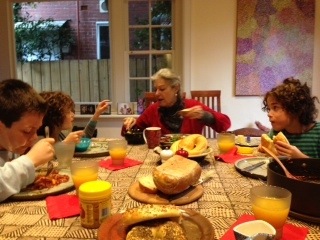
In my kitchen of now, I fry tomatoes and eggs and red kidney beans with onions fried in oil with garlic and smoked paprika and cumin. I serve this and avocado bathed in fresh lime juice and garlic-infused olive oil on a mountain of fresh bagels and specialty breads. All is prefaced by a glass of orange juice squeezed by my grandchildren. We serve this to the children’s grandmother and great-grandmother. Everyone gives gifts, festoons and cards (handmade, unHallmarked) to the old ladies. And I watch, a non-combatant. I look at my mother in law, fulfilled, filled with years. I come in, in from my chill principles, and I celebrate with them all.

*I’ve always felt the same away about Fathers Day and Valentines Day too.

20140511-050328.jpg

Mouth to mouth

Once a year your accredited family doctor undergoes retraining in CPR. Commanded to forget previous models she learns the latest tweak, he meets the newest gadget.

It’s pleasant, collegial, unreal.  They practise on a manikin. The plastic model lacks the saliva the pinking agonal froth. There are no dentures to yank out in a fret of haste, no sweat on the body that foretasted its death, no lips of purple grey in a face of grey.

My phone rang. It was a nurse in an outback hamlet no-one ever hears of. I know the nurse. I know her clinic.

“Howard? Thank goodness!”

A great indraft of air.

“There’s been a death. I have to report it.”

“What happened?”

“There was a fight. They’ve been rioting and fighting all week…” The nurse’s voice thinned and rose an octave. She gulped air.

“Someone raced into the clinic and called me out into the street. They said there was a man who was hit and fell and wouldn’t wake up. I looked down the street and I could see him, lying there. I ran and I asked what happened: a witness said he copped a glancing blow to the chin.  He said it wasn’t forceful.

I did CPR. I worked on him for a long while. I’m alone here. The only nurse. A copper helped me.

“Howard, I know him. It was Billy. He’s a lovely old man, gentle, you know. He was an old stockman. He always wore his old cowboy hat and his stockman’s boots. And now he’s dead!.

“Howard, we don’t have a morgue here. What do I do?”

I ran through the formalities, the bureaucracy of sudden death. There was a noise in the background, a moaning, wailing. Behind that, angry voices, shouting.

The nurse listened and took notes. Our conversation neared its end. Her work demanded and pressed but she didn’t seem ready to finish. She would be busy through the day with phone calls to the coroner, to the bush undertaker, and to the director of regional and remote nurses. There’d be the paperwork. And then she’d go home: home to her donger, the bedsitter that is really a shipping container; home to the memory of cold lips and the gentle fellow she liked and she couldn’t bring back.

“Howard, he’s lying here in the clinic. I checked him again in case I was wrong. But there’s no chest movement and I can’t hear a heartbeat. His pupils are dilated and they don’t react to the light. Is there anything else?”

There wasn’t anything else.

“Howard, Billy’s gone and now there’ll be Payback. He’s still wearing his hat and his boots.”

Australia Day in Doomadgee

Doomadgee, we write it

In our orthography

When really –

It should be – Dumat’ji


No flag raising here

No speech or ceremony

On Australia Day

In Doomadgee


The river runs warm

Kiddies swim and swarm

On Australia Day

In Doomadgee


Blackfellas bashing

(It’s the national fashion)

On Australia Eve

Here in Doomadgee


Broken hand, broken

Jaw, cut faces and more:

That’s Australia Day

In Doomadgee.


Adam Goodes

Too far away

This Australia Day

From Doomadgee


A busy day this

Australia Day –

Hordes in the wards

In Doomadgee


We plaster and we suture

Like there is no future:

Future no feature of Australia Day,

Not here, no way, in Doomadgee


The end of Australia Day –

Quietness falls

In hospital halls

Of Doomadgee


But short the respite –

Quick! Elder sick!

Dying on Australia night?

Dying here – in Doomadgee?


Quiet, quiet, his voice, his breath –

Small his smile at the threshold of death –

Good night Australia:

System failure in Doomadgee


Beside him, quiet woman – or girl –

His guard and ward in this world

Trembles, facing an Australian day

Without him in Doomadgee.


He slips away from his teeming kin

Who hold their tears and keening in;

A dreadful peace on Australia Day

And quiet, this night in Doomadgee.

Malpa

About ten years ago an old man consulted me as his doctor of second choice. (His own doctor was away; really I was the doctor of no choice.) A compact man, charming, he smiled beneath a tidy military moustache and carried a Veteran’s Gold Card. Eventually he promoted me to doctor of equal choice. In this capacity I doctored him to death.

In due course I received a letter from the son of the deceased, thanking me. Not for his father’s dying but for the doctoring. Eventually the son and I met.  A remarkable man: no moustache, same charm, huge human warmth.

The son’s name is Don Palmer. He says he used to work for God – in the Anglican franchise. Eventually he resigned from Holy Orders and created Malpa, the imaginative project born of urgent compassion and imagination that teaches Aboriginal kids how to become ‘Young Doctors’.

His story inspired a chapter in my forthcoming novel, Carrots and Jaffas, the story of a couple of identical twins, violently separated. With Don’s blessing I pinched his idea. My chapter reads as follows: Continue reading

This Consciousness that is Aware

A few days ago I wrote and posted a poem. It dealt, narrowly, with a contemplated stroke. More broadly, I suppose more deeply too, it is the certain fact of my one day death that I interrogate.
It is a big question, or set of questions, for me. I am sure it is for others too.
My feelings were pressing, my need to express them was strong. Poetry was the needed medium.
This morning I awoke (still alive), moved limbs (no motor stroke) and opened a volume of poetry. The book fell open at this poem of Emily Dickenson, a poem I had not previously known. I read the work (no central stroke) and understood Emily had addressed similar questions.

“This Consciousness that is aware”

This Consciousness that is aware

Of Neighbors and the Sun

Will be the one aware of Death

And that itself alone


Is traversing the interval

Experience between

And most profound experiment

death

Appointed unto Men-


How adequate unto itself

Its properties shall be

Itself unto itself and None

Shall make discovery.


Adventure most unto itself

The Soul condemned to be-

Attended by a single Hound

Its own identity.

Emily Dickenson


After reading and considering, I recalled how Death (Emily always capitalises and personifies her erotic forces) is the subject, her opposite actor, in many, many poems. Many poems, but never too many. Such is the subject and such is the poet.
It was my great friend (and the greatest critic of this blog) who observed of my writing a couple of decades ago: “You realise, don’t you Howard, that everything you write is part of the process of coming to terms with your own death?”

The Reunion

We met in the grounds of our old school. Cars drew up, old faces emerged, old bodies, sagging here and there, supported by stiffening joints. Faces lit in recognition or knitted in puzzlement – I can’t place you – then opened upon discovery. Older faces, stiffer frames – these were teachers, old and treasured. The pleasure was of a novel sort: it was as if one discovered an aged aunt or uncle not seen for fifty years; and the aged one was as delighted we were at the encounter.
Fifty years. A large chunk of time in anyone’s lifetime, an epoch unimaginable when we left in 1963.
We toured the school, the new and the old. The dunnies hadn’t changed except they were clean.
Afterwards we gathered in the dining hall.
I volunteered to speak about the lost eleven of our classmates. I didn’t want the ninety survivors of the class of 1963 to bee-suck on nostalgia and leave the dead unsung. So I read the following:

Here we are fifty years on.
We have become, I realise, walking memorials to those we have lost.
We travel the roads and the paths of our lives and our minds register: Aunty Sylvie lived in this street…Dennis used to walk his dog in this park…that’s the Shule Dad and his bothers walked to when they were kids…this is the street where my grandparents lived…

Now, gathered here at Scopus again, in this dining hall, beneath this roof, shadows of old friends, old rivals, flash across memory. Teachers we loathed, teachers we revered, those we mocked, those we feared, all move across the mind in their chalky academic gowns. They lived, they did their work and they passed on. And we – we who were once seventeen, eighteen years old and full of wonder about the future – we approach threescore years and ten, full of amazement about the years past.

But we have left some behind. I name them now.

Manny Olian, dead in 1964.
Faye Broons, dead only a few years later – in 1971.
Ephraim Bergner – died early – I haven’t been able to track down the year.
Leon Fust and Suzanne Gescheit in 2006;
Miriam Hamer, Norman Stern, Shareen Fremder – all in 2007;
Joe Serwetarz in 2008.
Zelda Slonim in 2009.
Michael Kowadlo, just over a year ago, in 2012.

The names are the bones. Some I can clothe in the flesh of concrete recollection.

Manny Olian.
Many memories, warm, smiling memories of a thin, manically funny boy, a stranger to malice, a friend who stood out from our glorious contemporaries for his originality of mind. Manny was the source of extraordinary insights that always astonished me. I see Manny holding a pen, grabbing a footy, his fingers spidering, hyperextending, exclamation marks at the extremities of a boy at the extreme.
Manny was a pioneer in death by drugs. During a trip on LSD, Manny stepped off a cliff in England and died.

In my imaginings I see Manny’s parents in 1946, at the time of his birth. They look upon their firstborn and they choose a name. The parents see their child before them and put the unspeakable past behind them. They called him Menachem, “comfort”. Eighteen years later, in 1964 – what comfort do they find?

Fay Broons.
I hardly knew Fay. I wonder how many did know her. Pretty, quiet, shy, ladylike, almost ephemeral at school, Fay was a mother of three little kids by 1971. She started the last weekend of her life in good health and was dead 48 hours later – of fulminating infection, or a brain haemorrhage? – even her family does not know to this day.

Ephraim Bergner.
Ephraim, Effy – that gifted, creative, wild child. Those fabulous good looks, that innocent disconnect from the rules, from the mundane, from consequences.
Our class’s James Dean.
Who was surprised that Ephraim’s life ended early?
Only the exact year, and the precise drug escape me.
What shadows, what secrets, what ghosts, was Ephraim escaping?

Leon Fust, skinny, nimble, fearless on the footy field, subtle and gentle in his thought; I last saw him in an Australian bank in Piccadilly, in an impeccable suit and a bowler. Leon looked the epitome of an English gentleman.
Never sighted again, what did Leon die of? Whom did he leave to mourn him?

Sue Gescheit, her kidneys failing after decades fighting off her viciously severe diabetes; Miriam Hamer, marrying for the first time at sixty, marrying for love, knowing her lung cancer had already spread to her brain; Norman Stern, one so jovial, often an innocent magnet for mischance, Norman, whom I had not sighted since school; he and Joe Serwetarz – the tall, the gregarious, the good looking, athlete – both of them, following just before or soon after Miriam and Sue.

Zelda Slonim – I think I knew her. Did I know her?

Shareen Fremder – I’m sure I didn’t know Shareen.

What does it mean that one passes and passes unknown?
Who knows? Who mourns?
Who carries their memory?

Finally, Michael Kowadlo, passing in 2012.

My first memory of Scopus is of Michael. This big friendly kid takes this very lost, very strange new kid –Howard Someone – from the country! – under his wing.
A week or so later I am climbing the steps of the slide when a bunch of interlopers races up the steps, pushing me aside. My face collides with the steel rail, a tooth chips, my mouth fills with blood and Michael, Big Michael, steps in and pushes the interlopers away. I take my turn and slide down. I meet and enrich a dentist. I become closest of friends with the principal slide aggressor – great to see you again Tommy – and Michael becomes a dentist.
The last 100 times I saw Michael occurred when we both spent a year reciting kaddish in memory of loved ones.

I want to recite kaddish now, and I invite everyone to stand and join with me, in memory of all our lost friends. In memory of Manny – “after the first death there is no other’’, as Dylan Thomas reminds us – in memory of youth, in memory – and in forgiveness – of our lost selves…

Yitgadal ve’yitkaddash sh’mei rabah…

***

After I delivered that sombre material, my voice dying at the end, I looked up. Fifty serious faces looked down. My schoolmates, silent for the first time in our twelve school years and in the following fifty years, did not meet my gaze. Gone was the buzz, the gaiety of moments ago. I had spoiled our evening. Or so I feared.

Mount Scopus College was born in Melbourne just after the end of the War. Fiercely partisan community leaders in their congregations and their factions came to historic agreement to bury difference and to create a school. The compromise they made was without precedent or subsequent. The leaders, the secular with the devout, the Yiddishists with the Hebraists, the political with the cultural, agreed on one thing: this ragged remnant of Jewry must educate its children if Jewry were to survive. So Mount Scopus was born at the same historic moment that we, the class of ’63, were born.
What did we know of the Shoah, what did we learn? Precious little at Scopus, only dark and unspoken shapes and silences from our parents. We did not realize until later that ours was a generation without grandparents.
Our Jewish teachers, burning with an intensity that burned us, cared unaccountably that we learn, that we incorporate the burden of their scholarship; while we, dull and distractible, remained unforgivably innocent, even indifferent to the heritage they were transplanting. Only in Rabbi Schwartz was truth writ clear in the body: his throat, a terrible terrain of wound and scar, remained red and swollen these years later. Somehow we all knew – the Nazis had pulled out his beard.
We are the result, their fruits, this class of 67-year olds, gathered again in the old Scopus dining hall that was also assembly hall and concert hall and community banquet room. Was I the only one to gaze about the room and to marvel at the achievement of Scopus, at the fruits of our parents’ sacrifice? The room crawled with professors, with doctors a dime a dozen, with lawyers, teachers, psychologists, with businesswomen, artists, computer greats. I could see how middle-of-the-roaders in our Scopus class rose to enduring distinction in the wider world. Truly the fires of the fathers had kindled huge drive in the children. Starved parents raised a generation hungry for success. We took our opportunities. Some seized the future, becoming pioneers and creators. We flamed, we made our mark.
Most of us had married Jews and produced Jews. Many of us had sent our kids to Mount Scopus. Making the real sacrifices needed for this costly schooling we endorsed the vision of the founders. Some of us had grandchildren at Scopus.

***

The class of ’63 has been decimated in two quite different ways – one in ten has died; one in ten has emigrated, made aliya – literally ascended – to Israel. Of these latter, three classmates have journeyed here solely for this occasion. It is a long and costly trip; why have they come? Why have others travelled from Western Australia and Queensland? Why have the remaining fifty-odd Melbourne residents bothered?
In the course of our four hours together clusters form and drift. Old intimates greet each other but do not linger, instead moving on to find others less known, less loved. A genuine thirst for connection, a tenderness, a respect – the things we all needed and often begrudged in those rougher days.
In place of the empty phrases of everyday greeting, men and women shake, hug, regard; they take in faces that have ripened and withered and deepened; they see and they don’t need to ask; the face of the other is the face they see in the mirror, a face stricken, blessed, stripped by the years. No-one is measuring, no-one comparing: that which we are, we are…

Four hours, equivalent to half a school day, long enough to discover

Equally interesting to me: why have others chosen not to come?
Two, I know, are disabled by mental illness. A third, with whom I am closer now than fifty years ago, told me she could not imagine a more distressing experience than to return to the terrain and personnel of her schoolday trauma. Having rebuilt herself from her remains, she has retreated to another state where she rusticates and has some peace. She begged me not to press her to come. She forbade me to explain. The committee was to erase her contact information. This friend would be astonished to know how many missed her, how many wondered aloud about her. In the face of this goodwill it was difficult for me to hold my peace. I fed friends scraps: She’s doing well…she couldn’t make it…
In the course of the reunion, another – likewise closer in adult life than in school days – turned up unannounced and stood at the rear, listening to the few speeches. The longest speech was my elegy for the lost. Upon completion of kaddish my friend turned and left in silence.
Not everyone won academic laurels. Not everyone had a stellar career. Some of those present at the reunion, vibrantly present, knew their unsuccess didn’t signify. As we toured the school, one removed his adhesive lapel tag and placed it between the names on the Honour Board. There he was, Dux of Mount Scopus College, now, after fifty years. There he was among us, huge in his mirth and delight.
There would be some who decided not to attend, conscious of ‘failure’ – in career, in material status, in family – unaware that no-one measures any more, no-one judges. We missed them.

***

What is the measure of the years? After fifty years what does it mean? I imagine the survivor of the Shoah washing up on this godforsaken Jewish wilderness, this godspared paradise, looking around, looking forward, never backwards, no never back to those places, those times. He stands, he mates with another survivor. Together they work, they scrape, they venture, they struggle and persist. They raise a generation, often of one only child – the previous children lost, burned – they find the tuition fees, they send the child to Scopus…

The Scopus of today dazzles. I venture to suggest there exist university campuses in Australia which would envy the facilities and the faculty of this school.

In all the vivacity of this evening, the buzz, the energy of this still radiant class of ‘63, in all the softening, the love, there abides among us grandparents the uneasy understanding that a Scopus education is beyond the means of many of our children to provide. Some of my contemporaries, I know, quietly pay their grandkids’ fees. Others work for the school, raising funds for scholarships and bursaries.

What would the founders say? Would they count Scopus a success if the rising generation were locked out?
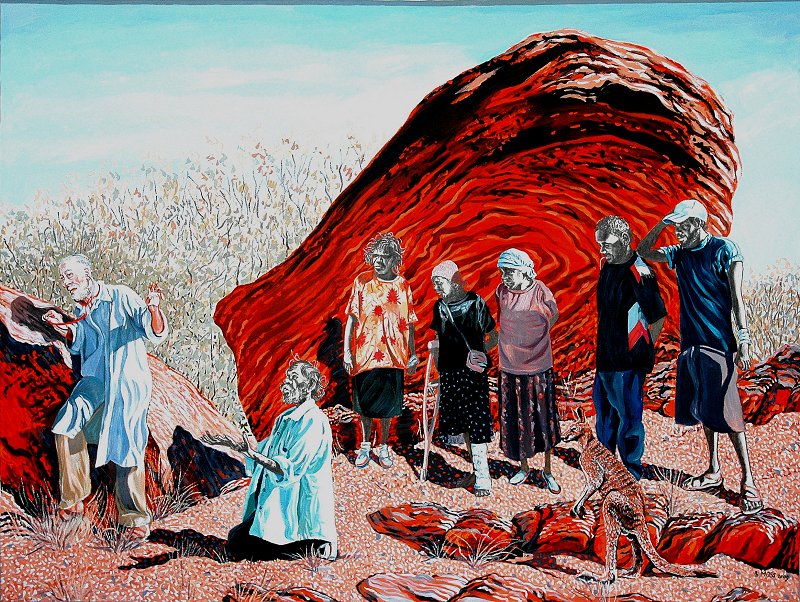
A Review of One Thousand Cuts, by Rod Moss

One Thousand Cuts by Rod Moss

One Thousand Cuts by Rod Moss

One Thousand Cuts: Life and Art in Central Australia

A book of the dead?

Yes, explicitly so.

Names are named, a violation of all norms, all practice in both whitefella and blackfella Australia.

Rod does this by virtue of trust, explicit consent, indeed the command of Rod’s friends.

Rod Moss’ singular role – to witness, to record and transmit.

Rod Moss grew up in the country. Well, in the 1950’s the Dandenong Ranges were country-ish. But he was never “in country” until some time well into his long apprenticeship under Edward Arranye Johnson, in and around Alice Springs.

Moss’ first book, “The Hard Light of Day” recounts that apprenticeship, which began with a spontaneous act of neighbourliness and evolved through friendship to become a connection of spiritual father to son. The building and the losing of that bond are the subjects of that first book, winner of the Prime Minister’s Award. It might sound like a large statement that the second book builds on and exceeds the first in its power. It does so by the swelling sorrow of loss after loss after loss, of the weight of pain.

The present volume is unique in the way it illuminates the experience of being “in country” – an opaque expression that whitefellers who work outback hear often from blackfellers. Subtly, delicately, in a characteristic Moss undertone, being ‘in country’ becomes luminous. The light is shed by Moss as he moves around Arranye’s hereditary domain as his named spiritual heir.

Moss gives us birdsong, birdflight as he walks beneath. He breathes the breezes and tempests that flutter or flatten foliage and carry mood or prophecy.

He names and describes the fauna – from grub to reptile to marsupial – that create the country.

Moss does all this in the same manner as in his painting. His colours are florid, his verbal sallies frequently outrageous, his attack fearless. But in all this bravura there’s nothing flash or glib, as Moss walks and paints and photographs the lands of his spiritual patrimony, bearing the loss of spiritual father (and of many brothers and sisters), accruing more and more losses until their weight becomes unbearable.

Most of the losses come abruptly. Each comes with the force of a thump to the solar plexus.

Moss, with his reader at his shoulder, absorbs blow after blow.

At this point we have Moss Agonistes, crying: “It rains in my heart. One drop at a time.”

Moss misses a much anticipated funeral: “I find myself crying on Saturday morning …Though I was sad at the gravesite, it has taken until now, opening the brochure and studying the commemorative words…for me to be sobbing.”

Continue reading

Mrs Hamlet’s Advice

Mr Hamlet Senior, formerly king of Denmark, has passed on. His son Hamlet Junior is sad, sulky, grumpy with Ophelia (who suicides), stabbish with Polonius lurking behind an arrass (who just happens to be Ophelia’s Dad, who dies incidentally of Hamlet’s stabbishness); obsessed, ruminative, haunted; angry, angryangry; refusing to be consoled, refusing to be reconciled.

His Mum, pragmatically re-queened to Hamlet’s uncle, offers some advice to  Hamlet Junior: ‘Tis common. Why seems it different with thee?

In other words, Get over it, son.

And in time we do. As a rule. ( If Hamlet fails to get over it’s because his uncle killed his Dad. And because Hamlet is, well, Hamlet.)


This week my sister and my surviving brother and I remember our father and our firstborn brother.  The anniversary of Dad’s death falls on the 13th day of the month of Ellul; Dennis died three years later, on Ellul 18.

Dad was 92, Dennis 63.

They died when they had to – Dad once his broken body began to break his iron will; Dennis, who lived for Mum, Dennis whose meaning was to be a son, Dennis constitutionally unable to live a motherless life. He died while Mum was alive. (Mum, most buoyant of my three lost ones, mourned Dennis, mourning lightly, living on, ever lightly.)


I think of them, all three. I wrestle with memories of the brother, he the first of his father’s strength, the brother who wrestled always with Dad. Two firstborn of firstborns, two men of fire who burned each other in their hot loving. I think of them, I remember their awful strife, I who knew, I who witnessed their mutual love, I, powerless to stop them hurting each other. Powerless in the end to stop the pain to myself.


I dream of them. The Dad dreams are never anything than pleasant. He smiles as we bump into each other in the lounge rooms of our lives. Dad prepares his enslaving coffee, I write, we smile, we know each other, we accept each other.

When I dream of Dennis the anxious need to rescue him clouds all. Not accepting, never reconciling to my brother’s pain, I strain against his self destruction. Aware always – in these dreams and when awake – aware of his love, his heavy tenderness towards me.

In my waking I recall Dad’s request, directed to me when I was twelve, Dennis fifteen: Some have a clear path in life. They are the lucky ones. You are one of those, one of the blessed. Your brother, your older brother, his path is not so easy. Help him, help Dennis when you can.

I tried, Dad. I never stopped trying.


The years pass.  ‘tis common. We get over it.


And yet, and yet, that Hamlet scene returns.

Hamlet’s Mum, Gertrude: “Thou knowest ‘tis common.

All that lives must die, passing through nature to eternity.”

Hamlet: “Ay Madam, ‘tis common.”

Gertrude: “If it be, why seems it so particular with thee?”

Hamlet: “I know not seems, Madam.”


I had a father. He passed through nature to eternity. I had an older brother, I lost him; I lost a limb. The phantom sensations do not end.


I write, a destiny. Until I have written the courageous, the impossible life of my brother, that hurt, hurting life, I will not earn dreamless rest.


Yitgadal ve’yitkaddash, shmei rabah.

Notice of the Death of a Son

A thin, linear lady, stringy, bounces in to my consulting room, sits down, beams at me from her lean oblong face. And waits. She has the grin of a six-year old.

We haven’t met before. Welcome. My name’s Howard.

A bony hand on a long arm grips mine vigorously and softly. The grin widens, shifting dentures. Hello Howard. I’m Lucy.

In general Lucy looks her age, which is seventy two years; but her skin looks a lot older. She might be a chicken, so scaly and irregular are her surfaces. The thicket of hair atop her bony head is fair. The skin is fair too, excepting for the plaques of pink, great blotches of healing. She is an old gum tree, her bark new, old, peeling, revealing, irresistibly alive.


She looks me over genially, taking my measure. She decides I will do and embarks on a story.

I had a son. He died last year. Lucy looks up, waits a bit, resumes: Your children are supposed to bury you, not the other way around.

Lucy bears her loss lightly. She hasn’t come here to shed grief. She looks at me, unbowed, light in her being.

I look back hard. There must be a wound.

How did your son die?

A heart attack, massive. He was forty-four.

Lucy has taken my measure. I am old enough. I will know the verities, the facts of death.

You know the smell of death.

A statement, not a question.

How does death smell, Lucy?

Indescribable. And unmistakeable. As you’d know.

I smelt death first the night Dad died. I was staying with him and I smelt that smell. When I found Dad he’d been dead a couple of hours. He was cooling. The smell started around the time he died…

I started smelling death again a year ago. I smelled it four nights in a row. My bed smelled of it, my pyjamas too. It was really strong. I wouldn’t let myself fall asleep: I thought I was the one dying. I was at my daughter’s place and I didn’t want her to have to find me.

After the fourth night they rang to tell me my son had passed. He died four nights before.

That smell starts ten minutes after they die. And it stops once you know.

Lucy looks at me, grins a smile of reality, of truth. Ultimate truth, the factuality of death.

I’ve lost both my boys; the first one died at birth.

But I’ve got my girls. They’re both good. And seven grandchildren and – a huge bright smile, a lightning strike in the summer of Lucy’s face – a little great granddaughter!

A pause. Lucy is a good pauser, unfrightened of the silences that flow, clear as her sentences. And in the pauses, Lucy smiles her knowings that I must share: the freshness of new life. How the fact of a baby redeems all.

You know I bounce back. Just about exactly a year come round since my boy passed, I lost a dear friend. Like sisters we were. That was tough… for a while.

This is a pause unlit by smiling. Lucy looks at me steadily.

But I bounce back.


Star of the Sea

Yvonne and Doreen are among the very few Jewish girls at Firbank. Some unpleasantness occurs and Yvonne pretends it isn’t happening, but Doreen, the younger sister, is not so submissive. (At the age of four she had objected to the dentist hurting her. When he hurt her again Doreen bit his finger.)

When her classmates tease her for her Jewishness, Doreen fights back. After a few of these fights, their mother recalls how happy had been her own schooldays with the Presentation nuns in Perth. The family withdraws the girls from Firbank and sends them to the Presentation nuns at Star of the Sea.

Yvonne and Doreen arrive at Star to find they are the only Jewish girls. On the eve of the Depression their father falls ill and the whole school assembles to offer prayers for his recovery. He dies and the school prays for his soul.

Their father’s investments crash and the family is hard up. Compared to Firbank, the nuns are cheap, but Star reduces its fees so the girls can stay.

A new Jewish girl arrives. Her father has died, and she is to be a boarder. The nuns discover she has no prayer book. They are greatly concerned. They have lots of Catholic prayer books but they ask Yvonne and Doreen’s mother to find a Jewish prayer book for the new girl.

A couple of years after their father’s death, their mother’s heart fails. The school prays, she dies – of a broken heart, as the girls recall it – one day following the third anniversary of their father’s death. The whole school comes to a stop to pray for her soul and for the two orphan girls.

Neither of the girls is particularly studious, but Yvonne rewards the nuns with a perfect score in Catechism.

Years pass, the girls grow up, leave school and marry. Yvonne moves to a small town in the remote Riverina, where she raises a bunch of children without a family to support her. She misses her parents, her sister and grandmother. She bears and feeds these babies, deficient first in family, then in iron, later in red blood cells. Finally, she is confounded: fulfilled in motherhood, she is nevertheless tearful and faint. In crisis, Yvonne returns to the nuns and finds comfort. Will you pray for me, she asks.

Doreen too, turns to the nuns whenever she needs surgery. She too asks them to pray for her: You girls are the professionals, she says, I think you are better at it than I am.

As the years pass, Doreen has cancer surgery, bowel surgery, heart surgery, the list of operations grows longer, and always she goes back to the nuns. She speaks to her old school principal, now retired: Would you light a candle for me Sister?

I’d burn the whole bloody Church down for you if it would help you, Doreen.

Yvonne and Doreen go the nuns again and again. It only ends, after sixty years, when their old principal, the last of their nuns, dies at the age of 103.